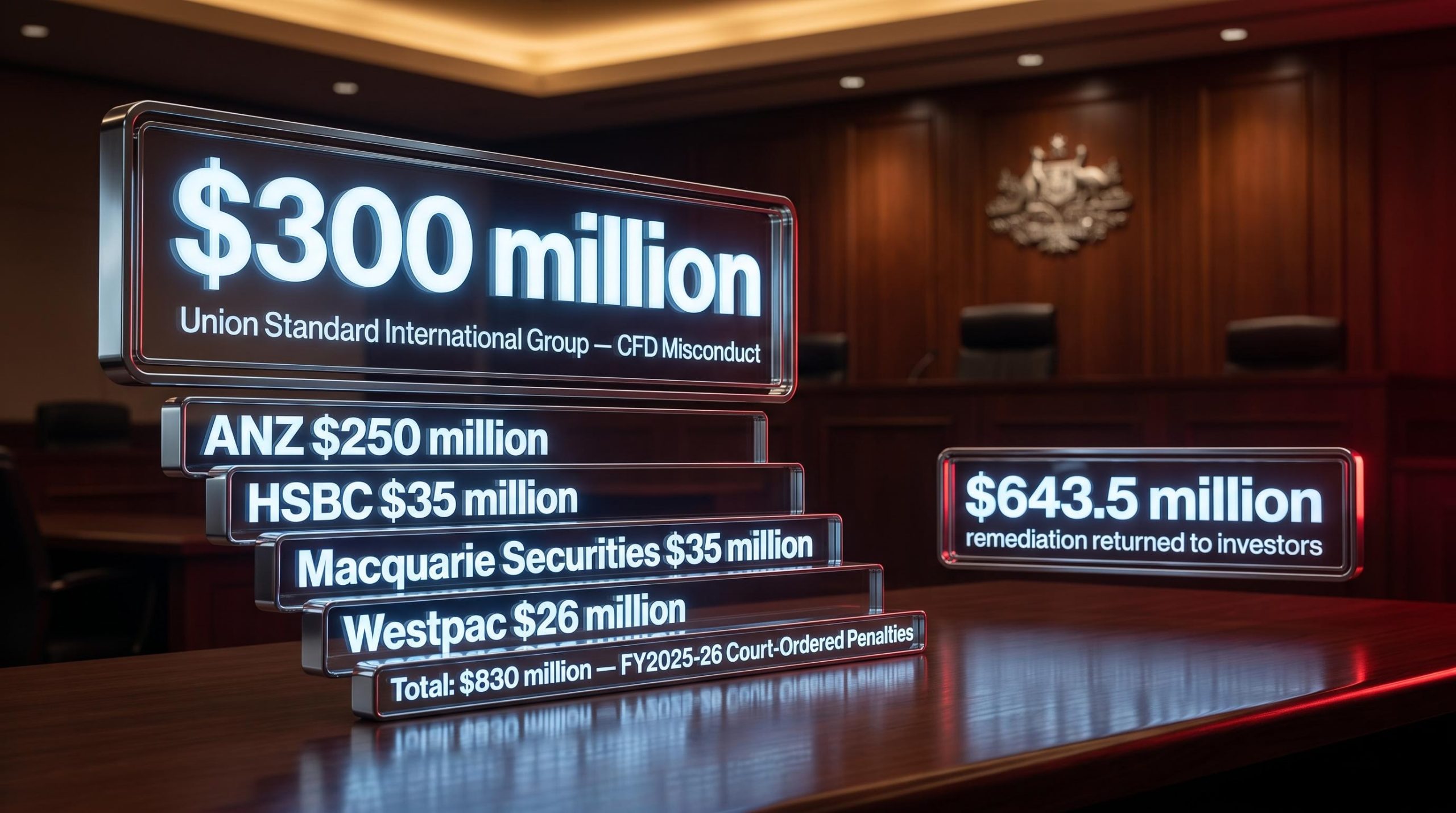
The largest individual civil penalty in ASIC’s history did not land on a major bank. It landed on a contracts-for-difference provider most retail investors have never heard of. Union Standard International Group received a court-ordered penalty of $300 million in June 2026 after the Federal Court found the firm had engaged in serious CFD misconduct that caused widespread harm to retail investors, a figure that reset what Australian courts consider proportionate when financial harm is systemic.
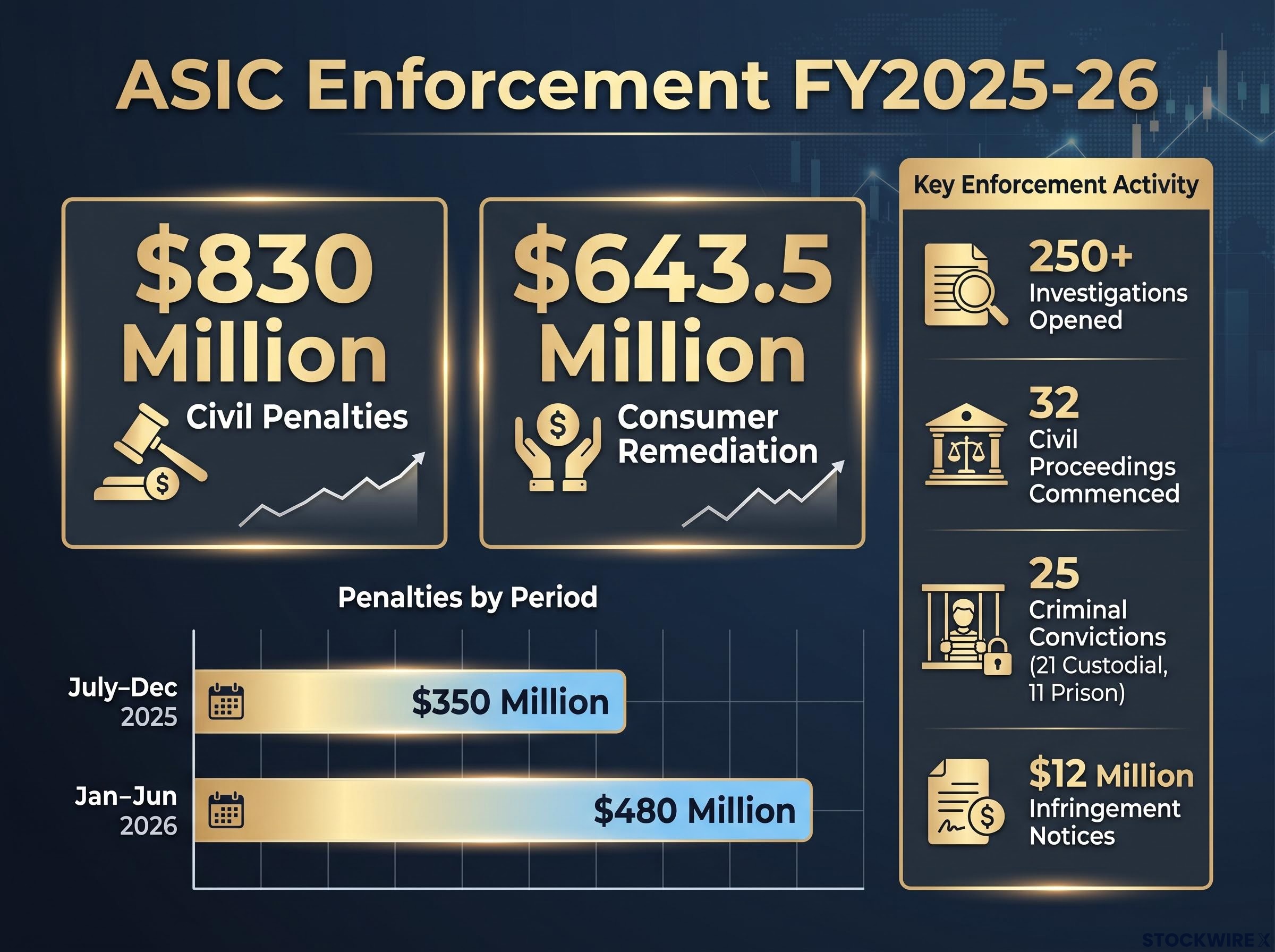
That single case anchored a financial year in which courts ordered $830 million in civil penalties connected to ASIC’s enforcement work, alongside $643.5 million in consumer remediation being returned to tens of thousands of customers and investors. The institutions caught ranged from ANZ and Westpac to superannuation trustees and consumer credit operators. This was not a one-off crackdown. It was evidence that courts are now sizing penalties to match actual consumer harm, and that recalibration touches every corner of Australian financial markets.
Here is what the enforcement data actually tells you: which institutions were penalised, which sectors drew the most heat, and what the pattern means for the rules of the game going forward.
How $830 million landed without a surge in case numbers
The headline figures are large enough to warrant laying out cleanly before any interpretation:
- 250+ investigations opened across the financial year
- 25 criminal convictions, of which 21 resulted in custodial sentences and 11 of those individuals were sent to prison
- courts saw 32 fresh civil proceedings commenced
- $12 million in infringement notices handed down
The first half of the financial year (July to December 2025) produced approximately $350 million in court-ordered penalties. The second half (January to June 2026) delivered approximately $480 million. Together they reached $830 million, with a further $643.5 million in remediation connected to ASIC’s work.
The structural finding underneath those numbers matters more than the total itself. Independent analysis of ASIC’s data, drawn from freedom-of-information requests, found that the $830 million haul was achieved without increasing the volume of civil penalty cases filed. Average penalties per case rose sharply. Courts did not process more misconduct. They priced it differently.
Market integrity enforcement sits across both the civil penalty data and the criminal conviction record: 25 criminal convictions across the financial year, with 21 resulting in custodial sentences, reflect a parallel enforcement track that includes a dedicated insider trading team established in late 2024 carrying the priority into 2026.
ASIC Chair Sarah Court described the ANZ penalties as the largest combined penalties the regulator had ever obtained against a single entity.
ASIC’s stated approach combines early detection, harm prevention, and the full spectrum of regulatory tools. That framing is consistent with the data: the regulator is not simply filing more cases and hoping numbers accumulate. Courts are re-rating the cost of misconduct upward, and that changes the incentive structure for every institution operating in Australian markets.
When big ASX news breaks, our subscribers know first
The cases that set the benchmarks
Two cases defined the scale. ANZ received $250 million in combined penalties, secured in December 2025, making it the largest combined penalty ASIC has obtained against a single entity. Then, in the first half of 2026, Union Standard International Group surpassed it with a $300 million individual penalty for CFD misconduct, alongside nearly $40 million in investor refunds.
Each figure set a new reference point. The ANZ penalty told the market that even the largest domestic banks face penalties calibrated to systemic harm rather than institutional prestige. The Union Standard penalty told the market that a lesser-known operator causing equivalent harm faces equivalent consequences.
The CFD penalty mechanics that produced the $300.2 million figure go deeper than the headline number: between 95% and 99% of retail clients at EuropeFX and TradeFred lost money, the firms’ B-book dealing model meant they profited directly from every client loss, and the court found systemic unconscionable conduct including unlicensed personal advice and pressure calls encouraging clients to fund positions using superannuation.
Mid-tier penalties and sector spread
Below those two headline cases, the breadth of institutions penalised told its own story. Banks, superannuation trustees, credit providers, and market intermediaries all appeared in the same enforcement year.
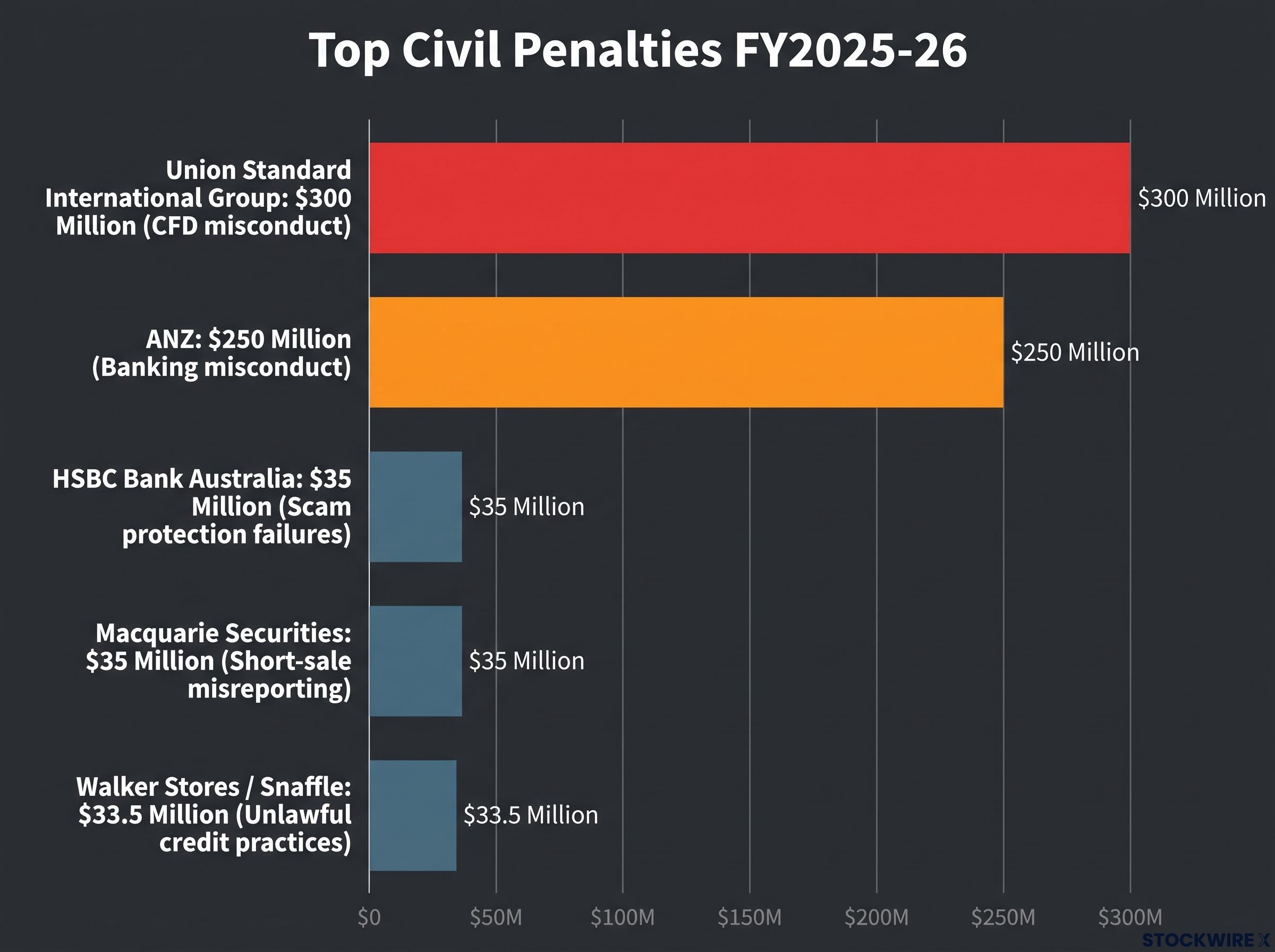
| Entity | Penalty | Category | Key Harm |
|---|---|---|---|
| Union Standard International Group | $300 million | CFD misconduct | Largest single penalty in ASIC history; nearly $40 million in investor refunds |
| ANZ | $250 million (combined) | Banking misconduct | Largest combined penalties against a single entity |
| HSBC Bank Australia | $35 million | Scam protection failures | ~$21.5 million compensation paid; $6.5 million recovered for customers |
| Macquarie Securities | $35 million | Short-sale misreporting | Systemic market data inaccuracies affecting market integrity |
| Walker Stores / Snaffle | $33.5 million | Unlawful credit practices | Consumers charged close to $20 million in excess interest they were never owed |
| Westpac | $26 million | Customer hardship failures | Widespread deficiencies in hardship response |
| Cbus | $23.5 million | Superannuation processing failures | Death benefits and insurance claims processing |
| RAMS | $20 million | Hardship failures | Consumer credit and home loan hardship handling |
| NAB / AFSH Nominees | $15.5 million | Hardship failures | Consumer credit hardship handling |
| Mercer Super | $10.3 million | Regulatory reporting failures | Failure to notify ASIC of significant compliance breaches |
The institutional breadth here tells you that enforcement risk in FY2025-26 was not concentrated in one corner of the market. It ran from the largest domestic banks through to CFD providers, superannuation trustees, and consumer credit operators. No sector offered regulatory shelter.
Six sectors ASIC put under the microscope, and why
The individual cases cluster into six sectors, and each cluster reveals where ASIC believes systemic risk sits in Australian markets right now:
- High-risk trading products: The $300 million Union Standard penalty, plus nearly $40 million in refunds, confirmed that retail-facing leveraged derivatives remain under the most intense scrutiny of any product category.
- Scams and technology-enabled harm: The $35 million HSBC penalty, with approximately $28 million in compensation and recovered funds, established bank-level accountability for scam protection failures.
- Superannuation governance: $23.5 million (Cbus) and $10.3 million (Mercer Super), plus hundreds of millions earmarked in the ongoing Shield and First Guardian remediation programmes, signal that governance failures in funds now attract forceful responses.
- Market infrastructure integrity: $35 million (Macquarie Securities) for systemic short-sale misreporting, treating market data accuracy as a public good whose degradation carries material consequences.
- Consumer credit and hardship conduct: $26 million (Westpac), $15.5 million (NAB/AFSH Nominees), $20 million (RAMS), and $33.5 million (Walker Stores/Snaffle), with the Snaffle matter alone involving close to $20 million in excess interest wrongly extracted from consumers.
- Digital assets and private credit: Not yet producing headline penalties but named explicitly as intensifying enforcement priorities.
Investment scam losses reached $837.7 million in 2025 despite ASIC removing nearly 12,000 scam websites across the year, a figure that contextualises why the HSBC scam protection case and the Scams Prevention Framework Act 2025 sit near the top of the regulator’s stated enforcement priorities for the period ahead.
For 2026 and beyond, ASIC has publicly identified the following as priority enforcement areas: private credit practices, digital assets, financial reporting misconduct, the handling of insurance complaints and claims, misleading pricing conduct, and governance and directors’ duties.
The sector map tells you which areas of your financial life are under the most active regulatory recalibration right now. If you hold a superannuation account, a bank loan, and a leveraged trading account, you are operating across three of the six sectors that drew concentrated enforcement attention in the same year.
What courts are actually saying when they set these numbers
Civil penalties in Australian financial regulation are set by courts, not by ASIC. ASIC brings the case and proposes a penalty range, but the final figure reflects a court’s assessment of the scale of harm caused, the institution’s culpability, and whether the penalty is large enough to deter future misconduct across the industry.
That distinction matters because of what changed in FY2025-26. For years, financial penalties in Australia were criticised as a cost of doing business, amounts large institutions could absorb without changing behaviour. The independent analysis of ASIC’s data shows that average penalties per case rose sharply without an increase in case volume. Courts are now calibrating penalties to match the actual harm inflicted, not the institution’s capacity to pay a routine fine.
The $300 million Union Standard penalty and the $250 million ANZ combined penalty are the clearest expressions of that recalibration. Neither figure could be absorbed as an operational footnote. They were sized to change behaviour.
ASIC Chair Sarah Court described the regulator’s approach as combining early detection of misconduct, harm prevention, and securing remediation for affected parties, deploying the full spectrum of regulatory and enforcement tools.
Remediation as enforcement, not afterthought
Across the financial year, $643.5 million in remediation connected to ASIC’s work is being channelled back to Australian customers and investors through refunds, compensation schemes, and related payments, reaching tens of thousands of people. This is not a separate process running parallel to enforcement. Courts and regulators treat remediation as part of the accountability equation.
The HSBC case illustrates the mechanism: alongside the $35 million court-ordered penalty, HSBC’s remediation programme had distributed roughly $21.5 million in compensation to affected customers by the time of reporting, with additional payments scheduled, and the bank had separately clawed back and returned $6.5 million to customers. In the superannuation space, the Shield and First Guardian remediation programmes have hundreds of millions earmarked for affected investors, with amounts expected to increase as programmes progress.
Understanding the mechanics tells you that penalty levels are no longer predictable or containable for institutions causing systemic harm. The deterrence logic courts are building into these figures is real, and it is changing institutional risk calculations across every sector.
Five things this enforcement year changes for Australian investors
- Stronger remediation expectations when things go wrong. With more than $643.5 million being returned to customers and investors, remediation programmes are now large-scale and routine. If you experience harm from a financial product or service provider, there is a stronger basis to expect structured, formal remediation rather than purely discretionary goodwill.
- Tighter scrutiny of high-risk and complex products. The $300 million Union Standard penalty, plus nearly $40 million in investor refunds, confirms that leveraged derivatives sold to retail clients sit at the top of ASIC’s enforcement priorities. If you use CFDs or similar products, anticipate stricter onboarding requirements and tighter leverage limits.
- Banking relationships and hardship handling now carry real enforcement weight. Combined penalties against ANZ, Westpac, NAB/AFSH Nominees, and RAMS totalling approximately $311 million tell you that how your bank treats you during financial stress is now a core enforcement concern, not a customer-service afterthought.
- Superannuation governance has moved to the foreground. Penalties against Cbus and Mercer Super, alongside the Shield and First Guardian remediation programmes, mean your fund’s compliance record and trustee communications deserve closer attention. These are now more likely to have tangible financial consequences for members.
- Technology-enabled harms are a permanent enforcement frontier. The HSBC scam case and ASIC’s 2026 priorities covering scams, digital assets, and misleading pricing signal that obligations on banks, platforms, and telcos around scam detection will become more prescriptive, with remediation programmes where those obligations are not met.
Taken together, these five shifts tell you that the enforcement environment is now operating in your favour in a way it was not five years ago, but only if you know what protections exist and where to escalate when institutions fall short.
Where enforcement is heading, and what to watch
ASIC has made public its priority enforcement areas for 2026 and the years ahead, and that list gives you a reliable forward map of where the next generation of enforcement headlines is most likely to emerge:
ASIC’s stated enforcement priorities for 2026, drawn from the same media release underpinning the annual enforcement data, name private credit practices, digital assets, financial reporting misconduct, and insurance claims handling as the sectors where the regulator intends to focus its next generation of cases.
- Private credit practices
- Digital assets
- Financial reporting misconduct
- Insurance complaints and claims handling
- Misleading pricing
- Governance and directors’ duties
The structural argument of FY2025-26 is straightforward: if courts will now size penalties to actual harm rather than institutional convention, then the frontier for the next enforcement period is wherever new harms are emerging fastest. Private credit and digital assets sit at the top of that list precisely because they are the areas experiencing the most rapid structural change with the least regulatory precedent.
ASIC’s capital markets reform agenda sequences digital-money experimentation, infrastructure accountability, and enforcement recalibration into a structurally coherent programme, with the ASX CHESS settlement of $20.5 million in June 2026 and a $150 million additional capital charge due by 2027 representing concurrent enforcement and structural obligations running alongside the FY2025-26 penalty cycle.
The Shield and First Guardian remediation programmes remain ongoing, a reminder that enforcement consequences extend well beyond the initial penalty and can run for years. ASIC’s stated approach of early detection and harm prevention suggests the regulator intends to intervene earlier in emerging sectors rather than waiting for harm to accumulate.
The priority list tells you that being an informed participant in these markets now carries more weight than it did before FY2025-26. Knowing where enforcement focus is moving allows you to make more informed decisions about product selection, fund choice, and institutional relationships before enforcement headlines break, rather than in response to them.
Holding institutions to a higher standard, for good
FY2025-26 proved two things simultaneously: courts are willing to size penalties to match the actual scale of consumer harm, and no sector of Australian financial markets is insulated from that recalibration. Together, those findings describe a durable shift in the enforcement environment, not a single exceptional year.
Remediation programmes remain ongoing. Enforcement priorities will continue to evolve as new products and risks emerge. The institutions that operate in your financial life, your bank, your super fund, your trading platform, are operating under a different set of consequences than they were even two years ago.
This article is for informational purposes only and should not be considered financial advice. Investors should conduct their own research and consult with financial professionals before making investment decisions.
The question going forward is not whether enforcement will stay elevated. It is whether the institutions you rely on have absorbed what these penalty levels are telling them.