
In Australia, a person can be banned from managing any company for up to five years without ever being convicted of a crime or appearing before a court. That ban is publicly searchable by anyone with internet access. The power sits in Section 206F of the Corporations Act 2001 (Cth), which gives the Australian Securities and Investments Commission (ASIC) an administrative mechanism to disqualify individuals from managing corporations when a pattern of corporate failure meets specific statutory conditions.
Section 206F operates quietly in the background of Australian corporate regulation, yet its consequences for affected individuals and the broader business community are significant. This article explains how the power works from the ground up: what conditions trigger ASIC director disqualification, what the prohibition actually prevents, how it fits within the wider framework of director disqualification in Australia, how the ASIC Banned and Disqualified Persons Register functions as a due diligence tool, and what review rights exist for affected individuals.
Why ASIC can ban directors without going to court
A multi-year ban from managing corporations sounds like it should require a judge, a courtroom, and a formal legal proceeding. Under Section 206F, it requires none of these. ASIC exercises this power administratively, without court involvement, distinguishing it from court-ordered disqualification under Sections 206C and 206D of the Corporations Act.
Parliament designed the power this way deliberately. Section 206F is protective and deterrent in character, not purely punitive. It targets patterns of corporate failure rather than proven wrongdoing, allowing ASIC to act before the damage deepens. ASIC has described the power as a tool for protecting the public and deterring serial misconduct, particularly where illegal phoenix activity may be a concern.
ASIC’s enforcement posture across all of its regulatory mandates has hardened materially since the mid-2020s, with the regulator establishing dedicated specialist teams, elevating insider trading to a named priority for consecutive years, and demonstrating an accelerated pipeline from investigation through to criminal referral.
Fraud or dishonesty does not need to be proved. The threshold is a pattern of multiple insolvencies within a seven-year period.
The maximum disqualification period under Section 206F is five years. By contrast, courts acting under Sections 206C and 206D can impose longer periods, with court-ordered disqualifications in practice ranging from two to 15 years. The administrative route trades that longer ceiling for speed and accessibility: ASIC can act without the cost, delay, and procedural formality of litigation, reaching conduct that falls below the threshold for criminal or civil penalty proceedings.
The ATO illegal phoenix activity guidance estimates the practice costs the Australian economy approximately $4.89 billion annually, a figure that contextualises why ASIC’s administrative disqualification power is designed to move quickly against patterns of serial corporate failure rather than waiting for a completed criminal investigation.
Understanding that this power requires no criminal conviction reframes how risk should be assessed when evaluating a director’s background. A clean criminal record is not the only signal that matters.
When big ASX news breaks, our subscribers know first
What Section 206F actually requires: the statutory test explained
The statutory test under Section 206F has two layers. The first is an objective threshold: a set of factual conditions that must be met before ASIC can even consider disqualification. The second is a discretionary assessment: ASIC must be satisfied that disqualification is justified in the circumstances. Both layers must be satisfied.
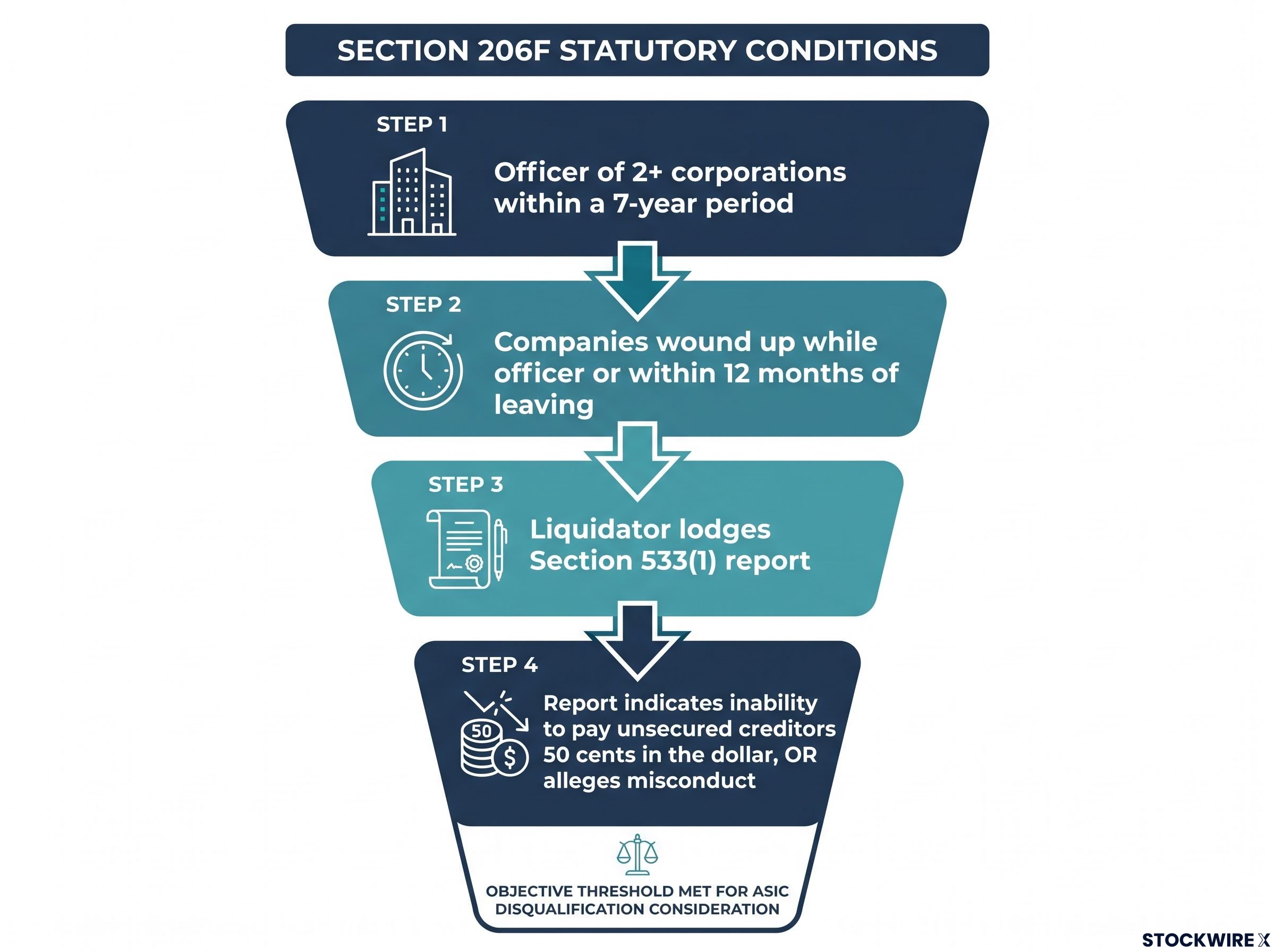
The objective threshold works as follows:
- The person must have been an officer of two or more corporations within a seven-year look-back period
- Each of those corporations must have been wound up either while the person was an officer or within 12 months after they ceased to be an officer
- In each winding-up, the liquidator must have lodged a Section 533(1) report with ASIC
- The Section 533(1) report must indicate that the company was unable to pay unsecured creditors more than 50 cents in the dollar, or allege that an offence or misconduct may have been committed
- ASIC must be satisfied that disqualification is justified in the circumstances
The 12-month post-officer tail is worth particular attention. The winding-up trigger is not limited to events that occur while the person holds office. If a corporation is wound up within 12 months after a person ceased to be an officer, that winding-up still counts toward the threshold. This prevents individuals from stepping down shortly before a collapse and arguing that the failure occurred after their involvement ended.
A Section 533(1) report is a document lodged by a liquidator with ASIC. It is triggered where the company cannot pay unsecured creditors more than 50 cents in the dollar, or where the liquidator believes an offence or misconduct may have been committed. The existence of such reports in each relevant liquidation is a prerequisite to ASIC exercising its power.
The statutory threshold versus ASIC’s discretionary analysis
Meeting the objective threshold is a gateway, not the finish line. ASIC must still apply a justification test before making a disqualification order. It must give the person notice and an opportunity to be heard, then satisfy itself that disqualification is warranted having regard to the person’s conduct, the public interest, and the pattern of corporate failure.
The proceeding is inquisitorial in character, and normal rules of evidence do not apply. This distinguishes the process from court proceedings and is one reason ASIC can act more quickly and without the formalities of litigation.
One consideration that arises frequently in practice is the one-business question. Where multiple failed entities are effectively a single integrated business operation, ASIC may treat them as one failure rather than independently counting each entity toward the two-corporation threshold. This prevents mechanical application of the test to situations where a single business happened to be structured across several corporate vehicles.
What a disqualification actually prevents, and the criminal risk of ignoring it
Once ASIC imposes a disqualification under Section 206F, the prohibition is broad. A disqualified person cannot:
- Be a director of any corporation
- Be a company secretary of any corporation
- Be directly concerned in or take part in the management of a corporation
- Be indirectly concerned in or take part in the management of a corporation
- Act as a shadow director (a person whose instructions or wishes the directors are accustomed to following)
- Act as a de facto director (a person who performs the functions of a director without formal appointment)
The prohibition applies across all corporations in Australia, not only the companies that failed and triggered the disqualification. A person disqualified because of two insolvencies in the construction sector cannot simply move into technology and take up a directorship there.
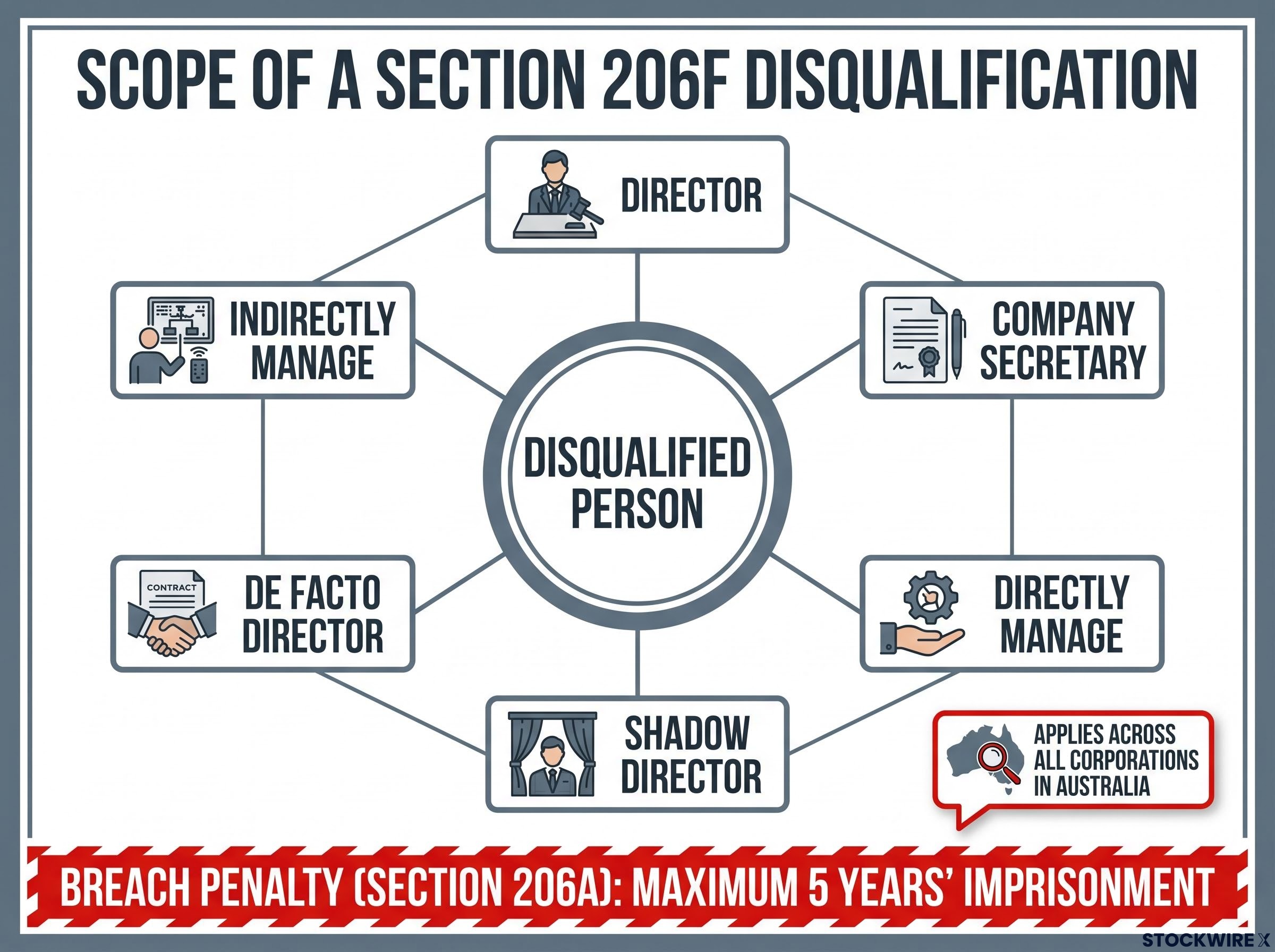
The inclusion of shadow and de facto directors in the prohibition is significant. It means a disqualified person cannot avoid the ban by operating informally or through a proxy, directing a company’s affairs from behind the scenes while someone else holds the formal title.
Breaching a disqualification order under Section 206A of the Corporations Act 2001 (Cth) carries a maximum penalty of five years’ imprisonment.
The criminal sanction applies regardless of whether the breach relates to one of the original failed companies or an entirely new corporate entity.
The five-year imprisonment maximum for breaching a disqualification order sits within a wider architecture of criminal sanctions under the Corporations Act that ASIC has demonstrated a willingness to pursue, with 46 insider trading convictions since 2009 and maximum custodial penalties reaching 15 years for market conduct offences.
How Section 206F fits within Australia’s director disqualification framework
Section 206F is one of several disqualification mechanisms in Part 2D.6 of the Corporations Act. Each serves a different function, is triggered differently, and involves different decision-makers. Understanding where the administrative power sits in relation to the other pathways helps readers interpret ASIC enforcement announcements accurately and assess the relative severity of different regulatory responses.
| Provision | Who initiates | Court required | Maximum period | Trigger event |
|---|---|---|---|---|
| s 206B | Automatic | No | Duration of underlying condition | Criminal conviction or personal insolvency (e.g. bankruptcy) |
| s 206F | ASIC | No | 5 years | Officer of 2+ failed companies within 7 years, s 533(1) reports lodged |
| s 206C | ASIC (applies to court) | Yes | Court’s discretion | Contravention of civil penalty provisions |
| s 206D | ASIC (applies to court) | Yes | 2-15 years (typical range) | Involvement with multiple failed companies, public interest test |
Section 206B requires no action by anyone. Disqualification flows automatically from events such as criminal conviction or bankruptcy and persists for as long as the underlying condition remains in force. Sections 206C and 206D require ASIC to apply to a court, which determines the appropriate disqualification period after a formal hearing.
The Section 206F administrative route fills a distinct gap. It is faster and less resource-intensive than court proceedings, yet it carries serious consequences: a publicly searchable register entry, a prohibition that covers all corporations, and criminal liability under Section 206A for any breach. It allows ASIC to reach patterns of failure that may not meet the threshold for criminal prosecution or a civil penalty proceeding, while still protecting the public from individuals whose track record of corporate management warrants intervention.
The ASIC Banned and Disqualified Persons Register as a due diligence tool
ASIC maintains a free, publicly accessible online register of individuals who have been disqualified from managing corporations or banned from other regulated activities. The register is searchable by name and displays the person’s name, the commencement date, and the cessation date of each ban or disqualification.
The register’s scope extends beyond corporate management bans. It covers four categories:
- Corporate management bans under Section 206F and related provisions
- Financial services bans (prohibitions from providing financial services)
- Consumer credit bans (prohibitions from engaging in consumer credit activities)
- SMSF auditing bans (prohibitions from conducting self-managed superannuation fund audits)
This breadth reflects ASIC’s broader regulatory mandate across corporate governance, financial services, credit, and superannuation auditing.
One limitation is worth noting: the register provides a point-in-time snapshot and is not an exhaustive record of all historical enforcement action ASIC has taken.
How to use the register effectively
Searches should be conducted using the person’s full legal name. The register does not support fuzzy matching or alias searching, so verifying the exact name of the person being checked is important before relying on a search result.
Both the commencement and cessation dates should be reviewed carefully. A current entry signals an active prohibition. A historical entry, where the cessation date has passed, still signals a past enforcement finding worth investigating further; it may indicate conduct that warrants additional scrutiny even though the formal ban has expired.
The register should be treated as one layer in a broader due diligence process, not a standalone clearance. For anyone appointing a director, engaging a financial adviser, or entering a significant business relationship, it provides a fast, free, and authoritative first check that requires no specialist legal knowledge to use. However, given its stated limitation as a non-exhaustive record, additional due diligence steps remain prudent.
The Banned and Disqualified Persons Register is one layer in a broader due diligence toolkit; investors and counterparties conducting background checks should cross-reference it with other corporate governance warning signs, including missing financial reports and unscheduled board departures, both of which ASIC has identified as active enforcement targets in its 2026 regulatory priorities.
Challenging a disqualification: review rights under the Administrative Review Tribunal
A person disqualified under Section 206F is not without recourse. The affected individual can apply for merits review of ASIC’s decision, providing a substantive check on the exercise of administrative power.
As of 14 October 2024, merits review of ASIC disqualification decisions is conducted by the Administrative Review Tribunal (ART), not the former Administrative Appeals Tribunal (AAT).
The ART replacement of the AAT took effect on 14 October 2024 under Commonwealth tribunal reforms, and the new body carries forward the merits-review jurisdiction that previously sat with the AAT, including the power to reconsider Section 206F disqualification decisions on their facts and merits.
The Administrative Review Tribunal (ART) replaced the AAT on 14 October 2024 following Commonwealth tribunal reforms. As at 13 June 2026, the ART is the current operative federal merits-review body for Section 206F decisions.
Merits review means the ART can reconsider the facts, the law, and the appropriate exercise of ASIC’s discretion. It is not limited to reviewing whether ASIC followed correct procedure. The tribunal can form its own view on whether disqualification was justified and, if so, whether the period imposed was appropriate. This makes the review a genuine pathway to contest a disqualification, not merely a procedural formality.
Practitioners and commentary published before October 2024 referring to the AAT as the review body are now outdated on this point. Any individual considering a review application should seek current legal advice referencing the ART’s jurisdiction and procedures.
A legal tool calibrated for protection, not punishment
Section 206F occupies a distinct position in Australian corporate regulation: a power that can impose serious, publicly visible consequences on individuals without requiring proof of criminal conduct. That distinction is precisely what makes it a practical and accessible regulatory tool, one calibrated for the protection of the public rather than the punishment of offenders.
The framework is coherent when viewed as a whole. The statutory test sets an objective gateway. ASIC’s discretionary analysis ensures that individual circumstances are considered. The prohibition is broad enough to capture shadow and de facto directors. The criminal penalty for breach ensures compliance. The public register provides transparency. And merits review through the ART ensures accountability.
Whether conducting due diligence on a prospective director, advising a client facing a Section 206F proceeding, or simply seeking to understand how Australia regulates corporate failure, the framework repays careful attention. The ASIC Banned and Disqualified Persons Register is a practical starting point for any upcoming director appointment or significant business engagement.
Investors wanting to understand how assertively ASIC now pursues governance failures at every level of the corporate ecosystem will find our deep-dive into ASIC’s institutional governance enforcement, which examines the regulator’s unprecedented inquiry into the ASX itself, the three interconnected failure domains it identified, and what the resulting joint ASIC and Reserve Bank supervision programme means for the broader accountability framework.
This article is for informational purposes only and should not be considered financial advice. Investors should conduct their own research and consult with financial professionals before making investment decisions.