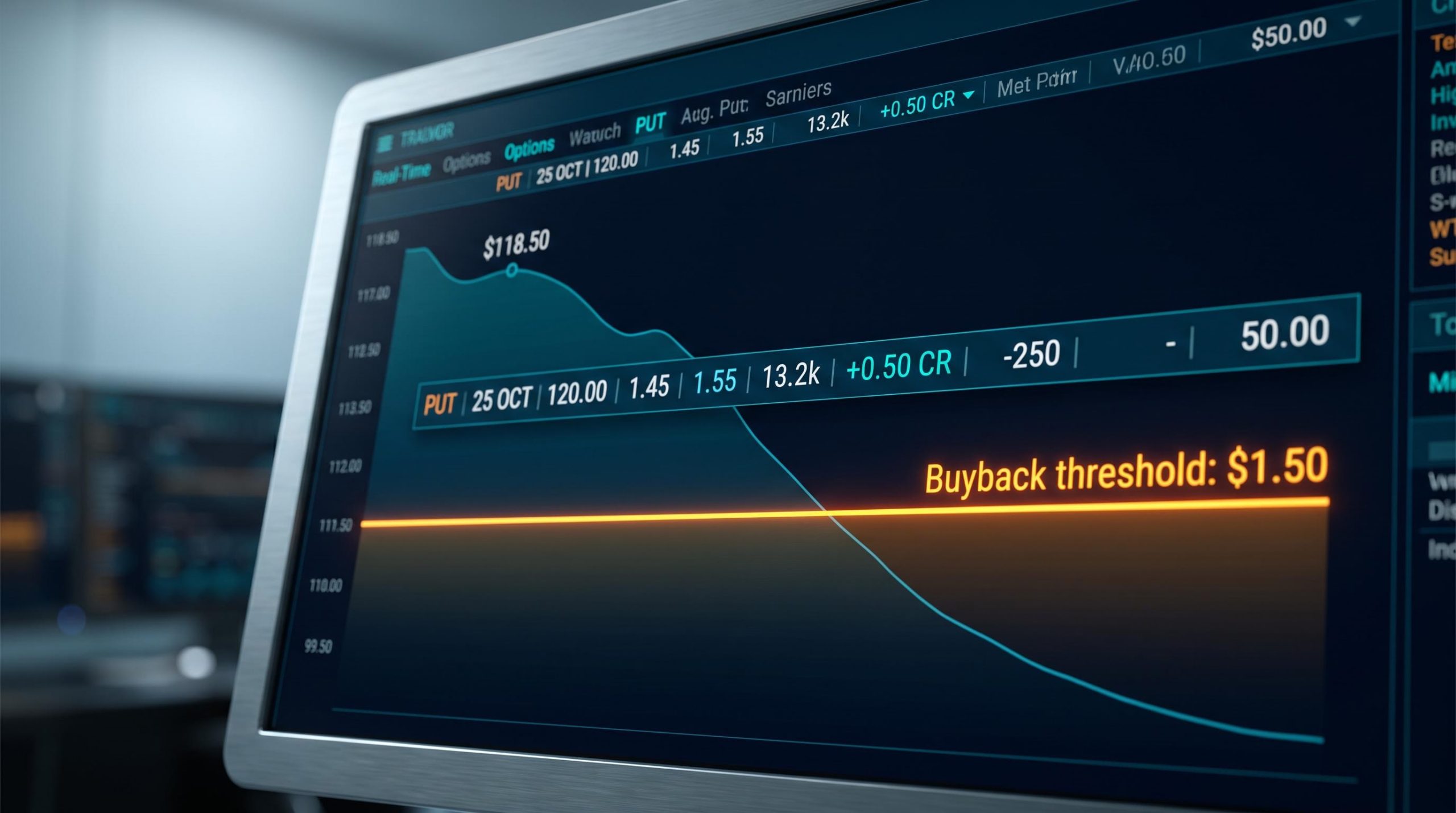
You sell a put, collect the credit, and then the stock starts sliding toward your strike. Now you have a decision to make, and if you are like most beginners, you have no framework for making it. At what point does holding the position become irrational rather than patient?
Selling put options is one of the most popular ways retail traders generate income, and there are now more people running short put positions than at any point in history. Total cleared options volume hit 15.2 billion contracts in 2025, according to Cboe, with roughly 46% of that activity attributed to retail traders. Yet exit discipline is rarely taught alongside the entry mechanics.
This guide gives you a concrete, pre-entry framework for knowing exactly when to close a losing short put, expressed as a simple multiple of the credit you collected. By the time you finish, you will have a rule you can apply to your next trade before you ever open the position.
What actually happens when you sell a put option
When you sell a put, you receive an upfront credit. In exchange, you take on an obligation: if the option is assigned, you must buy 100 shares of the underlying stock at the strike price. That trade-off is the entire structure, and understanding it is the key to why an exit rule matters.
The asymmetry baked into put options mechanics, where buyers pay a fixed premium for theoretically unlimited protection and sellers collect a fixed credit against an uncapped obligation, is the structural reason why exit discipline matters far more on the short side than the long side.
There are three ways this can go at expiration. Consider a real illustration: Comcast trading at $22.72, with the $22 strike put sold for a $0.50 credit. That put is roughly $0.70 out-of-the-money, giving you a buffer before losses begin.
Here is how each outcome plays out:
- The stock rises or stays flat. The $22 put expires worthless, and you keep the full $0.50 credit, which is $50 per contract.
- The stock slips slightly below the strike. The option goes in-the-money, but because you collected a credit up front, a small decline may still leave you profitable or only marginally down.
- The stock falls sharply. The put’s market price climbs well past your credit, and the loss scales with the decline.
Notice the imbalance. Your maximum gain is fixed at the moment you sell: $0.50 per share, no more. Your potential loss, on the other hand, keeps growing as the stock falls.
The core asymmetry Maximum profit is fixed at the premium received. Maximum loss is not.
You do not have to wait for expiration, either. If the stock rises, you can buy the put back for less than $0.50 and lock in a partial gain early. That flexibility works both ways, which is precisely the point.
This fixed-upside, uncapped-downside shape is why short put sellers need a predefined exit rule before opening the trade, not after the stock starts moving against them. When the loss has no natural ceiling, you have to build one yourself.
When big ASX news breaks, our subscribers know first
How the credit-multiple exit rule works in practice
So where do you put that ceiling? The credit-multiple exit rule answers this by tying your exit directly to what you collected. You close the position when the cost to buy it back reaches a predetermined multiple of your original credit.
The arithmetic is simple, and you set it up before you enter. The buyback target is your original sale price plus the loss multiple times the credit you received. Using the $0.50 Comcast credit, here is what each common threshold looks like.
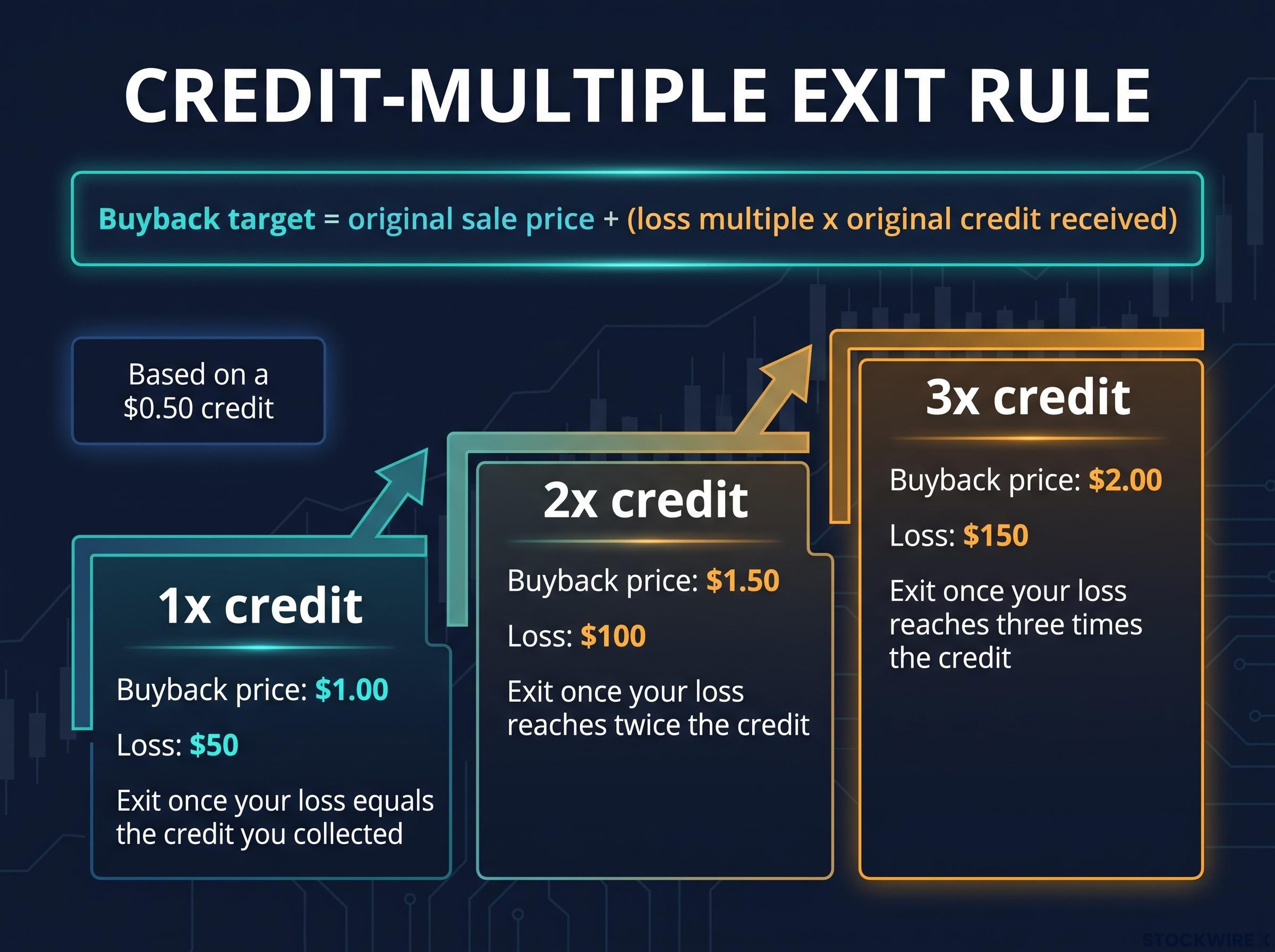
| Loss multiple | Buyback price (on $0.50 credit) | Loss per contract | Plain-English meaning |
|---|---|---|---|
| 1x credit | $1.00 | $50 | Exit once your loss equals the credit you collected |
| 2x credit | $1.50 | $100 | Exit once your loss reaches twice the credit |
| 3x credit | $2.00 | $150 | Exit once your loss reaches three times the credit |
To anchor the middle row in the Comcast trade: a decline of roughly $1.50, bringing the stock to about $21.20, would put the $22 strike around $0.80 in-the-money. At that point the $22 put would behave much like the $23.50 put currently trading at $1.50, which is your 2x exit level.
What is the formula, exactly?
Buyback target = original sale price + (loss multiple x original credit received)
That is all there is to it. Plug in $0.50 as your sale price, choose 2x as your multiple, and your buyback target is $1.50, capping your loss at $100 per contract.
The value here is not the number. It is the timing. Because you set the rule before you enter, the decision to close is already made. When the threshold is hit, execution is mechanical, and the emotion that clouds judgment mid-slide is removed from the equation.
Which multiple should you use?
The right threshold depends on three things: your account size and margin sensitivity, the volatility of the underlying, and how large this single trade is relative to your portfolio. Higher-volatility stocks generally warrant tighter thresholds, because they can move against you faster.
IV rank and IV percentile are the practical tools for deciding whether a current volatility reading is genuinely elevated or merely average for that underlying; choosing a tighter exit multiple in a low-IV environment where premiums are thin makes little sense if the stock routinely oscillates within that range on normal trading days.
Tighter thresholds like 1x preserve capital aggressively, but they will sometimes exit positions that would have recovered. Wider thresholds like 3x give the trade more room to breathe, but they amplify your loss if the stock gaps down hard.
Whichever you choose, decide it before you enter and treat it as a standing rule. The moment you start adjusting the multiple based on how a live position feels, you have abandoned the discipline that made the rule useful.
The risks that mechanical exit rules cannot fully solve
Here is where honesty matters. The credit-multiple rule is valuable, but it does not eliminate risk, and you should know exactly where it breaks down before you lean on it.
Four failure modes deserve your attention:
- Gap risk. An overnight or intraday price gap can push the option straight past your planned exit level before any limit order can fill, leaving you worse off than your threshold implied.
- Liquidity and wide spreads. During a volatility spike, bid-ask spreads widen and markets move fast, so your actual fill price can land materially away from your intended level.
- Volatility clustering. High-volatility periods tend to arrive in sequences, which can trigger the exit rule repeatedly and compound realised losses in a way single-event assumptions do not capture.
- Psychological hesitation. Even traders who set a rule freeze when it triggers, especially after a run of losses, which quietly defeats the entire purpose of having a mechanical threshold.
This matters more now than ever. With retail traders accounting for roughly 46% of the 15.2 billion contracts cleared in 2025, more inexperienced participants are exposed to these failure modes than at any prior point.
On 6 October 2025, FINRA published its World Investor Week 2025 investor bulletin, highlighting the importance of understanding complex and leveraged products such as derivatives. Regulators are watching this participation surge closely.
Knowing where the rule breaks down lets you supplement it with practical habits. Trade liquid underlyings, use limit orders rather than market orders at exit, and size each position small enough that a single gap-past-threshold event does not threaten your whole account. The rule is a boundary, not a force field.
Psychological hesitation at exit is not a personality flaw but a documented behavioural pattern: the disposition effect, which is the systematic tendency to hold losing positions too long while cutting winners short, is one of four biases that regulatory data across millions of retail accounts identifies as a primary driver of underperformance.
NBER research on options risk and investor behaviour finds that retail participants systematically underestimate the probability of large adverse moves in short options positions, which is precisely the dynamic that a predefined credit-multiple threshold is built to counteract.
When closing is not the only answer: assignment and the wheel
Closing at your threshold is one path, but it is not the only one. When a short put moves in-the-money, you face a genuine fork in the road, and accepting assignment is a deliberate strategy choice rather than a failure.
Accepting assignment means taking delivery of 100 shares at the strike price. Because you collected a credit up front, your effective cost basis is lower than the strike itself. On the Comcast trade, that is the $22 strike minus the $0.50 credit, giving you an effective entry of $21.50 per share.
Cash-secured puts are the most capital-conservative form of short put exposure, requiring you to hold the full purchase obligation in cash rather than using margin, and the effective cost basis calculation at assignment, strike price minus the premium received, is identical to the Comcast example used throughout this guide.
According to tastytrade’s beginner options framework, there are three pathways when a short put goes against you. Here is how they compare.
| Decision | When to favour it | Key risk | Effective outcome |
|---|---|---|---|
| Close | Capital preservation, avoiding stock exposure, keeping a premium-selling portfolio pure | Realising a defined loss on a position that might have recovered | Loss capped at your chosen multiple; buying power freed |
| Roll | You still believe the option can move back out-of-the-money | Extending duration and exposure if the stock keeps falling | New premium collected; risk shifted to a lower strike or later date |
| Accept assignment | Long-term bullish view, elevated volatility making covered calls attractive | Continued decline, capital tied up, compressed call premiums if volatility falls | Long 100 shares at an effective cost basis of strike minus credit |
Whether you close or accept assignment should come down to your thesis on the stock, not to which choice feels less painful the moment the put goes in-the-money.
The wheel in brief
Once assigned, you can sell covered calls at or above your effective cost basis to keep collecting premium. You repeat this until the shares are called away or you close the position. It is a conscious income strategy, not a last resort you fall into by accident.
Applying the rule before you open the trade
Now turn all of this into something you can actually use. The entire framework lives or dies on one habit: making the decision before you place the order, not while you are watching the position bleed.
Here is the pre-trade sequence, using the $0.50 credit and 2x multiple as your worked example:
- Determine your expected credit. In this case, $0.50 per share, or $50 per contract.
- Select your loss multiple. Say you choose 2x, based on the underlying’s volatility and your position size.
- Calculate your buyback threshold. $0.50 plus 2x $0.50 gives a $1.50 buyback target, capping your loss at $100 per contract.
- Set a Good-Till-Cancelled (GTC) limit buy order at $1.50 immediately after entering the short put.
- Assess position size against maximum loss. If $100 per contract is too large a slice of your account, reduce the size or reconsider the trade entirely.
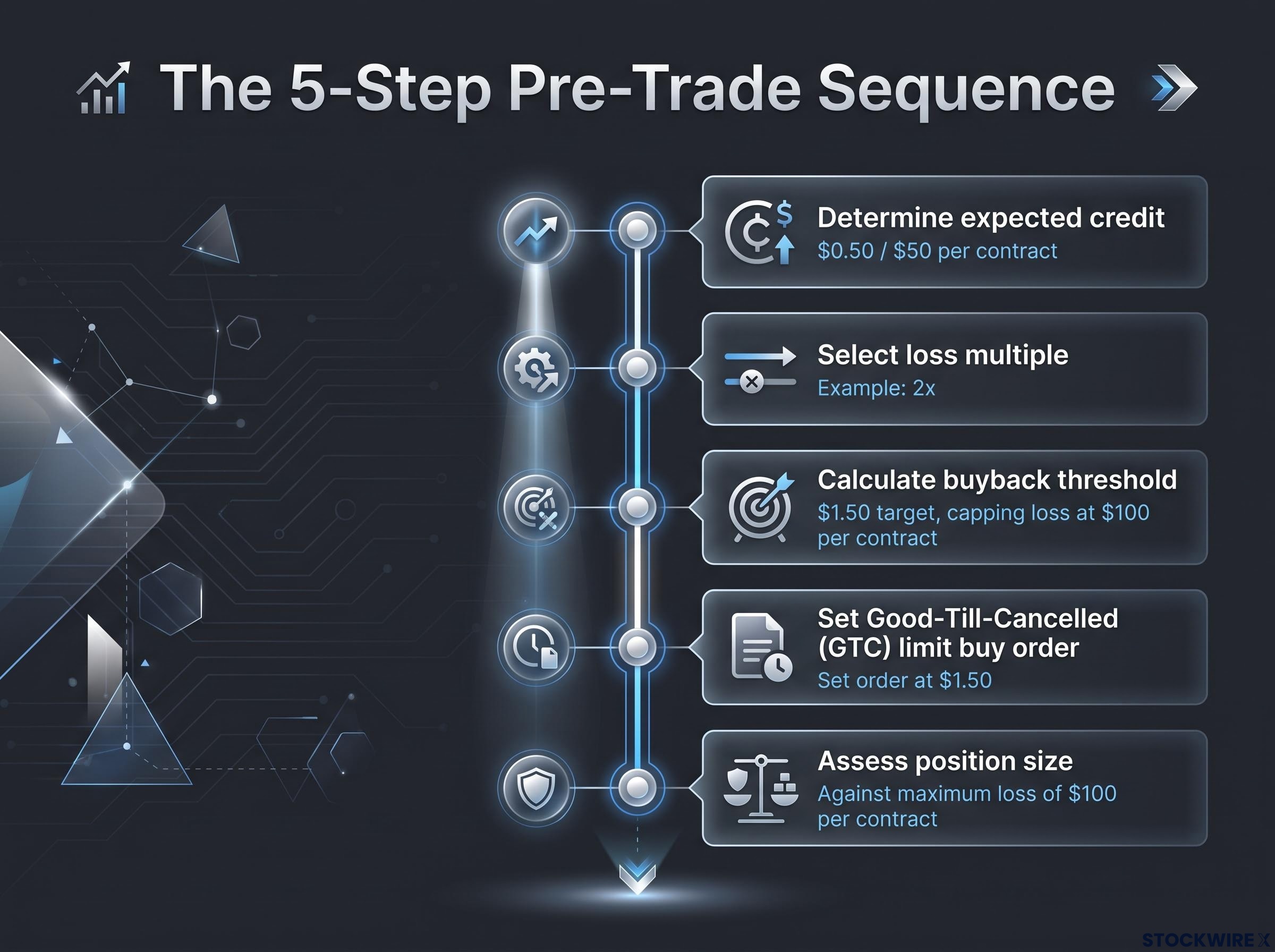
Set the GTC limit buy order at your buyback target the moment you open the short put. The exit is then automated.
That fourth step is the one that quietly does the most work. Once the GTC order is live, the exit decision is already made, and you have removed the psychological hesitation that undermines so many mechanical rules. What remains is simply letting the plan run rather than reacting to price under pressure.
One practical note. Liquid underlyings with tight bid-ask spreads reduce gap risk and improve your odds of filling near the intended threshold, so favour them when you are learning to apply the rule.
This article is for informational purposes only and should not be considered financial advice. Investors should conduct their own research and consult with financial professionals before making investment decisions. Past performance does not guarantee future results, and short put positions carry the risk of significant losses if the underlying declines sharply.
A rule is only as good as your commitment to following it
The credit-multiple exit rule will not make every trade profitable. What it does is stop any single trade from becoming disproportionately damaging to your account, which is the real long-run edge in premium selling: staying solvent enough to keep playing.
That discipline matters more than ever. With 15.2 billion options contracts traded in 2025 and retail traders accounting for roughly 46% of that volume, the population of traders who need a structured framework has never been larger. Both of your key choices, the multiple you set and whether you close or accept assignment, are decisions to make before you enter, not judgments to improvise under pressure. You now have a framework you can apply to any short put you consider, starting with the next one.