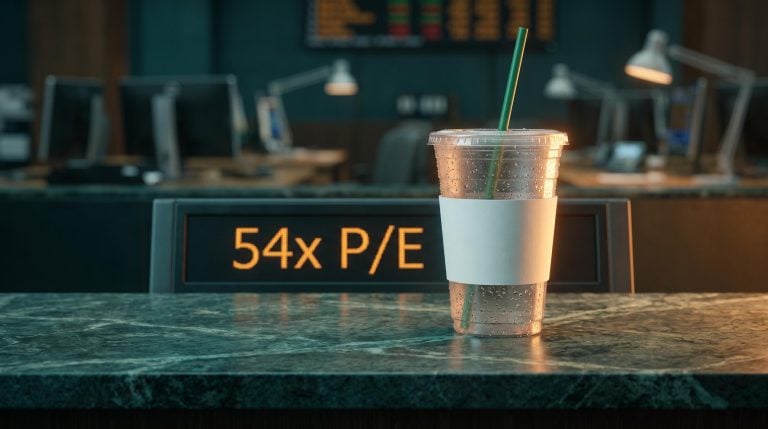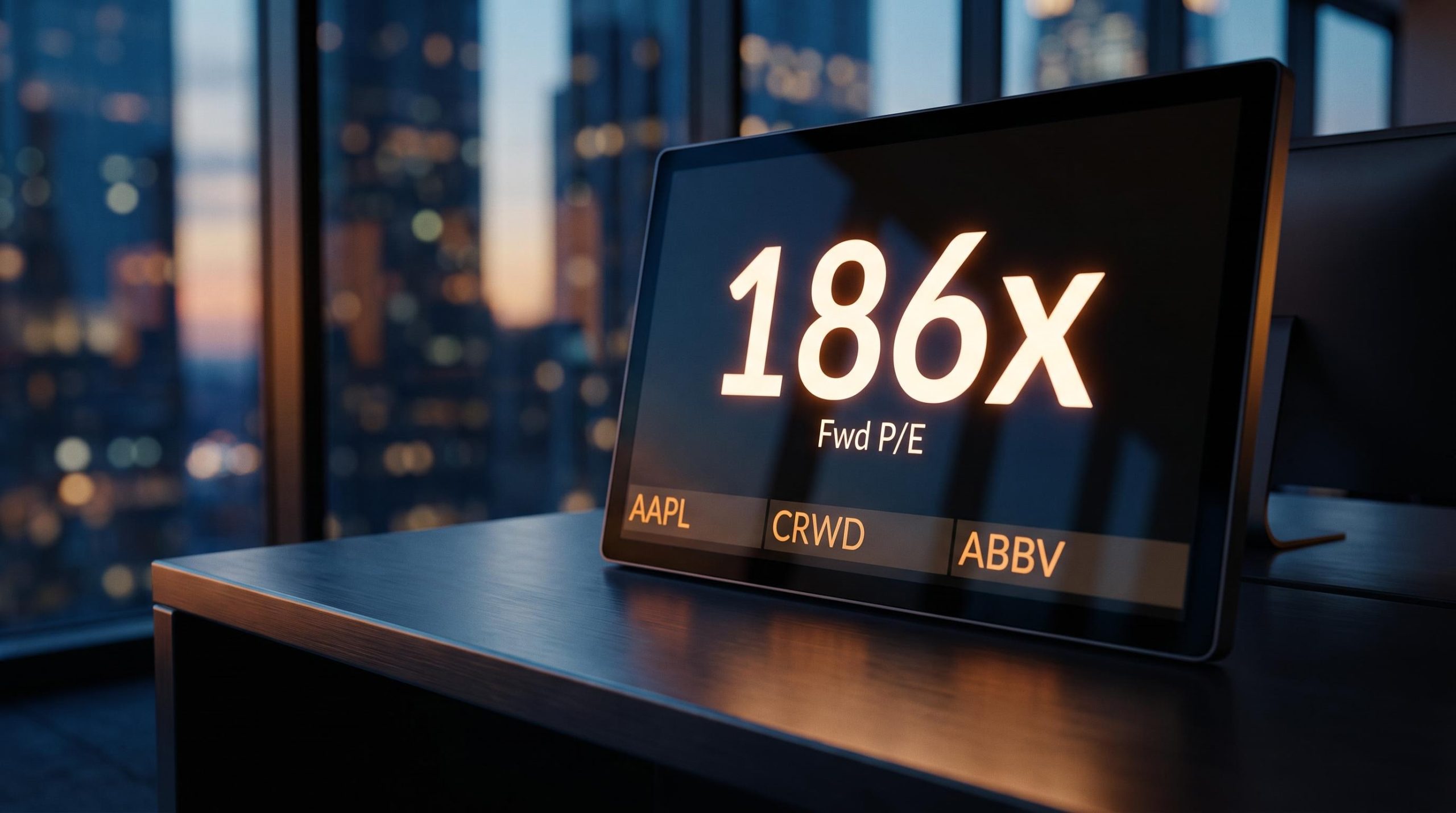
Three of the most admired companies in American business are trading at prices that leave serious investors unconvinced. Apple sits at roughly 37 times forward earnings while its earnings grow in the single digits. CrowdStrike trades near 186 times forward earnings after a 120% share price run. AbbVie has climbed more than 20% in a year and now trades above what a disciplined valuation framework suggests it is worth.
Admiring a business and buying its stock are two separate decisions, and the gap between them is where money is made or lost.
Retail investors routinely confuse business quality with investment quality. All three companies here are genuinely excellent operators. Apple’s ecosystem is structurally defensible, CrowdStrike’s Falcon platform is winning in one of technology’s most durable growth markets, and AbbVie pulled off a Humira succession that most feared would be damaging.
None of that changes the core discipline: price determines your return, not quality alone.
What you get from here is a company-by-company valuation walkthrough, with the specific numbers that matter, so you can decide whether these high-quality stocks belong in your portfolio at current prices or whether patience is the better position. This is the framework for answering that question without guesswork.
The rule every investor forgets when a great business is at stake
A high-quality business and a high-quality stock are not the same thing, and one does not imply the other at any price. A business is defined by its moat, its economics, and its management. A stock is defined by the return it is likely to deliver from the price you pay today. You can own a superb company and still make a poor investment if you overpay for it.
This is not a fringe view. It is the shared conclusion of some of the most respected investors alive, and their reasoning is worth internalising before you look at a single valuation multiple.
Warren Buffett is often paraphrased as preferring a wonderful company at a fair price over a fair company at a wonderful price. Notice the operative words.
“A wonderful company at a fair price” still embeds a valuation discipline. “Fair price” is the condition, not an afterthought. Quality is necessary but never sufficient.
Howard Marks of Oaktree Capital has made the same point repeatedly in memos including “Risk Revisited.” His central argument is that your expected return depends on the price you pay relative to intrinsic value, not on business quality alone. He describes a valuation pendulum: when optimism pushes prices far above reasonable estimates of worth, even a stable business can deliver disappointing returns as sentiment and multiples normalise.
Howard Marks built his framework around the primacy of price versus intrinsic value, arguing that the Nifty Fifty collapse of 1968-1973 destroyed roughly 90% of investor wealth not because the underlying companies failed but because buyers paid 80-90 times forward earnings for businesses priced to perfection.
The frameworks worth keeping in mind before the individual companies:
- Howard Marks (Oaktree Capital): Expected return is a function of price versus intrinsic value. The valuation pendulum normalises even when the underlying business is stable.
- Warren Buffett (Berkshire Hathaway): A wonderful company at a fair price. “Fair price” is the discipline that survives every quality narrative.
- Seth Klarman (“Margin of Safety”): Quality narratives entice investors into overpaying, converting a strong business into a low-quality risk-reward proposition.
- GMO and AQR (Jeremy Grantham, Cliff Asness): Empirical work shows that paying extreme multiples for high-quality companies often produces poor future returns, because multiple compression overwhelms continued fundamental strength.
None of these investors is arguing against quality as a factor. They are arguing that quality without valuation discipline is the specific mistake that costs money. And it is a mistake available in plain sight right now, in three of the most widely held names on the market.
When big ASX news breaks, our subscribers know first
Apple at 37 times earnings: what the premium assumes, and what it ignores
Apple trades at roughly 37 times forward earnings while analysts project only single-digit percentage earnings growth in the year ahead. That single line is where the analysis begins, because it frames every argument that follows.
Apple shares rose approximately 25% during 2026, outperforming most of the Magnificent Seven. The rally is real. The question is whether the price you would pay today still leaves room for a decent return.
The bull case for a premium multiple
The bull case is genuinely strong, and dismissing it would be lazy.
Daniel Ives of Wedbush has argued for years that Apple deserves a higher multiple because it has become an ecosystem and services powerhouse rather than a hardware cyclical. Its large installed base is monetised through the App Store, subscriptions, and wearables, all of which carry higher margins and recurring revenue.
Services growth, AI-driven upgrade cycles, and a recently introduced foldable phone all offer paths to new monetisation. Ecosystem switching costs make Apple’s user base extremely difficult to exit, and the balance sheet funds a steady programme of buybacks and dividends.
Put together, the bull camp sees a structurally higher-quality compounder that has earned a premium to its own history.
Where the arithmetic breaks down at current prices
Here is where the mathematics of that bull case runs into trouble.
| Metric | Current Level | Five-Year Historical Average | Implied Gap |
|---|---|---|---|
| Forward P/E | ~37x | Well below current, against single-digit growth | Premium to Apple’s own norm |
| Forward EV/EBITDA | ~28x | ~22x | Roughly 6 turns above average |
| Consensus 12-month price target | ~$328-$342 | Near current price | Little to no headroom |
| Implied 12-month return | Near-zero to slightly negative | N/A | Upside largely exhausted |
A multiple of 37 times earnings could be justified by a 30-40% earnings growth rate. Apple is a large, mature company for which that pace is not realistic in the near term.
There is a meaningful difference between acknowledging that Apple can keep growing and claiming the stock is worth any price. At 37 times earnings against single-digit growth, you are paying today for a growth scenario the business is unlikely to deliver on the expected timeline.
Skeptics including Toni Sacconaghi of Bernstein point to slowing unit growth in mature markets, heavy dependence on the iPhone, and genuine uncertainty about how much incremental revenue AI features actually generate versus simply preserving the franchise.
The bluntest signal comes from Wall Street itself. The consensus 12-month price target of roughly $328 to $342 sits near or slightly below the current price, implying near-zero to slightly negative return. When professional analysts’ own models leave no upside, that tells you the premium has done its work already.
CrowdStrike’s extraordinary business deserves a category of its own warning
Cybersecurity is one of the most structurally compelling growth sectors in technology, arguably more durable than artificial intelligence as an investment theme, driven by accelerating digitisation, cloud adoption, and AI-generated security threats. CrowdStrike sits at the centre of it.
The Falcon platform consolidates endpoint protection, identity security, cloud security, and threat intelligence into a single architecture, which drives strong customer retention. This is a legitimately exceptional business, and the numbers back it up.
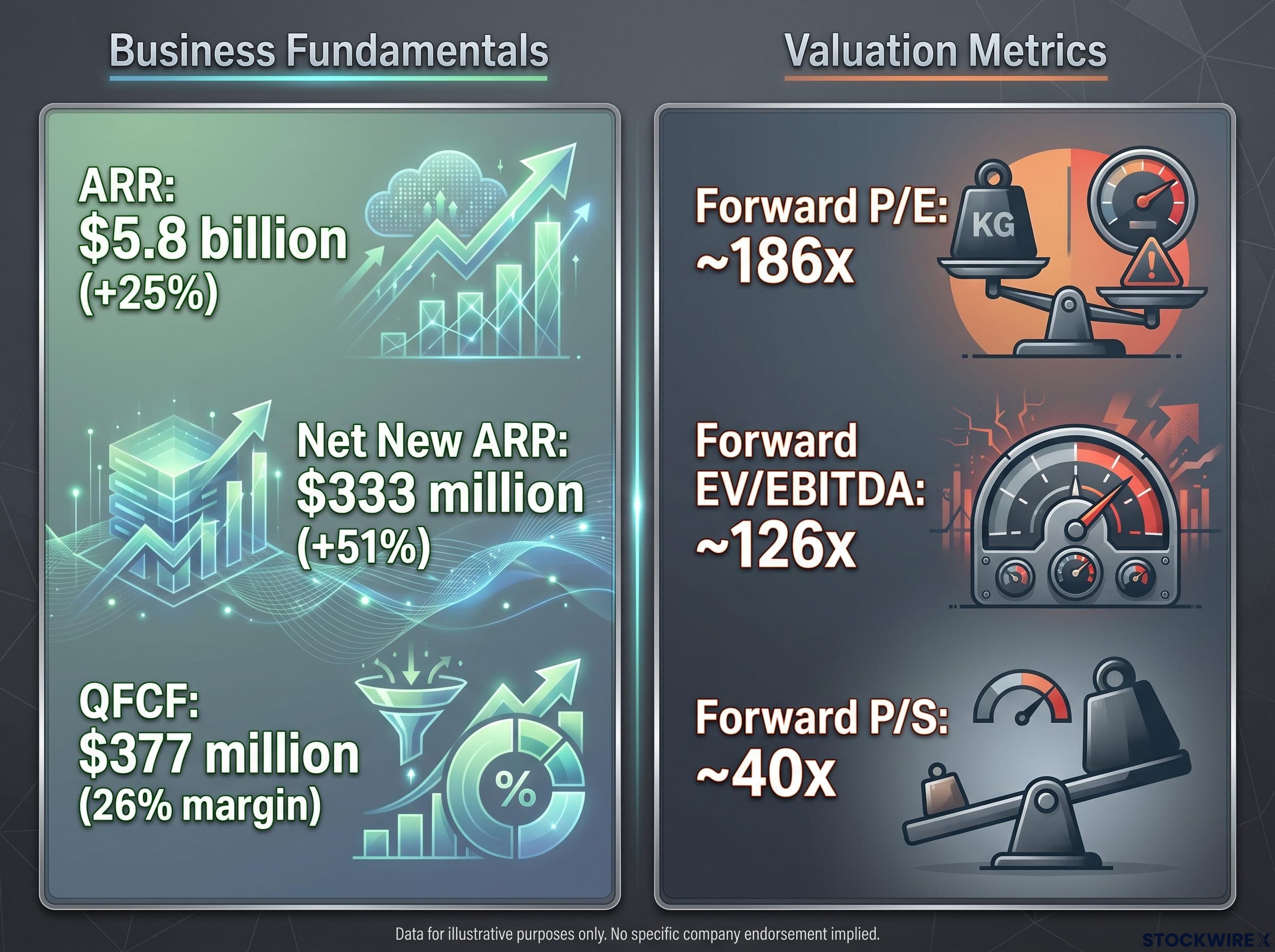
In its most recent reported quarter, CrowdStrike posted annual recurring revenue of $5.8 billion, up 25% year-over-year, with a record $333 million in net new ARR, an acceleration of 51% versus the prior period. Quarterly free cash flow reached $377 million, a 26% free cash flow margin. Management described it as the best quarter in the company’s history.
The shares reflected that performance, appreciating roughly 120% over the prior twelve months.
Now the valuation.
Management described the most recent quarter as the best in company history.
| Valuation Metric | CrowdStrike Current | Sector Comparison Context |
|---|---|---|
| Forward P/E | ~186x | Well above already-elevated historical averages |
| Forward EV/EBITDA | ~126x | Far above software peer norms |
| Forward P/S | ~40x | Among the richest in the sector |
| Consensus price target | ~$234 | ~10% below current price (negative implied return) |
The best quarter in company history, priced at 186 times forward earnings, with a consensus target that sits about 10% below the current price. Set those facts side by side and the concern writes itself.
The risk here is not that the business deteriorates. The risk is multiple compression. Aswath Damodaran of NYU has long argued that growth stocks are long-duration assets, meaning most of their value comes from cash flows many years out, which are acutely sensitive to assumed growth rates. When expected growth slips from 25% to the high teens, discounted valuations can fall sharply.
Howard Marks describes the same dynamic through narrative shift: once a stock embeds an aggressive growth story, any sign of slowing prompts investors to re-rate it, delivering a double hit of lower projected growth and a lower multiple applied to it.
ARR deceleration is the specific mechanism through which multiple compression materialises in high-growth software stocks: Zscaler’s guidance cut from 25% to roughly 16-17% growth triggered a 30% share price decline despite beating every reported metric in the quarter, illustrating exactly the dynamic that makes CrowdStrike’s current multiple fragile.
The historical precedents are not abstract:
- Okta, Zoom, and Shopify (2020-2022): Prices fell far beyond what fundamentals justified as multiples compressed from 30-40 times sales into the mid-teens once growth slowed.
- Cisco (post-2000): Deceleration from extremely high growth triggered severe compression even as revenues kept rising.
What this means for you is uncomfortable but clear. A deceleration from 25% to 20% growth, still excellent by any normal standard, could prompt investors to assign a lower multiple and deliver a severe price decline while the company continues to perform. The time to buy a business like this is not during the run, but at a price that provides a margin of safety.
AbbVie is a different problem: a great transition story that the market has already priced
AbbVie is the most nuanced of the three cases, and it is important not to lump it in with CrowdStrike. This is not a story of extreme overvaluation. It is a story of a shrinking margin of safety.
For years the central worry about AbbVie was Humira, one of the best-selling drugs in pharmaceutical history, and what the business would look like once patent protection lapsed. The transition many investors feared would be damaging has instead gone remarkably well.
What Skyrizi and Rinvoq actually delivered
The successor drugs have more than filled the gap.
| Product | Most Recent Quarter Revenue | Year-over-Year Growth |
|---|---|---|
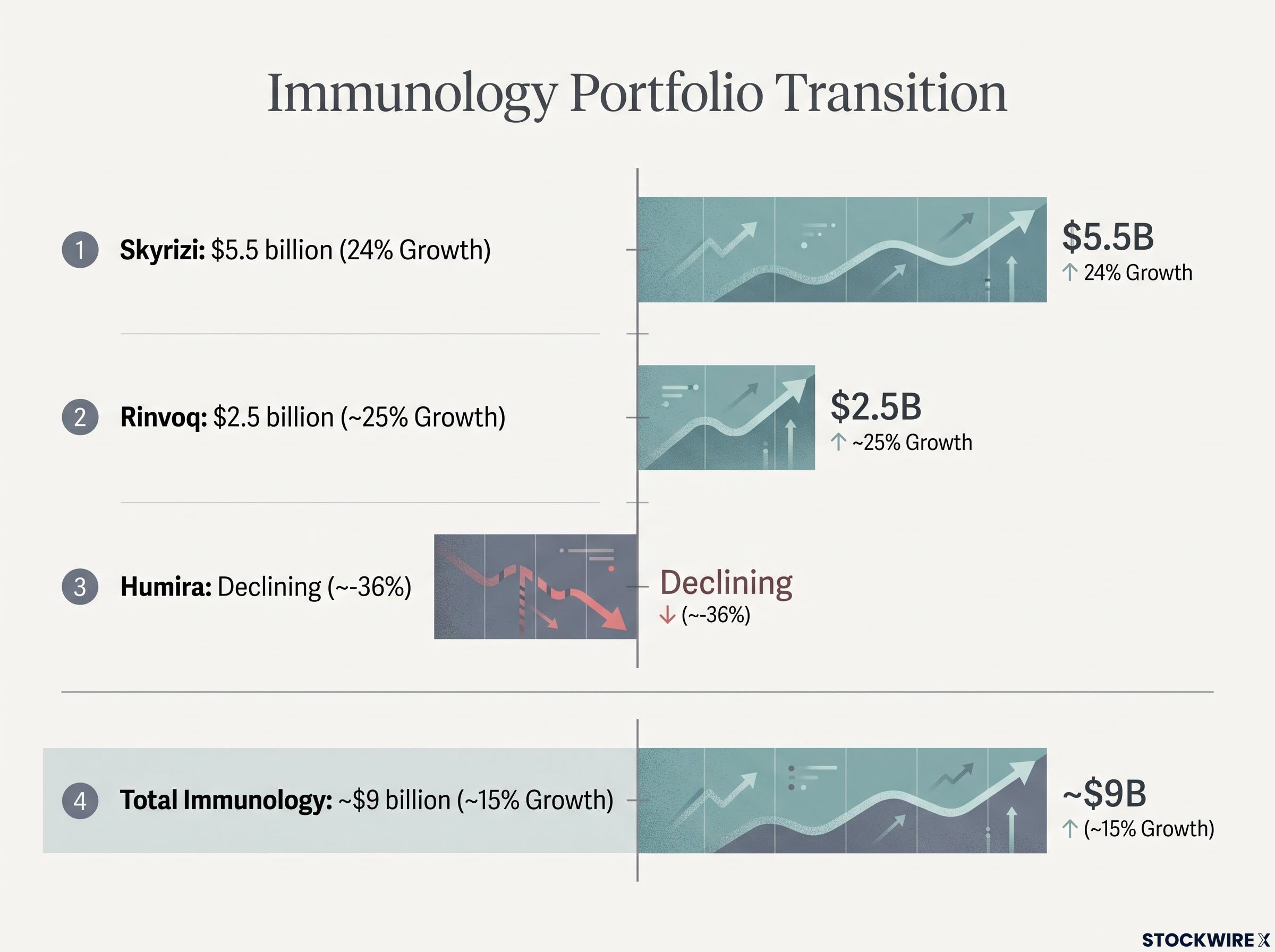
| Skyrizi | $5.5 billion | 24% |
| Rinvoq | $2.5 billion | ~25% |
| Humira | Declining | ~-36% |
| Total immunology portfolio | ~$9 billion | ~15% |
Total quarterly revenues reached $17 billion, a 10% year-over-year increase. Skyrizi and Rinvoq are growing at roughly 24% and 25% while Humira fell about 36%, and the net result is an immunology portfolio still expanding at around 15%. The transition is not theoretical. It is demonstrably underway and performing ahead of expectations.
Where the risk picture sits from here
The execution record is genuinely positive. The forward-looking risk set is separate, and worth treating on its own terms.
- Patent-cliff and concentration risk: AbbVie still concentrates significant revenue in a few blockbusters. Loss of exclusivity for Skyrizi and Rinvoq later in the decade or into the 2030s would create fresh cliffs.
- Clinical and regulatory risk: Pipeline assets in oncology and neuroscience carry the usual trial risks, including missed endpoints and regulatory delays, and pipeline valuations tend to assume success.
- Pricing and policy risk: The Inflation Reduction Act’s Medicare negotiation provisions are the most concrete near-term pressure, with potential to slow revenue growth on high-revenue therapies even where clinical profiles remain strong.
On valuation, AbbVie trades at roughly 17.5 times forward earnings and about 15.2 times forward EV/EBITDA, against a fair value multiple of around 15 times earnings for pharmaceutical peers. Its Edge Score sits near 75 out of 100, with valuation cited as the primary drag.
Here is the distinction that matters. AbbVie at roughly $260 is not the same investment as AbbVie below $200, where the earlier buy recommendation was made. The business has improved, but the price has improved faster, which means the risk-reward ratio for a new buyer today is measurably worse than it was for someone who entered earlier. This is a stock where patience, not action, is the disciplined response.
A formal margin of safety framework sets a 15% minimum annualised return hurdle on every position and calibrates the required discount to business quality, demanding 30% below intrinsic value for high-moat businesses and 40-50% for cyclical or leveraged ones, a standard that none of the three stocks discussed here currently meets.
What the numbers across all three stocks actually tell you
Line the three companies up and a spectrum appears, from extreme overvaluation through meaningful premium to reduced margin of safety.
| Company | Forward P/E | Forward EV/EBITDA | Implied Return | Positioning Signal |
|---|---|---|---|---|
| Apple | ~37x | ~28x | Near-zero to negative | Wait |
| CrowdStrike | ~186x | ~126x | ~-10% | Wait for correction |
| AbbVie | ~17.5x | ~15.2x | Fair value ~15x benchmark | Monitor for entry |
The valuations were reached in different ways. Apple’s 25% gain in 2026 and CrowdStrike’s 120% run pushed both multiples well above historical norms, while AbbVie’s move from below $200 to roughly $260 simply eroded the cushion that once made it attractive.
This is not a signal to avoid all three indefinitely. It is a reminder that price, not quality, governs the return you actually receive.
The pattern across all three is identical. The business quality is not in doubt. The real question is whether the price already embeds the optimistic scenario, and in every case the answer points toward waiting or watching rather than buying at current levels.
What would change the picture, ordered from most extreme overvaluation to least:
- CrowdStrike: A broad market correction that drives the price lower while the underlying business thesis stays intact. The business does not need to improve, only the price.
- Apple: A return toward its five-year historical average EV/EBITDA of roughly 22 times, signalling the premium has normalised.
- AbbVie: A pullback toward the 15 times forward earnings fair value threshold, restoring the margin of safety.
Quality is the starting point, not the destination
The most valuable takeaway here is not a verdict on three stocks. It is a repeatable skill. Once you separate business quality from investment quality, you can apply the same discipline to any stock you encounter, and you stop confusing admiration for a company with a case for buying it.
Apple, CrowdStrike, and AbbVie could each become genuinely attractive investments at the right price. This has never been a negative judgement on the companies themselves, only on the prices being asked today.
Your job from here is not to avoid these three forever. It is to know precisely what would move each from “wait” to “worth buying,” then to have the discipline to wait for it.
For investors reading this, our dedicated guide to permanent capital loss shows how the mathematics of a 50% decline require a 100% gain to recover, and documents why dot-com investors who were directionally correct about the internet still waited a decade to break even after buying at peak multiples.
Watch for these three conditions:
- CrowdStrike: A market-wide correction that lowers the price while the growth thesis holds.
- Apple: A return toward its ~22x five-year average EV/EBITDA.
- AbbVie: A pullback toward ~15x forward earnings.
This article is for informational purposes only and should not be considered financial advice. Investors should conduct their own research and consult with financial professionals before making investment decisions. Past performance does not guarantee future results, and financial projections are subject to market conditions and various risk factors.