Half of Australians cannot explain the fees charged on their own superannuation, according to Vanguard’s How Australia Retires report. Yet for most of them, super will end up being the single largest pool of money they ever accumulate.
That gap between how much rides on super and how little most people understand about it is the problem this guide exists to solve.
The timing matters. Payday super commenced on 1 July 2026, meaning your employer’s contributions now land in your account with every payslip rather than once a quarter. Contribution caps have also indexed upward for 2026-27, with the before-tax cap rising to $32,500 and the after-tax cap to $130,000. These are structural shifts that reward the Australians who know how to use them and quietly pass by those who do not.
Here is a framework for every lever in the super system, from the tax concessions you may be underusing to the specific balance targets and drawdown structures that will decide whether your savings actually last. Treat it as a working audit of your own position rather than a summary of the rules.
Why superannuation is the most tax-efficient vehicle most Australians will ever use
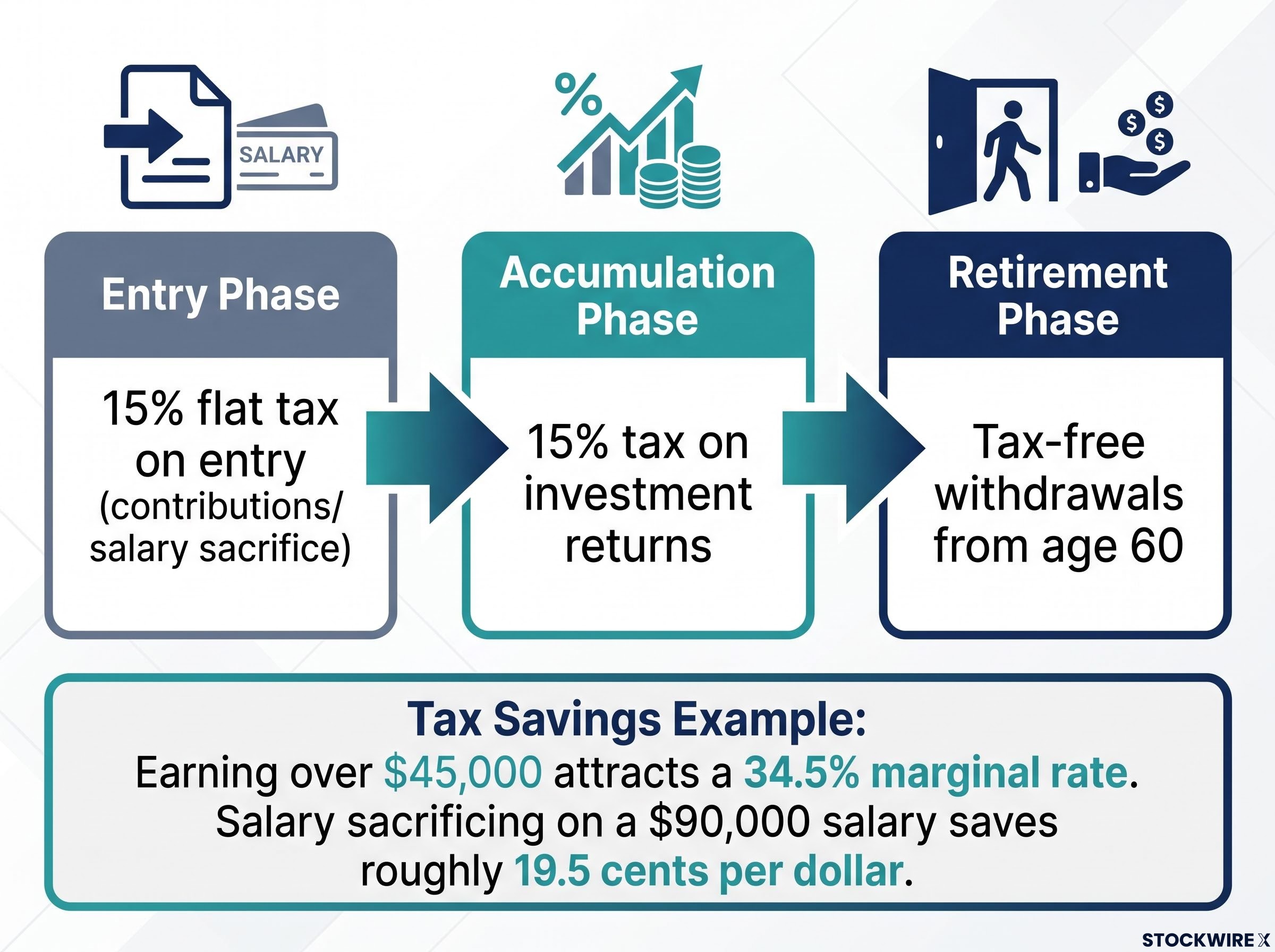
Super is not just a savings account with a lock on it. It is a structure that taxes your money at three separate points, and at each point the rate is lower than what you would pay outside the system.
Start with contributions. Money going in as employer contributions or salary sacrifice is generally taxed at a flat 15% on entry. If you earn above $45,000, your marginal rate on the next dollar is at least 34.5% once the Medicare levy is included. So every dollar you salary-sacrifice on a $90,000 salary saves you roughly 19.5 cents in tax the moment it goes in.
Next come the earnings. Investment returns inside super are taxed at just 15% during the accumulation phase, the years while you are still building the balance. Outside super, those same returns could be taxed at your marginal rate, according to ATO tax schedule rates.
Then comes the payout. From age 60, withdrawals from super are generally tax-free, and earnings in the retirement phase are typically tax-free up to a legislated limit.
Three tax breaks, one account: 15% on the way in, 15% on the growth, and tax-free on the way out from age 60. Nothing else in the ordinary investor’s toolkit stacks concessions like this.
The table below shows what the contribution concession is worth per $1,000 contributed, depending on your income.
| Income level | Marginal rate (incl. Medicare) | Super rate on contribution | Tax saved per $1,000 |
|---|---|---|---|
| Lower income | Refer to ATO tax schedule | 15% | Refer to ATO tax schedule |
| Mid income ($90,000) | Refer to ATO tax schedule | 15% | Refer to ATO tax schedule |
| High income | Refer to ATO tax schedule | 15% | Refer to ATO tax schedule |
Here is why this compounds in your favour. The three concessions do not just apply once; they apply year after year, so the gap between a dollar inside super and the same dollar invested outside it widens every single year. If you have never modelled that gap, you are almost certainly underestimating what each extra voluntary contribution is worth, and every year you delay is a year of tax-advantaged compounding you do not get back.
The tax wrapper advantage is what separates super from every other investment structure available to ordinary Australian investors: the same portfolio earning the same return inside super is projected to produce roughly $230,000 more wealth over 25 years purely because of how each dollar is taxed at contribution, growth, and withdrawal.
When big ASX news breaks, our subscribers know first
How to use contribution caps strategically in 2026-27
Knowing super is tax-efficient is one thing. Knowing exactly how much you can put in this year, and where your own gaps sit, is where the advantage actually gets captured.
The caps for 2026-27 have just moved. The concessional (before-tax) cap is now $32,500, up from $30,000 in 2025-26. The non-concessional (after-tax) cap is $130,000, up from $120,000. The three-year bring-forward limit for eligible members is $390,000. That extra room is real money you can now shelter at the concessional rate.
Concessional and non-concessional contributions are two different things, and the difference matters:
- Concessional contributions are before-tax money: employer super guarantee (SG), salary sacrifice, and personal contributions you claim a deduction for. Cap for 2026-27 is $32,500. These suit anyone wanting to reduce taxable income while building super.
- Non-concessional contributions are after-tax money you put in from savings or an inheritance, with no further tax on entry. Cap for 2026-27 is $130,000, four times the concessional cap. These suit people with a lump sum to move into the tax-advantaged environment.
Payday super changes how you track the concessional cap in practice. Because SG now arrives with each payslip rather than quarterly, your employer contributions accumulate against the $32,500 cap in real time throughout the year. If you also salary-sacrifice, you need to watch both streams together so you do not accidentally breach the cap late in the financial year.
Using carry-forward contributions to close a contribution gap
There is a catch-up mechanism most people never use. According to ATO rules, if your total super balance was below a specified threshold at 30 June of the previous financial year, you can carry forward any unused concessional cap space from previous years and add it on top of this year’s cap.
Consider a worker who salary-sacrificed little in 2022-23 and 2023-24 while on parental leave. Those unused amounts have not disappeared. On top of the current $32,500 cap, that member can now contribute the accumulated unused space, provided they meet the balance test.
The ATO tracks your available carry-forward amounts, and you can check exactly how much you have in myGov. For someone returning from a career break, the carry-forward rule combined with the indexed 2026-27 cap creates a genuine window to close a contribution gap that would otherwise compound into a serious shortfall by retirement.
The ATO concessional contributions rules confirm that the carry-forward mechanism is available to members whose total super balance fell below the relevant threshold at 30 June of the prior year, with your accumulated unused cap space visible directly through your myGov account.
Choosing the right investment mix for your age and retirement horizon
The most common super mistake is not a dramatic one. It is sitting in a default option for years without ever checking whether the investment mix actually matches your age and risk profile.
The starting framework is the growth-versus-defensive split. Shares and similar growth assets carry more volatility but historically produce stronger returns over extended timeframes. Bonds, cash, and other defensive assets offer steadier, more predictable performance that preserves capital during rough patches. The longer your runway to retirement, the more capacity you have to absorb short-term losses, which is why a higher allocation to growth tends to be appropriate earlier in your working life.
That calculus flips as retirement approaches, because of sequence-of-returns risk. This is the danger that a large market fall in the years just before you start drawing down permanently damages your balance, since you have no time left to recover before you begin spending it.
Sequence-of-returns risk: a major market fall shortly before retirement can permanently reduce the balance you have to draw on, because you start withdrawing before markets recover.
Many funds address this automatically through lifecycle or life-stage options, which gradually shift you from growth into defensive assets as you age. The trade-off, flagged by ASIC’s MoneySmart and independent advisers, is that these glide-paths can be blunt. They may de-risk too early for some members, or fail to account for other assets and plans to keep working.
Which raises the counter-risk. With retirements often running 25-30 years, moving too defensively too soon exposes you to inflation eroding your purchasing power over decades. Defensive does not automatically mean safe.
| Age band | Illustrative growth | Illustrative defensive | Rationale |
|---|---|---|---|
| Under 35 | High | Low | Long horizon; time to recover from falls |
| 35-50 | High to moderate | Low to moderate | Still growth-focused; begin monitoring |
| 50-60 | Moderate | Rising | Gradual rebalancing to manage sequence risk |
| 60 and over | Moderate, maintained | Moderate to high | Keep some growth against inflation over 25-30 years |
The practical guidance is gradual rebalancing over the 10-15 years before retirement rather than an abrupt switch. A member who bolted into cash and bonds at 50 to avoid volatility may well retire with a materially smaller balance than one who held growth exposure until closer to 60. Playing it too safe, too early, is itself a financial risk.
Understanding ASFA’s retirement balance benchmarks and what they mean for your savings plan
If you want a number to aim at, the Association of Superannuation Funds of Australia (ASFA) provides the most widely cited one. For a comfortable retirement at age 67, ASFA’s balance targets are $630,000 for a single homeowner and $730,000 combined for a couple, as at the September quarter 2026.
Those figures line up with annual spending benchmarks. ASFA’s comfortable standard for the September quarter 2026 is roughly $56,166 per year for a single and $78,998 for a couple. To put the indexing in context, the March 2026 figures were $55,923 and $78,566; ASFA updates them quarterly to track living costs.
Here is where most people misread the targets. The balance figures only hold under a specific set of assumptions:
- You own your home outright
- You qualify for at least a part Age Pension
- Your savings earn a 6% rate of return
- You draw down your capital fully over retirement
- You retire at age 67
| Measure | Single homeowner | Couple (combined) |
|---|---|---|
| Comfortable annual spend | $56,166 | $78,998 |
| Balance target at age 67 | $630,000 | $730,000 |
| Key assumption | Homeowner + part pension | Homeowner + part pension |
What this means for you personally depends on how well you fit that profile. If you do not own your home, or you cannot count on a part Age Pension, you will need a materially higher balance than the headline figure to fund the same lifestyle. The $630,000 target is a floor under specific conditions, not a universal finish line, so the real value of knowing it is checking whether its assumptions actually apply to you.
Age-appropriate balance benchmarks make the ASFA targets more actionable, because knowing you need $630,000 at 67 is less useful than knowing the intermediate milestone your balance should be tracking at 35, 45, or 55 to put that final figure within reach.
Structuring a retirement income stream: account-based pensions, drawdown rates, and the bucket approach
Building the balance is only half the strategy. The harder half is turning it into an income that lasts, and this is where two risks you now understand collide: running out of money too early, and being so cautious you never enjoy what you saved.
The main vehicle is an account-based pension. You move your accumulation savings into the pension phase, at which point earnings become tax-free up to the legislated limit, and withdrawals are tax-free from age 60. It behaves like an investment account you draw an income from, with rules attached.
The most important rule is the mandatory minimum drawdown. Under the SIS Regulations, you must withdraw a minimum percentage of your 1 July balance each year, and that percentage rises with age.
Sequence-of-returns risk is not a remote scenario: simulation data shows that two identical $1,000,000 portfolios with the same average annual return over 30 years can diverge by nearly $10 million in final balance, with the outcome determined entirely by whether poor returns arrive in the early or late withdrawal years.
Minimum annual drawdown: 4% of your balance for ages 60-64, and 5% for ages 65-74. The temporary COVID relief that halved these rates ceased on 1 July 2023 and does not apply in 2025-26 or 2026-27.
That minimum is a legislated floor, not an income plan. For a retiree with $630,000 in an account-based pension at 67, the 5% minimum equals $31,500 a year, already below the ASFA comfortable standard of $56,166 for a single. Treat the minimum as the least you must take, not the amount you should live on.
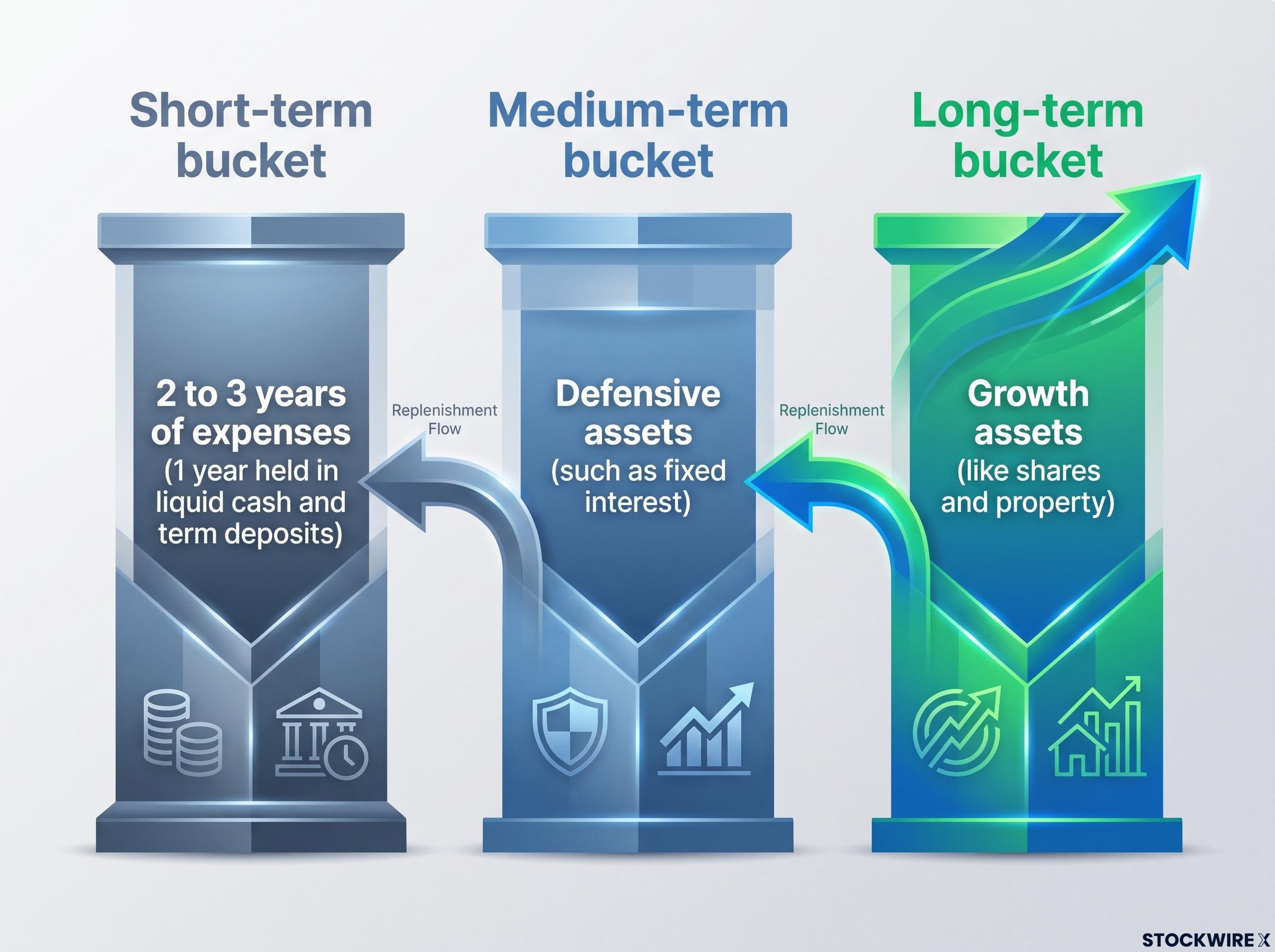
The bucket strategy is the framework most advisers use to manage the tension between those two risks. It splits your money by time horizon:
- Short-term bucket: two to three years of expenses, with roughly one year held in liquid cash and term deposits. You draw your income from here, which means you never have to sell growth assets during a market downturn.
- Medium-term bucket: defensive assets such as fixed interest, providing stability and a source to top up the short-term bucket.
- Long-term bucket: growth assets like shares and property, left to compound over the long haul.
Income comes out of bucket one. When markets are favourable, you refill it from buckets two and three. That sequencing is what protects you from sequence-of-returns risk during the drawdown years.
When to consider blending in a lifetime annuity or pooled longevity product
An account-based pension has one gap it cannot close on its own: longevity risk, the chance you outlive your savings. A lifetime annuity addresses this directly by paying an income you cannot outlive, no matter how long you live.
The trade-off is real. Annuities give up flexibility and liquidity in exchange for certainty, so the money committed to them is no longer available as a lump sum. A common structure is to cover essential spending with a lifetime annuity alongside the Age Pension, then use the account-based pension for discretionary spending where flexibility matters.
Treasury’s Retirement Income Review is the policy backdrop here, having drawn attention to how few Australians insure against longevity at all. A poorly structured drawdown can expose even a well-funded retiree to sequence risk or chronic under-spending; a structured one can deliver sustainable income across a 25-30 year retirement.
What makes or breaks a superannuation strategy over the long run
You can optimise contributions, nail your asset allocation, and structure a clean drawdown, and still lose a large share of the benefit to problems that operate quietly in the background. These are the erosion risks that undo good strategies.
- Fee drag: even a 0.5% difference in annual fees compounds into tens of thousands of dollars over a working life. The remedy is to review your fund’s fees and performance against benchmarks, and consider switching if it sits consistently in the bottom quartile, as MoneySmart suggests.
- Insurance erosion: default life and disability cover carries stepped premiums that rise with age, and holding multiple accounts means paying duplicated premiums. The remedy is to review your cover and consolidate accounts so you are not paying twice.
- Contribution gaps: career breaks from parenting, caring or insecure work leave lasting holes, disproportionately affecting women and casual workers. The remedy is the carry-forward concessional rule, used when income allows.
- Investment inertia: many members sit in a default option that no longer matches their risk profile or horizon. The remedy is a simple review every year or two against your age and retirement date.
Hidden superannuation fees extend well beyond the headline administration rate on your statement: costs embedded in pooled trust structures, swap-based index strategies, and CGT drag from exiting members can collectively reduce a retirement balance by up to $205,000 over a working life, according to Super Consumers Australia research.
Half of Australians cannot explain the fees on their own super, per Vanguard’s How Australia Retires. These risks are not hypothetical; they are what happens when engagement drops to zero.
The uncomfortable read for anyone who has done the hard optimisation work is this: if you have never reviewed your fund’s fees or consolidated your accounts, you may be handing back a meaningful slice of those gains in costs you are not even tracking. These are fixable, but only with active attention, not a set-and-forget approach.
This article is for informational purposes only and should not be considered financial advice. Investors should conduct their own research and consult with financial professionals before making investment decisions. Past performance does not guarantee future results, and financial projections are subject to market conditions and various risk factors.
The superannuation decisions that will shape your retirement outcome
The five levers in this guide are not a checklist of separate tips. They work as one system: the tax concessions make contributions worth more, the contribution caps determine how much you can capture, your asset allocation decides how it grows and survives shocks, the ASFA benchmarks tell you how much you need, and the drawdown structure decides whether it lasts.
Payday super, live since 1 July 2026, is the reason now is the moment to audit that system. With employer contributions arriving every payslip and cap tracking mattering in real time, the mechanics have changed underneath you.
The most useful next step is not more reading. It is action, and three concrete moves can be done without a financial adviser:
- Check your current balance against an age-appropriate projection toward the ASFA target for your situation.
- Review your investment option and confirm it matches your retirement horizon.
- Compare your fund’s fees and performance against published benchmarks using MoneySmart’s comparison tools.