Ask most Australian retail traders what the 20:1 leverage cap on gold CFDs actually does for them, and you will get a version of the same answer: it keeps their losses under control. The cap is real. The negative balance protection sitting behind it is real. Neither of them does what most traders assume.
The Australian Securities and Investments Commission (ASIC) built a specific framework for this: a product intervention order that limits how much leverage a retail client can take on a gold contract for difference, a mandatory margin close-out, and a floor that stops your account going negative. That is the backdrop. It is not the story.
The story is what those rules mean when you are sitting in front of a live gold position and the price moves against you faster than you expected.
By the time you finish this, you will have an honest, mechanics-level picture of three things: what the rules actually require, what the safeguards genuinely do when markets move quickly, and where the residual risks sit that no rule and no tool removes. Treat this as a pre-trade clarity check, not a compliance briefing.
What ASIC’s leverage rules actually require for gold CFD traders
The core rule sits in a single legislative instrument: ASIC Corporations (Product Intervention Order, Contracts for Difference) Instrument 2020/986. For retail clients, it caps leverage on gold CFDs at 20:1, which means you must put up a minimum initial margin of 5% of the position’s notional value.
Gold gets treated more generously than most commodities here. Other commodities are capped at 10:1, requiring 10% margin, which places gold alongside major stock market indices rather than with oil or copper. ASIC confirmed these limits in its public notice of 22 October 2020.
Here is what that 5% floor means in dollars, because the percentage hides the felt constraint. On a gold position with a notional value of $20,000, the minimum you can put up is $1,000. Everything else in your exposure is borrowed against that deposit. That is the skin in the game the rule guarantees, and it is thinner than it sounds.
| Asset class | Max retail leverage | Min initial margin |
|---|---|---|
| Gold (and major indices, minor FX pairs) | 20:1 | 5% |
| Commodities other than gold | 10:1 | 10% |
| Shares and other underlyings | Lower caps apply | Higher margin required |
These are live obligations, not paperwork. In its most recent review, ASIC found that two CFD issuers had contravened the leverage limits set by the order, a finding published in REP 828 on 20 January 2026. That matters to you directly. The first risk decision you make is not position size; it is whether the provider you have chosen is actually applying the cap correctly.
There is also a second tier. Eligible professional clients can access leverage of up to 500:1 on gold CFDs, according to Vantage Markets, but they surrender certain retail protections to get there. For most self-directed traders, the retail cap is the ceiling, and the enforcement record is the reason to check that your issuer respects it.
Regulatory timeline anchor ASIC has confirmed the CFD product intervention order remains in force until 23 May 2027, unless it is remade. The leverage caps, margin close-out, and negative balance protection all apply until that date.
When big ASX news breaks, our subscribers know first
How margin works when gold moves, what 20:1 leverage means in practice
The arithmetic is where the risk stops being abstract. Walk through a single position and the picture builds itself.
- Entry. Gold is trading at US$2,000 per ounce. You open a long position of 10 ounces, giving a notional value of $20,000.
- Margin required. At the 5% floor, you deposit $1,000 to hold the position.
- Adverse move. Gold falls 5%, from US$2,000 to US$1,900.
- Resulting loss. That 5% move on a $20,000 notional position is a $1,000 loss.
- The outcome. Your $1,000 deposit is gone. A 5% move in the wrong direction has wiped out the entire margin.
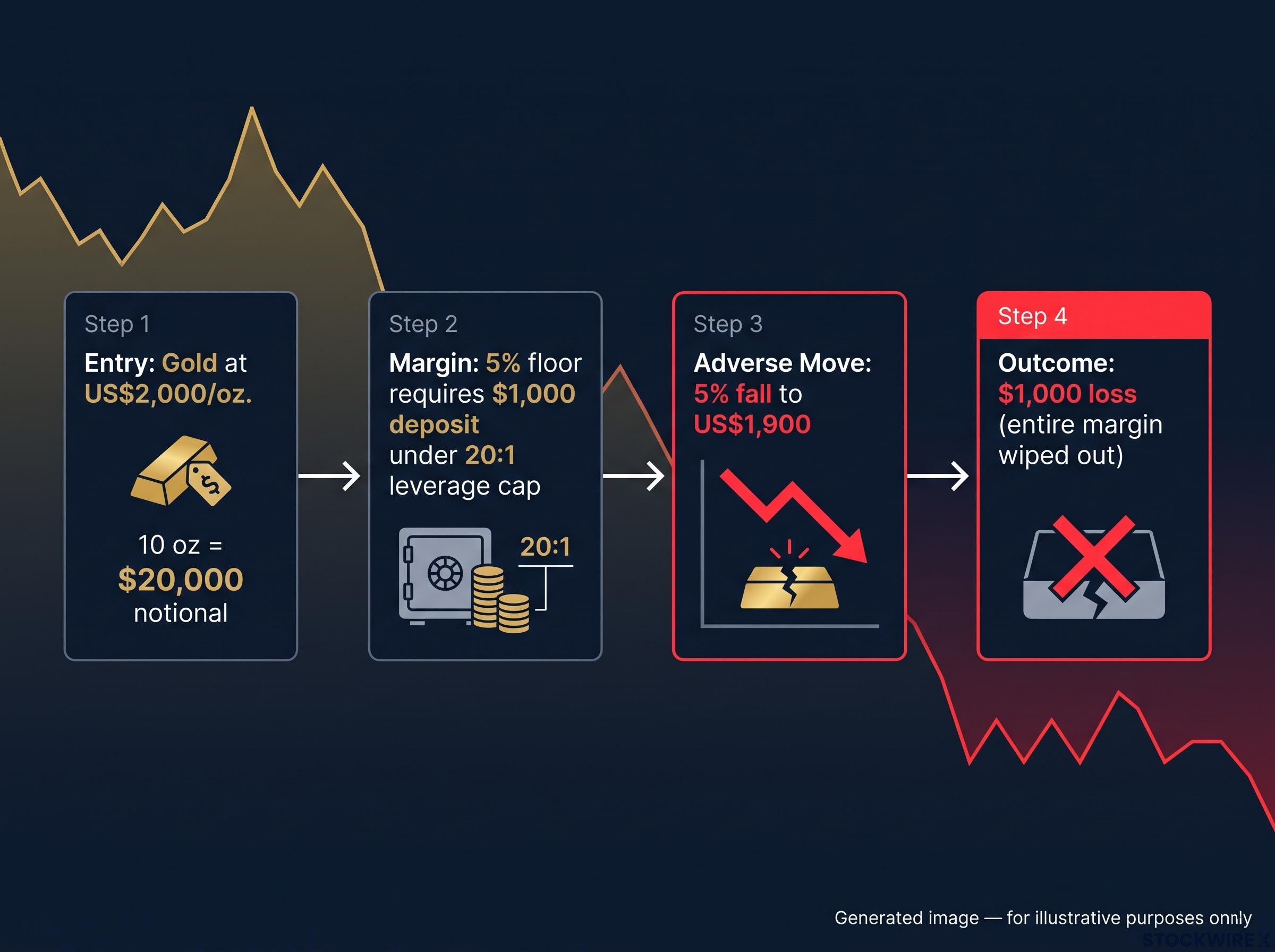
That is the mechanic most traders underestimate. At 20:1, a move that would barely register on an unleveraged holding erases your whole deposit. ASIC’s own Moneysmart guidance, last updated 14 May 2026, puts it plainly: leverage on CFDs can magnify both gains and losses. The magnification runs in both directions, but the account only has to hit zero once.
Position sizing is where you get to change the odds. You are not obliged to trade at the cap. Open a smaller position against the same account balance and you leave a buffer for adverse movement. Push to the 5% floor and you have almost no room before the position is underwater.
What margin close-out does and does not protect you from
The order embeds a margin close-out rule. When your margin falls to a specified threshold, the issuer is required to close your positions before the account balance reaches zero. It is automatic and mandatory.
What it is not is a way to walk away whole. By the time the close-out triggers, a substantial portion of your deposit can already be gone. The rule caps how far you fall, not how much you lose on the way down.
In gapping or fast-market conditions, the protection gets weaker still. The close-out is executed at the next available price, and if gold has jumped past the threshold level, that price can be materially worse than where the close-out was supposed to happen. Margin close-out stops your account going below zero. It does not stop the full deposit from being lost.
What gold CFD traders in Australia need to understand about leverage, risk, and the market
The 20:1 cap does not exist in a vacuum. It sits on top of a market that has its own amplifying properties, and understanding those is what separates sizing a position sensibly from sizing it by the number alone.
Gold CFDs priced as XAU/USD track a globally traded market that runs across multiple sessions and time zones. That continuous trading creates uneven liquidity windows. Order books thin out during off-peak hours, and thin books mean price can jump further when it moves, because there are fewer resting orders to absorb the flow.
Gold is also highly macro-sensitive. Central bank announcements, geopolitical shocks, and moves in the US dollar can produce sharp, rapid repricing. When you are holding a leveraged position through one of those events, the volatility and the leverage compound each other.
Here are the structural features that make gold a distinct risk environment:
- Liquidity windows: the Asian session is noted for lower gold liquidity, where thinner books amplify price jumps.
- Weekend gap risk: positions held over the weekend can open at a materially different price on Monday.
- Macro sensitivity: central bank decisions, geopolitical events, and dollar moves drive fast, large swings.
- Session-based volatility: liquidity and price behaviour vary predictably across the trading day.
This is not incidental to the leverage rule. In its consultation paper CP 322, ASIC proposed the leverage caps after finding that highly leveraged CFDs, including gold and index products, were causing significant retail client detriment, with leverage identified as a key driver of large and rapid losses. The 20:1 number was calibrated partly against exactly that pattern.
The professional tier throws the trade-off into sharp relief. Where retail clients are held to 20:1, eligible professionals can run up to 500:1 on gold, according to Vantage Markets, but without the retail protections that the lower tier guarantees. More leverage, less safety net.
The regulator’s own warning ASIC’s Moneysmart guidance describes CFDs as complex, high-risk products and warns that the leverage they carry can magnify both gains and losses.
The read for you is this: the cap reduces your maximum exposure, but it does not touch the underlying volatility of the instrument. A 20:1 position taken into a central bank announcement is still a dangerous position.
Stop-loss orders and negative balance protection, what the safeguards do and where they stop
Most traders treat a stop-loss as a guaranteed exit at a chosen price and negative balance protection as a promise they cannot lose more than they put in. Both beliefs are close enough to be dangerous.
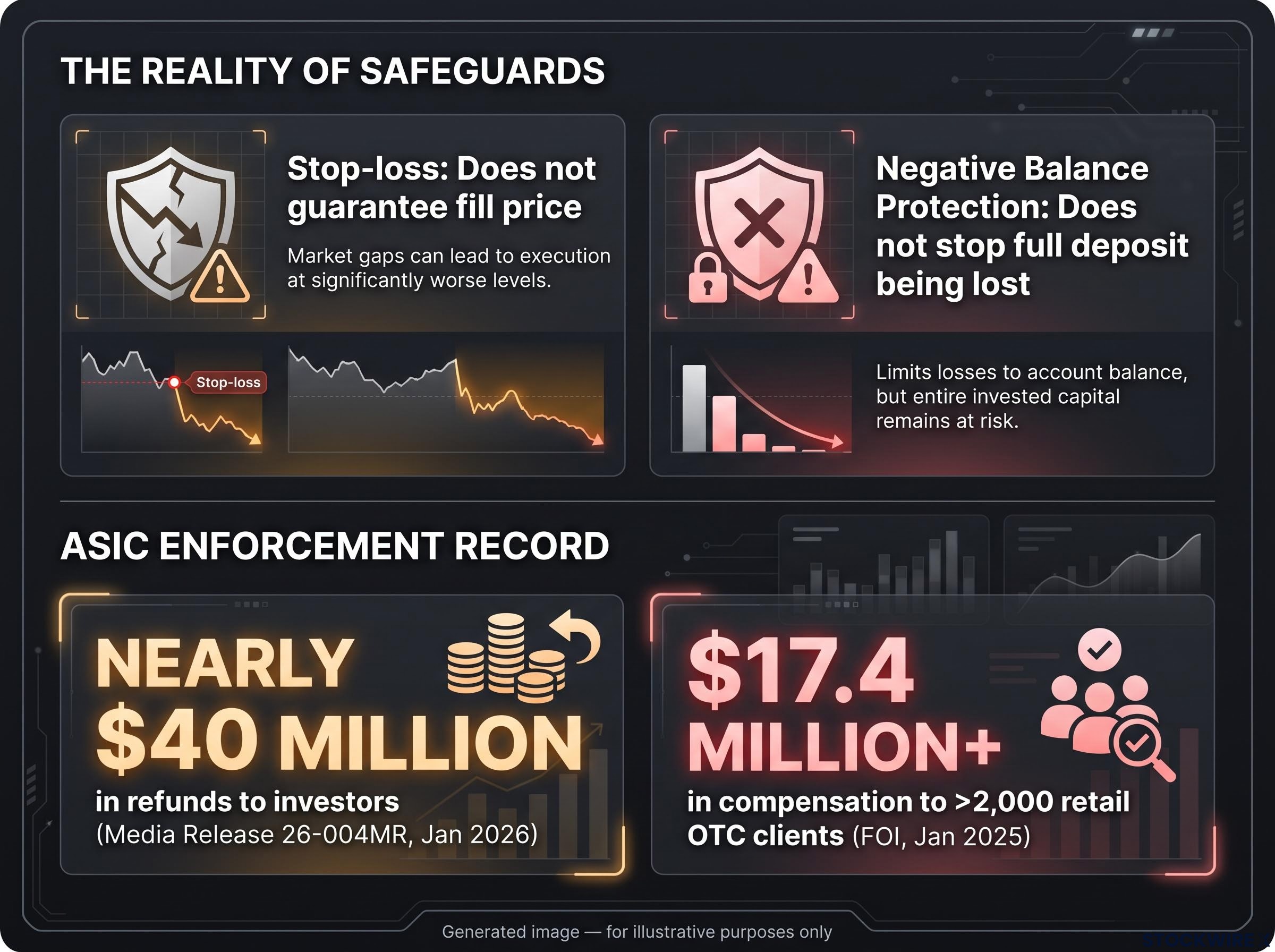
A stop-loss order is executed as a market order once the trigger price is reached. In normal conditions, the fill lands near your stop. In gapping or fast-market conditions, the next available price can be significantly worse than the level you specified, and you take the difference.
Slippage on gold CFD stops tends to cluster around specific conditions:
- Thin Asian session order books, where fewer resting orders mean larger price jumps when stops trigger.
- Major macro news events, where gold can gap straight over your stop level.
- Weekend gaps, where the market reopens at a price well away from Friday’s close.
- Simultaneous stop-triggering, where many accounts hit stops at once and sweep the order book, dragging the fill away from the nominal stop.
Negative balance protection is the other pillar. Under the product intervention order, retail CFD losses must be limited to the funds in the CFD trading account, so you cannot end up owing money beyond your deposit in that account. ASIC’s Moneysmart guidance, updated 14 May 2026, confirms that issuers must provide this so retail clients can never lose more than they invest.
The caveats are where traders get caught. The protection applies only to the CFD trading account, not to fees, interest, or other obligations. It does not stop your full deposit being lost. And it depends on the issuer actually complying, which the enforcement record shows is not guaranteed.
| Safeguard | What it guarantees / what it does not |
|---|---|
| Stop-loss order | Guarantees an attempt to exit at the trigger price. Does not guarantee the fill price; slippage can be significant in fast markets. |
| Negative balance protection | Guarantees you cannot owe more than your CFD account funds. Does not stop the full deposit being lost, and does not cover other fees or obligations. |
| Guaranteed stop-loss order (GSLO) | Guarantees exit at the specified level for a fee, transferring slippage risk to the issuer. Availability and conditions vary by broker. |
The gap between assumption and reality is not theoretical, and the numbers make that clear. ASIC secured nearly $40 million in refunds to investors after finding the CFD sector fell short, in media release 26-004MR of January 2026. Separately, FOI material shows ASIC oversaw more than $17.4 million in compensation to over 2,000 retail OTC derivative clients, last updated January 2025. Those figures are the distance between what traders expected the safeguards to do and what actually happened when markets moved and issuers fell short.
Negative balance protection, the contractual floor and its limits
The scope is narrower than it sounds. The protection covers the CFD trading account. It does not shield you from other fees, interest, or platform charges a provider may pursue under its terms.
There is also a solvency dependency. Negative balance protection is a contractual and regulatory obligation of the issuer, not a government-backed deposit guarantee. If the issuer becomes insolvent, recovery depends on client-money arrangements and insolvency law, not on the protection itself.
ASIC also flags a behavioural risk: the existence of the protection can encourage overconfidence and over-leveraging among traders who underestimate the chance of losing their whole deposit, even when they cannot go negative. The floor is not a substitute for sizing your positions yourself.
One mitigation worth knowing about is the guaranteed stop-loss order. Some brokers offer these for a fee, and unlike a standard stop, a GSLO transfers the slippage risk to the issuer, guaranteeing your exit at the specified level. Availability is limited and conditions vary.
Trading gold CFDs with the rules as they are, a realistic position before the next trade
Put the three layers together and the shape of the risk becomes clear. There is the market’s own volatility, unusually macro-sensitive and unevenly liquid. There is the leverage applied on top of it, capped at 20:1 but still capable of erasing a deposit on a 5% move. And there is the imperfect enforcement of the safeguards meant to contain the combined effect.
That last layer is the one traders forget. ASIC’s REP 828 recorded two issuers contravening leverage limits, and its Market Integrity Update Issue 161 from July 2024 documented issuers offering margin discounts that reduced close-out protection and required remediation. Non-compliant issuer practices can alter your effective leverage and protection without you ever knowing. Provider due diligence is part of your risk management, not a separate step.
Before you open a leveraged gold CFD position, work through these:
- Position size. How large is the position relative to your account balance, and how far can gold move against you before the deposit is gone?
- Event risk. Is a central bank decision, major data release, or weekend gap sitting inside your planned holding window?
- Provider compliance. Is your chosen issuer applying the product intervention order correctly, given ASIC’s enforcement record?
- Stop placement. Does your stop account for realistic slippage, or does it assume a fill at the exact trigger price?
The regulatory environment is stable for now. The product intervention order is confirmed until 23 May 2027, and ASIC is actively monitoring compliance. But stable rules and compliant execution are not the same thing, and the enforcement history is the proof.
Australia gives retail gold CFD traders more protection than most jurisdictions. Those protections are only as strong as the issuer applying them, which is exactly why the framework is a precondition for managing your own risk, never a replacement for it.
This article is for informational purposes only and should not be considered financial advice. Investors should conduct their own research and consult with financial professionals before making investment decisions.