
Across the European Union, the United Kingdom, and Australia, regulators with direct access to actual client account data report the same thing: between 68% and 89% of retail accounts trading leveraged products lose money. Not a slim majority. The overwhelming majority, documented under mandatory disclosure rules that brokers cannot opt out of.
That is not a statistic you can explain away with bad luck or a difficult market. If losing were random, the numbers would scatter. Instead they cluster, across different products, different platforms, and different decades. Something systematic is producing this.
That systematic thing is behavioral. The psychology of trading, specifically the repeating patterns of FOMO-driven entries, premature profit-taking, delayed stop-loss execution, and the mismatch between a trader’s temperament and their chosen approach, explains the gap far better than strategy quality or market access ever could. Here is what three decades of practitioner experience and regulators’ own account data reveal about where that gap actually sits, and what separates the accounts that survive from the ones that decay.
Why so many traders lose: the numbers regulators do not let brokers hide
Start with the source of the data, because it matters. These are not marketing figures or self-selected survey responses. They are mandatory disclosures required by law, calculated from real client accounts and published because regulators forced the issue.
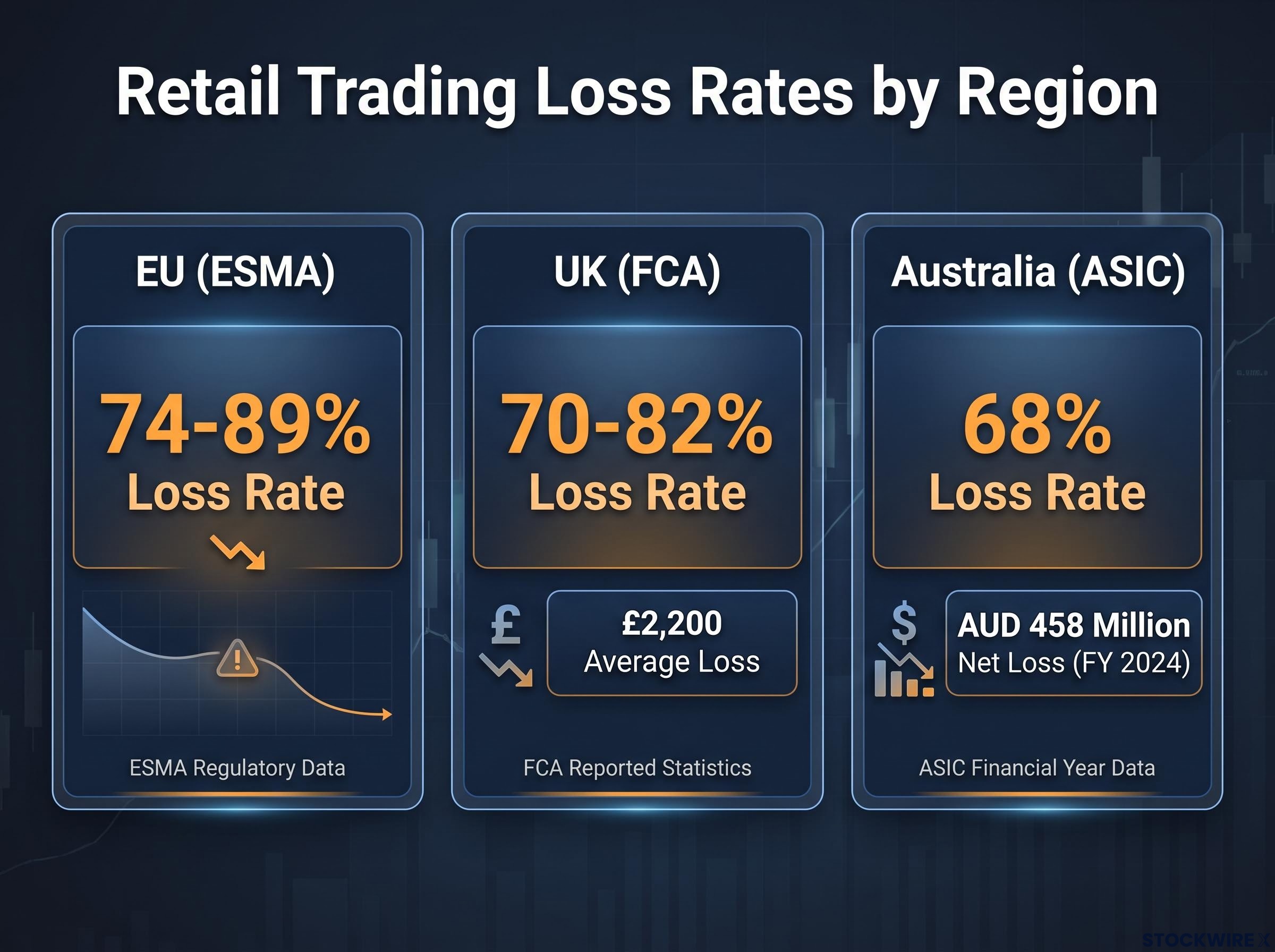
The European Securities and Markets Authority (ESMA) requires every CFD and forex broker in the EU to display the percentage of retail accounts that lose money. A contract for difference (CFD) is a leveraged product that lets you bet on price movements without owning the underlying asset. The standard warning states that 74-89% of those accounts lose money.
CFD leverage mechanics amplify this dynamic: at 10:1 leverage, a 5% adverse move produces a 50% loss on the margin deposit, meaning the emotional pressure described above arrives far faster and harder than it would in an unleveraged position.
In the UK, the Financial Conduct Authority (FCA) applies similar rules. Aggregated data points to roughly 70-75% of retail customers losing on CFDs and spread betting, and one FCA sample across eight firms found 82% of clients losing, with an average loss of around £2,200 per client.
Australia tells the same story. ASIC’s REP 828 recorded a 68% loss rate among retail CFD clients in the 2024 financial year.
ASIC REP 828, published in January 2026, provides granular account-level analysis across 133,674 retail CFD clients in Australia, giving the 68% loss rate and AUD 458 million net loss figure a documented empirical foundation rather than an estimated one.
The human cost behind the percentage ASIC found retail CFD clients in Australia lost more than AUD 458 million on a net basis in a single financial year, including significant fees. That is not a rounding error. It is the aggregate result of thousands of accounts following the same behavioral script.
The most recent aggregated picture reinforces the pattern. A 2026 synthesis of 49 EU and FCA-regulated brokers found 71.0% of retail accounts lose money, with a range of 51-81% and a median of 71.7%.
| Region | Regulator / Source | Loss Rate | Notes |
|---|---|---|---|
| EU | ESMA mandatory disclosure | 74-89% | Only 11-26% of accounts profitable consistently |
| UK | FCA aggregated data | 70-82% | Eight-firm sample: 82% losing, £2,200 average loss |
| Australia | ASIC REP 828 | 68% | Net losses over AUD 458 million, FY2024 |
| Global | 2026 synthesis, 49 brokers | 71.0% (median 71.7%) | Range 51-81%, based on 2024-2026 disclosures |
Look at the broker level and the consistency sharpens further. In 2024, IG reported roughly 68-70% of accounts losing, CMC Markets 68-76%, Pepperstone’s EU arm 72-75.6%, Plus500 76-80%, and eToro 51-79%.
Here is what that uniformity actually tells you. When the outcome barely moves whether you switch regulator, switch platform, or switch continent, individual explanation stops being credible. You cannot blame your own specific mistakes for a pattern that holds this steadily across millions of separate accounts. Something structural and behavioral is driving it, and that reframing is the honest starting point for doing anything about it.
When big ASX news breaks, our subscribers know first
The behavioral mechanics: how FOMO, loss aversion, and hope sabotage execution
If the losing is systematic, the next question is mechanical. What is the actual chain of decisions that produces it? Once you see the sequence laid out, you will likely recognise it, either from your own screen or from someone you have watched trade.
It usually begins with fear of missing out. FOMO is not a character defect; it is a documented behavioral bias with measurable consequences. It pushes traders into late entries on moves that have already run, into oversized positions, and into abandoning the stops and targets they set when they were calm. A 2025 paper in Gyan Management found that FOMO amplifies loss aversion, herding, and overconfidence, producing trend-chasing and lower risk-adjusted returns.
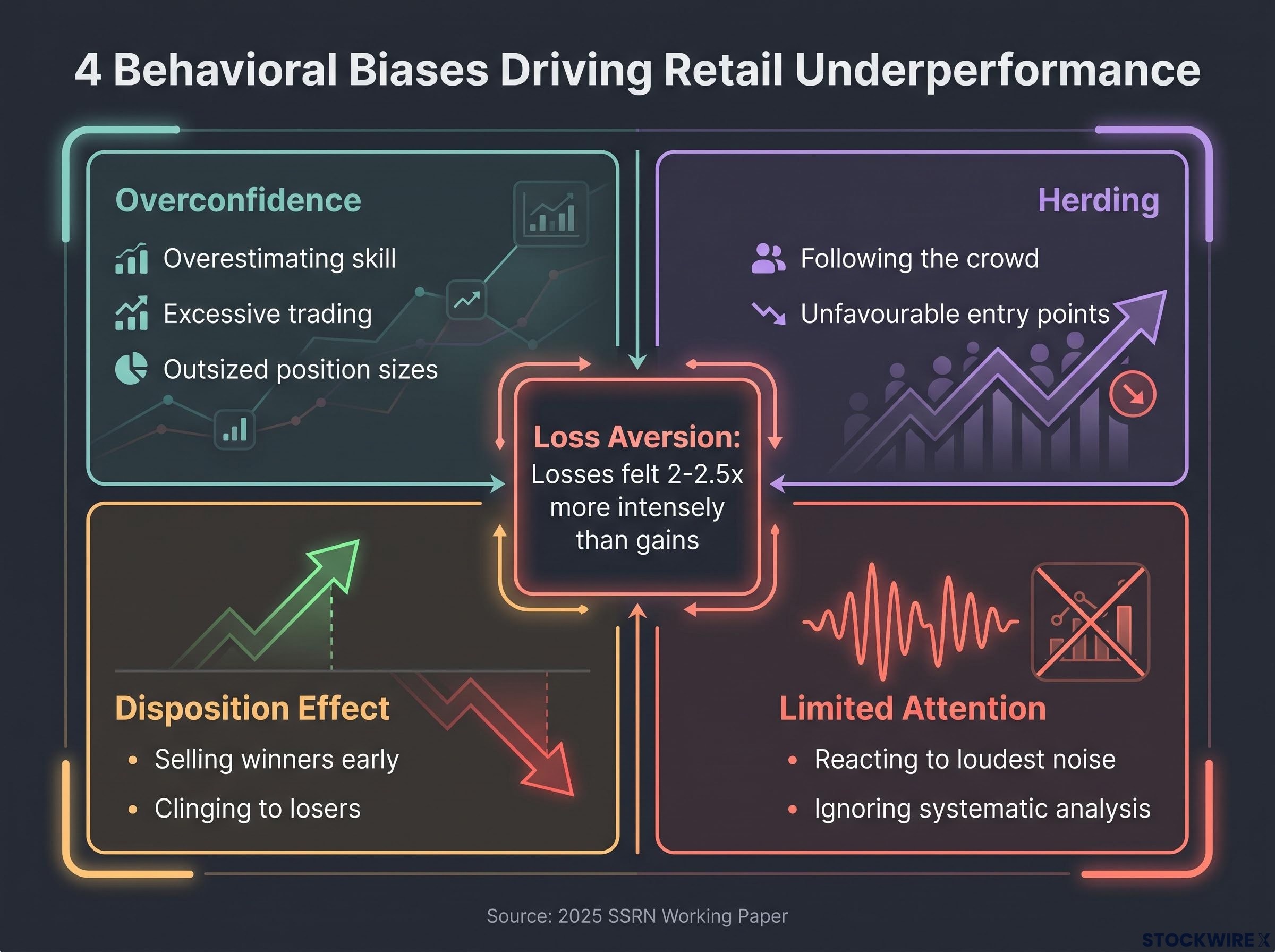
Then loss aversion takes over. The framework built by Barberis and Thaler on prospect theory establishes that people feel losses roughly 2-2.5 times more intensely than equivalent gains. That asymmetry is not trivial. It directly manufactures two opposite failure patterns from the same emotional root.
The first is taking profits too early, because a small gain feels safe and you want to lock it in before it evaporates. The second is refusing to cut a loss, because closing it makes the pain real. Together these produce the disposition effect: selling winners too soon and holding losers too long.
Sell-decision biases are so deeply embedded that a University of Chicago study found randomly selected exit points outperformed professional portfolio managers by up to 150 basis points annually, confirming that the exit problem is not unique to retail traders.
A 2025 SSRN working paper documents the four biases that drive retail underperformance most consistently:
- Overconfidence: overestimating your own skill, which leads to excessive trading and outsized position sizes.
- Herding: following the crowd into crowded trades at unfavourable entry points.
- Disposition effect: selling winners early and clinging to losers, the live-account expression of loss aversion.
- Limited attention: reacting to whatever noise is loudest rather than to systematic analysis.
An experienced trader with over 30 years in the markets identifies the same two culprits from the practitioner side: premature profit-taking and delayed stop-loss execution, both driven by psychological stress rather than any flaw in the underlying setup. Entering a market simply because prices are moving sharply after a high-impact data release, with no pre-planned setup, is singled out as one of the most common and expensive emotional mistakes.
What you should take from this is precise. These are not personality weaknesses you can willpower your way past. They are predictable cognitive mechanisms that operate on nearly everyone under financial stress, which is exactly why they produce such consistent loss rates across millions of otherwise very different people.
From first trade to blown account: how the emotional sequence unfolds
There is a documented lifecycle to this. ForexDetox’s account-level analysis describes it, and the 30-year practitioner account corroborates it independently.
It starts well. A few fortunate early trades build confidence, position sizes creep upward, and stop-loss discipline quietly loosens because it has not yet been needed. Then a single leveraged position moves sharply against the trader, and because the stop was never respected, the loss dwarfs anything the earlier wins produced.
That one move often defines the whole year’s result. Confidence turning into overconfidence, and hope preventing a stop from firing, is how a healthy account becomes a statistic.
What profitable traders actually do differently
The contrast between losing and profitable traders is not a matter of talent or temperament in the inspirational sense. It is operational, specific, and repeatable, which means it is something you can actually copy.
The single defining characteristic of consistently profitable traders, according to the same 30-year practitioner source, is that they pre-define everything before the trade goes on. Entry point, invalidation level, and profit target are all set in advance, then followed without deviation once the emotional pressure of a live position arrives.
Compare that to the losing pattern in one line.
Losing traders enter on FOMO and exit on hope. Profitable traders enter on a plan and exit on a plan.
The tools that make this real are not motivational accessories. Non-negotiable stop-loss orders, trade journaling, and pre-planned execution are the practical machinery that operationalises discipline, as Plancana’s 2025 guide sets out. The logic is simple: a plan made outside a live session is not exposed to the emotional distortions that operate during one.
Here is the checklist profitable traders run before every trade:
- Define the entry point.
- Set the invalidation level (the stop-loss where the trade idea is proven wrong).
- Set the profit target.
- Calculate position size relative to the risk on that trade.
- Execute, and do not deviate.
That last point does not mean rigid inflexibility. Rule-based trading still allows for adjustments, but the right kind: evidence-based changes made outside live sessions, when you are calm and reviewing data. Ad hoc changes made in the heat of a moving market are precisely the behavior that blows accounts.
The honest caveat matters too. Discipline is necessary, but it is not a cure-all. No amount of plan-following will rescue a strategy with negative expectancy, meaning one that loses money on average over many trades, or overcome the spread and fee drag baked into leveraged products.
What all of this tells you is liberating in its own way. The difference between profitable and unprofitable is not access to better information or a rarer kind of intelligence. It is the presence or absence of a pre-committed plan that removes the decision from the live emotional environment, and that is a skill, not a birthright.
The factors psychology alone cannot fix: style fit, program rules, and statistical edge
Pure mindset frameworks tend to stop at discipline. That leaves out parts of the puzzle that can sink you even when your psychology is sound, which is why leaving them out gives false comfort.
The first is temperament-style compatibility. Attempting an approach that is structurally at odds with your psychological makeup, high-frequency scalping when your temperament suits longer holding periods, for example, generates chronic pressure that amplifies every emotional error already described. The 30-year practitioner notes that swing trading (targeting price moves lasting several days to several weeks, holding overnight, using both technical and fundamental analysis) can reduce that pressure for temperamentally suited traders, allowing wider margins and calmer stops.
Checking program compatibility before the first trade
The second structural trap is program rule incompatibility, and it is badly underappreciated. Picture a swing trader who takes on a funded account challenge with a maximum daily drawdown that cannot absorb an overnight gap. The strategy might be sound and the discipline flawless, yet the account fails on a rule mismatch alone.
This check belongs before you enter a program, not after the losses have already landed. Confirm that the drawdown limits, overnight holding restrictions, and timing rules actually fit how you trade, because no amount of discipline overrides a rule you were always going to break.
Then there is the edge itself. Psychology coaching is a necessary but not sufficient condition for success; discipline cannot generate profit from a strategy with negative expectancy or overcome the consistent spread and fee friction of leveraged products. Honest assessment of your statistical edge must sit alongside the psychological work, not replace it.
Trading expectancy, calculated as win rate multiplied by average win minus loss rate multiplied by average loss, is the metric that reveals whether a strategy has a genuine mathematical edge before behavioral discipline even enters the picture.
Finally, watch for survivorship bias. Social media and marketing amplify the small minority of spectacular winners, while the ESMA and FCA data describe the full population, where 74-89% lose. If your benchmark is the visible success stories rather than the documented majority, you are measuring yourself against a distortion.
Before attributing your losses primarily to psychology, work through these four questions:
- Does my strategy have demonstrable positive expectancy?
- Does my trading style match my temperament and risk tolerance?
- Are my program or account rules compatible with how I actually trade?
- Am I comparing my results to the full population, or to survivorship-biased success stories?
The complete question is never just “how do I become more disciplined?” It is also whether the strategy is genuinely profitable, whether the style fits the person, and whether the rules fit the approach.
Building a practice that psychological discipline can actually support
Pull the thread together and the core distinction lands in one formulation. Profitable trading is not about eliminating emotion, which is impossible, but about removing live emotional decision-making from execution through plans committed to before the session begins.
Your next practical step is a three-part diagnostic, run before you change anything else. Verify that your strategy has a genuine statistical edge. Confirm that your style aligns with your temperament. Check that your program rules are compatible with how you actually trade.
Be honest about the structural reality too. Even with sound psychology, disciplined execution, and a compatible approach, the products and markets impose real friction through spreads, fees, and leverage. Psychological work is necessary, but it operates inside those constraints, not above them.
What consistently profitable traders share is not superior intellect or privileged access. It is a repeatable process, applied without deviation, reviewed honestly, and adjusted only on evidence, never on emotion.
For readers who have addressed the behavioral and structural checks and want to evaluate whether their entry signals have genuine statistical weight, our full explainer on building a multi-factor technical edge examines how combining indicators from independent analytical families raises trade probability estimates from roughly 60% with one factor to approximately 85% with three.
This article is for informational purposes only and should not be considered financial advice. Investors should conduct their own research and consult with financial professionals before making investment decisions. Past performance does not guarantee future results, and trading leveraged products carries a high risk of loss.