On 8 September 2026, while Micron Technology shares sat at exactly $1,000.26, three separate parties quietly placed roughly $3.51 million in combined options premium on the same directional bet: that MU was heading sharply higher before the end of November. They used three completely different instruments to do it.
With Micron’s fiscal Q4 2026 earnings scheduled for 30 September 2026, the options market was already pricing in elevated volatility. Sophisticated traders do not simply buy stock when they hold conviction ahead of a binary event like earnings. They engineer their exposure, choosing structures that match their risk tolerance, timeline, and return expectations.
Here is a field guide to the three trades, written so you can follow the logic each trader was running. This decodes the mechanics behind two short put sales and one aggressive long call, the risk-and-reward math for each, and what the full picture reveals about how institutional money expresses directional conviction without buying a single share.
Two short put sales and the $1.21 million case for Micron staying above $990
Start with the seller’s chair. Premium lands in your account the moment the trade fills, and from there the only job is to watch the clock run down while the stock behaves.
Two of the three MU trades were exactly this: short puts. Selling a put means you collect cash upfront in exchange for the obligation to buy the stock at a set price if it falls. You want the stock to stay flat or rise. That is a bullish-to-neutral stance, not a bearish one, which is where the instrument’s name misleads most people.
The mechanics behind both short put trades share the same foundation as cash-secured puts, where reserved capital backstops the obligation to buy shares at the strike and the premium collected reduces your effective cost basis from day one.
The first put sale, expiring 11 September 2026, carried a $1,000 strike and collected roughly $704,000 in premium. With just three days to expiration and the strike sitting almost exactly on the stock price, this was the more aggressive of the pair. The seller needed MU to hold the round-number $1,000 line for 72 hours to keep the full premium.
What assignment risk actually means at these strikes
If MU closes below the strike at expiration, the seller is obligated to buy 100 shares per contract at that strike, regardless of where the market is trading. Sell the $1,000 put and MU finishes at $960, and you are buying shares at $1,000 while the market values them at $960.
At $1,000 or $990 on a stock that closed at $1,000.26, assignment is a live possibility, not a distant tail risk. That is exactly why the probability figures matter. A 67% chance of expiring worthless also means a 33% chance of assignment. These numbers describe a real coin-weighting, not a comfort blanket.
The second put sale, expiring 18 September 2026, used a $990 strike and collected roughly $507,000, with an estimated 60% probability of expiring worthless. It is structurally identical to the first but with two adjustments: a ten-day runway instead of three, and a strike sitting slightly below the stock price, giving the seller a small cushion before assignment risk bites.
| Expiry Date | Strike Price | Premium Collected | Days to Expiration | Probability of Expiring Worthless |
|---|---|---|---|---|
| 11 September 2026 | $1,000 | ~$704,000 | 3 | ~67% |
| 18 September 2026 | $990 | ~$507,000 | 10 | ~60% |
Here is the detail that reframes both trades. Both expiries fall before the 30 September earnings date. That tells you these sellers are not taking a view on the Q4 report at all. They are betting that near-term price support holds, collecting elevated premium while implied volatility runs hot into earnings, and planning to be out of the trade entirely before the binary event lands. The combined $1.21 million is a wager on stability, not on a beat.
When big ASX news breaks, our subscribers know first
The $2.3 million call bet that needs Micron to break its all-time high
$2.3 million. All of it at risk. That is what the third trader paid for a single directional call, and unlike the put sellers, this buyer has every dollar exposed to loss.
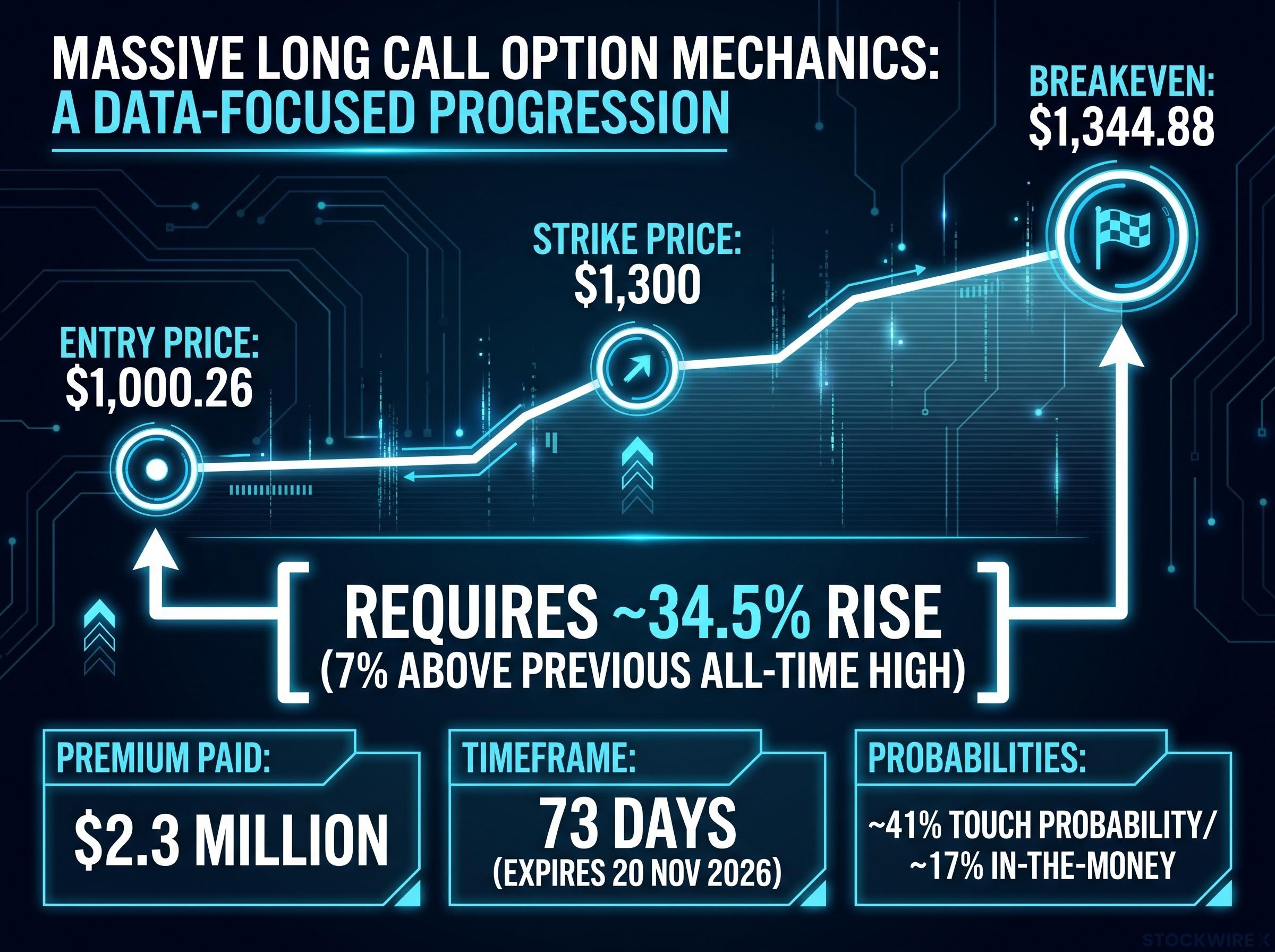
The trade is a 20 November 2026 call at a $1,300 strike. Buying a call gives you the right to purchase the stock at the strike, so your profit grows as the stock climbs above it. The structure is the mirror image of the short puts: maximum loss is defined and capped at the premium paid, upside is theoretically unlimited, but the stock has to move meaningfully in the right direction, and it has to do it inside 73 days.
Now the math that earns this trade the label “aggressive” rather than merely “bullish.” Implied volatility sat near 70% at entry, and the probability of the option expiring in the money was roughly 17%, about a one-in-six shot. The touch probability, meaning the chance MU reaches the $1,300 strike at any single point before expiry, was around 41%.
Implied volatility sat near 70% at entry, a level that inflates premium dramatically relative to lower-volatility regimes; the nonlinear relationship between implied volatility and dollar premium is why the $2.3 million figure is not simply a function of position size but of the volatility environment in which it was placed.
To read that gap correctly: the market priced full success as a long shot, but the touch probability tells you the buyer is counting on volatility opening a window near the strike, even if the stock cannot hold there when the contract expires.
The reference point that makes the $1,300 strike legible is Micron’s previous all-time high of $1,255, reached on 25 June 2026. The strike sits roughly 27.5% above the entry price of $1,000.26. Factor in the premium paid and the breakeven climbs further still.
At $1,344.88, the November $1,300 call becomes profitable at expiration. That is roughly 34.5% above where Micron traded when the position was opened, and about 7% beyond the stock’s previous all-time high.
So the buyer is not simply betting on a new record. They are betting on a move well past it. For this trade to pay at expiration, three separate conditions have to align:
- Direction: the stock has to rise, not drift or fall.
- Magnitude: it has to clear $1,344.88, not just touch a new high.
- Timing: all of it has to happen within 73 days, before 20 November.
Miss on any one of those and the entire $2.3 million evaporates. That is the core trade-off of a long call: you accept a low probability of full profit in exchange for a capped, known downside and explosive upside if the thesis fires at the right moment. No other capital is at risk, but every dollar of that premium is.
Why the AI memory supercycle makes a $1,300 Micron target seem less extreme than it looks
You have the mechanics. Now for the story that makes an otherwise outlandish price target feel internally consistent to the people placing these bets.
Start with the run that got MU here. Between 31 March 2026 and 25 June 2026, the stock rose roughly 176%, climbing from $311.49 to $1,255. Over 12 months it gained about 673%, with a year-to-date return near 256% and a 52-week range spanning $131.56 to $1,255.00. Against that trajectory, $1,000 reads as a resting point rather than a ceiling.
The engine behind the re-rating is high-bandwidth memory (HBM), the specialised memory stacked next to AI accelerator chips to feed them data fast enough. Three data points frame the demand picture:
- HBM and HBM3E capacity is completely sold out through calendar 2026.
- HBM revenue approached $2 billion in fiscal Q4 2025 alone, an annualised run-rate near $8 billion.
- Management projects the HBM total addressable market will reach $100 billion by 2028, growing at roughly a 40% compound annual rate.
The financials underneath are moving in step. Micron reported fiscal Q4 2025 revenue of $11.32 billion, up from $7.75 billion a year earlier. Full-year fiscal 2025 revenue reached $37.4 billion, up 49% year over year at a 41% gross margin.
When the highest-margin product line is sold out through year-end and already running near $8 billion annually, a $1,300 target stops looking like a moonshot. It becomes a bet that the current supply-demand imbalance survives one more earnings cycle intact.
What the analyst consensus actually says
Wall Street’s positioning corroborates the flow rather than contradicting it. MarketBeat data covers 38 analysts with 35 Buy ratings, 3 Hold, and zero Sell, average targets clustering near $1,261 to $1,269. S&P Global data across 48 analysts shows a Strong Buy consensus with a higher average target around $1,513.
The outliers sit at the high-conviction end of the distribution: UBS at $1,625 and Cantor Fitzgerald with a Street-high $2,000. Treat those as the aggressive tail, not the base case. Fitch also upgraded Micron’s long-term rating from BBB to BBB+ with a Stable outlook in May 2026, a credit-side vote of confidence.
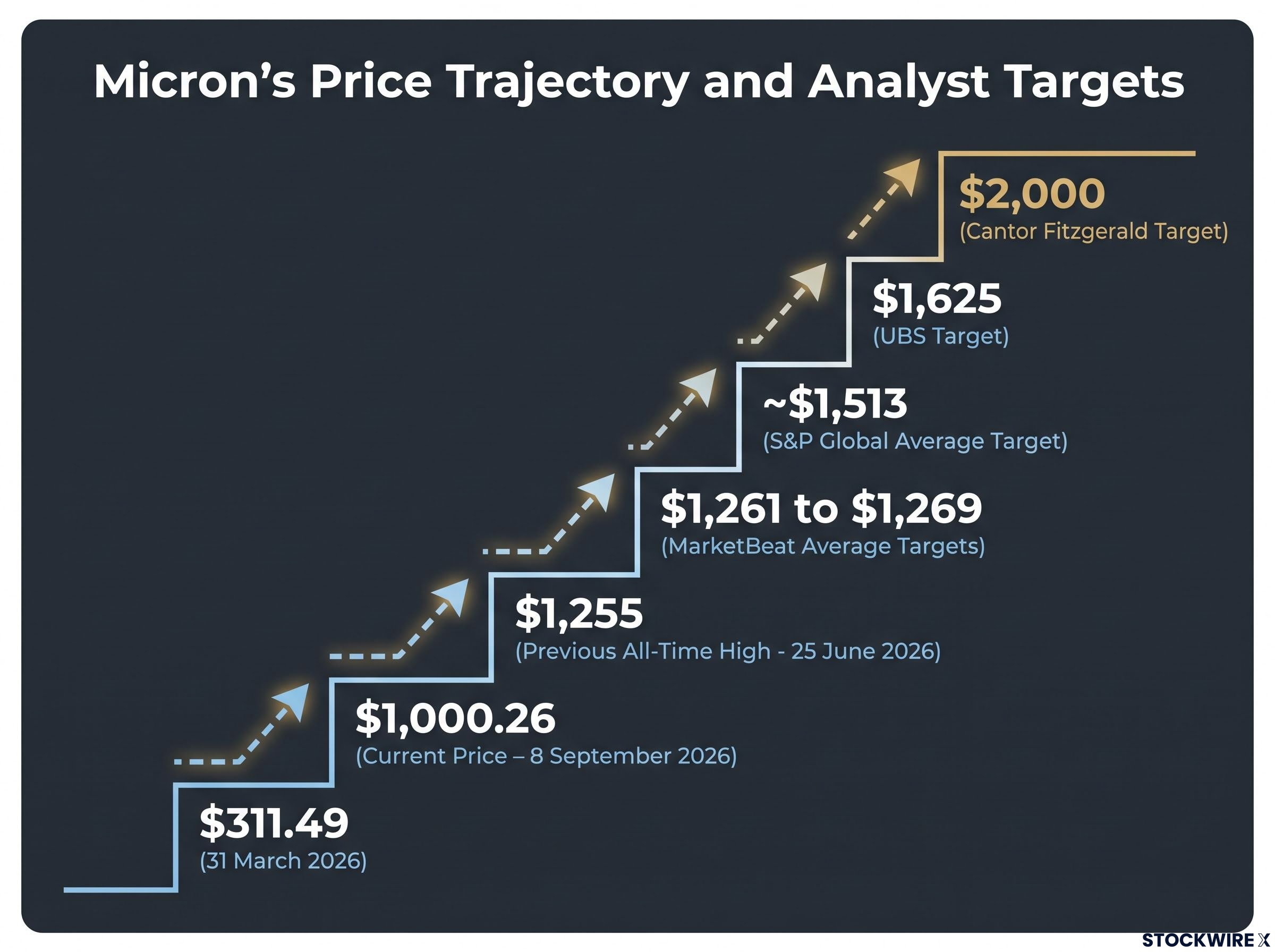
What this gives the options flow is context. This is not stray noise. It is a coherent institutional view, expressed through derivatives, that the AI memory cycle has further to run.
Short puts versus long calls: the same bullish thesis, three completely different risk structures
Here is what makes this case study worth your time. Three traders, one directional view, three risk-reward geometries that are almost opposites of each other.
The short put sellers collected premium upfront, carry a higher probability of profit, and win if MU rises, trades sideways, or even slips slightly. In exchange, their upside is strictly capped, the positions tie up meaningful margin collateral, and they carry assignment risk if the stock collapses through the strike.
The long call buyer paid premium upfront, carries a lower probability of profit, and needs a genuine move to win. In exchange, the downside is strictly limited to the premium, there is no assignment risk, and the upside is theoretically unlimited.
| Structure | Premium Direction | Max Gain | Max Loss | Probability of Profit |
|---|---|---|---|---|
| Short puts (x2) | Collected (~$1.21M) | Capped at premium ($704K + $507K) | Strike minus premium per share on assignment | Higher (~60-67%) |
| Long call | Paid (~$2.3M) | Unlimited above ~$1,344.88 | Full $2.3M premium | Lower (~17%) |
Two forces separate these structures further: theta and IV crush. Theta is the daily erosion of an option’s value as expiration approaches. IV crush is the sharp drop in implied volatility that typically follows an earnings release. Both work for the put sellers, who profit as time passes and volatility deflates. Both work against the call buyer, who is fighting decay and a post-earnings volatility collapse.
Theta and IV crush are the two forces most hostile to the long call buyer’s position, and they compound: theta erodes premium daily while IV crush after the earnings print can wipe a significant portion of residual extrinsic value in a single session, even if the stock moves in the right direction.
The short put seller earns the same maximum profit whether Micron rises 2% or 200%. The long call buyer earns nothing from a 2% move and everything from a 200% one.
The combined $3.51 million is not consensus of method. It is diversity of approach. One camp is collecting rent on a bet that the stock stays put; the other is buying a lottery ticket with better-than-lottery odds and a defined cost of entry.
The practical takeaway is for you. Most retail traders reflexively buy calls when bullish, without asking whether a short put might deliver a better risk-adjusted outcome for their specific thesis. Watching the same view expressed both ways, side by side, is the clearest way to work out which structure actually fits your own risk appetite.
What the $3.51 million in MU options flow tells you before September 30
Pull the three trades together and the signal sharpens. This is not monolithic bullishness. It is a portfolio of conviction expressed at three different risk tolerances, and that structural spread is itself a marker of institutional seriousness rather than retail excitement.
The bull thesis is discounting real risks, and knowing what they are tells you what the traders have chosen to look past:
- China export-control exposure: China banned Micron products in critical infrastructure in May 2023, putting roughly half of its China-headquartered business at risk and dragging on total revenue by a low-to-high single-digit percentage, potentially into low double digits.
- Memory market cyclicality: memory has always been boom-and-bust, with capacity expansions eventually overshooting demand and compressing margins.
- HBM execution risk: shifting output toward HBM ties up capacity at roughly a 3:1 ratio versus standard DDR5, and any cooling in AI build-outs could leave that capacity stranded.
Between now and the earnings call, three variables are worth watching:
- Whether MU holds the $990 to $1,000 support band through 18 September, which decides the fate of both short puts.
- Q4 revenue and, more importantly, HBM guidance on the 30 September call.
- How the November call premium behaves in the days immediately after the report.
Here is the near-term test. If both short puts expire worthless on 11 and 18 September, the sellers pocket $1.21 million with no further capital at risk, before the earnings report even arrives. That outcome, as much as the Q4 numbers themselves, is the first real check on whether the structural bull thesis is holding.
For readers wanting to understand how traders exploit the IV differential between pre-earnings and back-month options, our dedicated guide to calendar spreads around earnings walks through the exact structure and go/no-go thresholds used to assess whether the front-to-back volatility inversion is wide enough to trade.
This article is for informational purposes only and should not be considered financial advice. Investors should conduct their own research and consult with financial professionals before making investment decisions.
Past performance does not guarantee future results. Financial projections are subject to market conditions and various risk factors, and the probability and breakeven figures discussed here are estimates that can change with volatility and price. These statements are speculative and subject to change based on market developments and company performance.