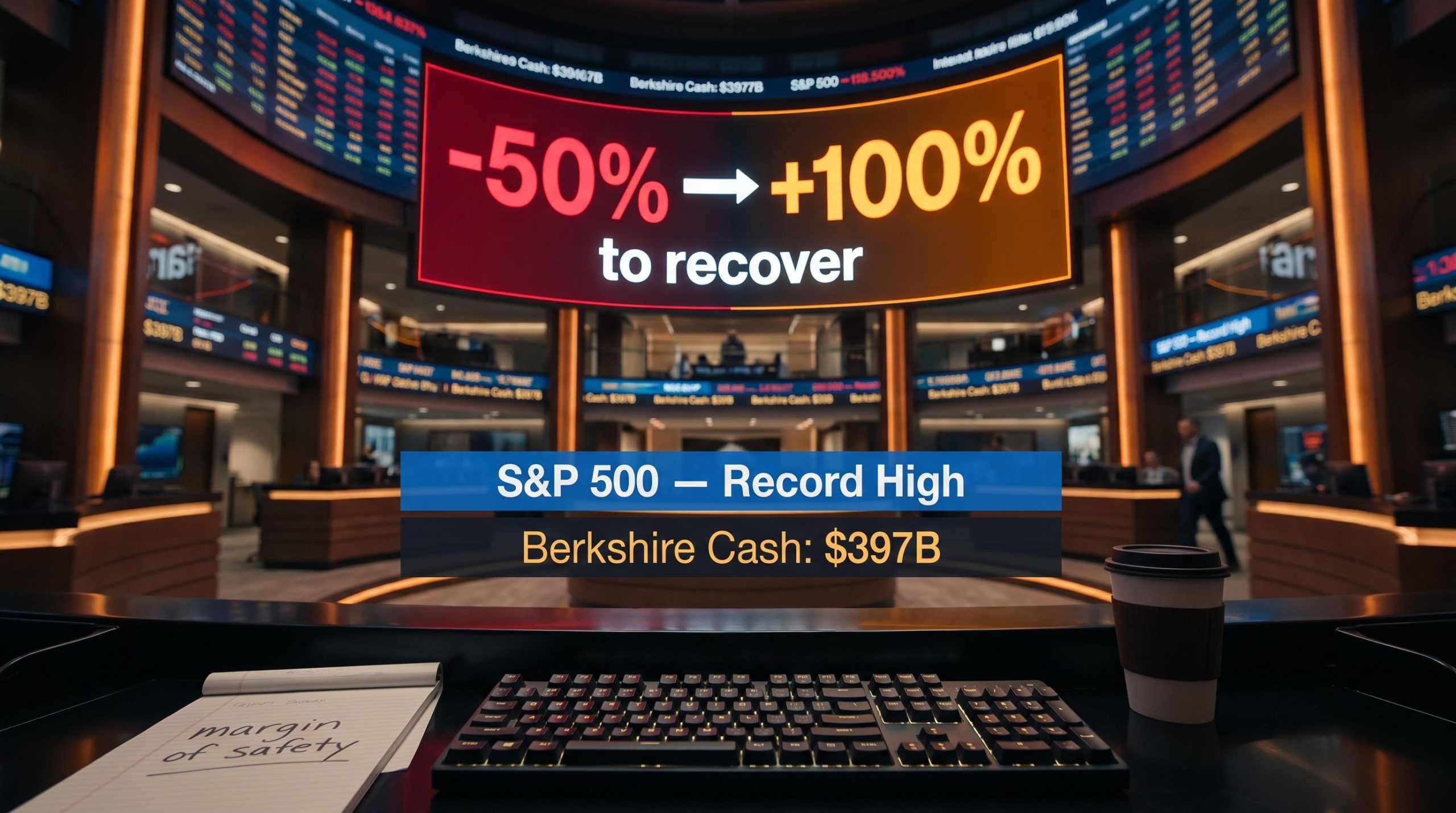
A 50% decline in your portfolio requires a 100% gain just to get back to where you started. Not a 50% gain. A 100% gain. That single piece of arithmetic should change how you think about every investment decision you make, because it means the most important question is not which stock to buy next; it is what could permanently destroy the capital doing the buying.
The timing makes this worth your attention right now. The S&P 500 is trading at record highs. AI-driven momentum is drawing direct comparisons to the dot-com era. And Berkshire Hathaway is sitting on approximately $397 billion in cash and Treasury bills, a posture that tells you something about the discipline required to sit out euphoria rather than chase it.
Here is what this piece gives you: a clear framework for identifying the two structural forces most likely to turn a temporary market setback into a permanent loss, and a set of concrete rules you can apply to your own portfolio today to guard against both.
The one rule that separates a recoverable loss from a permanent one
A stock price falling 40% is not a permanent loss. It feels like one, and it looks like one on your brokerage statement. But a loss only crystallises into something permanent at the point where you have no choice but to sell.
This is the distinction that separates investors who survive drawdowns from those who do not. According to Warren Buffett’s longstanding public guidance, a price decline results in permanent loss only when the investor is forced to liquidate. Owning a quality business outright gives you the one tool that markets cannot take away: time, and the ability to wait for rationality to return.
The Buffett principle: A price decline only becomes a permanent loss when the investor is forced to sell. Owning assets outright preserves the option to wait.
The corollary is where the real danger lives. Anything that removes your ability to wait, anything that forces you to act during peak stress, structurally converts ordinary volatility into capital destruction. Three forces do this most reliably:
- Margin calls: Your broker can force you to sell at the worst possible moment, regardless of whether you believe the business is fundamentally sound.
- Loan repayment obligations: Interest and principal payments continue regardless of what the market is doing, draining cash when you need it most.
- Over-concentration without a cash buffer: If your entire financial position depends on the portfolio recovering quickly, you have no room to wait.
Berkshire’s $397 billion cash position is the live illustration. That is not idle capital. It is optionality, the structural ability to act when opportunities appear rather than react when stress demands it.
Your most valuable asset in a downturn is not your stock picks. It is whether your financial structure allows you to do nothing. Building for that optionality is itself an active, strategic decision.
When big ASX news breaks, our subscribers know first
How borrowed money turns a bad month into a permanent setback
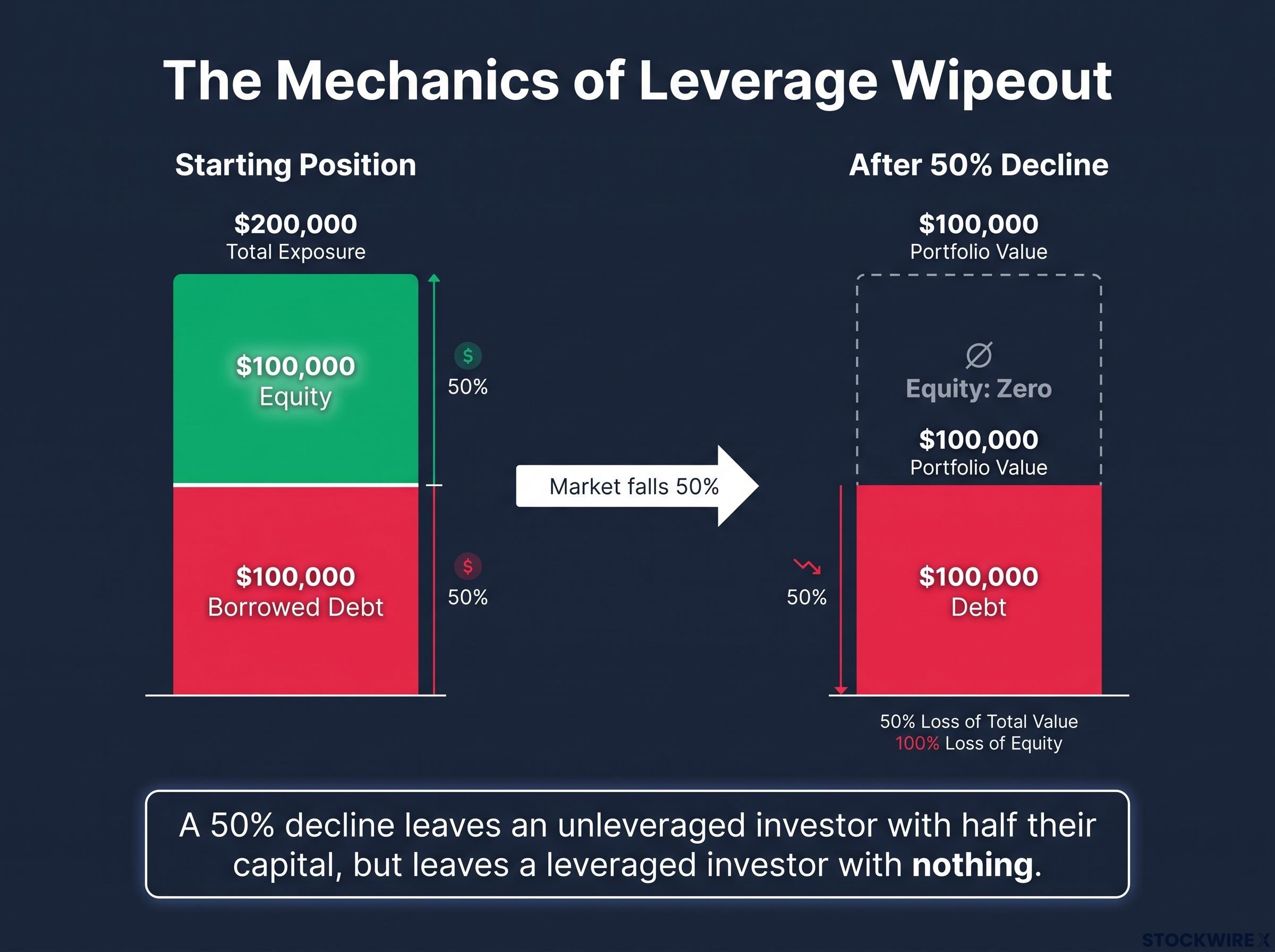
The mechanics of leverage are straightforward at the start and punishing at the end. Start with a $100,000 portfolio. Borrow another $100,000 to invest, giving you $200,000 in exposure. Your equity is $100,000; your debt is $100,000.
Now the market falls 50%. Your portfolio drops to $100,000. But the debt does not decline alongside the asset. You still owe $100,000. Your equity has gone from $100,000 to zero. The same 50% decline that leaves an unleveraged investor with half their capital leaves you with nothing.
In practice, it often gets worse than that. The sequence tightens around you in stages:
- The asset declines. A broad market correction, sector rotation, or company-specific event pushes prices down.
- Your equity falls faster than the asset. Because the debt is fixed, every dollar of decline comes directly out of your equity. A 25% decline in the asset can mean a 50% decline in your actual stake.
- The margin call arrives. Your broker demands additional cash or securities. This happens during peak market stress, precisely when raising cash is hardest and selling is most painful.
- Forced sale at the low. You sell at distressed prices, locking in a loss that a patient, unleveraged investor could have simply waited through.
Throughout this sequence, interest and principal payments continue regardless of portfolio performance. You face simultaneous asset depreciation and cash drain. Regulatory and investor education bodies consistently characterise borrowing to invest as very risky and not suitable for most individuals.
As Buffett has framed it publicly: capable investors have no need for leverage, while less capable investors cannot afford its risks.
Margin debt warning signals from the broader market reinforce the structural case against leverage at the individual level: total margin debt reached a record $1.416 trillion in May 2026, up 54% year-over-year, breaching both Leuthold Group thresholds that preceded the dot-com crash and the 2008 financial crisis.
For you as a retail investor using margin, a garden-variety bear market correction does not give you the option to wait. It makes that decision for you, usually at the worst possible moment.
Four rules for keeping leverage risk manageable
These are not abstract principles. They are stress-test questions you can apply to your own situation today.
- Avoid or strictly limit margin exposure. Could you survive a 30-50% drawdown in your leveraged positions without triggering a forced sale or threatening your broader finances? If not, reduce.
- Never rely on the leveraged investment itself to service debt obligations. If the only way you can make loan payments is by selling the investment, your structure is already fragile.
- Maintain a cash buffer that covers living expenses and debt payments independently of the portfolio. This is what lets you wait through stress instead of selling through it.
- Never pledge core assets as collateral for speculative positions. Home equity, retirement funds, and similar assets should not be on the line for market bets.
What the dot-com era teaches about paying the wrong price for the right company
The investors who lost the most money during the dot-com crash were not wrong about the technology. The internet was genuinely transformative. Many of the companies that fell 80-90% from their peaks survived, recovered, and eventually dominated their industries.
The investors were wrong about the price.
At peak valuations in the late 1990s, technology companies traded at hundreds of times earnings. The narrative was powerful, the adoption was real, and the future these companies were building turned out to be more or less correct. None of that mattered for the investor who bought at the top. Being directionally right about the technology and wrong about the price still destroyed capital.
The core principle: A great company can be a terrible investment at the wrong price. Whether you own a wonderful business and whether you have made a wonderful investment are two entirely separate questions, and the price you paid is the only thing that separates them.
Consider two investors in 1999, both convinced that the internet would reshape commerce:
- Investor A bought at peak multiples during the euphoria. Even in companies that survived, they sat through 80-90% drawdowns and, in many cases, waited a decade or more to break even.
- Investor B held cash through the mania, then bought the same businesses at rational valuations in 2002-2003. They captured the same long-term transformation at a fraction of the price.
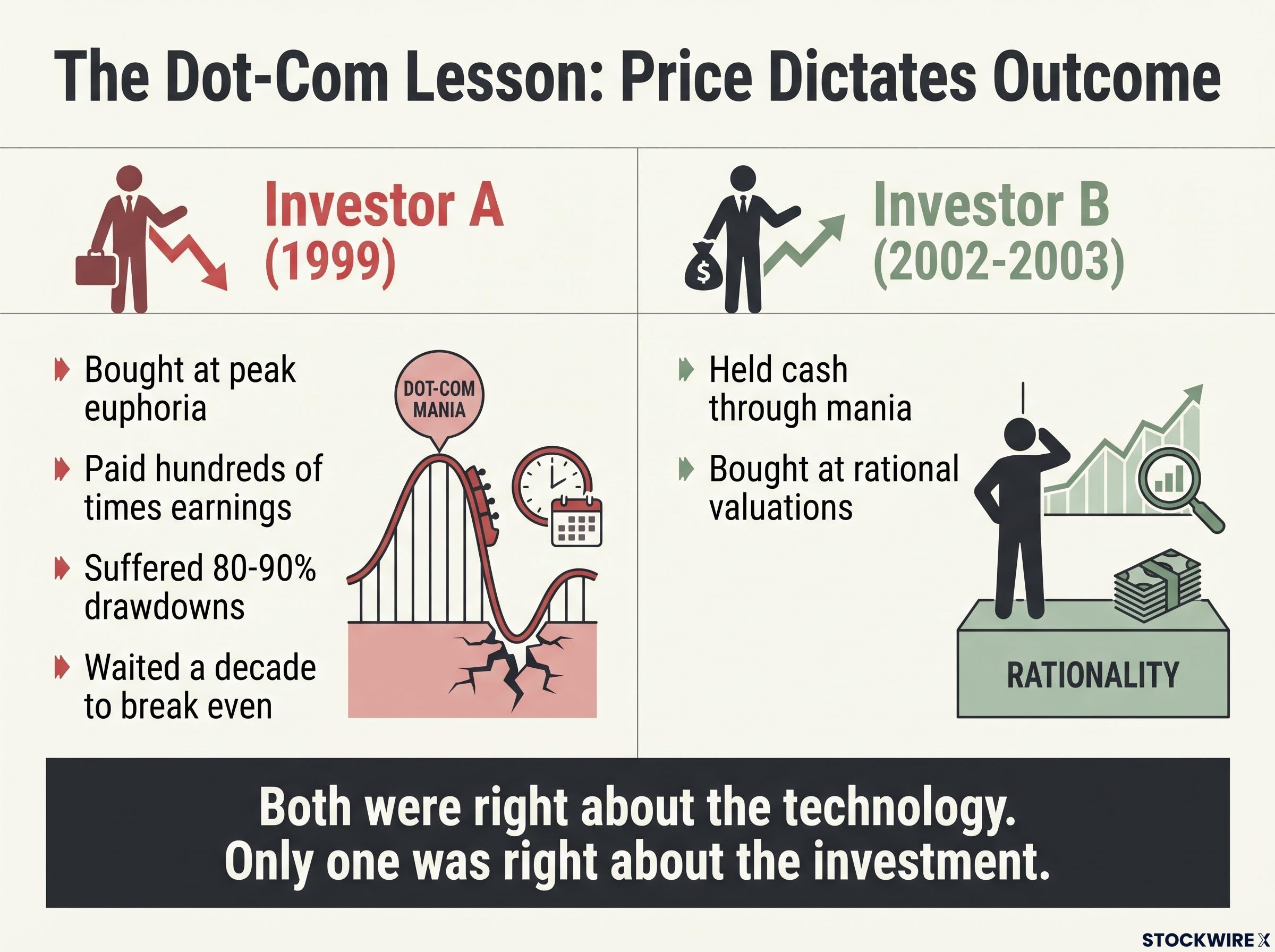
Both were right about the technology. Only one was right about the investment.
This is Buffett and Munger’s evolved philosophy in practice: pay up for quality only when future cash flows under conservative assumptions justify today’s price, not when narrative momentum does. The margin of safety, a concept from Ben Graham that Buffett and Munger built their careers around, is the buffer that protects against the inevitable errors in any forecast.
If you are currently holding or considering AI-sector stocks, being directionally correct about the technology tells you nothing about whether the current price will produce a good return over your investment horizon. The dot-com parallel is not about pessimism. It is about price.
Three valuation tools that keep price discipline practical
Valuation discipline is not a mystical skill. It is the structured habit of asking three specific questions before committing capital. You do not need to forecast with precision. You need to know whether the price you are paying is defensible across a range of plausible outcomes.
| Valuation Tool | What It Measures | Warning Signal |
|---|---|---|
| Historical Multiple Comparison (P/E, EV/EBIT, EV/EBITDA) | Whether the current price is high or low relative to long-term norms for the company and its sector | Price-to-earnings ratio, or P/E (share price divided by earnings per share), trading far above the company’s and sector’s historical range, implying sustained exceptional growth that may not materialise |
| Free Cash Flow Yield | The implicit return you earn by owning the business, calculated as free cash flow (cash generated after all operating and capital expenses) divided by market capitalisation | Very low FCF yield in a mature business, especially when it sits below current Treasury yields, meaning a risk-free government bond pays more than the equity |
| Scenario Analysis with Margin of Safety | Whether the price still makes sense if growth comes in at half of consensus expectations or margins compress | If the investment only works under the most optimistic scenario, there is no margin of safety, meaning the buffer between what you pay and what the business is conservatively worth is absent |
The FCF yield check is particularly telling in the current environment. If a mature company’s free cash flow yield sits below the yield on a Treasury bill, you are being paid less to take equity risk than you would earn from a risk-free government bond. That does not mean the stock will fall. It means the price is already assuming a great deal of future growth, and any disappointment leaves no cushion.
Run even the simplest version of these three checks against any AI-adjacent stock you are considering, and the picture sharpens quickly. Many are priced for perfection in a way that leaves no room for disappointment. Precise forecasting is not the standard here. Defensible pricing across a range of plausible outcomes is the standard.
A margin of safety framework that sets a 15% minimum return hurdle and calibrates the required discount to business quality, 30% for high-moat predictable companies and 40-50% for cyclical or leveraged ones, gives the scenario analysis step a concrete anchor rather than leaving it as an abstract exercise.
Why fear and greed cost investors more than bad stock picks
The average investor underperforms the average investment. That is not a character judgement. It is an empirical pattern observed across decades of investor behaviour data. The mechanism is consistent: people buy after strong performance, when prices are high and forward returns are lowest, and they sell after sharp drawdowns, when prices are low and forward returns are highest.
The cycle runs on two emotions. Rising prices generate greed and the fear of missing out, which draws capital in at exactly the wrong moment. Falling prices generate fear and loss aversion, which pushes capital out just before recoveries. You act against your own financial interests, repeatedly, because the emotional signal is always loudest at the moments when the rational response is most counterintuitive.
Loss aversion costs the average investor roughly 1-2 percentage points in annual returns, according to Morningstar’s ‘Mind the Gap’ research, driven almost entirely by the same pattern described here: selling near market lows and re-entering after prices have already recovered.
According to Buffett’s public guidance, the investor who keeps their head when markets are in turmoil holds a durable edge over those who react to every swing. The discipline to manage your own emotional responses to price movements is, in his view, worth more than any analytical edge you could develop.
The solution is not willpower. It is portfolio design. If you cannot hold through a 40% drawdown in fundamentally sound holdings, or better yet, add capital during one, then your portfolio’s risk level exceeds your genuine emotional tolerance. Not your aspirational tolerance. Your actual tolerance.
If you sold during the 2020 Covid crash, the 2022 rate-shock decline, or any other significant drawdown, that is not a lesson about the market. It is a data point about your real risk tolerance, and it should inform how you structure your portfolio today.
Berkshire’s cash posture illustrates the same principle at institutional scale. Holding cash and declining to participate in euphoric phases is a proactive, disciplined decision. It is not a failure of conviction.
Three pre-commitment rules you can adopt before the next downturn arrives:
- No selling based on price movement alone. Review fundamentals first. If the business is sound, the price decline is temporary by definition.
- Run the 40% drawdown scenario against your current holdings before adding to volatile positions. If you would sell at minus 40%, the position is too large for your temperament.
- Treat cash as an active allocation decision. Holding cash when valuations are stretched is not sitting on the sidelines. It is preserving the optionality to act when prices offer genuine margin of safety.
What a genuinely defensive portfolio looks like in practice
The three threads of this piece converge on a single portfolio design principle: structure your finances so that a severe market downturn cannot force you into permanent loss.
Avoid or strictly limit leverage, so that no margin call or loan obligation can compel you to sell at the worst moment. Insist on valuations with a genuine margin of safety, so that you own assets priced for a range of outcomes rather than only the most optimistic one. And design your asset allocation around your real drawdown tolerance, not what you wish you could endure, so that your behaviour during stress matches your plan rather than contradicting it.
Beta-weighted position sizing translates the 40% drawdown stress test into a measurable number before the drawdown arrives: a portfolio with equal dollar weights across a technology ETF at beta 1.8 and a utilities ETF at beta 0.2 carries a 90/10 risk split that is invisible on a standard brokerage statement.
Patience is the active strategic posture that ties these together. The absence of obvious opportunity at a reasonable price is a signal to hold your standards, not to lower them.
The compounding argument seals it. A 50% decline requires a 100% gain to recover. Time spent recovering from large drawdowns is time not compounding from a higher base. According to the convergent philosophy of Graham, Buffett, and Munger, the priority is to avoid permanent loss first and pursue returns second. Berkshire’s $397 billion cash and Treasury bill position, held while the S&P 500 trades at record highs, is this posture in action at institutional scale.
Here are six concrete actions you can take:
- Eliminate or strictly cap margin use.
- Maintain a cash buffer that is independent of your investment portfolio.
- Run the three valuation checks (historical multiples, FCF yield, scenario analysis) before any new purchase.
- Stress-test your existing holdings against a 40% drawdown.
- Pre-commit to no-panic-selling rules before volatility arrives, not during it.
- Treat holding cash as a legitimate active position when valuations are stretched.
If you apply even two of these, skipping leverage and demanding a margin of safety on new purchases, you will have structurally eliminated the two most common causes of permanent capital loss. That matters more to your 20-year outcome than finding the next great stock.
The investor Berkshire’s cash pile is actually talking to
AI-driven market euphoria, record S&P 500 levels, and Berkshire Hathaway’s $397 billion cash position are not a coincidence. They are a convergence of signals that the risk environment rewards discipline over participation right now.
Nothing in this piece requires you to sell everything or call a market top. The principles are simpler and more durable than that. Refuse to abandon the structural safeguards that protect against permanent loss. Demand valuations with a genuine margin of safety before committing new capital. And avoid borrowed money, so that no market correction can make your decisions for you.
The investor who waits for valuations with genuine margin of safety and avoids leverage has, structurally, already made their most important investment decision. Everything else is detail.
This article is for informational purposes only and should not be considered financial advice. Investors should conduct their own research and consult with financial professionals before making investment decisions. Past performance does not guarantee future results. Financial projections are subject to market conditions and various risk factors.