
Here is a problem every advertiser knows too well: you pay for attention that never arrives. The viewer scrolls past, skips the ad, or looks away before your message lands. You are competing for attention that does not yet exist, and the person holding all the control is the one you are trying to reach.
Now consider a category built the other way around. Place-based digital out-of-home advertising puts screens in venues where people are already stationary and waiting, which means the attention exists before the ad appears. That structural difference is not a marketing pitch. It is the reason the economics of these businesses work the way they do.
This article covers two ideas together on purpose. Understanding the media category explains why the financial engine behaves as it does, and the full-year 2026 result of one small Australian company, Motio, makes an important financial concept concrete.
Here is what you will walk away with: the ability to look at any company’s results and notice whether earnings are growing faster than revenue, understand why that gap matters, and know how to tell a structural pattern from a one-off. That single habit will change how you read a results announcement.
Why place-based screens have a structural attention advantage
Most advertising fights an uphill battle. The audience has not shown up to watch ads, they have shown up to do something else, and they can skip, scroll, or simply look elsewhere the moment your message intrudes. Attention has to be manufactured, and often it is not.
Place-based digital out-of-home flips that dynamic. In a medical waiting room, a café queue, or a petrol forecourt, the audience is already stationary with limited alternatives. The dwell time belongs to the venue, not to the advertising, so the screen does not have to create attention. It simply occupies attention that already exists.
Motio organises its network around exactly this insight, splitting its inventory into five channels, each targeting a distinct dwell context:

- Health targets medical and allied health waiting environments, where people sit for extended periods.
- Café captures food and beverage dwell settings.
- Venue covers hospitality and entertainment locations.
- Play reaches indoor sports and recreational facilities.
- Drive operates in petrol forecourt and automotive contexts.
That structure sits inside a category with genuine momentum. According to the Outdoor Media Association (OMA), Australian out-of-home net media revenue reached a record in full-year 2025.
A$1,449.5 million in full-year 2025, up 11.43% on 2024 (OMA, 22 September 2026)
Digital screens are taking a growing share of that total. Digital out-of-home made up 77.1% of all OOH revenue in the first half of 2026, up from 76% a year earlier, per OMA data published on 4 September 2026. PwC forecasts the digital share of OOH will climb from 74% in 2023 to 89% by 2028 (via the Australian Marketing Institute, July 2024).
What this tells you is that DOOH is not a cyclical advertising fad. It is a category with structural tailwinds, and the place-based segment Motio operates in sits at the highest-attention end of it. IVE Group’s Managing Director pointed to precisely this quality, the stationary and attentive nature of Motio’s audiences, as the rationale behind acquiring the business, per the 21 September 2026 announcement.
The structural momentum behind place-based digital screens is also visible at the broader sector level, where out-of-home media share hit a record 16.9% of Australian agency spend in the 12 months to June 2026, making it the fastest-growing major media category, ahead of digital and sharply contrasting with television and radio.
Motio’s network now spans more than 1,300 digital screens across more than 1,000 locations. When you evaluate any media business in this space, that structural attention advantage is the operational moat that makes the economics tractable.
When big ASX news breaks, our subscribers know first
What operating leverage actually is, and why it matters more than revenue growth
Most people read a results announcement and look straight at the revenue line. Did it go up? By how much? That instinct is understandable, but on its own it is incomplete, because revenue tells you nothing about whether the business is getting more efficient.
Here is the catch. Revenue can be bought. A company can spend more on staff, marketing, and infrastructure to generate more sales, and the top line will grow while the business becomes no better at converting effort into profit. Growth alone does not prove quality.
Operating leverage is the concept that fills that gap. When a company’s cost structure absorbs growth rather than expanding alongside it, a greater share of each additional revenue dollar reaches the earnings line. The result is earnings that grow faster than revenue.
The effect is more pronounced in smaller companies, where fixed costs sit across a narrower revenue base. Costs like property leases, network infrastructure, salaried staff, and software platforms stay broadly the same whether sales rise or fall. Once those fixed costs are covered, each incremental sale carries very little additional cost, so most of it flows through to profit.
Peer-reviewed operating leverage and capital structure research confirms that firms with higher fixed-cost ratios see their earnings amplify more sharply on both the upside and downside, which is precisely why the ratio between earnings growth and revenue growth carries diagnostic weight beyond what either number conveys alone.
Sequence matters here. Building the right cost structure before scaling produces a very different outcome from scaling first and trying to cut costs later. The companies that get this right shape the base, then grow into it.
The table below shows the concept in three simple scenarios, using the same 8% revenue growth in each case:
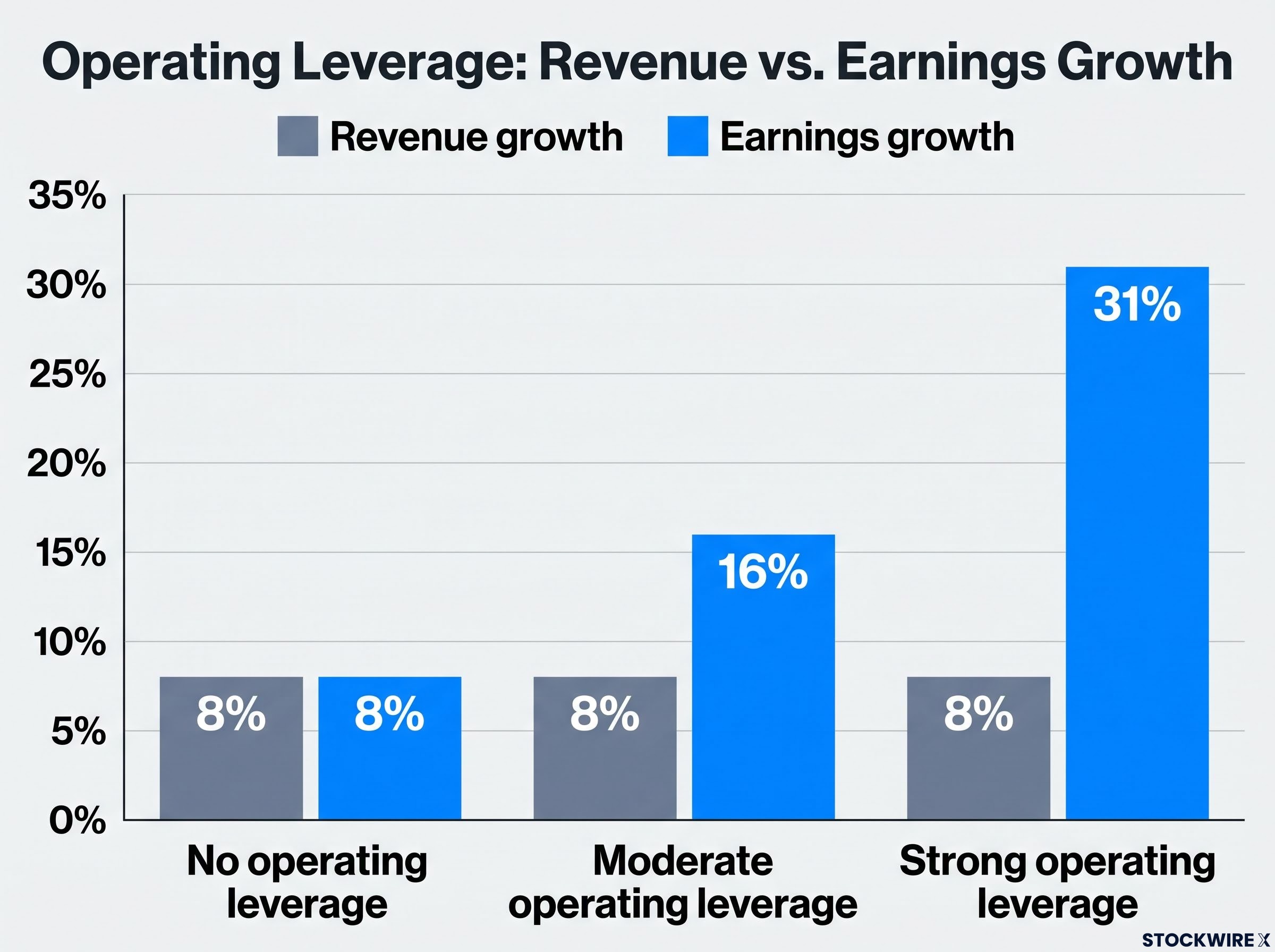
| Scenario | Revenue growth | Earnings growth |
|---|---|---|
| No operating leverage | 8% | 8% |
| Moderate operating leverage | 8% | 16% |
| Strong operating leverage | 8% | 31% |
Here is the signal to look for: a sustained, widening gap between revenue growth and earnings growth, paired with a balance sheet that has not weakened to fund the expansion.
The practical version is a ratio you can run on any result. Divide the earnings growth rate by the revenue growth rate. If the number sits materially above 1 across multiple periods, the business has a cost structure working in its favour. That is a second question to ask every time you see a headline about revenue.
When operating leverage works against a business
The same mechanism that amplifies profit on the way up amplifies losses on the way down. Fixed costs do not disappear when revenue falls, so a high-fixed-cost business can see margins compress rapidly in a downturn.
There is also a trap in reading a single good year. A one-off jump in earnings can reflect a temporary cost cut, an accounting change, or an unusually strong pricing period rather than genuine structural improvement. The meaningful signal, as analysts consistently caution, is sustained multi-period outperformance backed by a clean balance sheet.
Motio’s FY26 result: the concept made concrete
The numbers do most of the work here. For the financial year ended 30 June 2026, Motio reported revenue from continuing operations of $9.2 million, up 8% on the prior year.
Cash EBITDA came in at $2.5 million, up 31%, at a margin of approximately 27%. Cash EBITDA is a measure of the cash profit a business generates from its core operations before interest, tax, depreciation, and amortisation.
Set those two figures side by side and the pattern is unmistakable.
Revenue grew 8%. Cash EBITDA grew 31%. Earnings expanded at roughly four times the rate of revenue.
That four-to-one relationship is the clearest numerical expression of operating leverage in action. The modest top-line growth passed through a cost base that barely moved, and the difference landed as profit.
The balance sheet deserves equal attention. At 30 June 2026, Motio held approximately $3.9 million in net cash and carried zero debt.
| Metric | Result (FY26) |
|---|---|
| Revenue (continuing operations) | $9.2 million (+8%) |
| Cash EBITDA | $2.5 million (+31%, ~27% margin) |
| Net cash position | ~$3.9 million, zero debt |
Why does the debt-free position matter as much as the earnings growth? Because it tells you the margin expansion was self-funded. The company did not borrow or run down its cash to buy that growth. That is the condition that separates genuine operating leverage from financial engineering. Achieving revenue growth, margin expansion, and a stronger balance sheet at the same time is unusual for a company of this scale, and it is what the theory looks like when it actually holds.
The zero-debt position that makes Motio’s margin expansion credible is an expression of balance sheet discipline that matters independently of any single result, because a business that funds growth through borrowing faces a very different risk profile when revenue turns down than one carrying net cash.
How several years of unglamorous work produced a single impressive number
A result like Motio’s FY26 does not appear in a single reporting period. It is the visible end of a long process, and management has said as much.
Managing Director Adam Cadwallader described recent years as a period of simplifying the company, lifting its operating performance, and placing the business on firmer foundations, per the 21 September 2026 ASX announcements. Chair Jason Byrne separately acknowledged the transformation and the construction of a portfolio of specialist digital out-of-home networks over that time.
Simplification work of this kind rarely makes headlines while it happens. It usually means exiting non-core activities, consolidating operations, and accepting a smaller top line in the short term.
Recent years were characterised by simplifying the business, lifting operating performance, and placing it on stronger foundations, according to Managing Director Adam Cadwallader in the 21 September 2026 announcement.
That is the unglamorous part. There is no press release for the quarter you decided to shut down a distraction, and no headline for the year you deliberately shrank revenue to build a cleaner cost base.
Here is where it connects back to operating leverage. The reason Motio’s FY26 margins look the way they do is that the cost structure was shaped before the growth arrived, not alongside it. The base was set, the fixed costs were rationalised, and when revenue ticked up 8%, there was very little standing between that new revenue and the earnings line.
For you as a reader, the transferable lesson is the sequence. Simplify first, grow second. When you see a small company mid-restructuring, the FY26 result is a useful picture of what a successful outcome of that process looks like once it reaches the numbers. It also helps you tell durable improvement from a one-off, because durable improvement has a story behind it that spans years, not quarters.
What this result tells you the next time you read a results announcement
You now have a habit you can apply immediately, and it takes less than a minute. The next time you open a results announcement, put revenue growth and earnings growth next to each other and read the relationship between them.
Three outcomes are possible, and each tells you something different:
- Earnings growing meaningfully faster than revenue: the cost structure is working for the business, and operating leverage is doing real work.
- Earnings growing roughly in line with revenue: the business is scaling, but not leveraging. Growth is being matched by cost.
- Earnings growing more slowly than revenue: costs are rising faster than the top line, a sign of cost creep worth investigating.
Then run the second check: the balance sheet. Growth funded by borrowing or by drawing down cash is a different proposition from self-funded margin expansion. The combination of earnings outpacing revenue and a balance sheet that has held or strengthened is the signal genuinely worth noting.
The habit of reading the relationship between revenue and earnings growth is one part of a broader earnings report analysis discipline that also covers accounting presentation gaps, forward guidance signals, and the divergence between operating cash flow and reported net income.
That ratio, earnings growth divided by revenue growth, is now a permanent part of your analytical toolkit. It is simple, fast, and often more informative than the revenue headline everyone else is reading.
The earnings-to-revenue growth ratio introduced here pairs naturally with the implied growth rate embedded in any stock price, which converts the current market capitalisation into a minimum annual revenue growth requirement and gives you a second check on whether the market is already pricing in an optimistic operating leverage story.
This article is for informational purposes only and should not be considered financial advice. Investors should conduct their own research and consult with financial professionals before making investment decisions.
A binding scheme implementation deed between Motio and IVE Group was announced on 21 September 2026. Under the proposed schemes of arrangement, governed by Part 5.1 of the Corporations Act, a scheme meeting is indicatively expected to take place in late November 2026. The Motio board has unanimously recommended that shareholders vote in favour of the schemes, provided no superior proposal emerges and an independent expert determines the arrangement is in shareholders’ best interests. For a full understanding of the proposal, shareholders should consult the scheme booklet and the independent expert’s report once those documents are available, rather than relying on third-party commentary such as this article.
Numbers that speak for themselves: what Motio’s FY26 result actually shows
In FY26, Motio delivered earnings growth at roughly four times the rate of its revenue increase, all while maintaining a debt-free balance sheet and a net cash position of approximately $3.9 million. Achieving that combination at the scale Motio operates at takes years of deliberate cost discipline, and the numbers reflect exactly that. The result stands on its own terms, without embellishment.
It also returns you to where this began. Most advertising competes for attention that has to be created. Motio’s model inhabits spaces where attention already exists, and the financial result is what that structural advantage looks like once a disciplined cost base is layered on top.
The work behind the number stretched across several years, most of it quiet and unremarkable in the moment. That is worth understanding on its own terms, whatever comes next for the business.
—