#
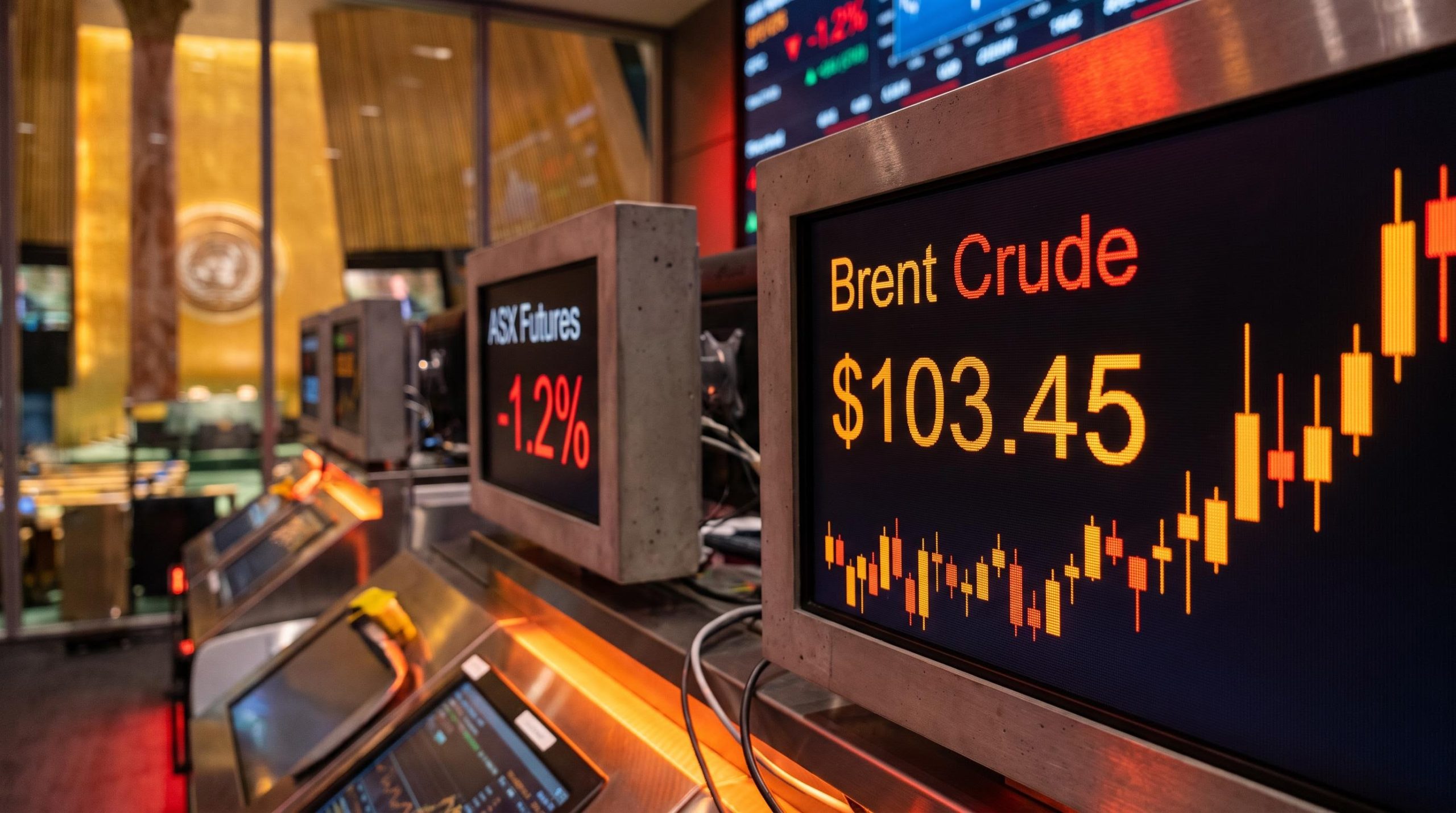
Brent crude settled just above $103 a barrel overnight, up nearly 4% in a single session, and ASX 200 futures are pointing to a 1.2% decline at Thursday’s open. Both moves trace to one moment at the UN General Assembly, where Iran’s president declared his country would not capitulate.
The overnight session marked a sharp turn. For five straight days, oil had drifted lower on hopes that diplomacy at the UN would cool the Iran conflict, and markets had begun to price in a de-escalation that Iran’s president’s address abruptly erased. That reversal rippled outward, dragging base metals, gold, and the Australian dollar lower into Thursday’s open.
Here is what moved overnight, what it means for the ASX open, and what to watch before midday as the September labour force data lands. This is same-day orientation for an investor already sitting at the screen, trying to separate genuine repricing from noise.
How Iran’s UN address reversed five days of oil market optimism
For most of the past week, the oil market had been telling a story of hope. Brent had fallen for five consecutive sessions, sliding from $101.67 on 21 September to $99.25 on 22 September, each leg framed by traders around the prospect of a diplomatic breakthrough at the UN.
The optimism had a specific catalyst. President Trump stated the US had held hours-long talks with Iran during the UN meetings, and markets read that as the first credible sign that supply fears might ease.
Then Iran’s president addressed the same forum on 23 September and declared his country would not capitulate. In a single session, the thesis unwound and Brent surged nearly 4% to settle just above $103.
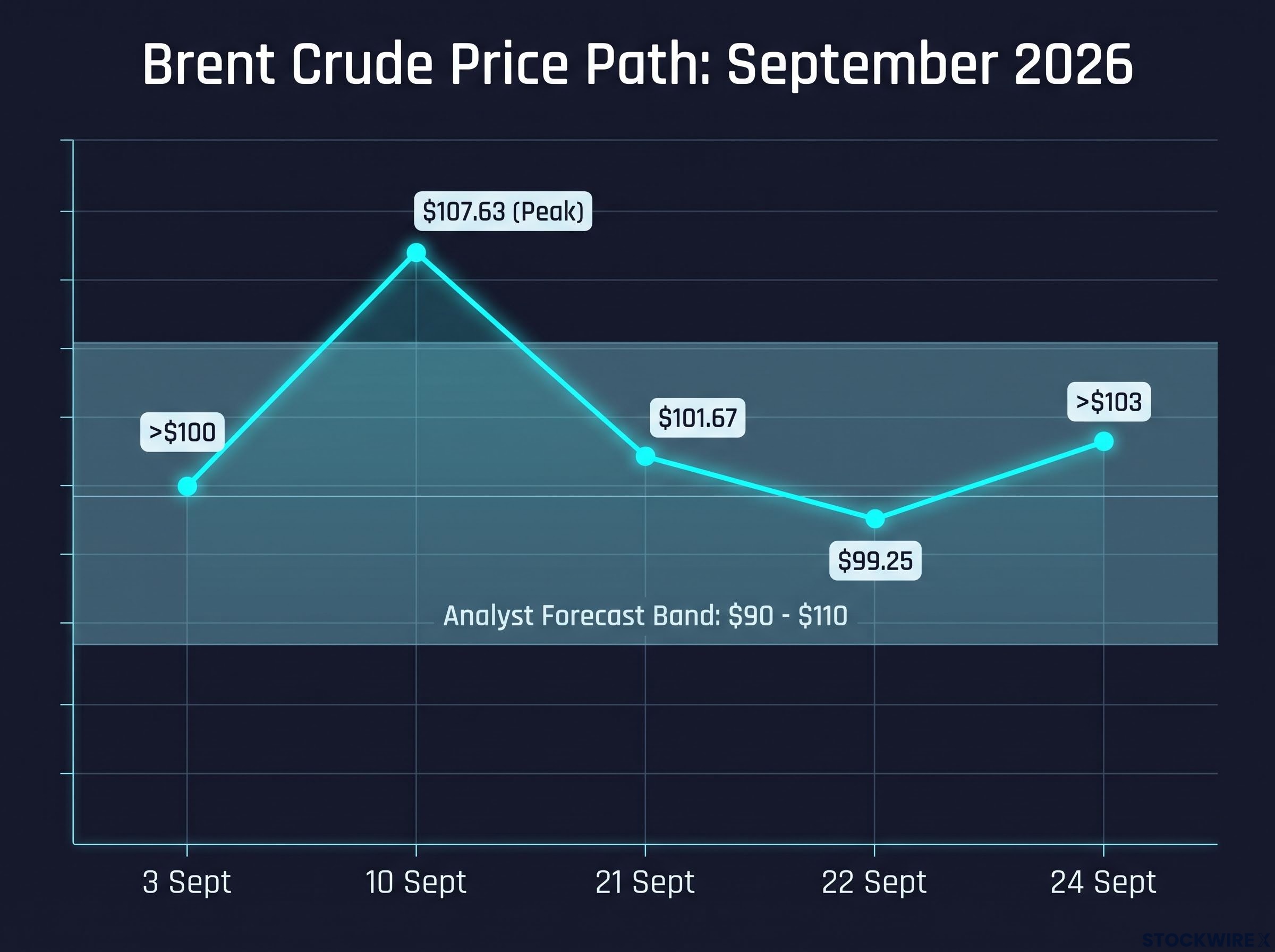
Here is the price path that shows how quickly sentiment turned:
- 3 September 2026: Brent already above $100 as tensions built
- 10 September 2026: peak settlement of $107.63 after the largest wave of tanker attacks, according to Reuters via Global Banking and Finance
- 21 September 2026: back to $101.67 as diplomatic hope set in
- 22 September 2026: $99.25, a fifth straight session of losses
- 24 September 2026: back above $103 following the UN address
That $103 level is not a new ceiling. It is a return to territory the market had already visited during the September escalation, which tells you the market is acutely sensitive to diplomatic signals in either direction. With headline risk from the General Assembly priced thin, any fresh statement from either side could move oil sharply again.
The July precedent is instructive: Brent fell 5.5% to $91.44 in a single session on a US-Iran military pause, demonstrating that Hormuz risk reprices sharply on headline sentiment even when no additional barrels reach the market and no tanker routes are actually secured.
Both sides remain nominally open to engagement, and that is the structural reason Brent has not pushed further above $110 despite the rhetoric.
Analysts forecast Brent to trade in a $90-$110 band through the rest of the year, given a structural supply deficit even if diplomacy improves flows (CNBC, 21 September 2026).
The $103 settlement is not simply a number to note. It marks the point at which the market judged diplomatic progress not yet credible, and that judgement is what is flowing directly into ASX futures overnight.
When big ASX news breaks, our subscribers know first
Commodities and currency markets: what else moved overnight
The oil surge was the exception, not the rule. Almost everything else in the commodity complex retreated overnight, pressured by a strengthening US dollar and profit-taking, which points to a broad risk-off rotation rather than a targeted move.
Copper and aluminium futures both fell 1.2%. Iron ore edged down 0.1% to $97 per tonne, and gold slipped roughly 1.3% to $2,650 per ounce. Oil stood alone, advancing while the rest of the board turned red.
Here is the overnight snapshot:
| Asset | Direction | Move | Level |
|---|---|---|---|
| Brent crude | Up | ~4% | Above $103/barrel |
| Copper futures | Down | 1.2% | – |
| Aluminium futures | Down | 1.2% | – |
| Iron ore futures | Down | 0.1% | $97/tonne (USD) |
| Gold futures | Down | ~1.3% | $2,650/ounce |
| AUD/USD | Down | On session | ~70.4 US cents |
Notice that gold fell rather than rallied. In a straightforward flight to safety, the metal usually climbs. That it dropped alongside base metals tells you the dominant force overnight was US dollar strength, not a classic safe-haven bid, and that nuance matters for how ASX gold and materials names are likely to open.
Why does an oil spike weaken the Australian dollar?
Three channels are at work. First, the Australian dollar trades as a high-beta risk currency, so it gets sold in a risk-off rotation while capital flows into the safe-haven US dollar. Second, Australia imports most of its crude and refined products, so a triple-digit oil price worsens the trade balance rather than boosting it. Third, higher oil acts as a tax on global growth, which limits how aggressively the Reserve Bank of Australia can raise rates relative to the US Federal Reserve, tilting yield differentials toward the USD.
For ASX investors, the currency move is a secondary signal worth watching. A weaker Australian dollar tends to cushion export-earnings stocks when foreign revenue is translated back to local currency, but it also confirms that global risk appetite is deteriorating in a way that will pressure the broader index.
The AUD’s slide reflects its status as a high-beta risk currency, structurally exposed to five simultaneous drivers including global risk sentiment, RBA policy, iron ore prices, Chinese conditions, and the trade balance, rather than any single overnight headline.
What the 1.2% futures drop signals for Thursday’s ASX open
The 1.2% futures decline is the market’s overnight verdict, feeding the oil surge and the risk-off shift directly into the local open. Break it down by sector and the picture sharpens.
Energy stocks stand to outperform on the higher oil price. Financials and heavyweight materials are the likely drag, and defensive names offer relative shelter. That split matters because the headline index number will not tell you the whole story.
ASX 200 futures are pointing to a 1.2% decline at the open, the sharpest overnight move in more than a week.
There is a mechanical wrinkle today that investors should not mistake for fundamental repricing. Several index heavyweights go ex-dividend on 24 September, which drags the index arithmetic lower regardless of sentiment. The stocks distributing today are:
- Amcor
- Ramsay Healthcare
- Rio Tinto
- ResMed
- AGL Energy
- Telstra
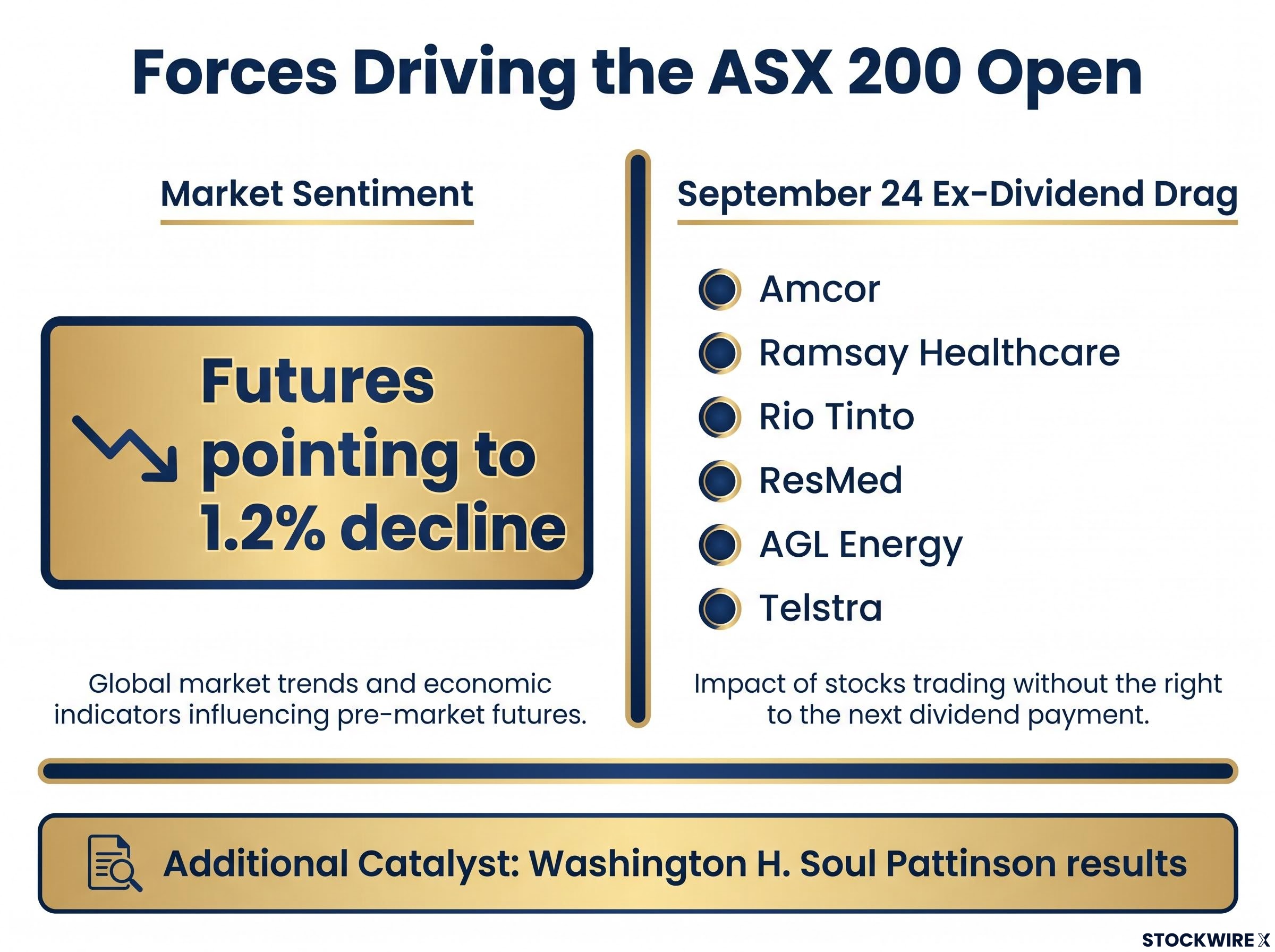
That means the headline move at open will be a composite of two separate forces: genuine geopolitical repricing on one side and routine ex-dividend mechanics on the other. Separating the two is the difference between acting and waiting, because they carry very different implications.
For context, Wednesday’s session saw the ASX 200 add just 7 points, with energy and financial losses offset by materials strength. That followed three sessions of single-digit point moves in the prior week, which makes the 1.2% futures signal a genuine step-up in volatility rather than more of the same holding pattern.
The ASX 200 support zone at 8,708 to 8,656 is the level the index was already testing before Thursday’s futures signal arrived, sitting beneath a trend ribbon acting as overhead resistance at 8,799 to 8,865, which means the 1.2% open decline lands on already fragile technical footing.
Adding a single-stock catalyst to an already event-dense day, Washington H. Soul Pattinson is due to release results later in the session.
The labour force data at 11:30 a.m. and what it adds to the picture
The second variable of the day lands at 11:30 a.m. AEST, when Australia’s September labour force figures are released. Consensus expects the unemployment rate to hold steady at 4.5%.
A result in line with that forecast is unlikely to shift the dominant geopolitical narrative. But a material surprise in either direction would reintroduce the RBA rate path into an already volatile session, and that is what makes the 90-minute window between open and release the highest-uncertainty stretch of the day.
Here is how the two outcomes read through:
- In line with consensus (4.5%): The number confirms the status quo and cedes the floor back to the oil and risk-off story. Any recovery or deepening of the open decline would then hinge on geopolitical headlines rather than domestic data.
- A material surprise: Unemployment falling below 4.5% would complicate any dovish RBA pivot, while a rise above 4.5% would signal an economic slowdown and could compound already weak risk sentiment.
The index was arguably primed for this. Those three sessions of single-digit moves in the prior week suggest it was already in a cautious holding pattern before the overnight shock, so the data has room to tip the balance.
For investors deciding whether to act at the open or wait, the 11:30 a.m. release is the first genuine piece of domestic information capable of changing the picture. Those with positions to manage have a defined window before the number either confirms or complicates the geopolitical story that drove futures lower overnight.
What Thursday’s session tells investors about the weeks ahead
The single most useful anchor for the weeks ahead is the analyst forecast band. Even a successful diplomatic outcome is unlikely to push Brent below $90 given the structural supply deficit, which means the risk premium is a persistent feature of this market rather than a one-off event.
Analysts forecast Brent to trade in a $90-$110 band through the rest of the year (CNBC, 21 September 2026).
That band reframes the choice investors face. This is not a decision between an oil crisis and a return to normal. It is an environment where an elevated price is the baseline, and the open question is whether Brent drifts toward the top or bottom of that range.
Two variables will drive ASX outcomes from here. The first is the trajectory of Iran-US diplomacy at and after the UN General Assembly. The second is the domestic data flow, starting with today’s labour force figures, that shapes the RBA’s next move.
The playbook of the past fortnight is the one to watch: oil retreating on diplomatic signals, from a $107.63 peak down to a $99.25 trough, then surging back above $103 on hawkish rhetoric. Today’s 1.2% futures decline is the market’s first test of whether that pattern holds after the escalation at the UN.
Understanding that elevated oil is now the structural backdrop, not a temporary shock, should change how you think about energy sector exposure, AUD hedging, and domestic rate-path bets over the next four to six weeks.
Energy stocks as an inflation hedge carry a dual-purpose logic in this environment: the same crude price action that damages bonds and cash feeds directly into sector cash flows, and many integrated producers built 2026 budgets around $75-$80 oil, meaning Brent sustaining above $100 generates material earnings upgrades not yet in consensus estimates.
This article is for informational purposes only and should not be considered financial advice. Investors should conduct their own research and consult with financial professionals before making investment decisions. Past performance does not guarantee future results, and financial projections are subject to market conditions and various risk factors.