
The US Treasury doubled the size of its long-bond buyback operations on Wednesday, purchasing longer-dated securities at roughly twice the usual clip in an effort to cool a bond market that had pushed 30-year yields to their highest levels since 2007. For a few hours, it worked. By Thursday’s close, every basis point of relief had reversed and then some.
The timing made the failure harder to dismiss. US federal debt crossed $40 trillion in the same week. The 30-year yield settled near 5.25%, and the 10-year pushed through 4.70%, above the level it held before the buyback announcement landed. The Jackson Hole Economic Policy Symposium, scheduled for 27-29 August 2026, is now the next flashpoint for whether policymakers acknowledge what the bond market is telling them or continue treating the problem as a technical glitch.
The question at the centre of this episode is whether long-end yields are rising because of a liquidity problem or a confidence problem. Here is a framework for distinguishing between those two explanations, understanding why the answer reshapes how you evaluate every future policy announcement, and knowing exactly what data to watch next.
How the buyback programme actually works, and what it cannot do
Treasury buybacks acquire longer-dated securities, typically in the 10-year to 30-year maturity range, and fund those purchases through the issuance of additional short-term bills. The effect is a reshaping of the maturity profile of outstanding debt rather than any reduction in its total size, and the process takes place entirely outside the Federal Reserve’s balance sheet, meaning no new money enters the system.
The latest change lifted individual operation sizes from approximately $2 billion to at least $4 billion per operation, covering a window from 9 September through 4 November. That sounds meaningful in isolation. Measured against a Treasury marketable debt market of approximately $31.5 trillion as of late July 2026, the programme’s footprint remains too small to shift the structural supply-demand balance at the long end.
Treasury’s official buyback announcement confirms the expanded operations cover the window from 9 September through 4 November, with individual operation sizes lifted to at least $4 billion, framed explicitly as liquidity support rather than yield-level management.
Three structural limitations separate this tool from anything that could genuinely reset long-end yields:
- No debt reduction. Buybacks retire long bonds and replace them with bills. Total debt outstanding does not change.
- No money creation. The programme operates entirely outside the Federal Reserve’s balance sheet. No new reserves enter the system.
- No credibility as a price-setter. Treasury is the issuer of the debt. It is asking the same investors it depends on to absorb future supply to also trust its yield-management signalling.
Analysts described the expanded operations as a marginal liquidity instrument rather than a mechanism capable of resetting long-end yields, noting that the scale falls far short of what would be needed to alter the underlying supply-demand dynamic.
Even a fully successful buyback day barely registers as a rounding error in the supply stack investors must absorb over coming years. Understanding that mechanical ceiling is the prerequisite for understanding why the market rejected the announcement so quickly.
When big ASX news breaks, our subscribers know first
Operation Twist had the same idea, with far more firepower
The conceptual ancestor of the current programme is the Federal Reserve’s Operation Twist, executed in 2011-2012. The Fed sold short-dated Treasuries and bought longer-dated ones, explicitly targeting the term structure of rates to compress long-end yields. The mechanism sounds similar. The differences explain why one worked and the other cannot.
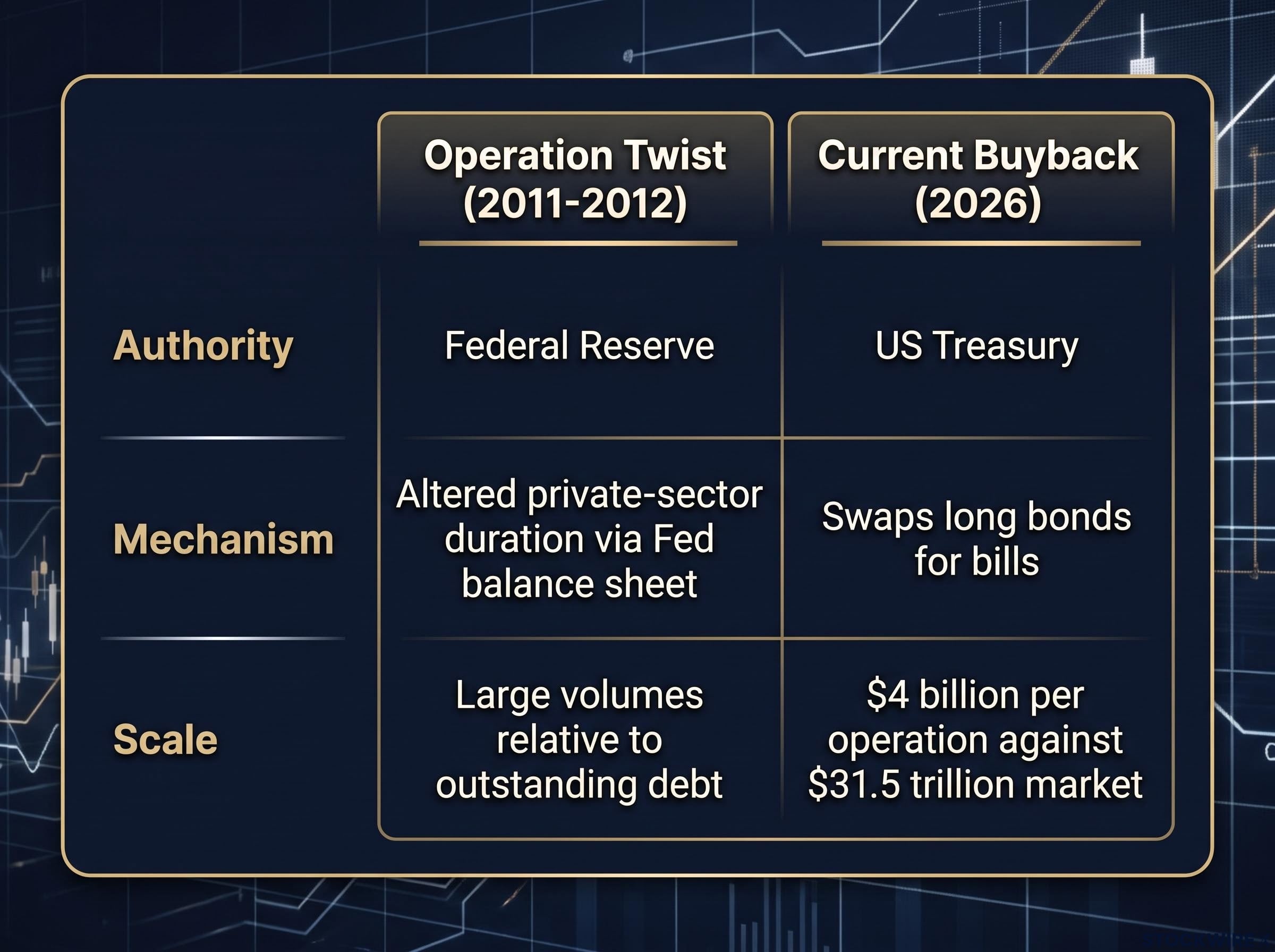
| Dimension | Operation Twist (2011-2012) | Current buyback programme (2026) |
|---|---|---|
| Executing authority | Federal Reserve | US Treasury |
| Mechanism | Altered private-sector duration exposure via Fed balance sheet operations | Swaps long bonds for bills; net debt and private-sector duration exposure change minimally |
| Scale relative to market | Large volumes relative to outstanding debt, backed by Fed’s balance sheet capacity | Approximately $4 billion per operation against $31.5 trillion market |
Sell-side analysts have described the current initiative as a “weaker version of Operation Twist,” capable of modest curve-shaping and localised liquidity support, but not of re-anchoring long-term yields against macro forces.
Operation Twist’s historical ceiling of approximately 15 basis points of long-end yield reduction, achieved under far more favourable conditions than those prevailing today, sets a sobering benchmark for what the current programme can plausibly deliver even if every operation attracts strong participation.
The most consequential gap is credibility. The Fed is a price-setter in the rate market. It is a dominant marginal buyer with an explicit policy mandate over interest rates. Treasury is the issuer, asking the same investors it relies on for financing to also accept its characterisation of where yields should trade. That credibility gap is what makes scale differences compound rather than merely add up. Recognising this gives you a calibrated benchmark for evaluating any future policy announcement aimed at suppressing long-end yields: if it does not carry central-bank authority, treat it as curve management, not yield control.
What is actually driving yields higher
The failed buyback rally was not irrational. It was proportionate. Four structural forces are converging on long-end yields, and none of them responds to a maturity-swap operation.
- Debt and deficit trajectory. US federal debt surpassed $40 trillion this week, having crossed $39 trillion approximately four months earlier. The pace of accumulation implies sustained heavy issuance of long-dated Treasuries for years to come, increasing the supply that investors must absorb.
- Rising real term premia. Investors are demanding more compensation for holding duration risk and fiscal uncertainty. This is distinct from simply pricing in higher expected short-term rates. Treasury’s own advisory documents acknowledge increased supply as a contributor to this repricing.
- Persistent inflation and policy uncertainty. Long-end yields embed not just current inflation but the perceived credibility of the inflation target over decades. Above-target inflation projections, energy price risks tied to geopolitical tensions, and uncertainty about future fiscal consolidation all widen that premium.
- Competing private-sector bond supply. Large-scale corporate issuance, especially by major technology companies financing data centres and AI infrastructure, has intensified competition for investor capital between Treasuries and high-grade corporate paper.
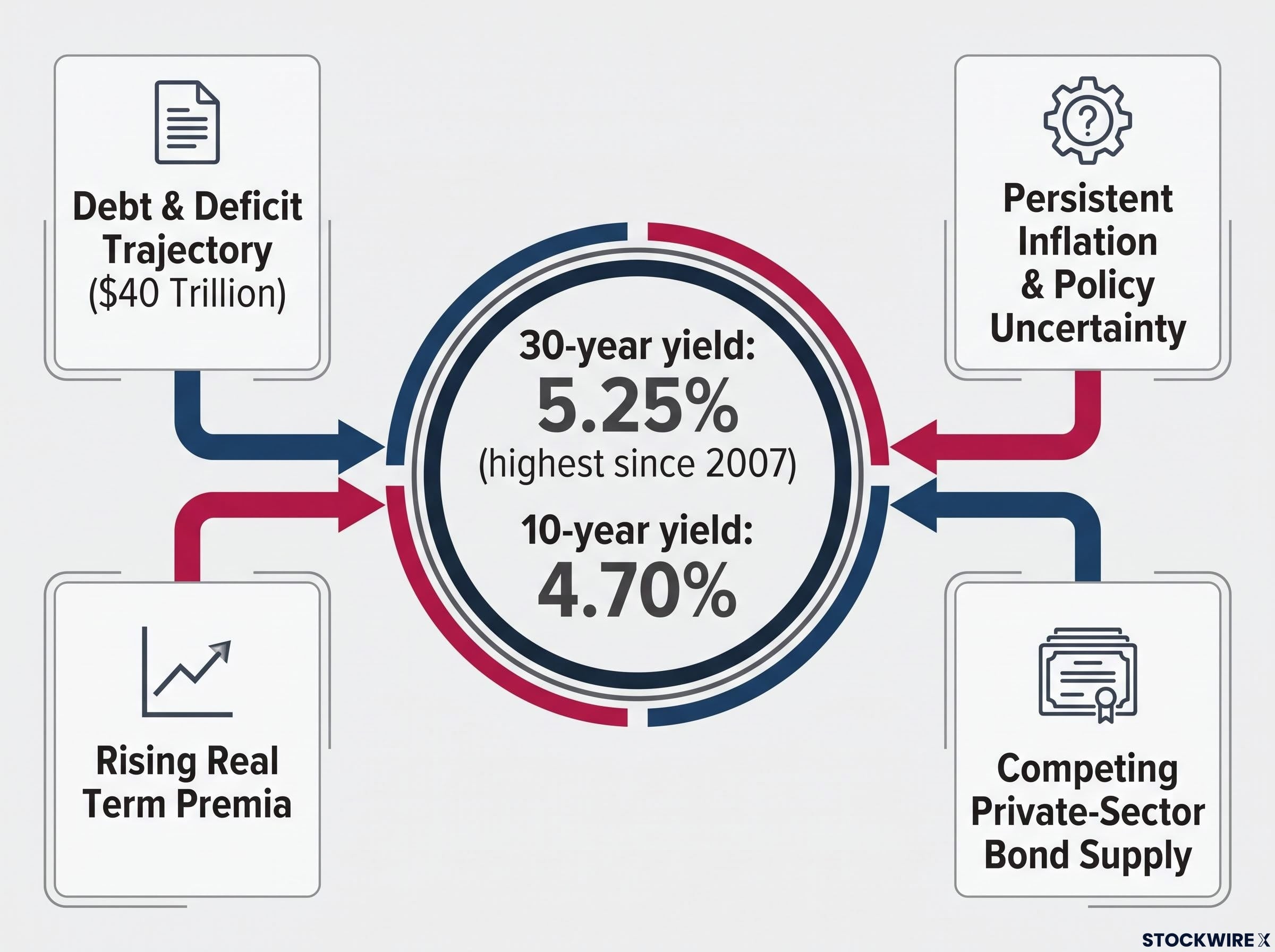
The 30-year Treasury yield settled near 5.25% this week, reaching its loftiest point since 2007, while the 10-year finished Thursday around 4.70%, a level that exceeded where it had been trading ahead of the buyback announcement.
Why term premia matter more than expected rate moves right now
Term premia, the extra yield investors demand for holding longer-duration bonds rather than rolling short-term ones, are the dominant force in the current episode. When term premia rise, it means investors are not simply expecting higher short rates. They are demanding more compensation for the uncertainty itself: will deficits stay large, will inflation stay sticky, will the supply of long bonds keep growing.
Term premia are not a single observable rate but a residual derived by stripping expected short-rate paths from nominal yields; when term premia rise independently of rate expectations, as they are now, the signal points to structural repricing rather than a shift in growth or inflation forecasts alone.
Treasury’s own advisory documents explicitly cite increased supply as a contributor to the term premia repricing. That is a remarkable admission. The issuer is acknowledging that its own borrowing pattern is part of what is pushing its borrowing costs higher.
These four forces are not independent. Heavy deficit spending increases supply, supply raises term premia, and elevated inflation uncertainty keeps the duration risk premium wide. Investors absorbing more long bonds require even higher yields to do so, compounding the cycle. What this tells you is that no single policy response, including Fed rate cuts, can meaningfully reverse the trend unless fiscal fundamentals change.
Liquidity problem or confidence problem, and why the difference matters
Treasury has framed the buyback expansion as a response to impaired liquidity in longer-dated sectors. The Treasury Secretary argued that long-end yields had lost touch with the economy’s underlying fundamentals, that conditions in the long-end market were severely impaired, and that disruptions linked to tensions with Iran would prove short-lived. Past buyback operations attracted strong participation, cited as evidence of functioning demand.
The sell-side counter reads differently:
- Treasury’s liquidity framing: buybacks address a mechanical functioning issue; strong past participation proves demand is there; yields are temporarily distorted by geopolitical noise and should normalise.
- Market’s confidence framing: historical and recent buybacks consistently attracted ample offers, suggesting orderly market functioning rather than impairment; the structural confidence problem around fiscal trajectory and inflation credibility cannot be solved by tools that only tweak issuance timing.
The market’s own behaviour resolved the tension. Official commentary from the Treasury Secretary caused yields to retreat briefly during the period when remarks were being made, before selling resumed as investors assessed what had actually been offered. The 10-year crossed back above its pre-announcement level, ending Thursday near 4.70%.
One strategist noted that once the market starts pricing sovereign financing dynamics and long-run debt sustainability, the effectiveness of yield-suppression measures that only tweak issuance mechanics becomes “increasingly limited.”
When official commentary produces a relief rally that fully reverses by the next session, the market is not malfunctioning. It is performing exactly as expected when investors are pricing a confidence problem that a liquidity tool cannot address. The distinction is not semantic. If the problem is liquidity, technical tools can fix it. If the problem is confidence in fiscal sustainability, only substantive policy change can move the needle, and that should inform how you evaluate every future Treasury or Fed announcement on yield levels.
Where the Fed fits, and what Jackson Hole changes
Elevated long-end yields are already exerting tightening pressure across the economy without any formal Fed action. Mortgage rates, corporate borrowing costs, and discount rates on long-horizon investments all rise when the long end sells off, tightening financial conditions without any formal Fed vote or rate change. The bond market has front-loaded part of the tightening that would otherwise require explicit Fed action.
FOMC internal divisions, which reached their deepest point since 1992 at the April 2026 meeting, mean the Fed chair arrives at Jackson Hole without a unified committee behind any single path, narrowing the range of credible signals the symposium can deliver and raising the cost of a framing misstep.
The resulting tension puts the Fed in an uncomfortable position, and the Jackson Hole Economic Policy Symposium on 27-29 August 2026 is the venue where markets will learn how the Fed chair intends to navigate it:
- Align with Treasury’s liquidity narrative. If the Fed frames elevated long-end yields as a distortion or unwarranted tightening, it faces pressure toward rate cuts or enhanced forward guidance to offset the bond market’s repricing. That path risks credibility if the data does not support the framing.
- Acknowledge the structural repricing. If the Fed treats higher yields as a rational reflection of term premia and fiscal risks, it may welcome some of the tightening and feel less urgency to ease policy, especially with growth data still resilient.
Near-term data catalyst: August S&P Global PMI flash estimates are scheduled for release on 21 August at 13:45 GMT. Market expectations point to Manufacturing at 53.8 (previous reading 53.9), Services at 54.0 (previous reading 54.6), with the Composite index having last printed at 54.5.
A PMI upside surprise makes the Fed’s path harder, not easier. Solid growth and persistent inflation give the Fed less cover to counteract yield-driven tightening, reinforcing the case that long-end yields are pricing something real rather than something fixable. A downside surprise might justify some easing of yields, but it would not in itself alter the debt arithmetic driving term premia higher. The Fed chair’s Jackson Hole posture will function as a signal for whether policymakers intend to fight the bond market’s structural repricing or acknowledge it, and that signal has direct implications for rate-sensitive positions, mortgage costs, and corporate borrowing decisions in the second half of 2026.
What the failed rally reveals about the new bond market regime
Three things converged in the same week: the $40 trillion debt milestone, near two-decade highs in the 30-year yield, and a doubled buyback programme whose relief evaporated within a single trading session. That convergence is not coincidence. It is the signature of a regime shift.
Markets are moving from an environment dominated by central-bank technicals and liquidity interventions to one where fiscal fundamentals, long-run inflation credibility, and structural supply-demand imbalances set the price of long-term government debt. Small liability-management tools can smooth edges, but they cannot reset the level. Investors will continue demanding higher term premia until there is a credible path to fiscal consolidation and durable inflation control. Policy communication that treats a confidence problem as a technical one risks further erosion of market confidence, potentially embedding even higher risk premia over time.
Investors calibrating whether current yields represent distress or normalisation must account for the QE-era baseline, when 10-year yields averaged 1.5-3% under sustained central bank intervention, a level that may have created reference-point anchoring that now makes historically ordinary yields appear alarming.
The variables worth monitoring from here:
- Jackson Hole posture (27-29 August). Whether the Fed chair aligns with Treasury’s framing or acknowledges the fiscal risk premium. Alignment with Treasury would signal potential rate relief; acknowledgement would validate current yield levels.
- PMI trajectory (21 August and beyond). Above-consensus readings reinforce the case that yields reflect genuine economic pressures. Below-consensus readings may ease yields temporarily without changing the debt arithmetic.
- Buyback scale communication. Any Treasury signal about expanding or contracting operations beyond the current $4 billion level would indicate whether officials accept the market’s verdict.
- Fiscal outlook signals. Upcoming Congressional budget discussions will reveal whether any path to deficit reduction is politically viable, the only variable that could durably alter the term premia calculus.
The bond market has effectively rendered its verdict: the tools deployed this week are not sized for the problem they are being asked to solve. If you hold rate-sensitive positions, that verdict is the operating assumption until fiscal fundamentals change.
This article is for informational purposes only and should not be considered financial advice. Investors should conduct their own research and consult with financial professionals before making investment decisions. Past performance does not guarantee future results. Financial projections are subject to market conditions and various risk factors.