
US government interest expense is on track to rival what the country spends on defence. The 10-year Treasury has spent extended stretches above 4.5%, and the Treasury Department has been shortening the maturity profile of its debt to manage rollover costs. Yet most retail portfolios are still allocated as if the post-2020 playbook of falling rates and expanding multiples is the only future worth positioning for.
The unusual challenge here is not that the outlook is uncertain. It always is. The challenge is that the three most plausible resolutions to the US debt situation are structurally opposed to each other in how they affect your stocks, your bonds, and your gold allocation. The portfolio that thrives in a soft landing is the one most exposed to severe loss under debt monetisation. The allocation that protects you under financial repression drags on your returns if the economy finds its footing.
This piece maps each scenario to specific asset characteristics so you can see, clearly, which parts of your portfolio are fragile and which are not, without requiring you to predict which path arrives first.
Why the US debt situation creates three genuinely different futures
Interest expense on US federal debt is approaching a scale comparable to national defence spending. That alone would be a structural concern. But the Treasury’s response, shortening debt maturities to manage rollover costs, has transferred the policy problem onto the Federal Reserve. When enough short-term paper accumulates in the system, Fed policy rate decisions become disproportionately impactful on total interest expense. Current conditions are assessed as sitting between the stagflationary trap and outright debt monetisation.
The US debt spiral is not merely a balance-sheet abstraction: net interest outlays are projected at $952 billion for FY2025, equivalent to roughly $2.6 billion per day, and the Treasury’s auction calendar is already transmitting those costs through mortgage rates, equity risk premiums, and household budgets in measurable ways.
What makes this moment different from ordinary macro uncertainty is that the three plausible resolutions are not mild, moderate, and severe versions of the same outcome. They have fundamentally different winners and losers. A portfolio optimised for scenario one is dangerously fragile in scenario three, and the uncertainty about which path unfolds is exactly why scenario-agnostic construction is the only rational approach.
The three paths at a glance
- Soft landing: Inflation moderates, the Fed cuts, yields fall. Bonds and growth equities rally. Gold lags.
- Stagflationary trap: Inflation sticks above 3%, yields stay elevated, the Fed is stuck. Valuation multiples compress. Value and short duration outperform.
- Debt monetisation: The Fed intervenes to suppress yields through bond purchases. Nominal asset prices inflate, but real returns deteriorate. Gold is the standout beneficiary.
Your portfolio cannot be optimised for all three simultaneously. But it can be built so that none of them is catastrophic.
When big ASX news breaks, our subscribers know first
Scenario 1: Soft landing and what it actually requires to play out
The soft landing is not the default. It is a conditional outcome that requires several things to go right at once: inflation moderating to approximately 2-2.5%, the Fed resuming rate cuts toward a policy rate near 3%, fiscal deficits stabilising relative to GDP, and renewed global institutional demand for Treasuries from pension funds, insurers, and sovereign buyers.
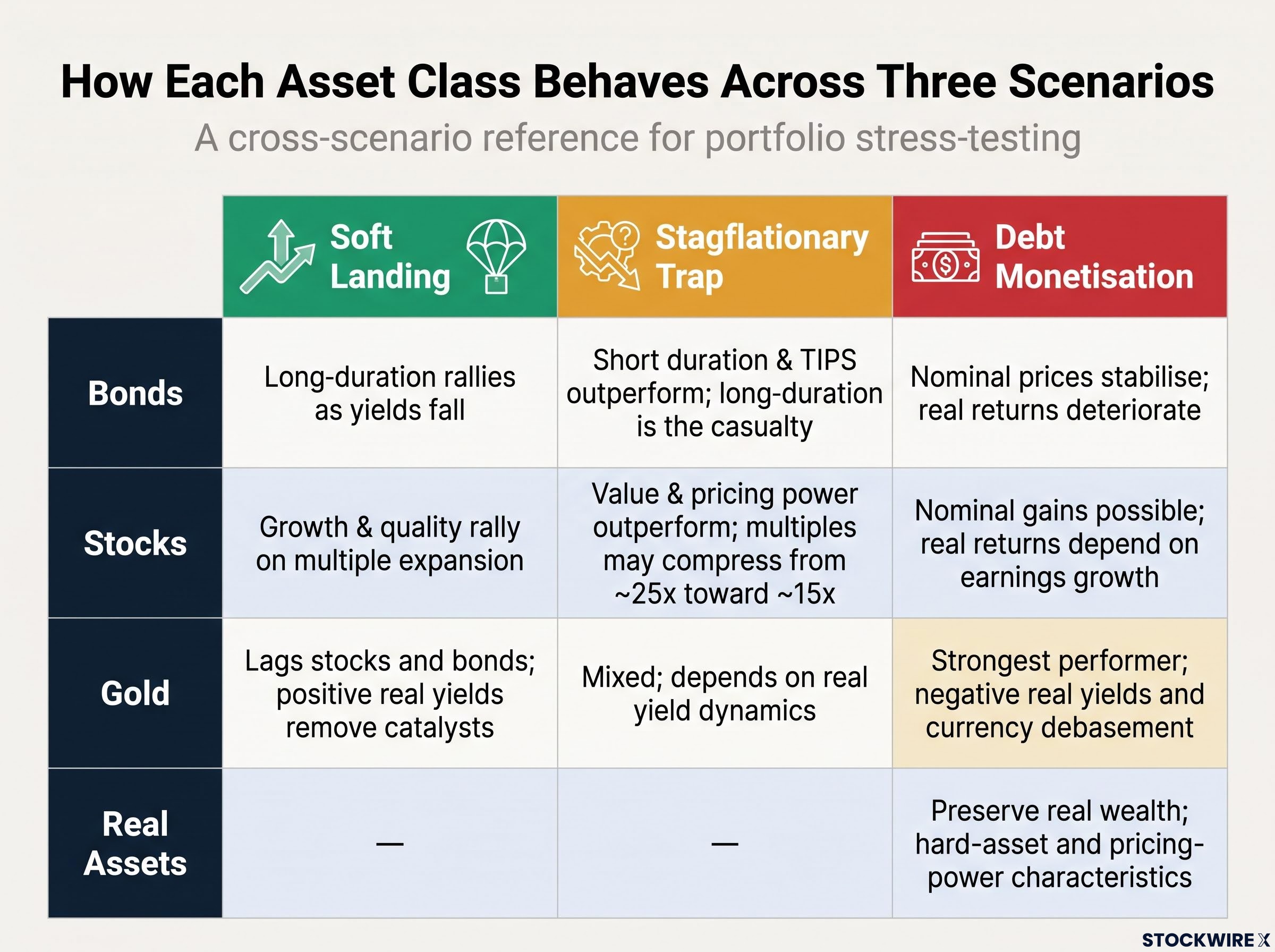
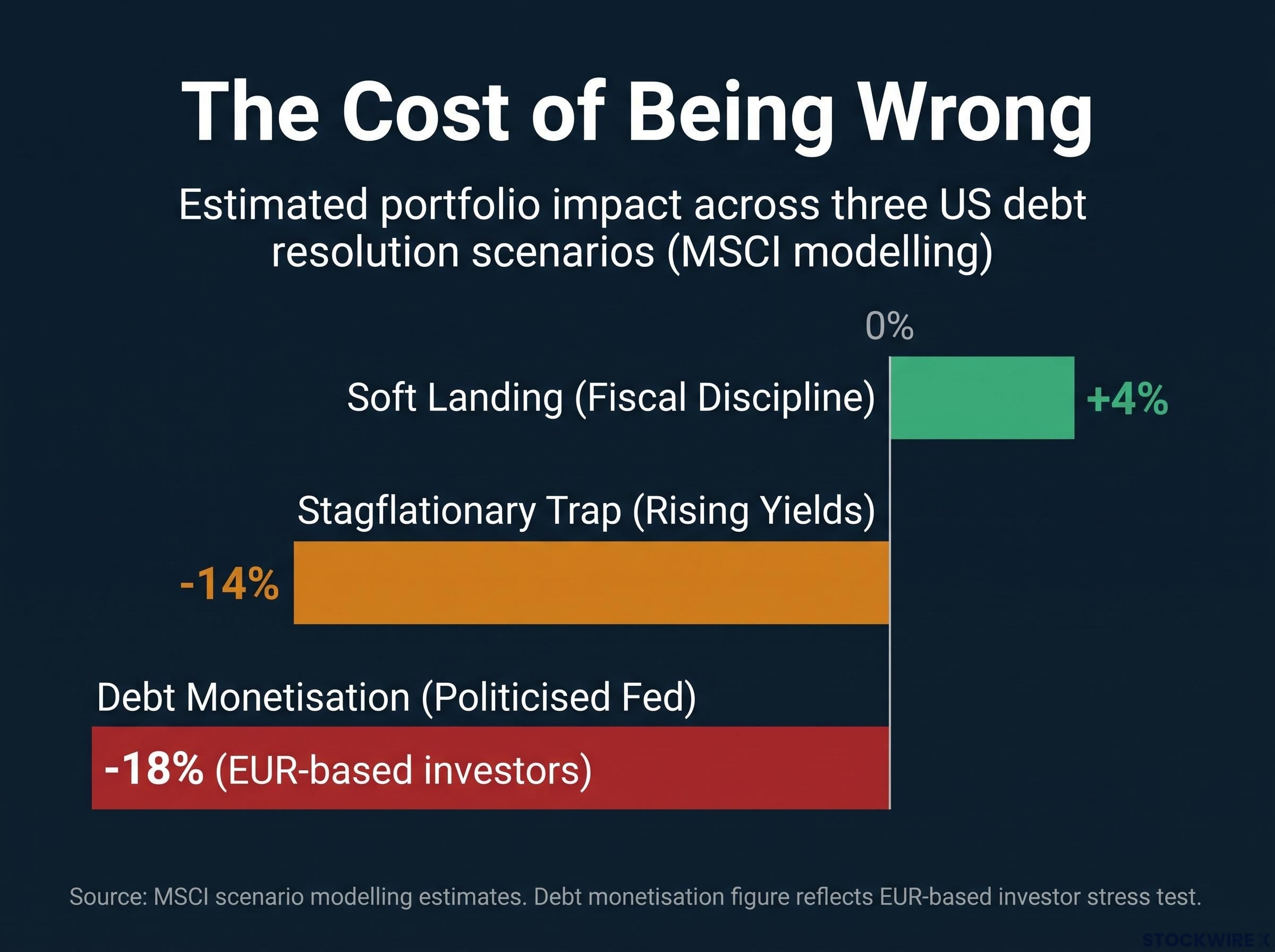
When all of that aligns, long-duration bonds gain as yields fall, quality growth equities benefit from multiple expansion, and gold lags both on a total-return basis because positive real yields and low macro stress remove its primary catalysts. MSCI scenario modelling estimates a fiscal-discipline scenario produces approximately +4% portfolio impact for a diversified multi-asset allocation.
The concentration risk is worth naming explicitly. This is the only scenario where heavy long-duration bonds plus high-multiple growth is clearly optimal. If you are positioned that way, you are implicitly making multiple simultaneous macro bets: that inflation cooperates, that the Fed delivers, that fiscal policy tightens, and that foreign buyers keep showing up. That is a lot of things to get right at once.
| Asset class | Soft-landing behaviour | Key driver |
|---|---|---|
| Bonds | Long-duration rallies as yields fall | Fed rate cuts and lower term premium |
| Stocks | Growth and quality benefit from multiple expansion | Declining discount rates boost valuations |
| Gold | Lags both stocks and bonds | Positive real yields and low macro stress |
Scenario 2: The stagflationary trap and what it does to valuations
This is the scenario currently assessed as most consistent with conditions on the ground, and the valuation math is where you need to pay attention.
The trap works like this: inflation retreats from its post-pandemic peak but fails to reach the Fed’s comfort zone, settling stubbornly above 3% and giving policymakers no room to cut. Yet raising rates is equally untenable, because the government’s debt stock, increasingly weighted toward short-maturity paper, means higher rates feed directly into a widening deficit spiral. The 10-year Treasury hovers in the 4.5-5%+ range. The Fed is stuck.
Supply-side stagflation, driven by energy price shocks rather than demand overheating, is the variant of the stagflationary trap most difficult to escape through conventional policy: the Fed cannot ease to support growth without entrenching inflation, and it cannot tighten further without accelerating the deficit spiral the article describes.
Which equity characteristics hold up in a high-rate, stuck-inflation environment
The valuation consequences are specific and severe. Equity multiples could compress from approximately 25 times earnings toward 15 times earnings as higher yields give investors an alternative to equities that did not exist during the zero-rate era.
When the 10-year moves from 5% to 6%, a stock at 10 times earnings absorbs the shift without catastrophic damage. A stock priced at 20-25 times earnings faces a very different outcome: the valuation multiple itself becomes the source of loss, entirely separate from any deterioration in the underlying business.
If your portfolio is concentrated in high-multiple growth names, that is not a minor headwind. It is a mechanism for substantial loss through valuation compression alone.
What survives here: value stocks with high current cash flows and reasonable multiples, companies with genuine pricing power and fixed-rate debt, and short-duration fixed income including T-bills and TIPS. Stocks trading at 2-3 times price-to-sales while generating profits and growing at 40-50% annually represent the kind of lower-multiple opportunity that handles rate pressure without requiring multiple expansion to deliver returns.
MSCI modelling estimates the rising-yields stagflationary scenario produces approximately -14% portfolio impact, with losses driven mainly by equities and long-duration bonds. Long-duration nominal Treasuries are the primary casualty.
Scenario 3: Debt monetisation, yield curve control, and why gold matters here
The trigger path here is distinct from a standard high-inflation environment. As short-maturity rollover needs rise to a level where the Treasury’s finances come under genuine stress, the Fed intervenes to suppress yields through large-scale bond purchases funded by newly created money. Hypothetical yield curve control could involve capping the 10-year at 5%, 5.5%, or 6%, with the Fed purchasing whatever quantity is needed to enforce the ceiling.
What makes this different from simply “rates stay high” is the mechanism of wealth transfer it creates. When a yield cap sits below the prevailing rate of inflation, holders of nominal bonds receive a return that fails to keep pace with rising prices, by deliberate policy design. Real purchasing power drains steadily from bond portfolios. This is the mechanism by which the government offloads its debt burden onto savers and investors.
Equities get an initial nominal lift from the liquidity injection. But the rally can mask real-return deterioration happening underneath. Your portfolio statement may show nominal gains while your purchasing power erodes. Understanding that distinction matters before interpreting any gains as genuine wealth creation.
Gold is the historical standout in this environment. Negative real yields, money creation, and currency-credibility concerns are exactly the conditions that have supported large gold bull markets historically. Global investors losing confidence in artificially suppressed real yields could rotate away from US dollar assets, adding a currency-loss layer and further supporting commodity-priced assets. MSCI modelling estimates a politicised-Fed scenario produces portfolio losses of up to -18% for EUR-based investors in related stress tests. Businesses with founder-operator leadership are considered more likely to actively manage through these conditions rather than being optimised for a single favourable outcome.
The relationship between sovereign debt and gold has shifted from cyclical to structural: central banks bought 244 tonnes in Q1 2026 alone, and institutions including BlackRock and JPMorgan have explicitly replaced a portion of their bond diversification exposure with gold as the stock-bond correlation has turned persistently positive during inflation shocks.
| Asset class | Behaviour under debt monetisation | Key driver |
|---|---|---|
| Bonds | Nominal prices stabilise, but real returns deteriorate | Yield cap below inflation erodes purchasing power |
| Stocks | Initial nominal rally; real returns depend on earnings growth | Liquidity injection boosts multiples, but inflation offsets |
| Gold | Strongest performer across the three scenarios | Negative real yields and currency debasement fears |
| Real assets | Preserve real wealth, though cyclical and localised | Pricing power and hard-asset characteristics |
What holds up across all three paths
The three scenarios create opposing pressures. But certain portfolio characteristics reduce fragility regardless of which path arrives. They are not bets on a single outcome. They are structural properties that limit the downside without requiring you to predict the future correctly.
- Reasonable valuations. Stocks at 10 times earnings are significantly less exposed to yield-driven compression than those at 20-25 times. An insurance company trading at approximately 10 times earnings, for example, handles rate moves that would severely damage a stock at 25 times. Lower multiples reduce your portfolio’s sensitivity to the discount-rate environment.
- Pricing power. Businesses that can raise prices with or ahead of inflation deliver better real returns than passive inflation hedges across scenarios one and two. This is because pricing power operates through the earnings line rather than as a separate allocation. The question is not just “how much gold do you own” but “can these companies raise prices.”
- Shorter duration across the portfolio. Short-maturity bonds, T-bills, CDs, and laddered fixed income reduce interest-rate risk while capturing higher coupons. Critically, high-multiple growth stocks are long-duration assets too, meaning their value is most sensitive to rate moves. Duration risk (the degree to which an asset’s price changes when interest rates move) hides in equity portfolios that appear diversified but are concentrated in long-duration names.
The stock-bond correlation breakdown documented through the 2022 and 2025 inflation shocks is precisely why the cross-scenario resilience framework matters: long-duration bonds and growth equities, the twin anchors of the classic 60/40 allocation, now tend to fall together when inflation surprises to the upside, removing the diversification buffer the prior decade’s investors relied on.
- Strong balance sheets and fixed-rate debt. Companies with low leverage and fixed-rate funding are more resilient when rates stay elevated. Variable-rate borrowers face rising financing costs that compress margins regardless of their business quality.
- Selective real-asset and gold exposure. A measured allocation, sized as insurance rather than the portfolio’s primary engine, offers protection in scenario three without creating significant drag in scenario one.
High-multiple growth stocks are long-duration assets. Their value is most sensitive to interest rate moves. If your portfolio looks diversified across sectors but is concentrated in long-duration equities, you carry more rate risk than you may realise.
Why pricing power beats gold as an inflation hedge in most scenarios
Businesses with durable pricing power outperform passive inflation hedges in scenarios one and two, where gold either lags or delivers mixed results. Gold provides complementary protection specifically in scenario three, where negative real yields and currency concerns are the dominant forces. They are not competitors. They are tools with different scenario profiles, and your portfolio benefits from both.
Why management quality matters across scenarios
Businesses led by capable, owner-oriented management, particularly founder-operators, are more likely to adapt actively across varying economic conditions. Management teams optimised for a single favourable macro outcome tend to struggle when conditions shift. Adaptability is a characteristic that compounds across all three paths.
The three-question stress test for your existing holdings
The framework above is useful. But it becomes actionable when you apply it to what you already own. For each holding in your portfolio, run these three questions:
- What happens if the 10-year stays at or above 4.5-5% for five or more years?
- Is this holding’s expected return contingent on valuation multiples expanding or yields declining over time?
- Is the bond or fund exposed to significant duration risk?
- If the answer to either is yes, you are carrying an implicit soft-landing assumption in the position.
- How does this holding behave if inflation averages 3-3.5% with the policy rate staying above it?
- Does the business have genuine pricing power?
- Is its debt fixed-rate or variable?
- Companies with variable-rate borrowing face direct margin compression in this environment.
- If real yields are capped below inflation through financial repression, how is real purchasing power protected?
- Does this holding have hard-asset characteristics, global revenue, or explicit inflation linkage?
- Is there exposure to dollar weakness from foreign investor rotation?
- If neither, your purchasing power erodes even while nominal prices may rise.
Holdings that score acceptable across all three questions rarely maximise upside in any single scenario. That is the trade-off. But they dramatically reduce the chance of being structurally wrong regardless of which path unfolds. Most retail portfolios were built during a decade of falling yields and expanding multiples. Running these three questions reveals which of your holdings are implicitly betting that decade continues, and which are genuinely robust to what comes next.
Building for the path you cannot predict
The allocation that travels across all three scenarios is not mysterious. It is specific: equities tilted toward value, pricing power, strong balance sheets, and capable management; fixed income focused on short duration and inflation-aware instruments; real assets and gold as structured insurance, sized to matter in scenario three without dragging on returns in scenario one.
The MSCI scenario data frames the cost of being wrong. A stagflationary trap produces approximately -14% portfolio impact. A politicised-Fed scenario produces up to -18% for EUR-based investors. A fiscal-discipline soft landing produces +4%. The gap between the downside scenarios and the upside scenario tells you something important: the cost of being positioned exclusively for the best case, and being wrong, is several times larger than the modest cost of resilience positioning.
| Portfolio dimension | Soft landing | Stagflationary trap | Debt monetisation |
|---|---|---|---|
| Equities | Growth and quality rally on multiple expansion | Value, pricing power, and low multiples outperform | Nominal gains possible; real returns depend on earnings |
| Bonds | Long duration benefits from falling yields | Short duration and TIPS; long duration is the casualty | Nominal prices stabilise; real returns deteriorate |
| Gold and real assets | Lags both stocks and bonds | Mixed; depends on real yield dynamics | Strongest performer; negative real yields are the catalyst |
| Valuation approach | Higher multiples justified by lower rates | Lower multiples required; 10x earnings handles pressure | Real earnings growth is the only metric that matters |
| Key risk to avoid | Excessive caution that forgoes the rally | Concentration in high-multiple, long-duration growth | Treating nominal gains as real wealth creation |
This approach does not maximise your upside in any single scenario, especially the soft landing. That is the trade-off, and it is worth naming honestly. But it means you stop requiring a correct macro prediction to avoid severe outcomes. The question to ask of any holding is not “will this outperform if I am right about where the economy is heading” but “how does this behave if I am wrong.”
Resilience positioning is not defensive pessimism. It is a deliberate choice to build a portfolio that does not need you to be right about the future to protect your wealth across it.
This article is for informational purposes only and should not be considered financial advice. Investors should conduct their own research and consult with financial professionals before making investment decisions. Past performance does not guarantee future results. Financial projections are subject to market conditions and various risk factors.