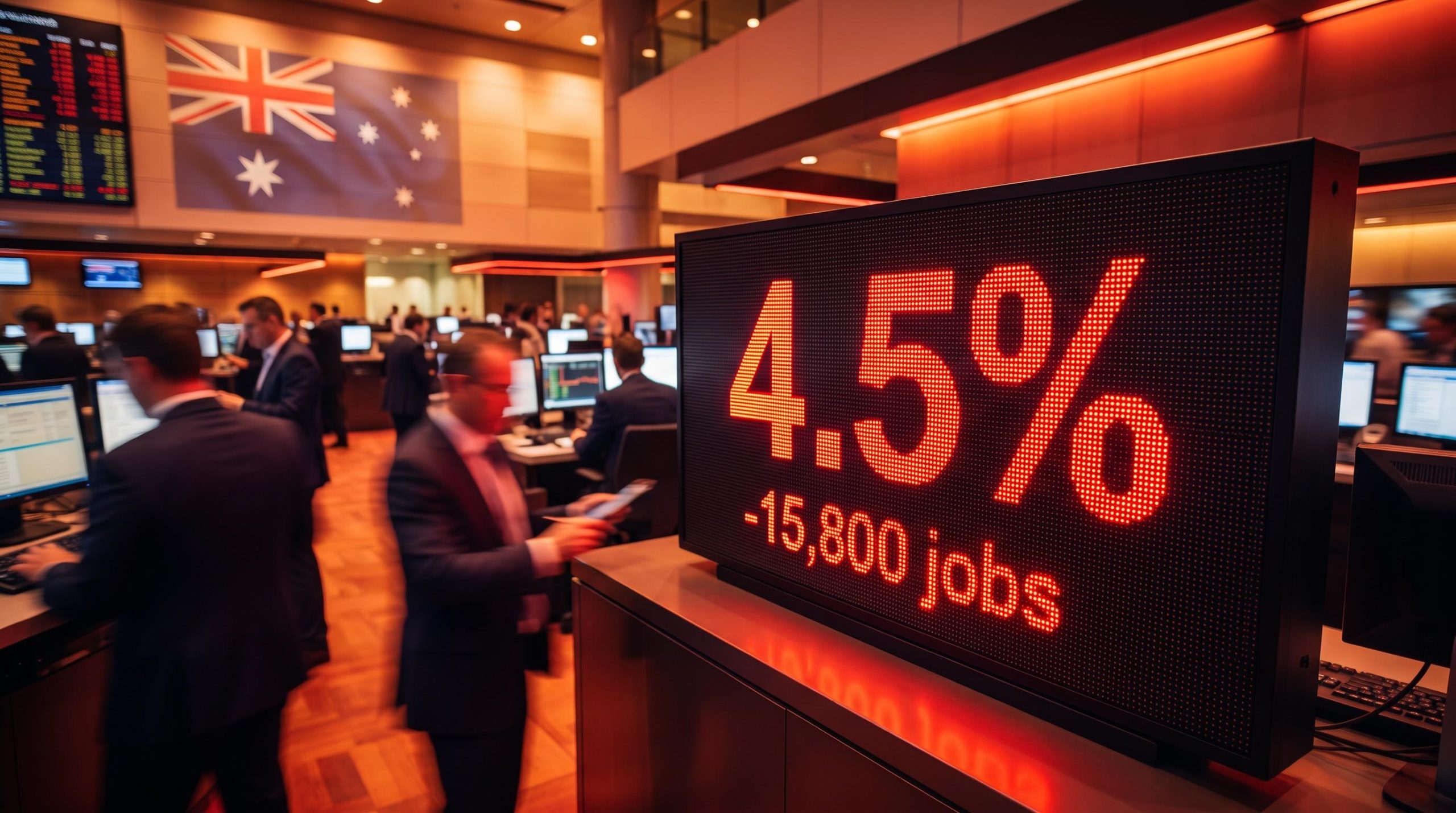
Australia’s July labour market data, published on 21 August 2026, delivered a clear cooling signal: the unemployment rate reached 4.5%, its joint-highest level since the COVID period, while the economy shed 15,800 jobs in a month when forecasters had expected a gain of 12,000.
The print does not arrive in isolation. The S&P/ASX 200 Financials Index had already lost 9.2% across the preceding ten trading sessions, Wall Street closed lower across the board overnight, and the August earnings season is producing sharp divergence beneath the index surface. The data point that would have once been a footnote now lands as a macro anchor for Australian investors navigating the final weeks of August.
Here is what the Australian jobs data actually tell you about the RBA’s next move, what they mean for bank stocks already under pressure, and where the cleaner earnings stories are emerging in a market that rewards picking carefully right now.
Australia’s July jobs report: what the numbers actually showed
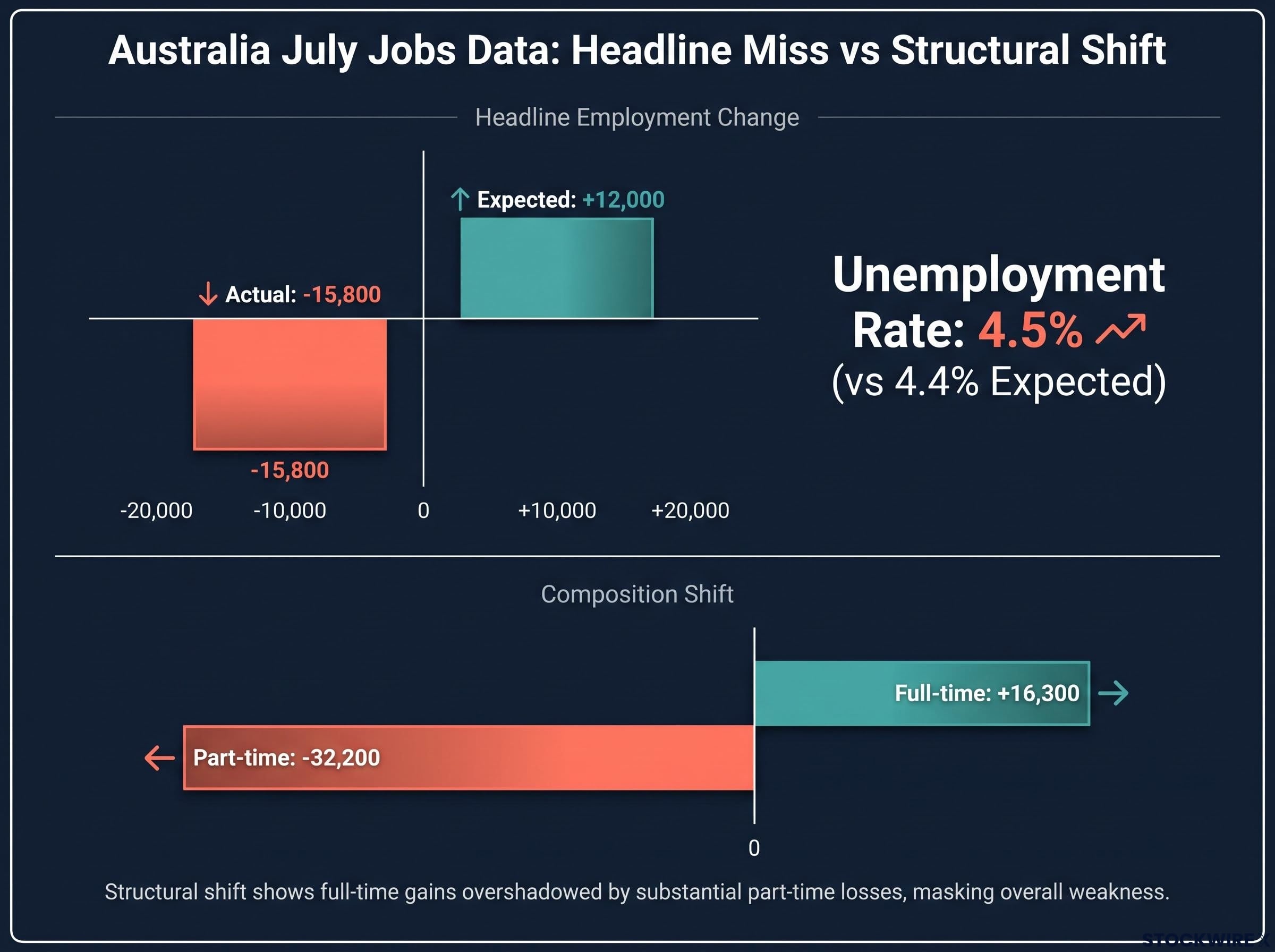
The headline: unemployment rose to 4.5% in July, up from 4.4% in June, beating the 4.4% consensus estimate and marking its equal-highest level since late 2021.
The miss was sharper beneath the surface. July’s employment count dropped by 15,800 positions against a market forecast of a 12,000 rise. That is a swing of nearly 28,000 jobs relative to expectations.
-15,800 jobs vs. a consensus expectation of +12,000, a near-28,000 miss that represented the sharpest labour market shortfall relative to forecasts recorded in 2026.
Then the composition tells a different story. Full-time roles expanded by 16,300, with all of the headline weakness concentrated in a 32,200 decline in part-time positions. The employment-to-population ratio slipped 0.2 percentage points to 63.9%, and participation edged lower.
That full-time/part-time split matters. This was not a broad-based jobs collapse. It was a structural shift in the composition of employment, with part-time roles bearing the full weight of the adjustment. For anyone reading the headline as a signal of economy-wide deterioration, the detail underneath complicates that view considerably.
July’s 4.5% unemployment rate matches the April labour market reading that first triggered concern among major bank economists, who at the time characterised conditions as gradual cooling rather than structural deterioration; the reoccurrence of the same print in July, combined with a sharper employment miss, adds weight to the case that the softening is more persistent than initially assessed.
| Metric | Actual | Consensus | Prior Month |
|---|---|---|---|
| Unemployment rate | 4.5% | 4.4% | 4.4% |
| Employment change | -15,800 | +12,000 | Positive |
| Full-time change | +16,300 | N/A | N/A |
| Part-time change | -32,200 | N/A | N/A |
| Employment-to-population ratio | 63.9% | N/A | 64.1% |
When big ASX news breaks, our subscribers know first
Why the July data removes September from the RBA’s agenda
Markets had been pricing hike risk into the near term after strong June employment figures suggested the labour market was holding tighter than the RBA wanted. July reversed that narrative in a single print.
The July report, combining a rise in unemployment with a net fall in employment, led economists to conclude that the probability of a September rate increase had become vanishingly small. The chain of reasoning is straightforward: a labour market at its equal-highest unemployment since late 2021 is no longer in overheated territory, and an RBA that hikes into softening employment data would be doing so against its own stated framework.
The RBA monetary policy framework explicitly ties rate decisions to both price stability and full employment conditions, which is why a labour market printing at its equal-highest unemployment since late 2021 materially changes the calculus for any near-term tightening move.
The market signals that followed were consistent:
- The Australian dollar weakened against major peers as investors wound back expectations for imminent policy tightening
- Domestic bond yields retreated, with the near-term rate path repricing to reflect a more accommodative outlook
- September rate hike odds compressed materially from their post-June highs
For your portfolio, the September hike coming off the table is not just a monetary policy detail. It is a repricing catalyst for rate-sensitive assets: government bonds, property-linked equities, and defensives all benefit when the market stops pricing a near-term tightening. That repricing was already moving within hours of the release.
What “lower rates because of weaker growth” actually means for ASX investors
The relief of no rate hike comes with a cost. A dovish RBA path driven by weak demand is categorically different from one driven by inflation returning to target with growth intact. The reason rates are staying low matters as much as the fact that they are staying low.
“The reason rates are staying low matters as much as the fact that they are staying low.”
Weaker labour demand feeds through to consumption, credit growth, and earnings for domestically exposed businesses. Rising unemployment is a leading indicator for higher arrears, tighter lending standards, and slower top-line growth across banks, retailers, and discretionary services, even as funding cost pressure eases.
The same dynamic underpins the broader stagflation risk that economists flagged when April 2026 data produced an identical 4.5% unemployment reading alongside trimmed mean inflation still running above the RBA’s target band, a combination that constrains the RBA’s ability to cut aggressively even as growth softens.
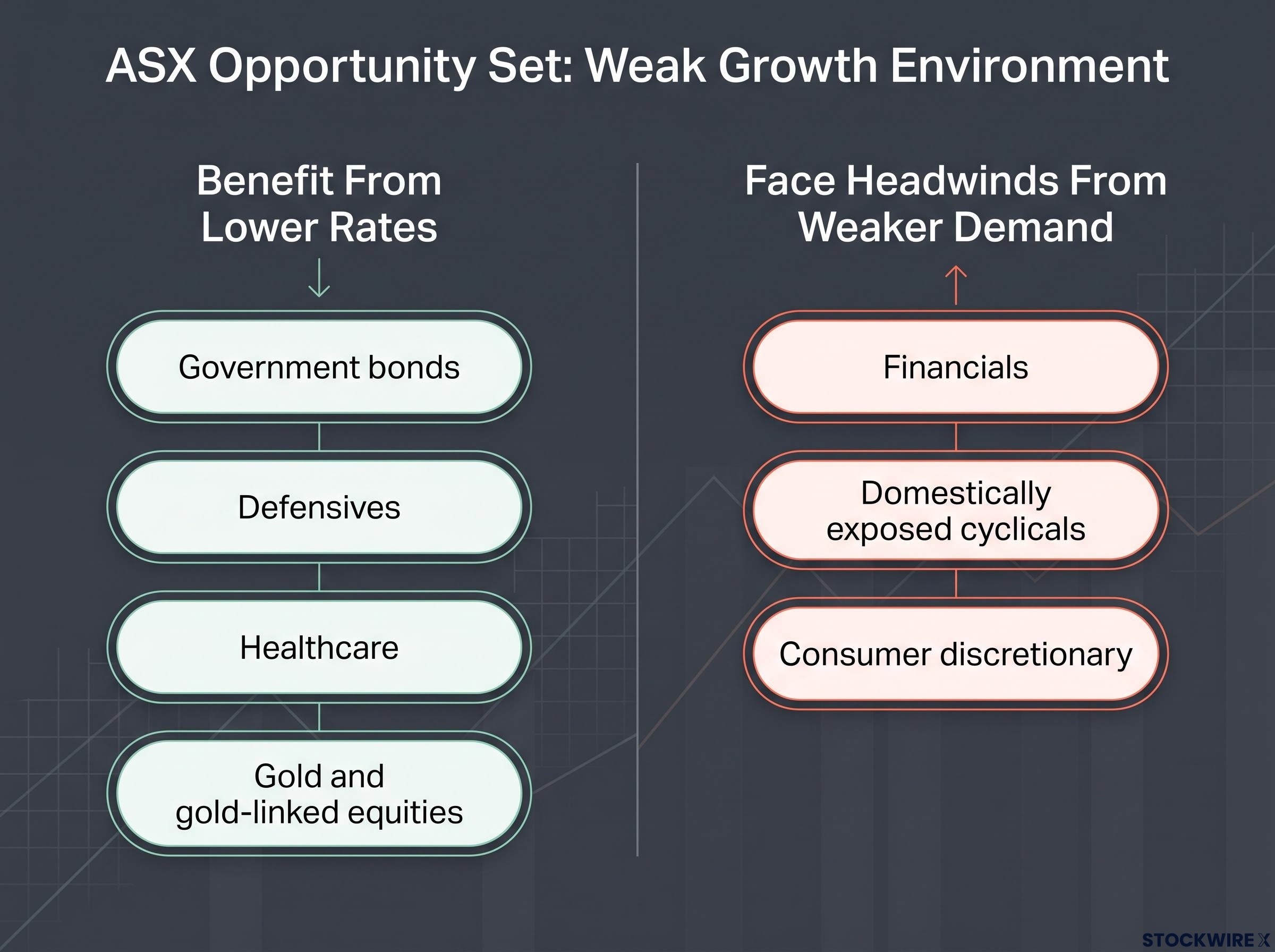
That creates a bifurcation in the opportunity set:
- Benefit from lower rates: Government bonds, defensives, healthcare, gold and gold-linked equities
- Face headwinds from weaker demand: Financials, domestically exposed cyclicals, consumer discretionary
The same data point that removes hike risk also signals pressure on household spending and bank credit quality. For the ASX as a whole, this is not an unambiguous positive. It is a sorting mechanism, and knowing which side of the sort your holdings sit on is the most practically useful framework right now.
ASX Financials under pressure, and why the jobs data deepens the concern
“By the close on 21 August 2026, the S&P/ASX 200 Financials Index had recorded losses in nine of its preceding ten sessions, accumulating a total decline of 9.2% over that stretch.”
That pace tells you this is not a one-day reaction. The S&P/ASX 200 Financials Index had already been repricing the sector’s near-term earnings outlook before the July jobs data arrived. The labour report confirmed the headwind that was already embedded in the price action.
The mechanism is direct. Rising unemployment increases the probability of higher loan loss provisions as mortgage stress builds. Tighter lending standards compress top-line growth. Even if the RBA holds rates steady, thereby easing some funding cost pressure, the demand-side deterioration that is causing the hold creates its own structural headwind for bank earnings.
ASX bank valuation had already been stretched heading into August, with CBA trading near 27-28x forward earnings against a long-run average of 18x, meaning the sector entered this reporting period with limited room to absorb a credit quality deterioration.
Short-term volatility in the sector is likely to persist until investors see clearer evidence that credit quality is stabilising. The three forward watchpoints:
- Language from the RBA and major banks on loan loss provisions and mortgage stress
- Subsequent labour, retail sales, and housing data confirming or contradicting July’s signal
- Evidence of mortgage arrears stabilisation in the next round of bank disclosures
For investors holding bank stocks or financial sector funds, understanding this mechanism, rather than just the magnitude of the decline, is what allows an informed decision about whether to hold, reduce, or wait for a stabilisation signal.
What the 21 August earnings slate reveals about dispersion beneath the index
The reporting slate on 21 August made one thing clear: the index-level story is masking a wide spread of individual outcomes. Record results in gold and quality growth names sat alongside impairments and strategic pivots in commodity and consumer-facing businesses.
Record results and guidance upgrades
Regis Resources produced a standout FY2026 full year: NPAT of A$715 million and EBITDA of A$1.345 billion (up 72%) were underpinned by gold sales revenue of A$2.349 billion (up 43%), with the group’s cash and bullion balance reaching a record A$1.184 billion. Shareholders received a record full-year dividend of 35 cents per share, which incorporated a 5 cent special component.
Guzman y Gomez posted full-year network sales of A$1,378 million, a rise of 17.9%, alongside underlying EBITDA of A$85.0 million (up 28.7%) and underlying NPAT of A$53.4 million (up 29.7%). The business returned capital through a further A$100 million buyback and declared a full-year dividend of 48.0 cents per share.
Fisher & Paykel Healthcare revised its FY2027 NPAT guidance upward to a range of NZ$525-565 million from the prior NZ$500-550 million band, with the updated figures incorporating NZ$23 million in US tariff refunds. QuickFee crossed into profitability for the first time, recording NPAT of A$3.7 million for the full year and announcing an inaugural dividend to shareholders.
These are businesses whose earnings drivers, gold prices, network expansion, medical device demand, and professional services fee finance, are structurally independent of Australian labour market conditions.
Restructuring, impairments, and strategic pivots
Mount Gibson Iron reported a full-year net loss of A$30.2 million, with results weighed down by a A$58.9 million non-cash impairment against its Koolan Island asset and an iron ore revenue line that contracted to A$204.0 million from A$330.5 million in FY2025. Management is redirecting the business toward gold, and the group’s A$412.1 million in cash and investments gives it the balance sheet capacity to pursue that transition.
Perenti announced the sale of its BTP equipment rental business to a Cratus Group-led consortium for A$100 million, a transaction that will generate an accounting loss of approximately A$64 million on a non-cash basis. Credit Corp entered a binding agreement to take on HSBC Australia’s credit card run-off book for around A$150 million, and updated its FY2027 NPAT guidance to A$112-120 million.
| Company | Key Result | Key Metric | Outlook Signal |
|---|---|---|---|
| Regis Resources | Record NPAT A$715M | EBITDA +72% | Record dividend, record cash |
| GYG | Underlying NPAT +29.7% | Network sales +17.9% | A$100M buyback, first full-year dividend |
| Fisher & Paykel Healthcare | Guidance raised | NPAT NZ$525-565M | Strong first-half momentum |
| QuickFee | Maiden positive NPAT | EBTDA +58% | First dividend declared |
| Mount Gibson Iron | Net loss A$30.2M | A$58.9M impairment | Strategic pivot to gold |
| Perenti | BTP divestment A$100M | A$64M accounting loss | Portfolio simplification |
| Credit Corp | HSBC book acquisition ~A$150M | FY2027 NPAT A$112-120M | ~10% earnings growth guided |
The spread between Regis Resources’ record cash position and Mount Gibson’s impairment-driven loss illustrates the point: two companies in adjacent resource sectors produced radically different outcomes in the same reporting period. Index exposure alone does not capture that divergence.
Positioning for what comes next: selectivity over index exposure
Offshore markets compound the domestic caution. US equities finished lower across all major benchmarks, with the S&P 500 settling at 7,641 (down 0.87%), the Dow at 52,759 (down 1.32%), the NASDAQ at 26,067 (down 1.00%), and the Russell 2000 at 2,992 (down 1.34%). The VIX advanced 7.6% to reach 16.01, a level not seen since 5 August, while ASX 200 futures indicated an opening decline of 28 points (down 0.31%) on the morning of 21 August 2026.
Fear gauges moved sharply higher, with the VIX settling at 16.01 after climbing 7.6%, reaching its loftiest point since 5 August, as overnight pressure from rising bond yields and oil prices drove the move.
A negative Wall Street lead, a domestic jobs miss, and sustained Financials sector selling are pointing in the same direction. The burden of proof for new broad index positions is elevated right now.
Favour in this environment:
- Government bonds and duration-sensitive assets
- Defensive sectors and healthcare
- Gold and gold-linked equities
- Quality businesses with pricing power, strong balance sheets, and earnings drivers independent of the domestic cycle
Treat with caution:
- Financials and bank stocks, until credit quality indicators stabilise
- Domestically cyclical names exposed to consumer spending and employment trends
- High-beta positions without clear near-term earnings support
The watchpoints that would change the picture: subsequent RBA language on the labour market, the next round of retail sales and housing data, and credit quality disclosures from the major banks.
Earnings dispersion this wide means index exposure is a blunt instrument. The environment rewards knowing what you own and why.
For investors weighing whether current index-level weakness is a temporary earnings-season disruption or something more structural, our deep-dive into ASX 200 August seasonality examines 45 years of return data and explains why concentrated earnings-day swings from index heavyweights have repeatedly broken the month’s historically constructive seasonal pattern.
This article is for informational purposes only and should not be considered financial advice. Investors should conduct their own research and consult with financial professionals before making investment decisions. Past performance does not guarantee future results.