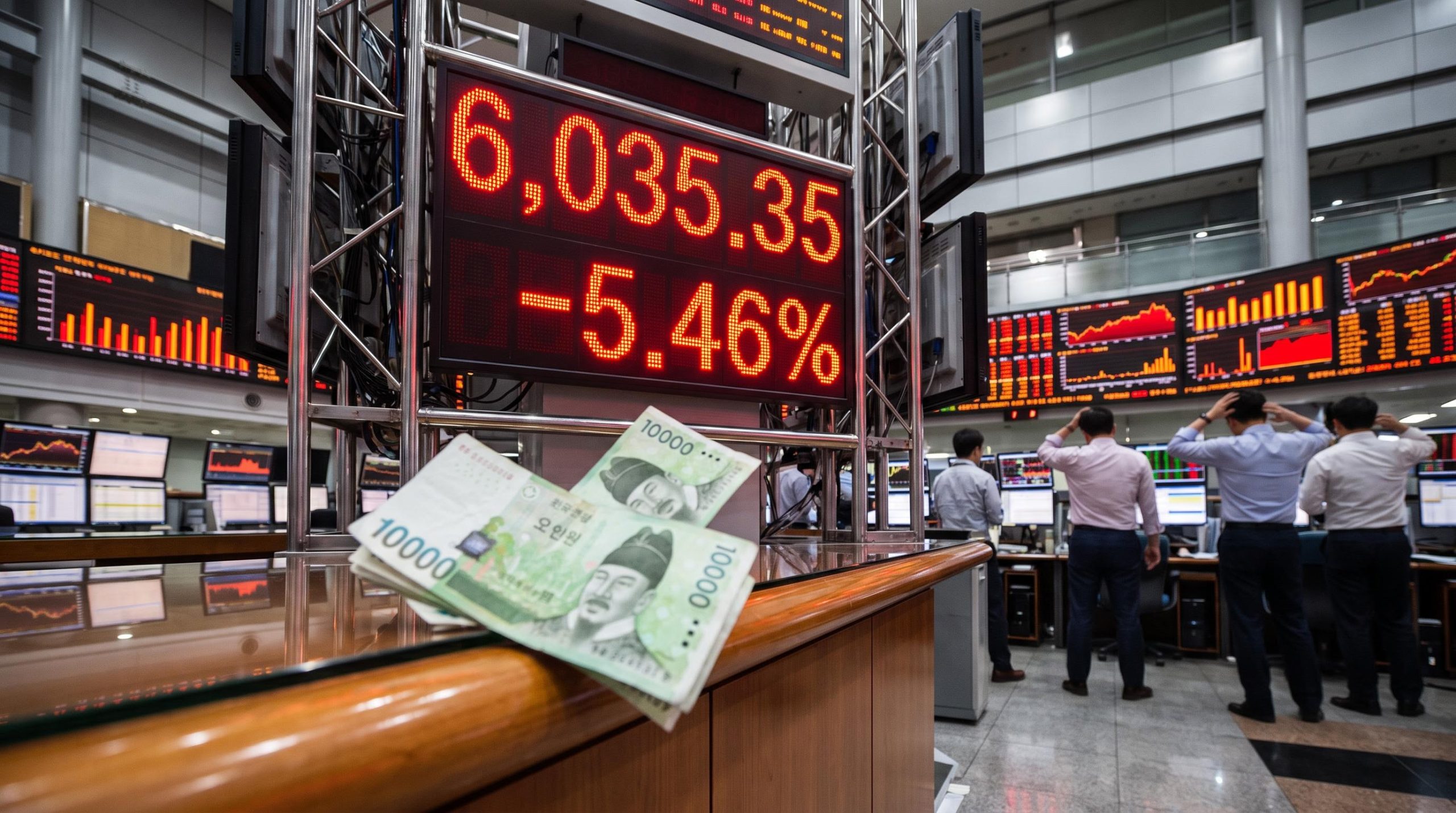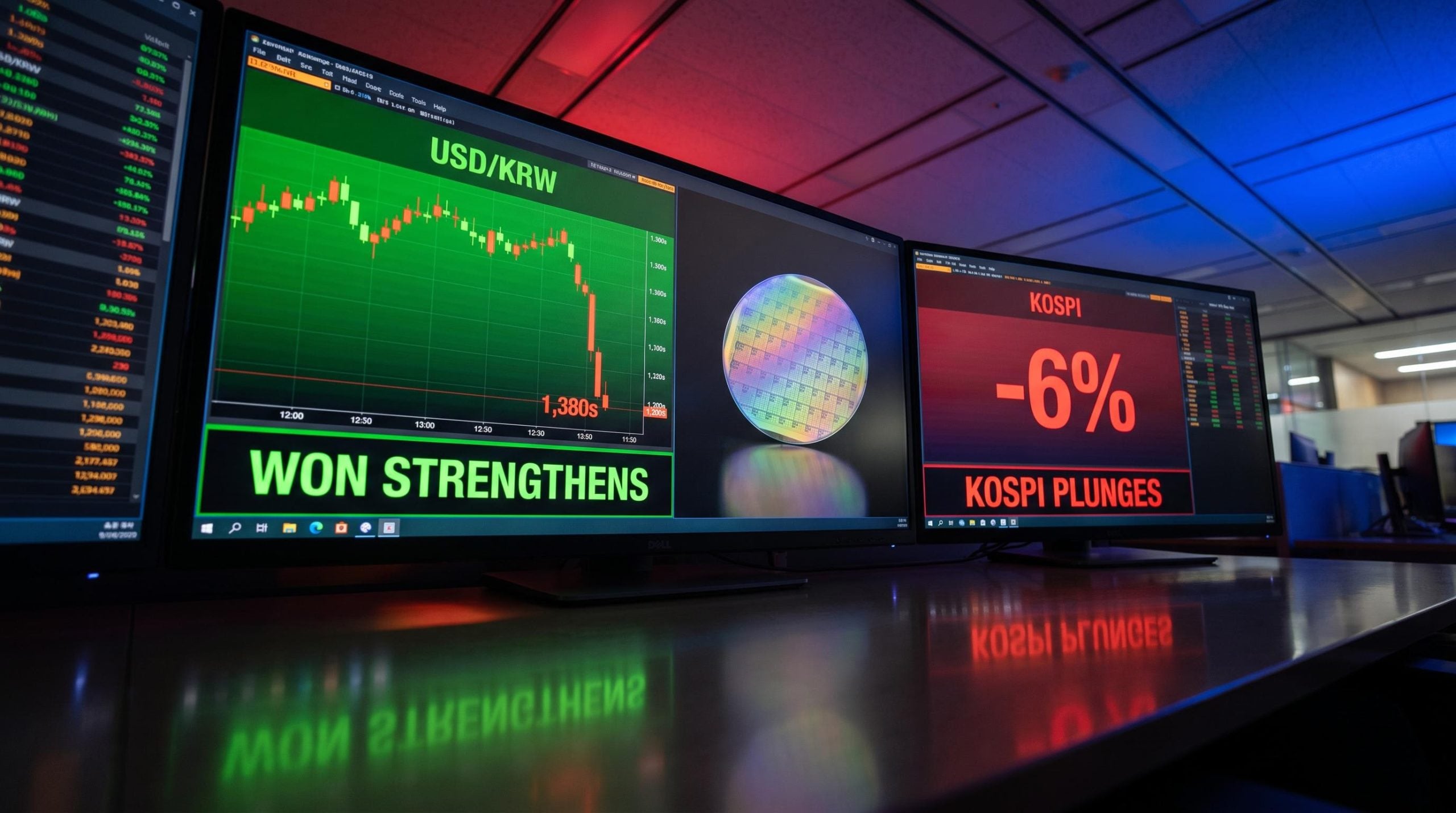
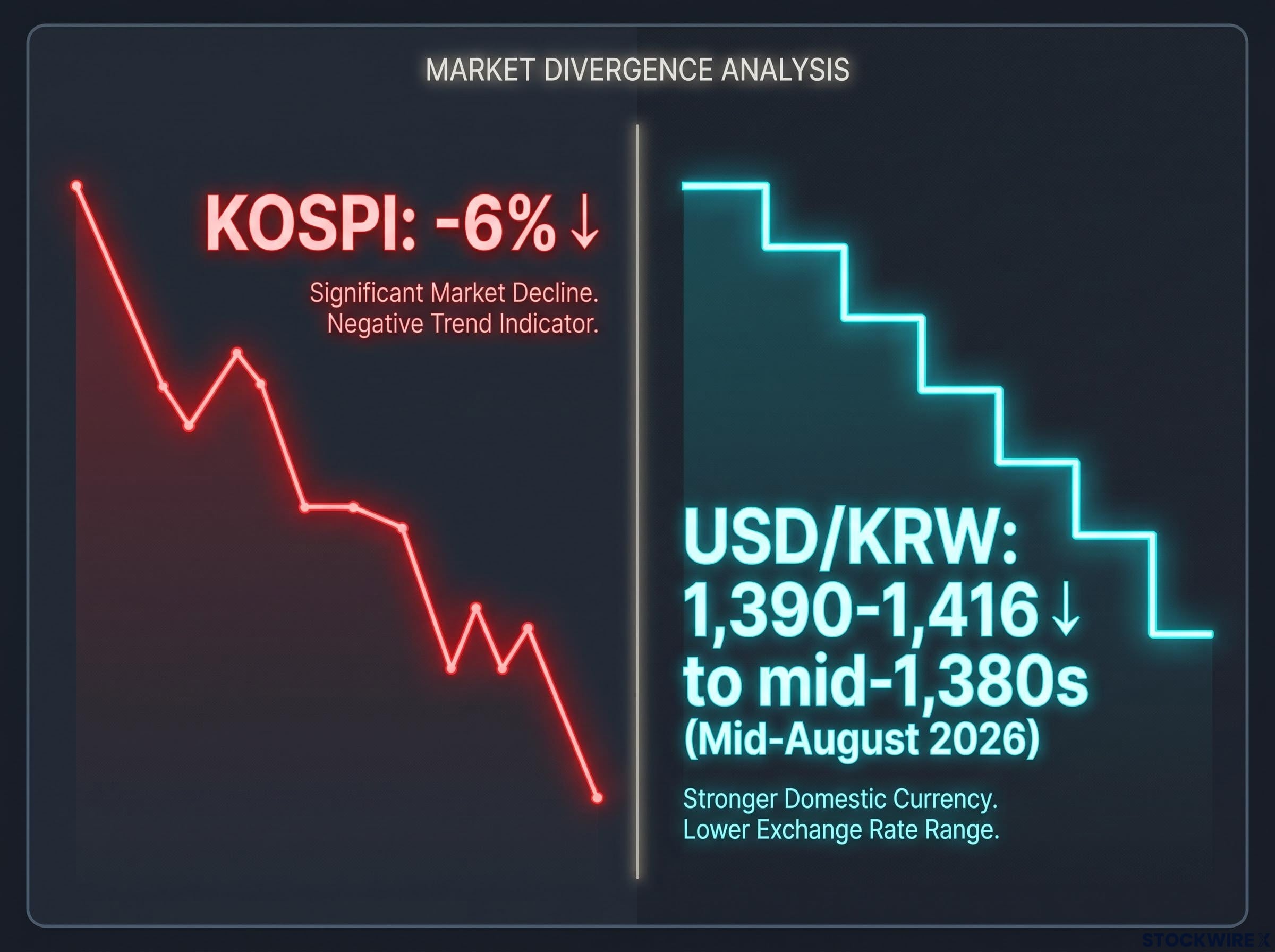
A sharp reversal in the USD/KRW exchange rate brought the pair down to the mid-1,380s, representing one of the Won’s most notable rallies of the year. The move ran counter to what was happening in Korean equities, where the KOSPI shed roughly 6% over the same period, dragged lower by heavy selling in semiconductor names.
That combination, a strengthening currency alongside a weakening equity market, matters well beyond Seoul. Korea is one of the most trade-dependent economies in the world, and the conventional expectation is that equity weakness drags the currency down with it. When the opposite happens, it tells you something specific about who is buying, who is selling, and which market is responding to which set of forces.
Here is the mechanism behind the divergence, what DBS strategist Chang Wei Liang identifies as the structural supports holding the Won up, and the four variables that will determine whether the currency can hold these levels in the weeks ahead.
The number that makes no sense at first glance
The headline data looks contradictory. Before resolving the tension, it is worth sitting with the raw numbers:
- USD/KRW fell to the mid-1,380s, marking one of the pair’s strongest moves in favour of the Won this year
- The KOSPI retreated by around 6%, with the sell-off concentrated in semiconductor stocks
- The broader mid-August 2026 USD/KRW trading range was 1,390-1,416, making the move to the mid-1,380s a meaningful push through the lower boundary
- DBS strategist Chang Wei Liang has been the primary analyst attributing this divergence to specific settlement mechanics
The surface-level logic runs the other direction. Korea’s economy is heavily concentrated in semiconductor exports. When those stocks sell off, foreign capital should, in theory, exit Korean assets, generating USD buying and Won weakness. That is the intuition most readers carry into this data.
The KOSPI’s concentration in semiconductor names is not incidental context: Samsung Electronics and SK Hynix together have represented well over 40% of the benchmark’s total market capitalisation, meaning that sector-specific selling transmits directly into broad index declines through passive ETF redemption mechanics.
The FX market and the equity market are not responding to the same set of buyers and sellers. That distinction is the starting point for understanding why the numbers make perfect sense once you look beneath the headline.
When big ASX news breaks, our subscribers know first
How custodian banks move currencies without moving markets
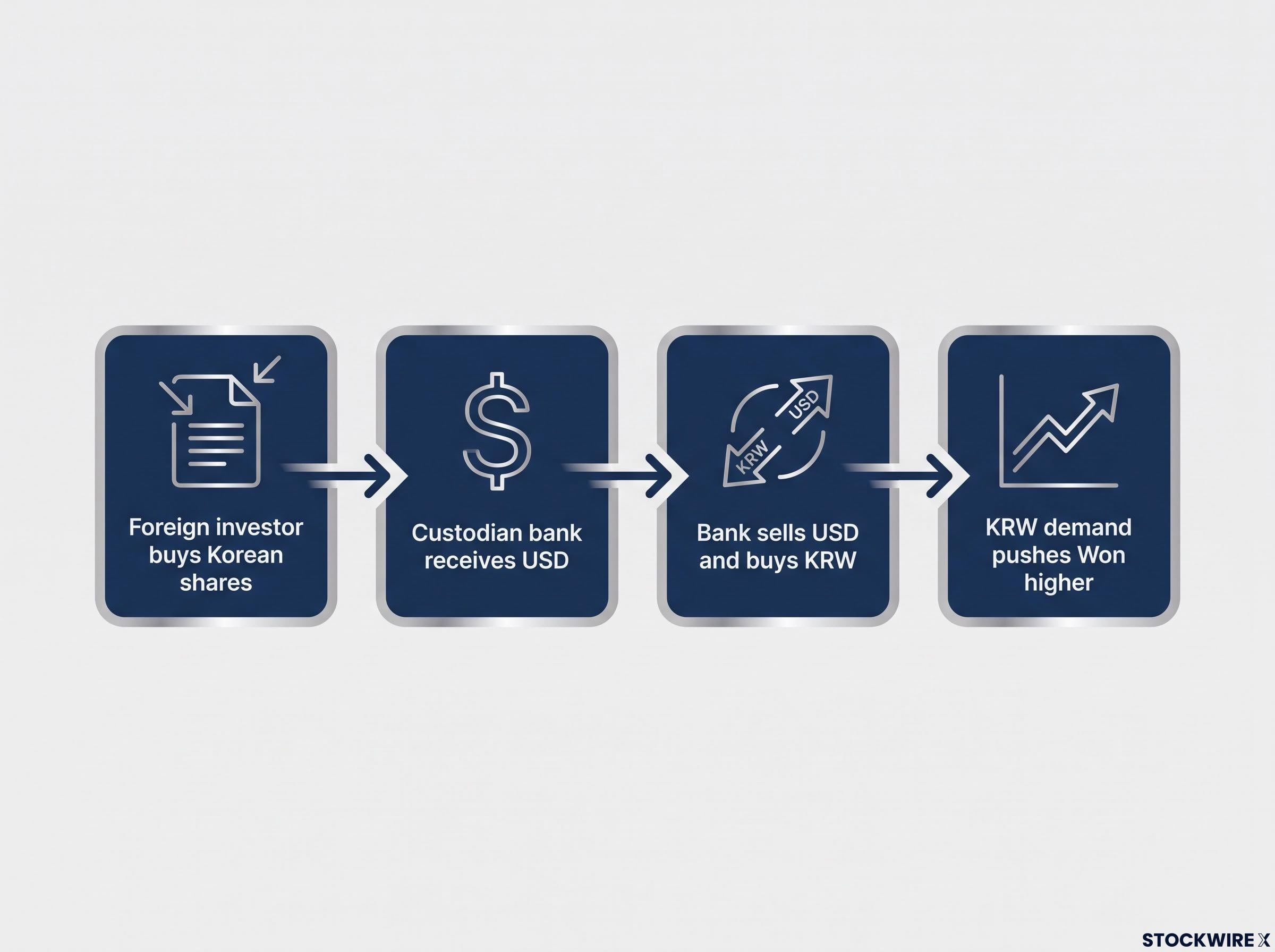
The mechanism is mechanical, not speculative, and it unfolds in a specific sequence:
- A foreign investor decides to buy Korean shares during the semiconductor-led pullback
- The investor’s custodian bank receives USD from the buyer
- The custodian bank must sell that USD and buy KRW to deliver Won at settlement
- That KRW demand pushes the Won higher in the FX market, independent of any view on the currency itself
The critical detail is that these FX trades are driven by contractual settlement obligations, not by directional currency bets. Custodian banks do not care whether they think the Won will appreciate or depreciate. They need KRW to complete the transaction, and they need it on the settlement date.
Reports indicate that overseas investors treated the equity downturn as a buying opportunity, rotating into Korean stocks and focusing on semiconductor names whose valuations had compressed during the pullback. When that purchasing activity reaches sufficient scale, the USD selling that custodian banks must execute to settle those trades is large enough to push USD/KRW lower even as the index itself continues declining.
The scale of foreign inflows into Korean equities in late July 2026 reinforces the custodian settlement story: Citi recorded the largest single-day net purchase in KOSPI history on 31 July 2026, with overseas investors channelling approximately 7.2 trillion won into the market in a single session.
Equity prices reflect near-term risk-off in tech. FX flows reflect ongoing foreign interest in Korea’s chip and export story. The two markets are pricing different things simultaneously.
That reframes the apparent contradiction as a structural feature of how cross-border equity settlement works, not a market inefficiency waiting to correct.
What is actually holding the Won up beyond the settlement window
Settlement flows explain the trigger, but they do not explain why the Won has been Asia’s best-performing currency more broadly. Three structural pillars do.
| Factor | Specific Development | Impact on KRW |
|---|---|---|
| Terms of trade | Surging memory chip and AI-related chip prices lifting export values relative to import costs | Generates sustained demand for KRW through export receipts, independent of equity market direction |
| Rate policy | BoK raised rate to 2.75% in July 2026 (from 2.50%); CPI at 3.2% in June 2026 | Narrows rate differential with the US, making KRW-denominated assets slightly more attractive on a carry basis |
| FX intervention | Coordinated Korea-Japan-US FX actions in late July 2026; Japanese intervention to cap JPY weakness | Directly limits Won weakness and reduces speculative pressure; regional intervention indirectly supports KRW |
The Bank of Korea’s (BoK) rate hike (the BoK is South Korea’s central bank, equivalent to the US Federal Reserve) came after inflation ran above 3%, forcing a tightening move that had the side effect of supporting the currency. The coordinated FX actions involving Korea, Japan, and elements of US support were rare and sent a clear signal to speculative sellers that policymakers were willing to intervene directly.
Coordinated FX intervention in Asia reached an unusual scale in the same period, with Japan and the US deploying an estimated $59 billion in a single trading session during the week of 7 August 2026 to arrest the yen’s slide, a regional policy backdrop that reinforced the credibility of similar intervention signals around the Korean won.
DBS’s DEER model, a framework for estimating where a currency should trade based on economic fundamentals, characterises KRW as undervalued versus its fair value. A Won internationalisation roadmap and a widening trade surplus provide additional structural support.
For a reader with exposure to Asian currencies or Korean equities, the convergence of trade fundamentals, policy action, and intervention backing means the Won’s strength rests on several independent pillars. That reduces the risk of a sudden reversal driven by any single factor giving way.
Why analysts who were bullish are now watching more carefully
DBS remains fundamentally constructive on KRW and continues to hold a short USD/KRW preference, meaning the firm is positioned for further Won strength. But the conviction has shifted from confident to measured, and two specific changes explain why:
- Tech equity volatility has increased. Heavy selling in KOSPI semiconductor names can flip foreigners from net buyers to net sellers of Korean shares. If that happens, the custodian bank settlement mechanism that is currently generating USD selling reverses direction, and the fundamental semiconductor story cannot compensate fast enough in the short term.
- The valuation cushion has eroded. As USD/KRW moves lower into the mid-1,380s to 1,400s range, the undervaluation captured in DBS’s DEER model is being consumed. The risk-reward for further Won appreciation is less asymmetric than when the pair was trading significantly higher.
The KOSPI’s decline has been described in research as a “world-beating bear market” in parts, with heavy foreign selling and portfolio-limit constraints on domestic institutions like the National Pension Service. That equity-side stress is genuine, even if the FX story has been more resilient.
DBS’s bottom line: KRW has a solid fundamental case, but the easy gains are behind and the path forward is bumpier. The July-August 2026 coordinated FX actions remain a specific reason to stay short USD/KRW, but the position now requires more active monitoring than it did three months ago.
The shift from bullish to cautiously constructive is the market’s signal that the straightforward phase of KRW appreciation may be over. If you hold active currency exposure, the question is whether the remaining upside justifies the position at current levels.
The variables that will determine where USD/KRW goes from here
Four specific variables, each trackable in real time, will shape the direction from here. The BoK’s next rate decision is due late August 2026, making it the nearest-term policy event on the calendar.
The Bank of Korea monetary policy framework for 2026 sets out the BoK’s official assessment of inflation trajectories and its approach to FX market management, providing the policy context behind the July 2026 rate hike and the intervention posture that has helped set a floor under the Won.
| Variable | Bullish Signal for KRW | Bearish Signal for KRW | Why It Matters |
|---|---|---|---|
| Foreign equity flows | Foreigners buying KOSPI dips, generating settlement-driven USD selling | Net outflows resuming as bear market deepens | The custodian bank mechanism only supports KRW while foreigners are net buyers |
| Semiconductor and AI chip prices | Memory and AI chip prices stay firm or rise | Chip prices soften, undermining the terms-of-trade boom | Korea’s export revenue and trade surplus depend directly on chip pricing power |
| BoK and FX intervention policy | BoK holds or hikes; further coordinated FX actions confirmed | BoK cuts rates; intervention signals fade | Rate differentials and intervention credibility set the floor for KRW |
| Global tech risk sentiment | Global chip and AI names stabilise or rally | Broad tech sell-off spills into Asia | KRW functions as a high-beta Asia/tech proxy; global tech moves amplify Korean FX swings |
Each of these is something you can monitor through weekly foreign flow data, semiconductor spot pricing, BoK announcements, and global tech index performance. The analytical framework built across this piece converts directly into a monitoring checklist for the weeks ahead.
What the divergence tells you about how Korea’s markets actually work
The Won’s strength alongside the KOSPI’s weakness is not a paradox once you understand the distinct buyer pools operating in the FX and equity markets simultaneously. Settlement flows from foreign bargain-hunting, a semiconductor-driven terms-of-trade boom, a recent rate hike, and coordinated intervention all support the currency through channels that operate independently of the equity index.
The genuine uncertainty is forward-looking. The fundamental case is intact. The valuation cushion is thinner. The near-term path is more sensitive to global tech sentiment than it was six months ago.
DBS’s framing captures the balance: the Won has solid underlying support from Korea’s semiconductor-led export boom, intervention backing, and improving terms of trade, but much of the valuation advantage has already been consumed and the road forward is bumpier.
The broader takeaway extends beyond Korea. Any export-heavy economy with sector-concentrated equity markets can produce exactly this kind of FX-equity divergence when settlement mechanics, trade fundamentals, and intervention policy pull the currency in a different direction to short-term equity sentiment. Understanding how that works in Korea gives you a framework for recognising it elsewhere.
FX-equity divergence in Asian markets is not unique to Korea: Japan produced the mirror-image pattern in the first half of 2026, with the MSCI Japan Index returning 15.7% in USD terms while the yen traded near 40-year lows, a case study in how currency and equity markets can price fundamentally different things simultaneously across the same economy.
This article is for informational purposes only and should not be considered financial advice. Investors should conduct their own research and consult with financial professionals before making investment decisions. These statements are speculative and subject to change based on market developments and company performance.
—