
Alphabet reports Q2 2026 results after the US market close on Wednesday 22 July, two days from now, with the stock sitting roughly 13% below its May 2026 peak inside a descending price channel that has printed a series of lower highs. The fundamental expectations are strong. The chart is not.
Analyst consensus projects approximately $116.8 billion in revenue and $2.87 in earnings per share, both representing strong double-digit growth. But previews from multiple research desks flag a harder question behind the headline numbers: the market has grown sceptical of AI spending justified by narrative rather than numbers, and analysts now want to see whether Alphabet’s record capital expenditure is producing concrete results in Cloud margins, AI product revenue, and sustained free cash flow.
Here is what you need before the numbers drop: the specific consensus figures to benchmark the release, the three quality-of-earnings debates that matter more than the headline beat, and a scenario framework tied to concrete price levels so you can interpret the reaction on your own terms.
What analysts expect from Alphabet on 22 July
Street forecasts cluster around another strong growth quarter, with the headline numbers carrying real weight for a company of Alphabet’s scale.
| Metric | Q2 2026 consensus estimate | YoY growth | Q2 2025 actual |
|---|---|---|---|
| Total revenue | ~$116.8 billion | ~21% | ~$96.5 billion |
| GAAP EPS | $2.86-$2.87 | ~24% | $2.31 |
| Google Cloud revenue | ~$22.5-$22.8 billion | ~65% | ~$13.7 billion |
Google Cloud’s projected ~65% year-over-year growth would make it by far the fastest-growing segment in the report and the primary driver of the AI investment thesis.
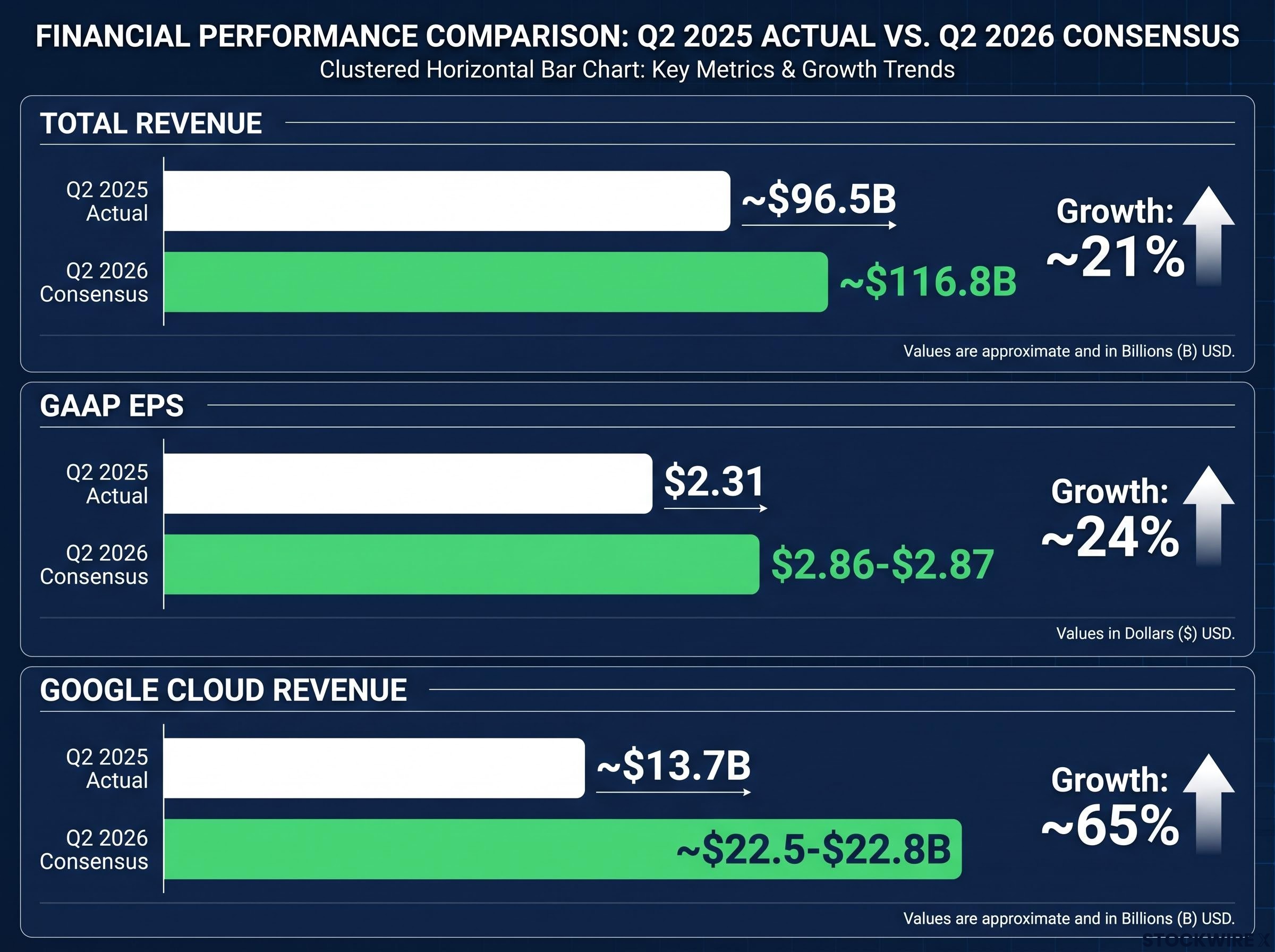
Consensus ranges do vary modestly across data providers (revenue $116.5-$120.2 billion; EPS $2.86-$2.95), reflecting differing assumptions on ads mix and Cloud. But the central estimates are tight enough to benchmark a beat or miss quickly.
These growth rates are genuinely strong by any historical standard for a company generating revenue at this scale. That is precisely why the market’s muted pre-earnings positioning is not about doubting the numbers; it is about what the numbers alone cannot resolve.
When big ASX news breaks, our subscribers know first
Why a clean beat may not be enough this quarter
The central debate heading into 22 July is not simply whether Alphabet will beat consensus. It is whether the quality of that beat is sufficient to shift sentiment in an environment that has become considerably more demanding.
Multiple research desks have converged on the same pre-earnings argument: investors are past the point of rewarding AI spending on narrative alone. A strong top-line beat accompanied by margin compression or elevated capital expenditure without monetisation clarity has, in this environment, repeatedly produced muted or negative stock reactions across large-cap AI names. The pattern is not a one-quarter anomaly. It is a structural shift in how the market is evaluating these businesses.
The capex-to-revenue conversion dynamic played out in stark relief after Q1 2026 results, when Alphabet surged more than 7% to an all-time high while Meta fell more than 9% on the same day, a divergence that established the market’s current framework for rewarding or punishing AI spending disclosures.
The three quality-of-earnings themes the Street is watching most closely:
- Cloud margin trajectory: Has the Cloud business reached a point where accelerating growth is accompanied by improving unit economics, or is profitability being sacrificed to win market share?
- AI monetisation evidence: Are Gemini and AI Overviews generating measurable commercial revenue, or are they raising costs without a corresponding revenue uplift?
- Capex-to-revenue efficiency: Is Alphabet’s record-level capital expenditure translating into financial returns, or is free cash flow compressing under the weight of the build-out?
Interpreting the Alphabet release on 22 July means listening to the earnings call as closely as reading the financial tables. The qualitative disclosures on AI returns will likely move the stock more than the revenue number itself.
Google Cloud margins and the AI infrastructure payback question
Cloud margin direction is the single most binary fundamental signal in this report.
What Cloud margins show
Google Cloud is expected to deliver approximately $22.5-$22.8 billion in Q2 revenue, but the market’s focus has shifted from scale to profitability. Visible Alpha consensus points to a 2026 Cloud operating margin of around 29-30%, with Q2 margin expectations up roughly 900 basis points year over year.
Google Cloud’s Q1 2026 margins reached 32.9%, up from approximately 18% a year earlier, a single-quarter expansion that placed the business within the profitability tier of AWS and set the bar analysts are now benchmarking against for the Q2 report.
The ~900-basis-point year-over-year margin improvement expectation is based on analyst estimates and has not been confirmed by the company. Treat it as the bar the market is pricing in, not a guaranteed outcome.
The dispersion in analyst models tells its own story. Cloud margin estimates range from the low teens to the mid-30s, a spread wide enough to confirm that the true economics of AI infrastructure remain genuinely uncertain at this stage.
What compression or expansion would mean for the stock
The binary outcome is stark. Cloud growth with margin expansion would signal that Alphabet’s AI infrastructure spending is building a cost-advantaged business, one where scale is creating operating leverage rather than simply buying market share. Cloud growth with margin compression would reinforce concerns that the build-out is capital-intensive with slower-than-hoped payback.
For you, the margin direction in Cloud will tell you whether Alphabet’s AI infrastructure spending is generating durable financial returns or accumulating costs that have yet to be justified. It is the single number worth tracking most carefully on 22 July.
What Gemini and AI Overviews need to show investors
For the Search segment, the key question this quarter centres on whether AI Overviews and Gemini are opening up genuinely new commercial revenue streams, or whether their primary effect has been to inflate the cost of serving each query without a corresponding lift in advertising returns.
Gemini’s user growth to 750 million monthly active users by early May 2026 is the commercial context behind the monetisation question: at that scale, even a modest revenue-per-user improvement would represent a material incremental revenue line, which is precisely why analysts are listening for any concrete figure on the Q2 call.
Analysts are listening for three specific disclosure signals on the earnings call:
- Quantified contribution of generative AI products to revenue growth. Any concrete figure linking Gemini, AI Overviews, or Cloud AI workloads to incremental revenue would represent a step change in disclosure quality.
- Evidence of higher advertiser engagement or ad yields in AI-enhanced search. This means data on click-through rates, richer ad formats, or more shopping and performance-ad inventory surfacing within AI Overviews.
- Clarity on whether AI features are expanding monetisable inventory or primarily increasing costs. More queries and richer ad formats are positive. Higher cost-per-query without revenue uplift is not.
Workspace and Cloud AI bookings are secondary but meaningful signals, particularly for enterprise revenue durability.
The key marker to watch on the call is whether management attaches a specific revenue figure to any AI product for the first time. Any such disclosure would signal a material improvement in transparency. If the commentary remains broad and directional without concrete metrics, analysts will likely conclude the AI monetisation story has not yet moved beyond its early chapters.
Where Alphabet’s chart stands heading into the report
Alphabet shares had pulled back to around $350 as of approximately 20 July, sitting some 13% below the peak reached in May 2026 and tracing out a pattern of lower highs within a descending price channel. Each rebound has faded at a lower level than the one before, which tells you upside momentum is weakening, not building.
The levels that matter on both sides are specific.
| Level type | Price level | Significance |
|---|---|---|
| Resistance | $355 | Upper channel boundary and prior breakout area; a decisive close above signals sellers are losing control |
| Resistance | $375 | Next major level if $355 breaks; a move here shifts the stock back toward May highs |
| Support | $335 | First meaningful downside reference; a post-earnings break increases odds of a full channel retest |
| Support | $318-$320 | Stronger support zone; a break below would signal active repricing of the longer-term AI and capex story |
The options market is pricing approximately a 6% move in either direction, equivalent to roughly plus or minus $21 on a $350 stock. That puts the implied range at approximately $329 to $371.
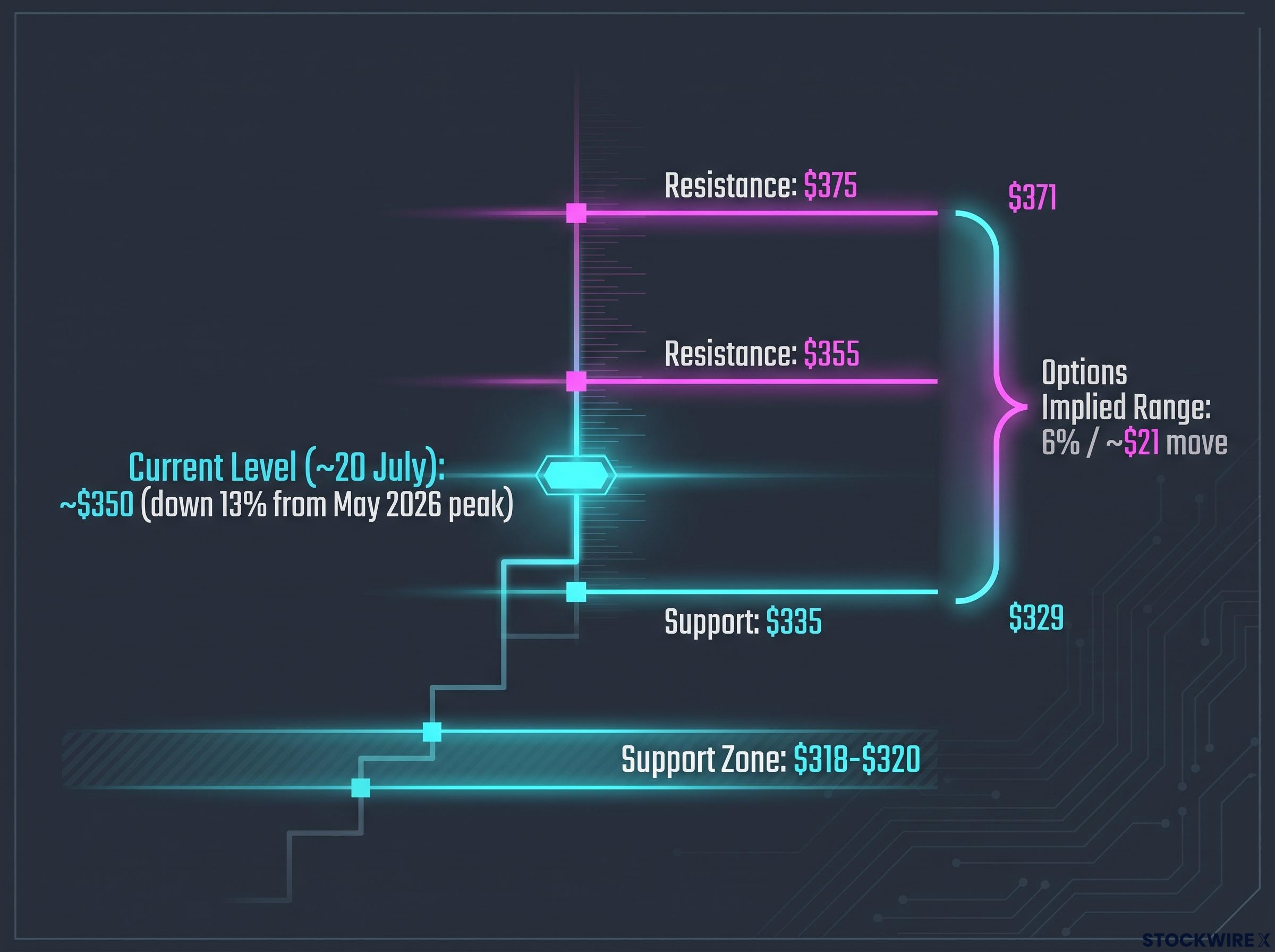
That range lands almost exactly between the $335 support and $375 resistance. The market has essentially priced the binary outcome into the width of the current technical channel, making those levels the natural reference points for post-earnings positioning decisions.
Three scenarios for how the stock reacts on 22 July
Rather than a prediction, here is a framework. Which scenario unfolds depends on the combination of fundamentals and price action together, not either in isolation.
Bullish break: price clears $355
- Cloud revenue meets or beats consensus at approximately $22.5-$22.8 billion, with margins expanding or holding near the 29-30% range
- Management provides at least one quantifiable AI monetisation metric, whether that is incremental ad revenue from AI Overviews, higher-yield formats, or concrete Cloud AI bookings
- Capex commentary is measured or includes clearer linkage between spend and returns, preserving free cash flow
- A post-earnings rally through $355 would confirm a technical trend shift, with $375 as the next target
Mixed outcome: trapped between $335 and $355
- Revenue and EPS beat modestly, but Cloud margins or AI commentary are ambiguous
- Capex remains very high with limited new detail on payback timelines
- Price action chops within the $335-$355 range, keeping the descending channel intact and leaving the medium-term debate unresolved
- The stock neither breaks out nor breaks down, and investors are left waiting for Q3 for resolution
Bearish reaction: price breaks through $335
- Cloud revenue growth slows versus expectations, or margins compress noticeably
- AI investments are framed as “still early” with limited quantified revenue benefit
- Capex outlook is raised again or left very elevated without clearer monetisation guidance
- A drop through $335 targets the $318-$320 support zone and validates the current downtrend
The scenario framework is designed to keep your interpretation contingent, not pre-committed. Match the actual numbers and commentary to the scenario that fits, and let the price action confirm it.
What 22 July will actually resolve, and what it will not
The Q2 report will provide the most substantive data yet on whether Alphabet’s AI and Cloud investment is generating durable financial returns. But a single quarter is unlikely to fully resolve the longer-term debate about capex efficiency and AI monetisation at scale. These are multi-year questions, and one set of results will move the conversation forward, not close it.
If you are investing on a longer time horizon, weight Cloud margins, capex guidance, and AI monetisation disclosure most heavily. If you are trading the event, anchor your interpretation to the $335 and $355 price levels relative to the options-implied 6% move.
Alphabet’s antitrust overhang, encompassing two live DOJ proceedings covering search distribution and the ad tech stack, adds a structural dimension to any earnings reaction because remedy outcomes ranging from behavioural restrictions to asset divestitures could alter the long-term revenue model that Q2 results are being valued against.
What management says on the call about the outlook for H2 2026 and beyond may carry more weight than the reported Q2 figures themselves. The Street is attempting to value a multi-year AI and Cloud build-out, not a single quarter’s earnings, and the pivotal question is whether management shifts from broad qualitative framing to attaching actual numbers to AI-driven revenue growth.
This article is for informational purposes only and should not be considered financial advice. Investors should conduct their own research and consult with financial professionals before making investment decisions. These statements are speculative and subject to change based on market developments and company performance.