Roughly 43% of all U.S. domestic deposits, about $8.7 trillion, sits above the federal insurance limit. That money has no guaranteed protection, yet much of it stays parked in accounts paying less than easy alternatives. If deposits are meant to be the stable foundation of regional bank funding, that gap should make you curious about what is really holding the money in place.
March 2023 gave a blunt answer. Silicon Valley Bank, Signature Bank and First Republic collapsed within weeks as depositors pulled funds faster than any previous run in U.S. history.
The force keeping deposits in banks is friction: the hassle, the habit and the lack of better options close at hand. As of October 2026, that friction is wearing thin from several directions at once, and regional bank fragility is the result.
Here is a framework for judging where disruption risk in banking actually sits, which threats are real, and which are further off than the headlines suggest.
Why leveraged, deposit-funded banks break so easily
A bank takes your deposit, which you can withdraw at any time, and uses it to fund loans, Treasuries and agency mortgage-backed securities (bonds built from pools of home loans) that may not mature for years. This is called maturity mismatch: borrowing short-term money to fund long-term assets.
It works as long as most depositors stay put. When enough of them leave at once, the bank has to sell long-term assets in a hurry, often at a loss.
What leverage means for a bank
Leverage measures how much a bank funds with borrowed money compared with its own capital. The equity-to-assets ratio is the share of a bank’s assets paid for with shareholders’ money rather than deposits or debt.
The FDIC puts that ratio at 9.92% for all insured institutions in Q2 2026. Put simply, for every $100 of assets, only about $10 belongs to shareholders, which is the roughly 10 to 1 leverage a recent industry panel cited. Regional banks typically run single-digit ratios, so a modest loss can eat a large slice of their cushion.
That cushion is already under pressure. FDIC data shows $326.7 billion in unrealised losses on securities, equal to 5.5% of amortised cost, though no regional-specific figure is published.
You can see why the unrealised losses matter by looking at stress test design: the Fed’s standard scenario assumed falling yields, so the rate losses that hurt SVB sat outside what it measured.
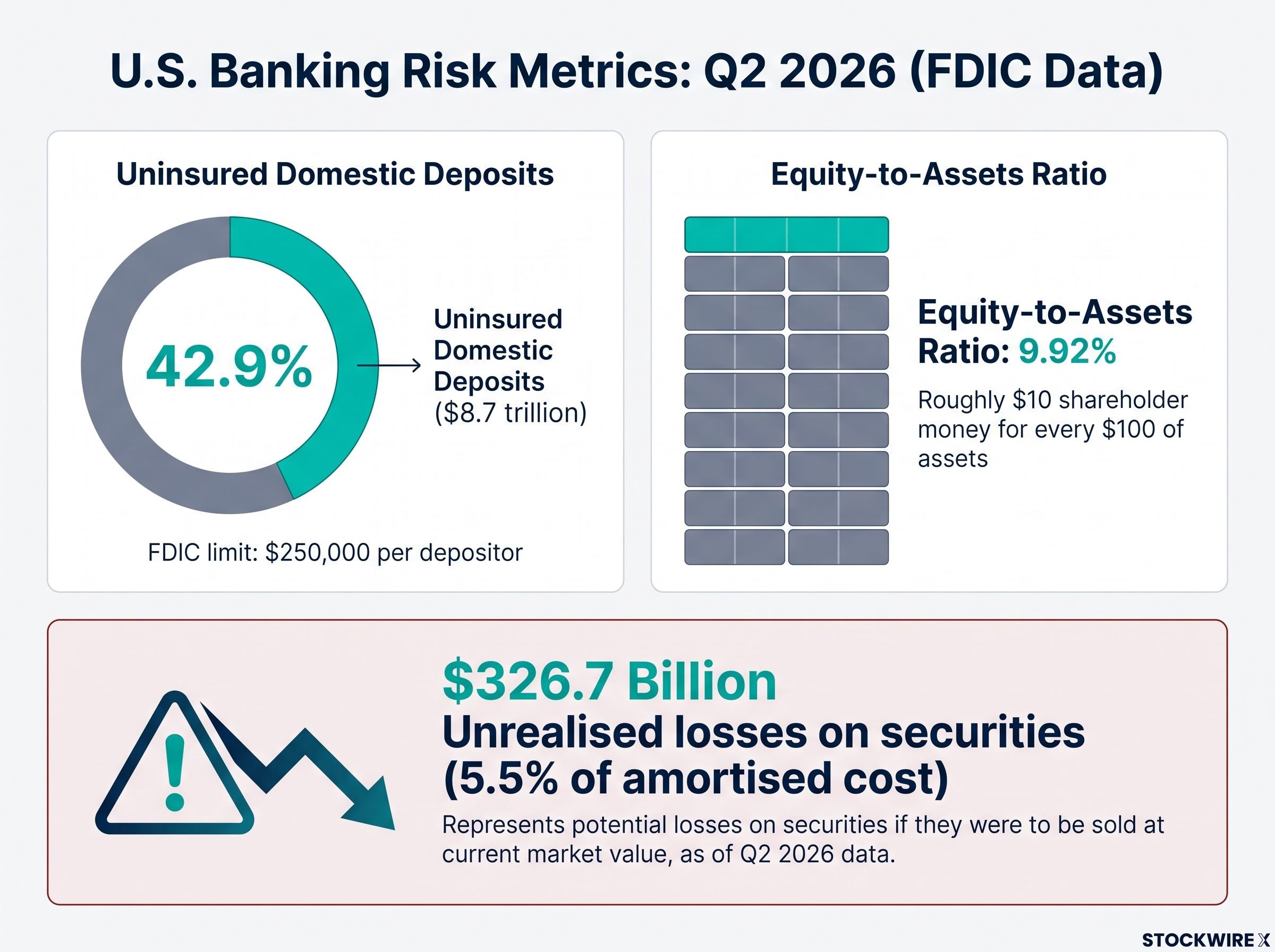
The runnable share About 42.9% of domestic deposits at insured banks, roughly $8.7 trillion, were uninsured in Q2 2026.
Those balances shrank after 2023, then grew again, rising $197.3 billion (2.7%) in Q3 2024 and $218.5 billion (3.0%) in Q4 2024. One panellist went as far as likening banks to Ponzi schemes, while conceding the comparison was deliberately provocative. The accurate version is narrower: fragility here is a funding problem as much as a solvency one, and a run alone can topple a bank that looks healthy on paper.
If you hold more than $250,000 at one bank, you are the kind of depositor whose behaviour decides whether a leveraged bank survives. Your balances are the ones that move first.
Why 2023 ran faster than past panics
Reviews by the Federal Reserve, FDIC, BIS and IMF describe group chats and social media spreading alarm within hours, while online banking let depositors move millions with a few clicks. Tens of billions of dollars left in a single day.
| Bank | Depositor base | Failure driver |
|---|---|---|
| SVB | Tech companies, venture capital firms and startups | Long-duration securities losses crystallised during a capital raise, sparking a rapid digital run |
| Signature | Crypto-related and commercial clients | Concentrated uninsured deposits sensitive to perceived risk |
| First Republic | Affluent coastal households and businesses | Rate mismatch plus flight of large uninsured balances |
Across all three, four drivers repeated: rate mismatch, concentrated uninsured depositors, digital run speed and supervisory misses. Economists still debate whether this was a new kind of run or an old panic on faster rails. They broadly agree the speed made it worse.
When big ASX news breaks, our subscribers know first
How technology is lowering the cost of leaving a bank
If speed turned 2023 into a crisis, the next question is what makes leaving easy in calmer times. The answer is not one rival product but a series of small cuts to the moat:
- Stablecoins. Dollar-pegged tokens such as USDC settle around the clock, removing the friction of banking hours for corporate treasurers.
- Tokenised deposits and money market funds. These are bank deposits or fund shares recorded on a blockchain, which lets excess cash be swept into yield and pulled back automatically.
- Decentralised finance (DeFi) collateralised borrowing. Users post tokenised Treasuries or crypto as security for a loan, so they can keep minimal bank balances.
- Options-based financing. Box spreads and buffer lending give wealthy clients borrowing without a bank’s balance sheet.
- AI cash-management agents. Software monitors yields and moves money when a spread crosses a set threshold, removing the effort of manual transfers.
The destination for much of that cash already exists. Investment Company Institute (ICI) data shows money market fund assets hit $7.03 trillion in the week ended 5 March 2025, then $7.26 trillion by 3 September 2025.
Cash on the move Money market fund assets reached $7.37 trillion in the week ended 1 October 2025, according to ICI, with industry commentary pointing to continued strength into 2026.
The yield gap on idle cash
Average savings rates at traditional banks still trail prime money market funds, short-term Treasury funds and top online high-yield accounts. Current national-average figures were not available, but the direction of the gap is consistent across sources.
For investors weighing where idle cash could earn more, fixed income alternatives such as insured deposits, CDs and Treasury paper offer different yield and safety trade-offs once inflation and taxes are counted.
The panel claimed that only about 6% of Americans hold deposits in products well matched to their cash needs. That is the panel’s assertion rather than a published statistic, yet it fits a picture of a lot of money earning less than it could.
If your cash sits in a low-yield account out of habit, the barrier is no longer difficulty but attention. Software that never gets distracted will not share that habit, and the panel flagged the obvious risk: AI tools steering many people toward better products at once could inadvertently trigger a run.
Box spreads, buffer lending and the quiet challenge to bank credit
Deposits are only half of a bank’s relationship with wealthy clients. The other half is lending, and options markets are chipping away at it.
A box spread combines four options contracts whose payoff is fixed regardless of where the market moves. Selling one gives you cash today and a known repayment later, which works like a fixed-rate loan. Securities-based lending lets you borrow against a portfolio of shares or bonds without selling them.
Panellists argued that box spreads and buffer lending can cost far less than bank margin loans, and that variable prepaid forwards can now be structured at scale without a bank. No recent published comparison of all-in box-spread costs against margin rates, or of securities-based loans against home equity lines, was found, so treat those cost claims as unverified.
| Option | How it works | Who it suits | Key risk |
|---|---|---|---|
| Bank margin loan | Borrow from a bank or broker against securities | Active investors with brokerage accounts | Margin calls |
| Box spread | Options combination creating synthetic fixed-rate borrowing | Sophisticated, options-literate investors | Basis and model risk |
| Securities-based loan | Credit line secured by a diversified portfolio | High-net-worth clients | Forced selling in a downturn |
| Buffer lending | Options-structured borrowing with some downside protection | Wealthy and institutional clients | Counterparty risk |
The knock-on effect matters more than the product. Clients who fund liquidity this way can keep only small transactional balances at a bank, weakening the relationship that once made their deposits sticky.
These structures carry real risks:
- Basis, counterparty and model risk in box spreads and structured lending
- Forced selling and margin calls on securities-based loans when markets fall
- Unsuitability for investors without options experience
This threat targets high-net-worth and institutional clients first. If you are an ordinary saver, the practical risk is indirect, through the health of the banks that serve you, not a product you would use. For context, a small number of banks have failed between 2024 and 2026, including the first of 2026 in February, none near 2023 scale.
Will banks survive the squeeze? Backstops, rules and the CBDC question
Every argument so far has pointed one way. The counter-case is strong, and it deserves equal weight.
Several protections slow the drain:
- FDIC insurance up to $250,000 per depositor per bank, which keeps most retail deposits calm
- Emergency backstops, including the Discount Window and Federal Home Loan Bank advances, plus past extensions of protection to uninsured depositors in systemic crises
- Relationship value, as payroll, credit lines and local lending make full migration costly for smaller firms
- Regulatory limits on stablecoins, DeFi and tokenised funds, which may shrink any funding-cost edge
Stablecoins carry their own run risk if reserve quality is doubted, and fragmentation across blockchains adds operational hazards. In severe stress, those markets could seize up or gate redemptions, making a plain bank deposit look attractive again.
Views on scale split sharply. Some analysts expect meaningful migration of corporate and high-net-worth deposits, especially in high-rate or stress periods. Others call the threat overstated because so much money is tied to payroll and local relationships. Bank trade groups warn of higher funding costs and heavier wholesale reliance, though they are interested parties.
The net view Deposits are unlikely to disappear. The realistic concern is that marginal, rate-sensitive and uninsured balances become more mobile and more volatile.
Where the retail CBDC stands
The panel pictured a free digital dollar held at the Fed, forcing banks to compete for every customer. That product does not exist. Executive Order 14178 (2025) and the 21st Century ROAD to Housing Act (2026) bar a U.S. retail central bank digital currency (CBDC) through 31 December 2030, and the Fed has said Congress would need to authorise one.
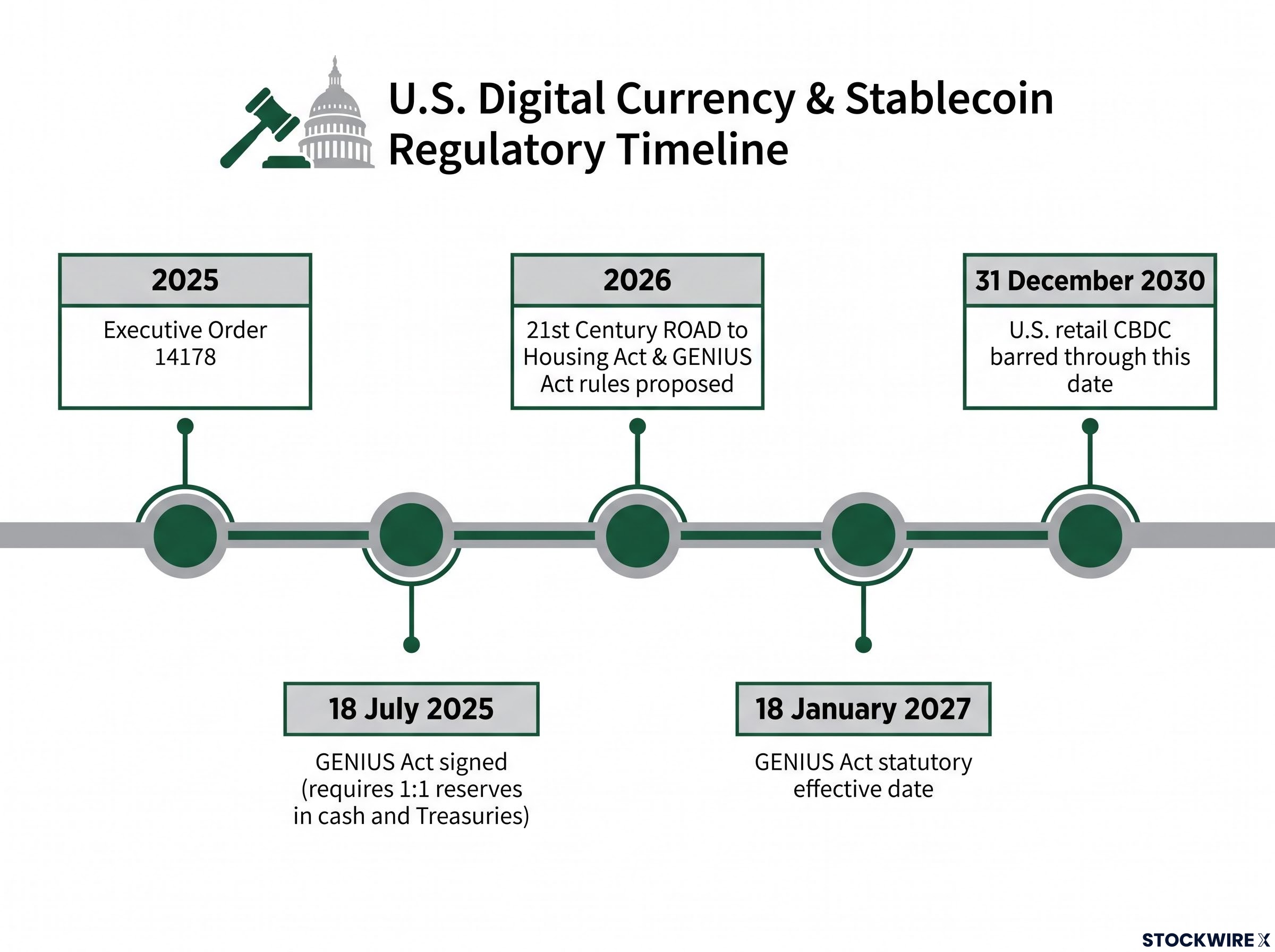
The live rule-making sits with stablecoins. The GENIUS Act, signed on 18 July 2025, requires 1:1 reserves in permitted assets such as cash and Treasuries. Implementing rules were proposed in 2026 but not finalised as of late September, and the statutory effective date is 18 January 2027.
The GENIUS Act framework matters beyond banking, because its reserve rules and yield ban are designed to route stablecoin demand toward US-supervised infrastructure and away from offshore dollar markets, shaping how far private tokens can compete with deposits.
For you, the useful conclusion is that private competition, not a government digital dollar, is the live disruption channel through at least 2030. Watch yield spreads and stablecoin rule-making, not CBDC headlines.
What the squeeze changes for regional banks, and what it does not
The framework comes down to four parts: thin equity cushions, a large pool of runnable uninsured funding, shrinking friction and private rather than public competition. Together they point to faster, jumpier deposit movement at the margin, not the end of banking.
Bank funding costs feed straight into earnings, and net interest income guidance is the line analysts watch for signs that margin pressure from deposit competition is arriving faster than consensus assumes.
If you hold regional bank shares or large balances, four indicators will tell you whether that margin is widening:
- The uninsured deposit share in the FDIC Quarterly Banking Profile
- Weekly money market fund asset trends from ICI
- Final GENIUS Act rules ahead of 18 January 2027
- Any bank-issued token launches
The decision is less about whether banks survive and more about which ones depend most on the balances now easiest to move.
This article is for informational purposes only and should not be considered financial advice. Investors should conduct their own research and consult with financial professionals before making investment decisions. Past performance does not guarantee future results, and forward-looking views are speculative and subject to change based on market and regulatory developments.