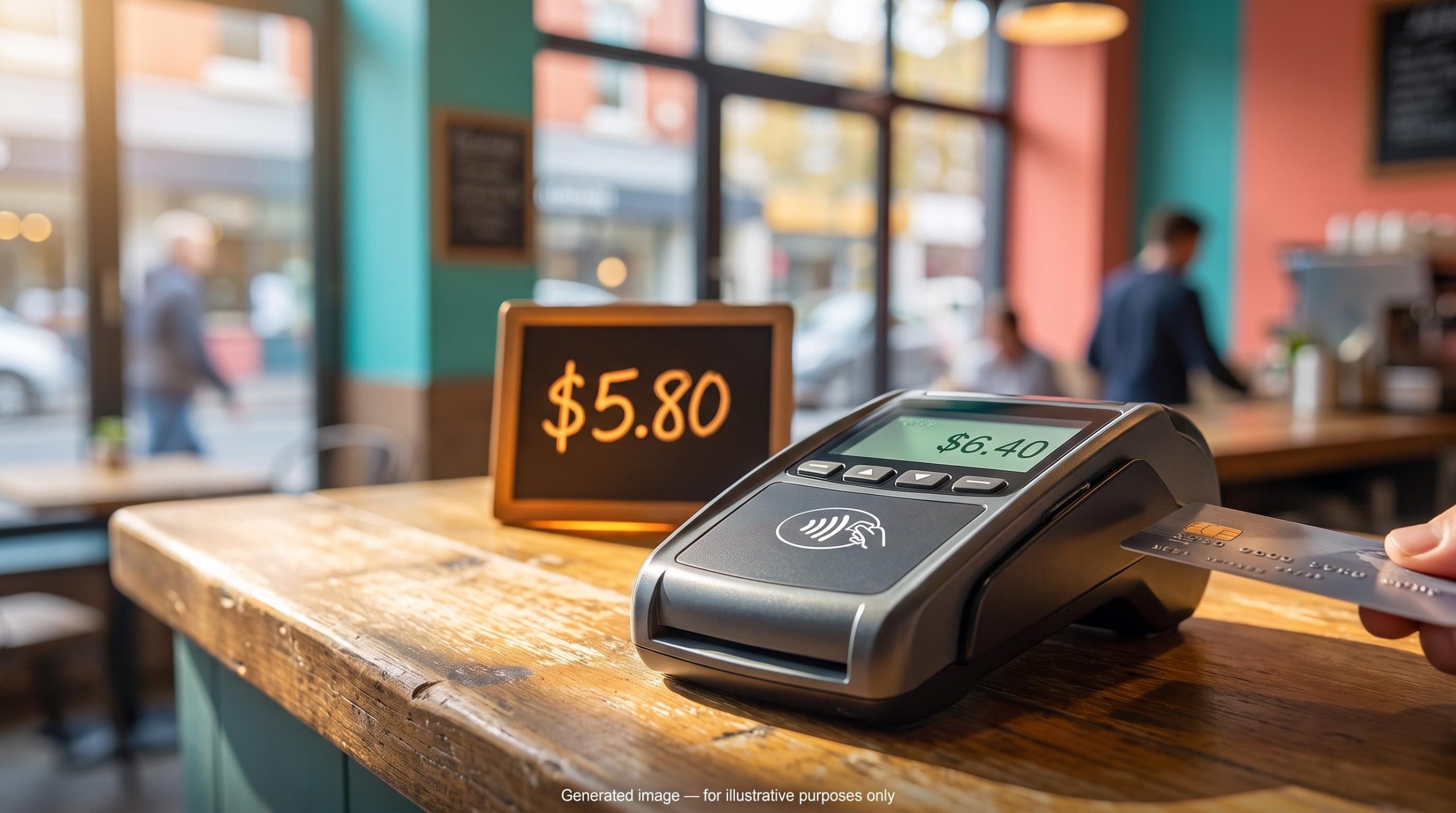
Morningstar has just put a price on Cuscal, and it sits below the market’s. The research house values the payments business at $5.80 a share. The stock last traded at $6.40, even after a FY26 in which underlying profit grew 20%.
How does a business growing that quickly still look expensive? The answer depends on what you think the next five years look like, not on the last twelve months.
Cuscal (ASX: CCL) is a payments infrastructure provider most investors never see. It sits behind mutual banks, smaller lenders and fintechs, quietly processing the card and account payments their customers make. With a market capitalisation of roughly $1.3 billion, it now has formal coverage from Morningstar, which initiated on 8 October 2026 with a narrow moat rating and a Medium uncertainty rating.
That makes this a good moment for a full Cuscal analysis. Here is a framework for judging whether the premium to fair value is justified, and the specific signals that would push you toward the bull case or the bear case.
What Morningstar’s $5.80 fair value says about a $6.40 share price
The gap is small. At $6.40, Cuscal trades about 10% above Morningstar’s estimate, which is modest overvaluation rather than a warning sign.
The headline call Morningstar fair value: $5.80 per share. Last price: $6.40. Implied premium: roughly 10%.
Morningstar analyst Nathan Zaia is not questioning the quality of the business. His fair value equals about 20 times FY27 earnings and 2.6 times book value, a respectable multiple for a steady infrastructure company. The disagreement is about how quickly growth turns into profit.
The FY26 result, released on 20 August 2026, was strong. Underlying net operating income rose 20% to $347.7 million and underlying net profit after tax (NPAT) climbed 20% to $46.2 million. Statutory NPAT reached $42.7 million, up 49%, and transaction volumes grew 12% to 4,798 million. The board paid a final dividend of 7.0 cents, taking the full-year total to 11.5 cents.
Zaia’s model does not extend that pace. He forecasts underlying profit compounding at about 11% a year to roughly $77 million by FY31, with EBITA margin (earnings before interest, tax and amortisation, as a share of income) edging from 24% to 26%.
| Metric | FY26 actual | Morningstar forecast | Note |
|---|---|---|---|
| Underlying NPAT | $46.2M | About $77M by FY31 | Includes Indue savings |
| EBITA margin | 24% | 26% by FY31 | Modest expansion only |
| Profit growth | 20% | About 11% a year | FY26 boosted by acquisition |
| Valuation multiple | Low-to-mid 30s trailing P/E | About 20x FY27 earnings | Different earnings bases |
One caution on that last row. The trailing price-to-earnings (P/E) ratio in the low-to-mid 30s is calculated on FY25 pro forma earnings, while Morningstar’s 20 times uses forecast FY27 profit, so the two figures cannot be compared directly.
Morningstar rates Cuscal’s capital allocation as Standard, reflecting a sound balance sheet and suitable distributions. What the gap tells you is that the market is already paying for the synergy and growth story. A buyer at $6.40 needs Cuscal to deliver at or above Morningstar’s forecasts to earn a return; a merely steady business will not be enough.
When big ASX news breaks, our subscribers know first
How Cuscal earns revenue per transaction, and why the narrow moat protects volume more than price
To judge those forecasts, you need to understand how the money is made.
What Cuscal actually does
Cuscal means smaller banks, mutuals, fintechs, corporates and government bodies can provide card, BPAY and direct-entry payments to their customers without having to build the underlying systems. According to Morningstar, the four major banks and Cuscal are the only players with the licences, connectivity and processing capacity to cover every major payment type inside a single legal entity.
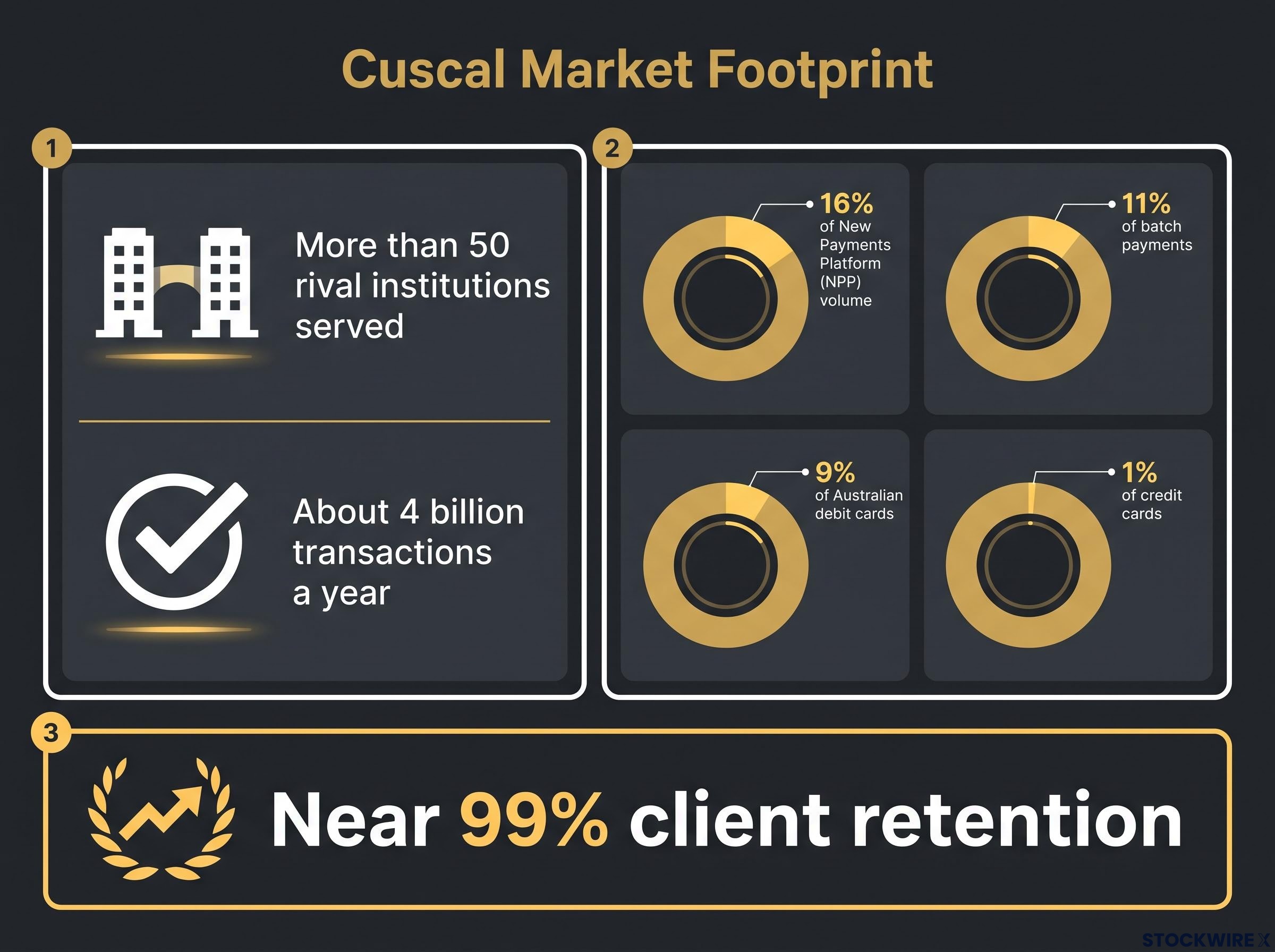
Cuscal is an authorised deposit-taking institution (ADI), a regulated status that gives it access to the settlement systems banks use to move money between each other. It takes no retail deposits and makes no loans, so it never competes with its clients. That neutrality lets it serve more than 50 rival institutions at once.
APRA’s ADI licensing requirements set a high bar for prudential standards and capital, which helps explain why only the four major banks and Cuscal can cover every major payment type within a single legal entity.
Its footprint is meaningful. Cuscal issues about 9% of Australian debit cards and roughly 1% of credit cards, and it processes around 16% of New Payments Platform (NPP) volume and 11% of batch payments.
Revenue follows the number of payments, not their dollar value. A $4 coffee and a $4,000 invoice can earn a similar fee, so more frequent payments help directly. About 4 billion transactions a year are spread across a high fixed-cost base, which is where Morningstar’s cost-efficiency advantage comes from.
Where the moat holds, and where it does not
The second moat source is switching costs. Moving to another provider takes clients about a year and carries real operational risk.
Near 99% client retention, according to Morningstar
That stickiness protects volume. It does much less for price, because four forces cap what Cuscal can charge:
- Volume tiers: contracts reward bigger clients with lower per-transaction fees
- Repricing at renewal: renewals have historically been struck at lower rates
- Client bargaining power: a concentrated client base can threaten tenders or partial insourcing
- RBA oversight: the Reserve Bank’s scrutiny of card costs, surcharging and access discourages high margins
Clients rarely leave. They renegotiate instead, which explains why Morningstar expects only modest margin expansion beyond the Indue savings.
For you, a narrow moat means you can reasonably expect Cuscal to keep its clients, but you should not expect it to lift prices. Earnings growth has to come from volume and cost savings.
What drives transaction volume in Australia’s shifting payments mix?
If volume is the engine, the next question is how hard it can run. Several structural forces are pushing payment counts higher:
- E-commerce growth: more online purchases add card transactions Cuscal can process
- Fragmented purchases: smaller, more frequent grocery shops mean more payments per dollar spent
- Buy now, pay later (BNPL): splitting one purchase into instalments multiplies transaction counts
- NPP migration: the shift from batch direct entry to real-time payments offers a modest lift and new services
That last driver has an extra layer. The NPP supports value-added services such as mandate management, Confirmation of Payee and overlay products, giving Cuscal ways to earn beyond the basic fee. AusPayPlus reports the NPP processed nearly 2 billion real-time payments in 2025.
The cash story needs qualifying, though. The RBA’s 2025 Consumer Payments Survey found cash made up about 15% of payments by number, up from about 13% in 2022, and around 8% by value. Cash use has stabilised at a low level rather than continuing to fall. The RBA’s Payments System Board reports that cards remain the most common consumer payment method.
| Driver | Direction | Strength of evidence |
|---|---|---|
| E-commerce and BNPL | Supportive | Structural, qualitative |
| NPP real-time payments | Supportive | Strong: nearly 2 billion in 2025 |
| Cash decline | Stalling | RBA data: share up to about 15% |
Cuscal’s 12% volume growth in FY26 sits well ahead of Morningstar’s mid-single-digit forecast, and part of that came from Indue. The gap tells you the market may be extrapolating a recent run rate that the cash data suggests will fade.
Bull case, bear case: the Indue integration and the risks that decide the outcome
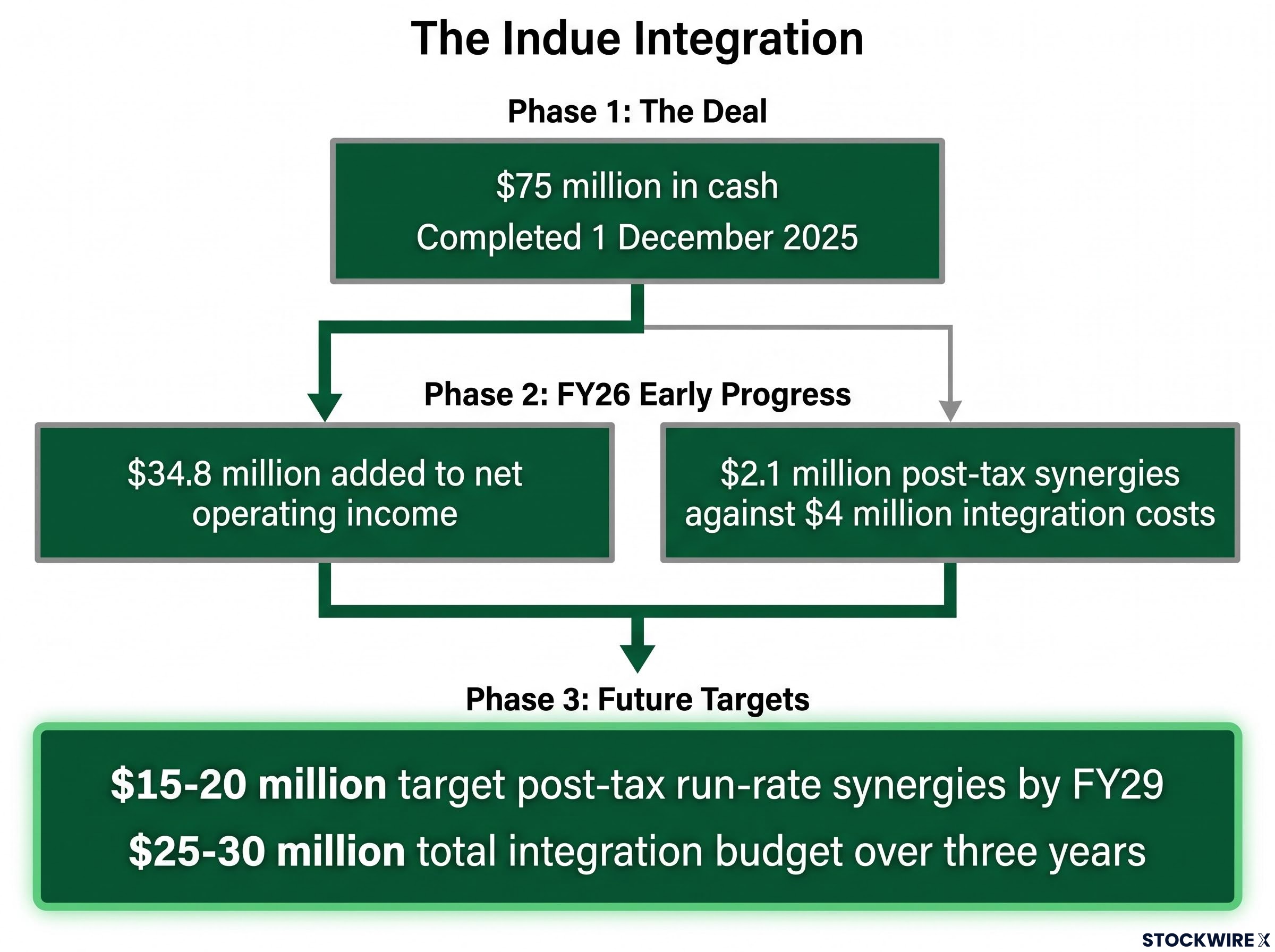
The variable that links both scenarios is Indue. Cuscal paid $75 million in cash for the payments business, completing the deal on 1 December 2025. Management targets $15-20 million of post-tax run-rate synergies by FY29, earnings per share accretion above 25% and return on invested capital (ROIC) above 20%.
The bull case
Indue added $34.8 million to FY26 net operating income. Early progress tracked the staged plan: $2.1 million of post-tax synergies against $4 million of integration costs, within a total integration budget of $25-30 million over three years.
The optimistic path has no material client losses, fintechs outsourcing infrastructure rather than building it, steady NPP migration and full synergy delivery. In that world, volume and savings compound together.
The bear case
The risks are just as concrete. Mutual bank mergers shrink the client pool and strengthen bargaining power, and large clients may demand a share of the Indue savings. The RBA’s focus on surcharging and interchange could compress fees, while Morningstar flags regulatory shifts that lower entry barriers.
Cuscal is also integrating two acquisitions, Indue and Paymark, which helps explain the Medium uncertainty rating. Any serious outage or breach would hit hardest at a business whose reputation rests on reliability.
For readers wanting the deal mechanics, our detailed coverage of Cuscal’s Paymark deal explains the $21 million switch upgrade and the 25% ROIC target.
| Factor | Bull case | Bear case |
|---|---|---|
| Clients | No material losses | Mutual consolidation, tougher renewals |
| Volumes | Fintech outsourcing, NPP growth | Insourcing, global processors |
| Indue synergies | Full $15-20M by FY29 | Clients claim a share of savings |
| Regulation | Stable fee settings | Surcharging or interchange reform |
| Operational risk | Clean two-deal integration | Outage, breach or integration misstep |
Because Morningstar’s fair value already assumes up to $20 million of post-tax Indue savings, net of assumed client losses, you should treat synergy delivery as the baseline. Upside only appears if volumes or retention beat the model. Three signals to watch:
- Cumulative synergy disclosures against the FY29 target
- Client wins, losses or renewal announcements
- RBA decisions on surcharging and interchange
These statements are speculative and subject to change based on market developments and company performance. Past performance does not guarantee future results.
Weighing a narrow-moat payments stock priced above fair value
Cuscal is a sticky, reliable business whose growth depends on volume and cost savings, not pricing power. At $6.40, you are paying a modest premium for it.
The decision comes down to confidence. If you trust management to land the Indue savings without leaking clients, the premium may look fair. If you doubt it, waiting for a price closer to $5.80 gives you a margin for error.
The decision at a premium to fair value is easier when you apply a structured ASX share-picking checklist covering business quality, earnings, debt and position sizing, rather than reacting to a single broker target.
At the next half-year result, focus on three variables: synergy progress, volume growth against Morningstar’s mid-single-digit forecast, and any RBA movement on surcharging or interchange.
This article is for informational purposes only and should not be considered financial advice. Investors should conduct their own research and consult with financial professionals before making investment decisions.