
Most readers assume US stablecoin legislation is a crypto housekeeping exercise, a set of rules to stop scams and bring order to a chaotic market. One community of analysts reads it very differently. They see the GENIUS Act and the pending CLARITY Act as the authorisation documents for a new dollar plumbing system, one designed to route around the offshore Eurodollar network that has dominated global dollar flows for decades.
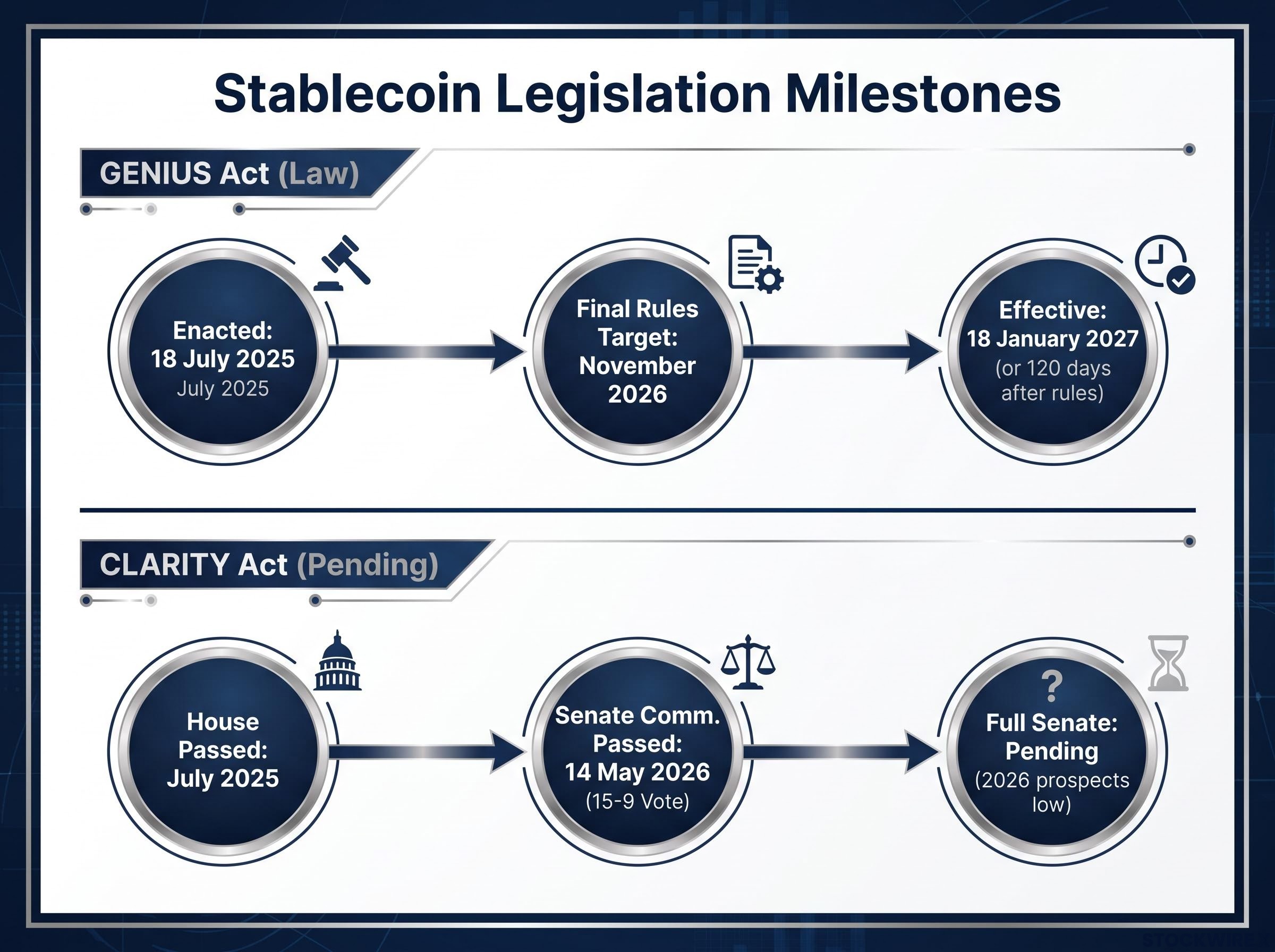
That framing matters more now than it did a year ago. The GENIUS Act was signed into law on 18 July 2025. The CLARITY Act cleared the Senate Banking Committee on 14 May 2026 in a 15-9 bipartisan vote. These are no longer hypothetical frameworks sitting in committee drawers; they are active or advancing legislation with implementation timelines measured in months.
Here is what you will be able to see clearly after reading this: the specific structural distinction between the Eurodollar shadow banking system and a stablecoin-based dollar architecture, what each piece of legislation actually does to each system, and why that distinction carries stakes that extend well beyond domestic fintech policy into Treasury markets, global bank balance sheets, and cross-border capital flows.
The two acts at the centre of the debate, and what they actually do
The US Stablecoin Clarity Act conversation is really about two pieces of legislation that fit together like building blocks, not interchangeable labels for the same thing.
The GENIUS Act (Guiding and Establishing National Innovation for US Stablecoins) is already law. Enacted on 18 July 2025, it creates the baseline federal regime for payment stablecoins under banking-style oversight, with licensing requirements for US issuers and restrictions on foreign-issued tokens. Its effective date is 18 January 2027, or 120 days after final implementing rules, whichever comes first. Final rules are targeted for November 2026.
The GENIUS Act public law text (P.L. 119-27) establishes the reserve mandate, licensing requirements, and oversight structure that form the operational backbone of the federal stablecoin regime effective from January 2027.
The CLARITY Act (the Digital Asset Market Clarity Act) extends that architecture across the broader digital-asset market. It passed the House in July 2025 and cleared the Senate Banking Committee on 14 May 2026 on a 15-9 bipartisan vote, but full Senate passage remains pending. Where GENIUS sets the stablecoin baseline, CLARITY would divide the entire digital-asset universe into three categories: digital commodities under the CFTC, investment-contract assets (effectively securities) under the SEC, and payment stablecoins under the banking-style regime GENIUS established.
That bipartisan committee vote is worth registering. The Senate’s financial oversight committee moved this forward with both Republican and Democrat support, which changes the political baseline for what comes next. This is no longer a crypto-fringe issue.
| Act Name | Status as of August 2026 | Key Scope | Implementation Timing |
|---|---|---|---|
| GENIUS Act | Enacted (18 July 2025) | Federal baseline for payment stablecoins; licensing, reserves, oversight | Effective 18 January 2027 or 120 days after final rules |
| CLARITY Act | Passed Senate Banking Committee (15-9, 14 May 2026); full Senate pending | Three-category taxonomy for all digital assets; refines stablecoin treatment under GENIUS | Most rules take effect approximately one year after enactment |
Understanding which law does what prevents the common error of treating “stablecoin clarity” as a single event. The distinction between what is already law and what remains pending is your starting point for evaluating real-world impact and timing.
When big ASX news breaks, our subscribers know first
How the Eurodollar system actually works, and why it is the reference point here
To understand what stablecoin legislation is proposing to change, you first need to understand the system it would partially replace.
Eurodollars are US dollar deposits held in banks outside the United States, primarily in London, that sit outside the Federal Reserve’s direct jurisdiction. The system expanded after World War II as global trade demanded more dollar liquidity than the domestic US banking system could supply on its own. It is not a relic. It is the dominant architecture through which global dollar liquidity is manufactured and distributed today.
The dollar’s global dominance rests on structural features that predate any stablecoin debate: it appears on one side of 89.2% of all global FX trades and holds approximately 57% of official reserves, a grip that gives US policymakers unusual leverage in designing new payment infrastructure on dollar rails.
Here are the structural features that define it:
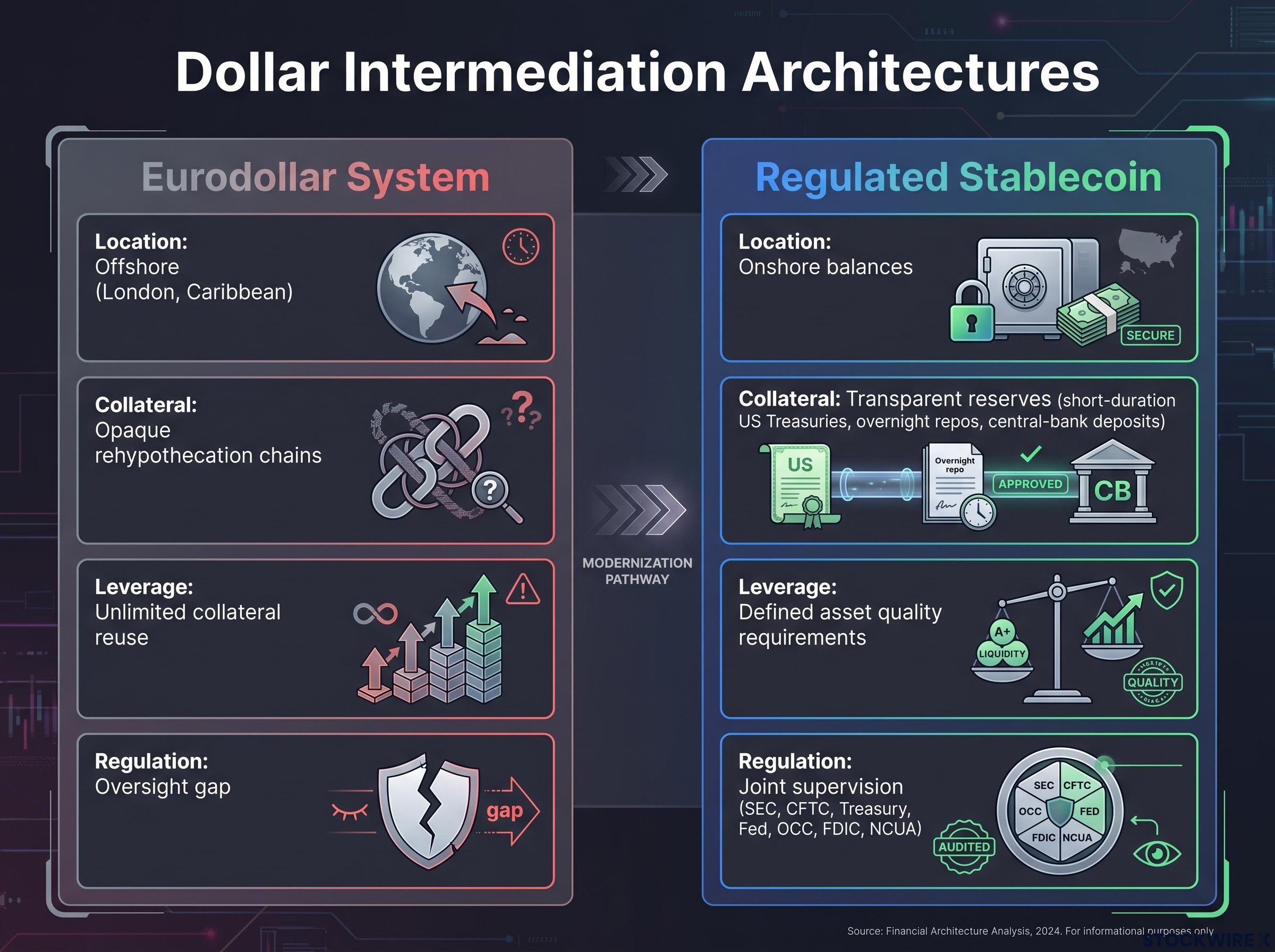
- Location: Dollar deposits held offshore, primarily in London, with additional nodes in Caribbean vehicles and global correspondent banks
- Rehypothecation: The same collateral can be reused across multiple lending chains, manufacturing dollar liquidity through leverage. Rehypothecation is the practice of a bank taking collateral posted by one borrower and using it as collateral in its own borrowing, and then the next bank does the same. This creates long chains of claims built on the same underlying asset.
- Leverage characteristics: Unlike US domestic rules, which cap collateral reuse, the London regulatory framework sets no upper limit on how many times the same asset can be pledged, permitting substantially higher leverage ratios than onshore American institutions can achieve
- Oversight gap: This shadow banking network creates and destroys dollar claims outside formal US bank regulation, with limited transparency into the total leverage embedded in the system
Why London became the system’s centre of gravity
The city’s regulatory framework offers market participants something unavailable under US domestic rules: the ability to recycle collateral through successive lending arrangements without a statutory ceiling on reuse. That structural opening is what draws offshore dollar creation to London and keeps it there. Each additional step in a collateral chain earns intermediation fees for the institution handling the link, and no other major jurisdiction allows as many steps.
That same structural advantage is also what makes London most exposed in any architectural transition. The 2008 financial crisis demonstrated what happens when confidence in those offshore collateral chains breaks: the entire system seizes because no one can trace how many claims sit on top of the same collateral. If you grasp this vulnerability, you understand why a regulatory debate that looks like domestic fintech policy can carry implications for Treasury markets, global bank balance sheets, and cross-border capital flows.
What stablecoins would replace, and how the new plumbing would work
The rails for a parallel dollar system are already in place. Dollar-denominated stablecoins can settle transactions on blockchain infrastructure, cutting out the multi-tier correspondent bank intermediaries that characterise the Eurodollar network. The missing ingredient has been explicit regulatory authorisation allowing US-supervised institutions to operate on that infrastructure at meaningful scale. The GENIUS and CLARITY Acts represent, in this framing, that authorisation arriving.
Here is what changes under a regulated stablecoin architecture, mapped against the same dimensions that define the current system:
- Location of balances: Onshore, regulated stablecoin balances replace offshore Eurodollar deposits
- Collateral transparency: Transparent reserve portfolios replace opaque rehypothecation chains
- Leverage characteristics: Reserve-backed tokens with defined asset quality requirements replace unlimited collateral reuse
- Regulatory oversight: Joint supervision from SEC, CFTC, Treasury, the Fed, OCC, FDIC, and NCUA replaces the current oversight gap over offshore dollar creation
The reserve requirements are the structural anchor of the new framework. Under both GENIUS and CLARITY, issuers must hold high-quality liquid assets against every token in circulation.
Tokenized repo markets represent one of the most concrete near-term expressions of blockchain-based dollar plumbing: Deutsche Bank projects they could drain $250 billion in idle reserves from the Federal Reserve, expanding quantitative tightening headroom and adding institutional weight to the case for on-chain Treasury settlement infrastructure.
Reserve mandate: Payment stablecoin issuers must hold short-duration US Treasuries, overnight repurchase agreements, and central-bank deposits against every circulating token. This makes leading dollar stablecoins resemble supervised narrow-bank money funds rather than lightly supervised offshore tokens.
That reserve requirement detail is the key signal for you. Requiring issuers to hold short-duration Treasuries against every circulating token means that large-scale stablecoin adoption creates a structural, ongoing bid for US government debt. The more stablecoins in circulation, the more Treasuries issuers must buy. That connection has implications for Treasury markets that extend well beyond the crypto sector.
Federal banking agencies are required to deliver a report to Congress within two years of enactment covering stablecoin effects on Treasury yields and bank deposits, which tells you that legislators themselves expect these market-level effects to materialise.
Settlement itself changes too. Smart contracts can encode compliance and reporting rules directly into the payment infrastructure, a feature that replaces the manual, multi-day clearing processes of correspondent banking. Programmable settlement means compliance is built into the pipes, not layered on top of them.
Why the yield ban is the most contested provision, and what it reveals about the stakes
The fight over whether stablecoins can pay interest looks like a technical provision. It is actually a fight over which financial institutions capture the economic rent from dollar intermediation.
The yield prohibition bars issuers and platforms from offering returns that are “economically or functionally equivalent” to bank deposit interest on idle stablecoin balances. You hold a stablecoin and leave it sitting in your wallet; the issuer cannot pay you for that.
The compromise that moved the bill through committee permits activity-based incentives. You get rewards for payments, transfers, or platform use, but not for passive savings-style holding. That distinction was a central bargaining chip necessary to achieve the 15-9 committee vote.
The yield ban tells you something specific about the political architecture of this legislation. It reflects a deliberate choice to protect regulated banks and money-market funds from direct competition with stablecoin issuers. The legislation simultaneously enables a new dollar infrastructure and constrains who benefits from it.
For you, the practical question is where yield-seeking dollar capital migrates under this framework:
- Regulated money-market funds that can offer yield on dollar holdings without the stablecoin restrictions
- Tokenised Treasuries that give investors direct exposure to government debt yields on blockchain rails
- Bank deposits that retain their regulatory privilege as interest-bearing instruments
If you are evaluating stablecoin-adjacent investments, this provision redraws the competitive map. The stablecoin itself becomes a pure transactional tool; the yield opportunity sits in the instruments that surround it.
What the geopolitical dimension looks like, and how to hold it without overstating it
If US-regulated stablecoin rails become the preferred channel for global dollar transactions, a share of the fee-rich intermediation that currently flows through Eurodollar correspondent banking migrates to US-supervised infrastructure. Of the major financial centres, London carries the greatest structural vulnerability to that shift, given how deeply its dollar business depends on leveraged collateral reuse.
This does not mean an overnight collapse of London’s dollar business. It means the direction of flow changes: more dollar business routed through US-regulated stablecoins, less through rehypothecated offshore deposits. Every transaction that moves onto the new rails is one that no longer generates intermediation fees for the current system’s operators.
The EU has taken a measured stance toward widespread dollar stablecoin adoption within its borders, with regulators repeatedly raising consumer protection and financial stability arguments. Certain analysts suggest this position may also reflect the financial interests of European intermediaries who currently profit from offshore dollar flows routed through the existing network.
EUR/USD dynamics carry a specific relevance to this legislative debate: if dollar stablecoin rails attract cross-border transaction volume currently routed through European correspondent banks, the structural demand for euro-dollar intermediation contracts, compressing one of the channels through which ECB-Fed rate differentials transmit into exchange-rate moves.
Using the geopolitical lens without overreading it
That interpretation, that European opposition is primarily about defending Eurodollar rents, is analytically useful but not conclusively evidenced. You should treat it as a hypothesis about institutional incentives, not a settled geopolitical claim.
Tracing who profits from the current dollar intermediation system gives you a working map of whose regulatory resistance is most likely to be sustained and where it will be directed. That framing tends to be more predictive than treating every objection as purely principled consumer protection advocacy. It remains, however, one analytical tool among several, and the weight you place on it should reflect the limits of what can be confirmed from public information.
How the US midterm elections resolve is a concrete near-term variable for this legislative trajectory, because the composition of the next Congress will determine whether digital-asset market-structure legislation advances or stalls through the following cycle.
What this means for your understanding of the transition, and the timeline that matters
The legislation is real and advancing, but the timeline for system-level effects means your evaluation framework needs calibration, not urgency.
GENIUS implementation begins phasing in from January 2027. The broader CLARITY framework depends on full Senate passage that has not yet occurred, and prospects for 2026 enactment are described as low. Any shift from Eurodollar infrastructure to stablecoin rails, should it materialise at scale, would unfold across a timeframe better measured in decades than in quarters.
| Milestone | Status as of August 2026 | Significance |
|---|---|---|
| GENIUS Act enactment | Enacted 18 July 2025 | Baseline federal stablecoin regime is law |
| GENIUS implementation date | 18 January 2027 (or 120 days after final rules) | First operational deadline for issuers and regulators |
| Final rules target | November 2026 (delayed from original deadline) | Determines whether January 2027 effective date holds |
| CLARITY Senate committee vote | Passed 15-9, 14 May 2026 | Bipartisan support established; political viability confirmed |
| CLARITY full Senate passage | Pending; 2026 enactment prospects low | Broader digital-asset taxonomy remains contingent |
Two variables are worth your attention. First, the Senate’s path to a CLARITY floor vote, which has stalled as of mid-2026. Second, US midterm election outcomes as a signal for which legislative direction the next Congress takes.
Near-term price action around votes or enforcement decisions is noise on a slow structural signal. But the GENIUS Act’s Treasury-backed reserve requirement creates a live and growing structural bid for US government debt starting in 2027, and federal banking agencies are required to submit a report to Congress within two years covering the market-level effects. That reporting requirement tells you legislators expect measurable consequences, not just compliance paperwork.
This article is for informational purposes only and should not be considered financial advice. Investors should conduct their own research and consult with financial professionals before making investment decisions. These statements are speculative and subject to change based on market developments and legislative outcomes.
Two systems, one currency, and the decision still being made in Washington
The Eurodollar system and the stablecoin architecture are two different answers to the same question: how do you distribute dollar liquidity globally? The US regulatory framework is the variable that determines which one scales.
The GENIUS Act is law and creates the first operational baseline. The CLARITY Act is the structural extension that remains contingent on full Senate passage. Any wholesale shift in the underlying architecture is a generational process rather than something a single piece of legislation can deliver.
What to watch from here: Senate action on CLARITY, the November 2026 final rules process, and how large US banks respond to the GENIUS framework when it goes live in 2027. Those early institutional responses will be the first real signal of whether the stablecoin architecture is genuinely attracting the adoption that turns a structural thesis into operational reality, or whether the Eurodollar system’s incumbency advantage holds for another cycle.
For investors wanting a structured framework for positioning capital around the digital-asset transition, our dedicated guide to sizing digital-asset allocations addresses the risk-return tradeoffs between Bitcoin and equities, including the pre-conditions and position-size logic that apply when regulatory clarity is still evolving.
—