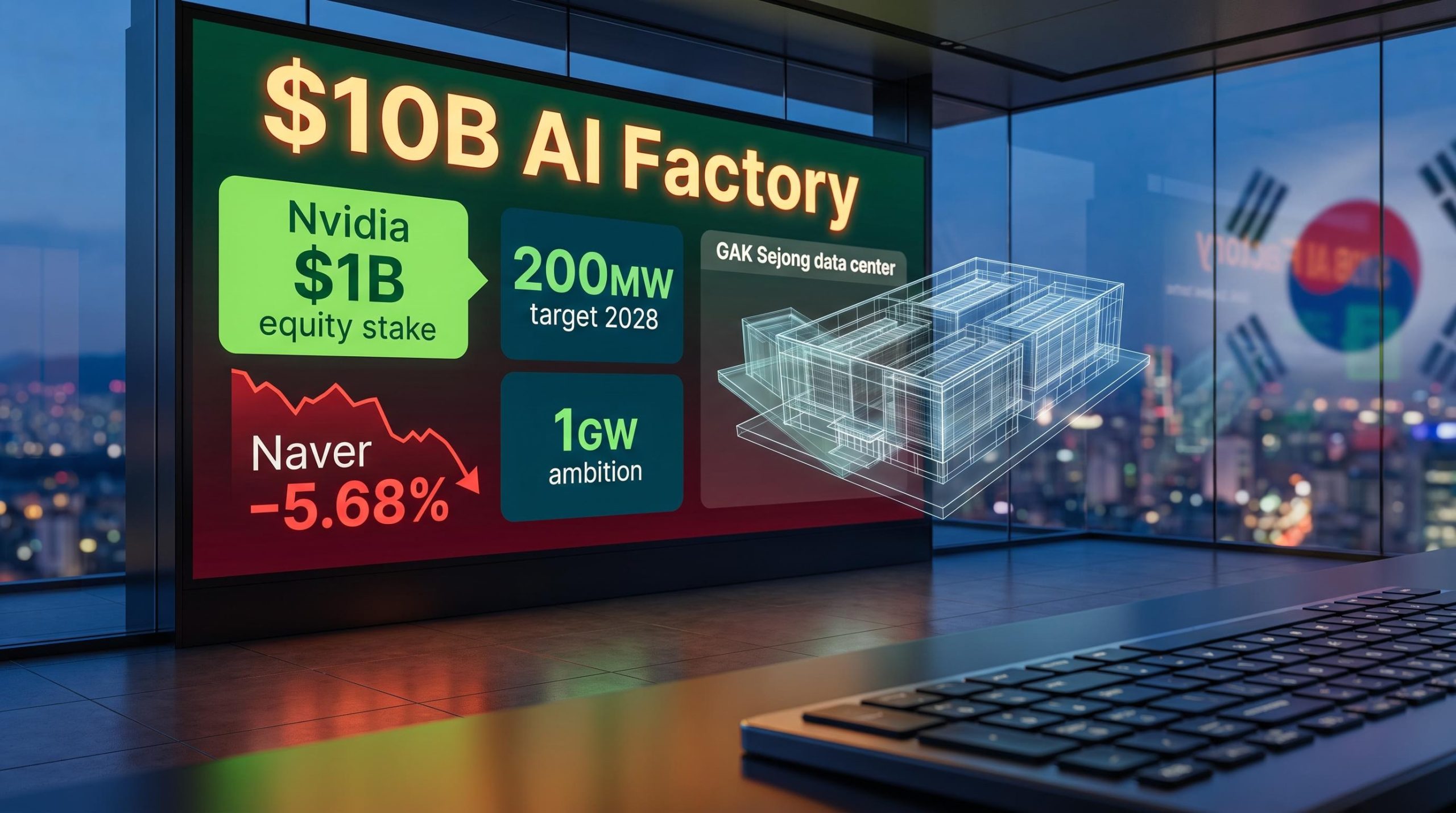
Nvidia just spent $1 billion buying into one of South Korea’s largest internet companies. The market’s response was to sell Naver shares.
The contradiction dissolves once you understand that this is not a conventional investment. Nvidia is subscribing to newly issued Naver shares to co-finance a $10 billion AI data centre project in South Korea, with Brookfield providing the bulk of the capital. The deal blurs what investors typically mean by the word “investment”: it is simultaneously an equity stake, a hardware supply lock-in, a platform deployment, and a geopolitical positioning move. Understanding which of those elements matters most changes how both Nvidia shareholders and Naver shareholders should respond.
Here is the framework for reading this deal as Nvidia’s broader capital deployment strategy takes shape, and for deciding whether the market reaction to Naver represents a misread or a correct pricing of dilution risk.
The anatomy of a $10 billion AI factory deal
Nvidia is not buying Naver stock on the open market. It is the sole subscriber to newly issued shares, meaning fresh capital enters Naver’s balance sheet earmarked specifically for AI data centre development. That distinction matters: this is project financing wrapped in an equity instrument, not a portfolio trade.
The June formalisation of the sovereign AI infrastructure alliance between NAVER Cloud and Nvidia, which the market anticipated with a 30% single-session surge six days before the official announcement, established the strategic template that the $1 billion equity stake is now designed to finance at scale.
The total project of approximately $10 billion combines three capital sources:
| Party | Commitment | Structure |
|---|---|---|
| Brookfield | Up to $9 billion | Exclusive capital partner; non-binding term sheet |
| Nvidia | $1 billion | Equity stake via newly issued Naver shares |
| Naver | Remaining balance | Direct corporate funding |
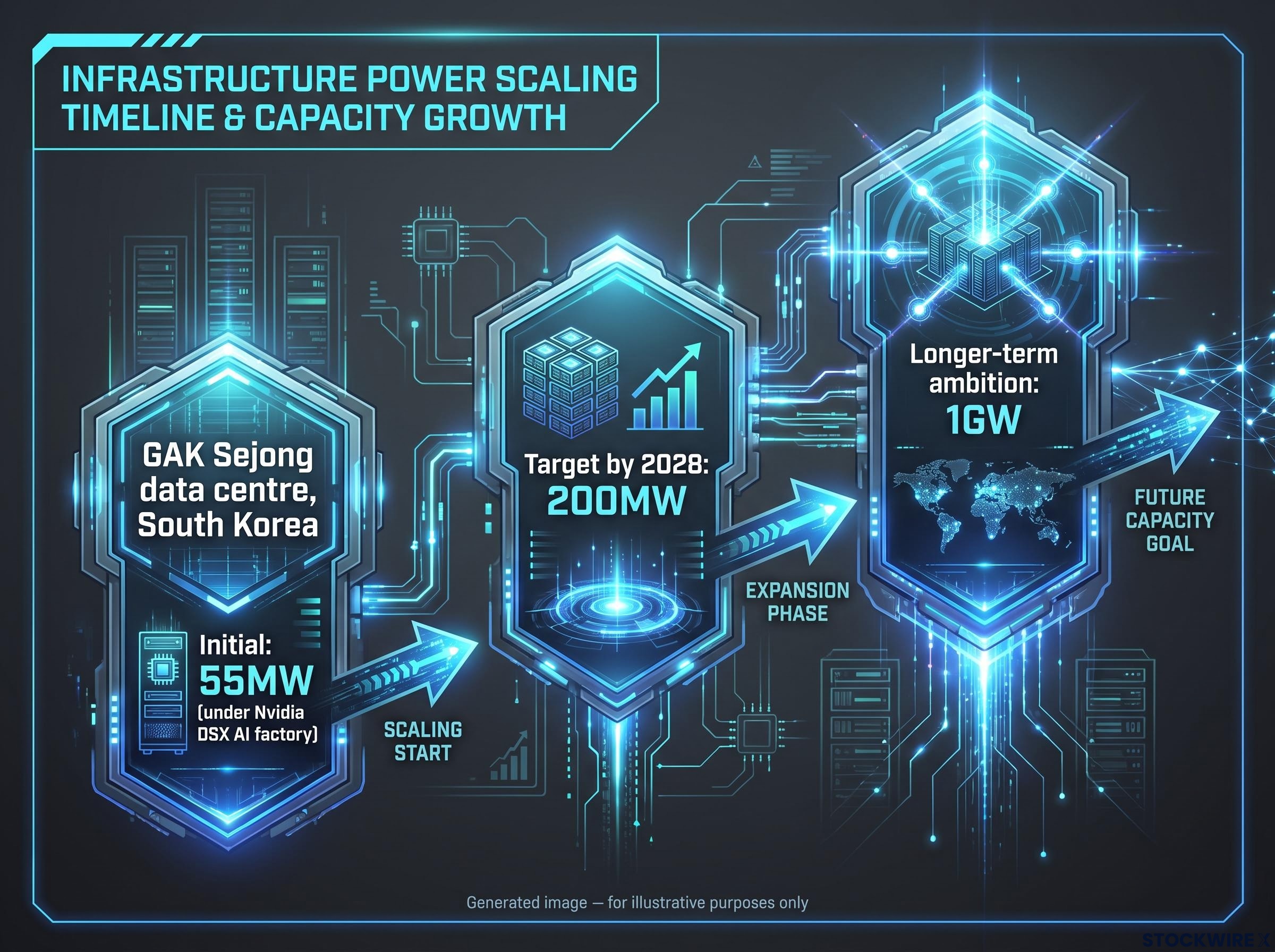
The infrastructure scope at Naver’s GAK Sejong data centre in South Korea scales in three stages:
- 55MW initial deployment under the Nvidia DSX AI factory
- 200MW target by 2028
- 1GW longer-term ambition
The hardware platform spans Nvidia’s Vera Rubin and Blackwell architectures, with the DSX software and operations stack running the facility.
The conditionality clause and what it signals about risk discipline
Nvidia’s $1 billion only deploys if Naver secures at least $9 billion in committed project financing, primarily from Brookfield. That commitment is currently a non-binding term sheet, making it the single largest execution dependency in the entire structure.
The clause functions as a downside protection mechanism. Nvidia does not commit capital to an underfunded project. What this tells you about risk is straightforward: this is disciplined co-investment rather than speculative equity exposure, and that distinction should inform how you weigh Nvidia’s downside in this deal.
When big ASX news breaks, our subscribers know first
Why Nvidia is buying into its own customers
Nvidia’s constraint is no longer GPU demand. It is the speed at which AI-ready data centres can be financed, built, and connected to power. Land, grid capacity, permitting, and local political support are all bottlenecks that chip sales alone cannot solve.
Power availability, grid interconnection timelines, and cooling density are the AI infrastructure bottlenecks that have made land and permitting as strategically important as silicon, a dynamic that explains why Nvidia’s equity co-investment model targets operational operators rather than simply expanding its own manufacturing footprint.
Taking an equity stake converts a vendor-customer relationship into a locked-in infrastructure partnership. Nvidia simultaneously supplies the hardware, provides the DSX platform, and holds ownership in the operator. The vertical integration across those three layers creates a structure that is not just commercially advantageous; it is structurally difficult to displace. That is the point.
- Hardware supply (Vera Rubin, Blackwell architectures)
- DSX platform (software and operations stack embedded in the facility)
- Equity ownership in the operator (Naver)
“Sovereign AI factory”: the official deal documentation frames this project as sovereign AI infrastructure, positioning domestically operated Korean AI capacity as a national strategic asset.
The Naver deal is not isolated. Parallel to it, Nvidia announced a multi-hundred-billion-dollar commercial partnership with SK Group, spanning more than 2GW of AI data centre capacity and long-term high-bandwidth memory (HBM) supply from SK Hynix. This is a Korea-wide strategy. For Nvidia shareholders, the $1 billion is not a balance-sheet cost to question in isolation. It is a customer lock-in mechanism with long-duration hardware revenue attached, and that reframes the capital allocation decision.
What equity partnerships like this actually are (and are not)
When the headline reads “Nvidia invests $1 billion in Naver,” the instinct is to think of it as a fund manager buying a stock. That frame is wrong, and using it will consistently produce the wrong conclusions.
Three elements distinguish this from a conventional equity investment:
- New share issuance. Nvidia is subscribing to freshly created shares, not purchasing existing ones. The capital goes into Naver’s treasury, not into a seller’s pocket.
- Earmarked capital. The proceeds are tied explicitly to AI data centre development, not general corporate purposes.
- Conditional deployment. Nvidia’s capital only flows if the broader financing structure is secured, linking this to project viability rather than share-price conviction.
In economic terms, this functions more like project financing than a portfolio investment. Fresh capital enters a company’s balance sheet to fund a specific infrastructure project, with the equity instrument serving as the legal wrapper.
The vendor-operator-capital triangle: a template for AI infrastructure deals
The structure here has three parties solving three bottlenecks simultaneously: a hardware vendor (Nvidia) providing technology access, a local cloud operator (Naver) providing operational expertise and sovereign credibility, and global infrastructure capital (Brookfield) providing large-scale, long-duration financing.
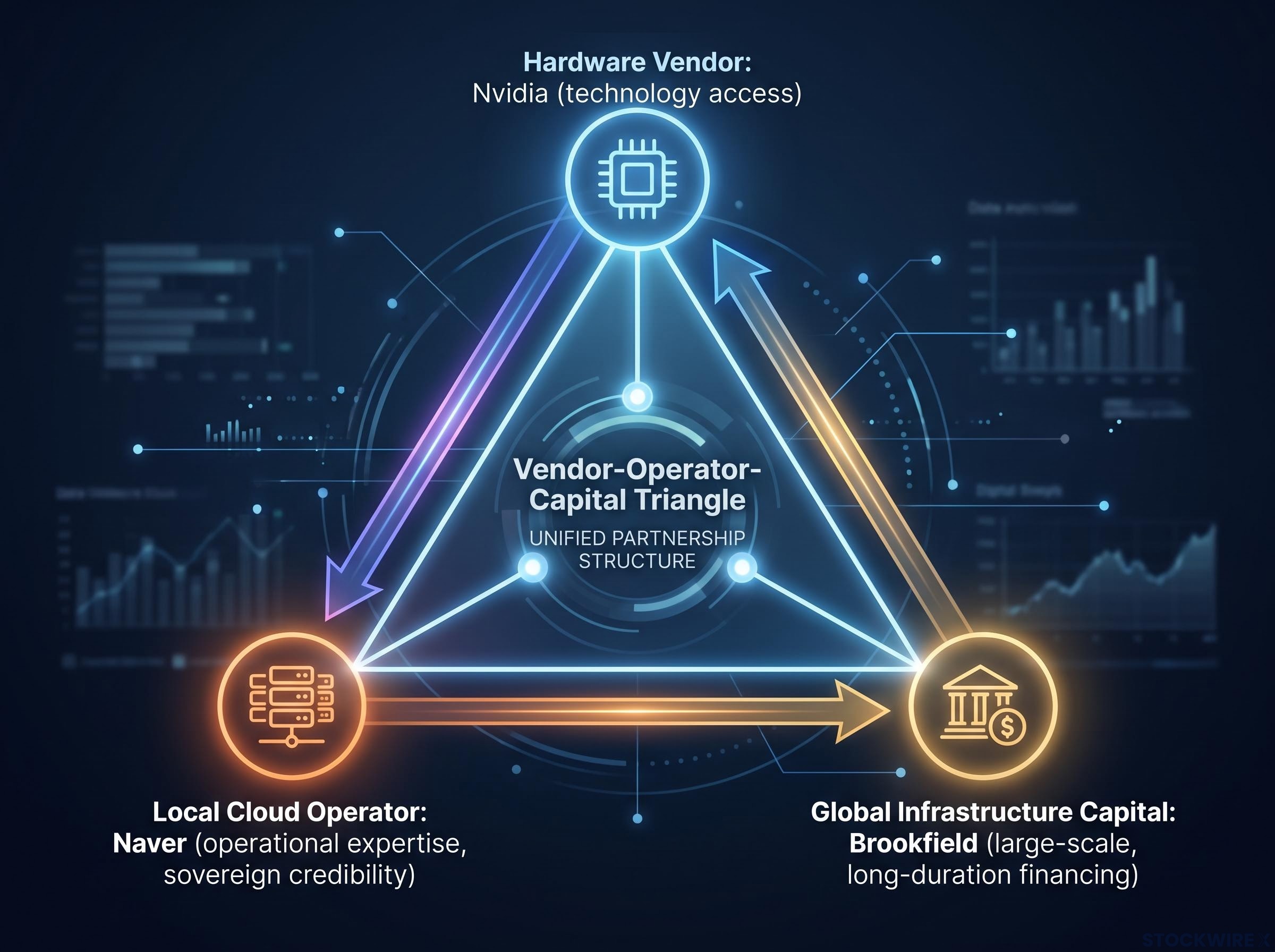
This triangle is worth naming because it is repeating. The AI infrastructure buildout is no longer driven by hyperscalers writing capex cheques from their own balance sheets. Watch for similar vendor-operator-capital structures in Japan, India, the Middle East, and Europe. Once you recognise this as the pattern, the market reaction, the dilution concern, and the strategic logic all become easier to read accurately.
Why Naver’s shares fell 5.68% on what looked like good news
On 24 July 2026, Naver’s share price declined by 5.68% in the session that followed the deal’s announcement. That reaction and the deal’s strategic logic are both defensible simultaneously.
Naver shed 5.68% on the day the partnership was announced, a move that markets appear to have driven by near-term dilution concerns rather than any fundamental rejection of the project’s long-term potential.
Three distinct concerns drove the selling:
- Dilution from new issuance. Because Nvidia is buying newly created shares, existing holders’ ownership percentage shrinks without an immediate offsetting revaluation of future cash flows. The dilution is real and quantifiable today; the revenue upside is years away.
- Long-duration capex timeline. The project scales to 200MW only by 2028, with the 1GW target further out. Returns will materialise over years, not quarters, and are exposed to AI demand cycles, execution risk in construction and power procurement, and competition from other regional cloud and AI platforms.
- Valuation and governance questions. Sophisticated investors price in the subscription terms: at what valuation Nvidia is entering, and whether strategic benefits such as hardware commitments or governance rights accrue to Nvidia but not to existing holders.
The sell-off tells you that equity markets currently weight near-term dilution and execution risk above the long-term infrastructure optionality. Whether you agree with that weighting is the core investment question for anyone considering Naver at these levels.
What the deal signals for Nvidia’s capital allocation strategy
$1 billion is modest against Nvidia’s current cash flows and market capitalisation. It is material enough, however, to signal an intentional direction rather than a one-off experiment.
Three checkpoints for Nvidia shareholders to monitor from here:
- Frequency and scale of similar deals. If vendor-operator-capital structures appear in Japan, India, the Middle East, and Europe over the next 12-18 months, equity co-investment in infrastructure operators becomes a recurring capital allocation category that any Nvidia valuation model needs to account for.
- Return on invested capital trajectory. The financial upside from equity holdings is secondary to hardware revenue, but over time these positions could materially impact Nvidia’s ROIC profile, positively if AI factories scale profitably, negatively if projects are overbuilt or underutilised.
- Financial treatment and governance disclosure. How Nvidia reports these equity stakes, and what governance rights it holds, will determine whether analysts can properly model the economic impact.
Platform dominance versus balance-sheet flexibility: the core trade-off
Deploying equity into infrastructure operators reduces the balance-sheet optionality Nvidia could otherwise direct toward buybacks, acquisitions, or accelerated R&D spending. That is a real cost.
Nvidia’s capital return profile, already under scrutiny for a free cash flow return rate that has fallen to approximately 47% against a historical average of 82%, becomes more complex when equity co-investments in infrastructure operators are factored into balance-sheet optionality calculations.
The strategic logic holds if AI platform stickiness, through embedded hardware and the DSX operations stack, compounds into multi-year hardware and software revenue that would not otherwise materialise. It is harder to defend if the equity stakes generate returns below Nvidia’s cost of capital.
This is an open analytical question, not a settled conclusion. The answer will emerge over the next two to three years as these projects either scale or stall. Nvidia shareholders who are only tracking chip shipment data are watching one variable in an increasingly multi-variable story.
What to watch before the next move in this deal
The deal is announced but not closed. The risks are real. And there are specific, observable milestones that will resolve the current uncertainty.
Brookfield’s non-binding term sheet is the load-bearing element of this entire structure. Until it converts to committed financing, the $10 billion project remains a well-structured intention rather than a locked-in outcome.
The variables that matter are meaningfully different depending on which side of this deal you sit on:
| Investor Type | Key Variable to Monitor | Why It Matters |
|---|---|---|
| Nvidia investors | Brookfield financing conversion | Triggers Nvidia’s $1B capital deployment |
| Nvidia investors | Pipeline of similar deals in other regions | Determines whether equity co-investment is a pattern or an experiment |
| Nvidia investors | Governance rights and financial reporting treatment | Enables accurate modelling of economic impact |
| Naver investors | Construction timelines and power procurement | Determines whether 200MW by 2028 is achievable |
| Naver investors | Subscription price and dilution terms | Quantifies per-share impact on existing holders |
| Naver investors | Commercialisation of AI infrastructure capacity | Determines whether capex translates to durable revenue |
| AI infrastructure theme | Vendor-operator-capital deals in other geographies | Validates or invalidates the triangle as a repeating pattern |
| AI infrastructure theme | Sovereign AI policy narratives and government incentives | Shapes where capital flows and which platforms win selection |
Investors who track the right milestones will be positioned to update their view as the deal either firms up or encounters delays, rather than reacting to each headline without a framework.
Reading this deal correctly before the next one arrives
This deal performs three functions simultaneously: strategic equity stake, hardware supply lock-in, and sovereign AI infrastructure foothold. Conventional equity analysis captures only the first. The other two are where the durable value, or the durable risk, actually sits.
The vendor-operator-capital triangle introduced here is a repeating structure. Investors who have internalised it will be faster to interpret similar announcements as they surface in Japan, India, the Middle East, and Europe. The analytical frameworks in this piece are not specific to one Korean data centre; they apply directly to the next deal, wherever it emerges.
Investors exploring how the vendor-operator-capital triangle applies across other geographies will find our full explainer on sovereign AI infrastructure models, which examines how Australia’s National AI Plan 2025 is shaping domestic compute node deployments that mirror the structural logic of the Naver-Nvidia arrangement.
Two questions will resolve over the next two to three years: whether Naver can turn gigawatt-scale AI infrastructure into durable, high-margin revenue streams, and whether Nvidia’s equity co-investment model generates returns above its cost of capital. Both are unknowable today. Both are observable from here.
This article is for informational purposes only and should not be considered financial advice. Investors should conduct their own research and consult with financial professionals before making investment decisions. Forward-looking statements regarding project timelines, capacity targets, and financial commitments are subject to change based on market developments and company performance.