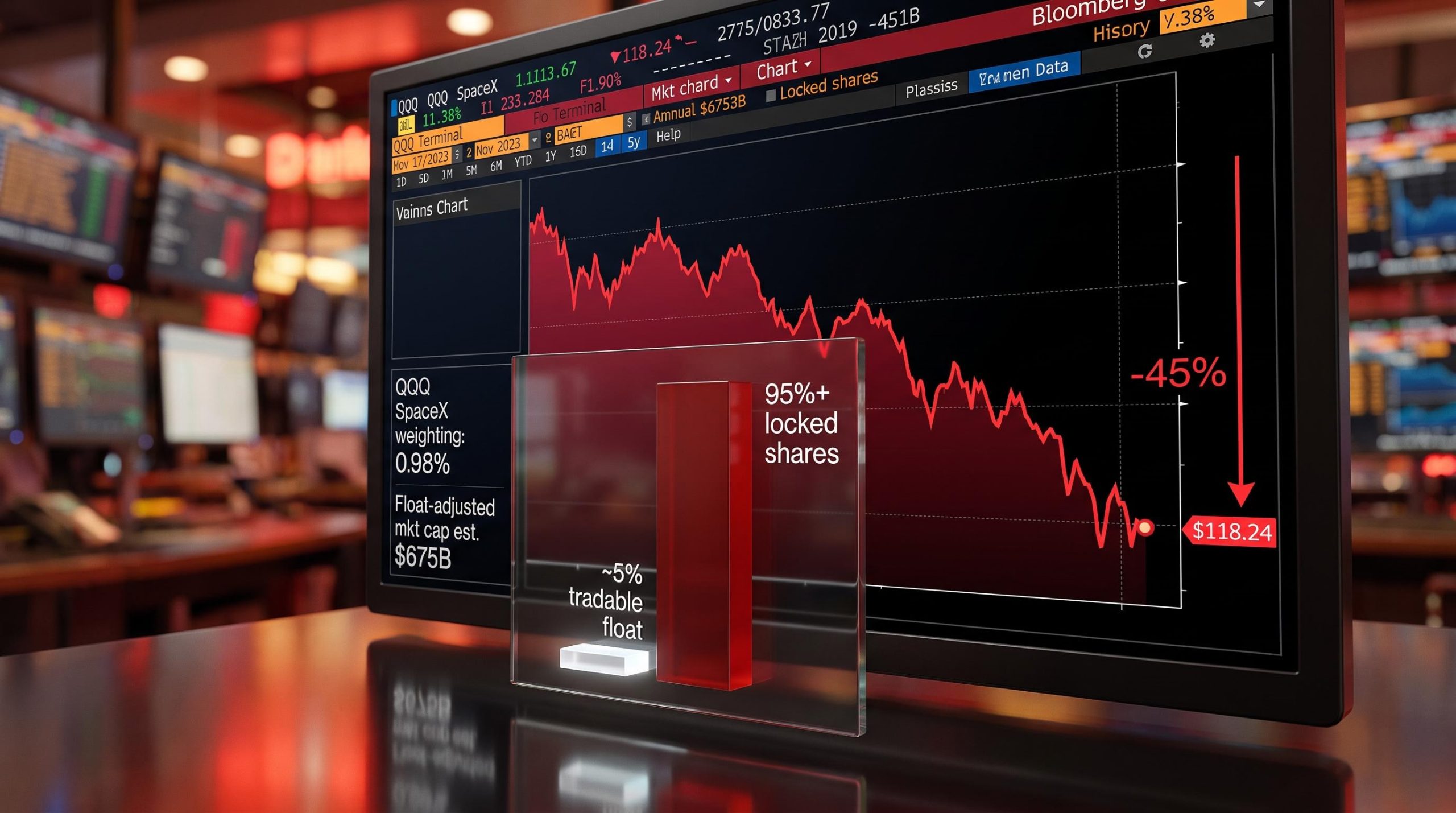
SpaceX raised $75 billion at its June 2026 IPO, the largest in history, and briefly traded above $201 per share within its first week. By late July, the stock had fallen to $118.24, well below its $135 listing price. The same mechanical force that will push index funds to buy more SpaceX shares is also releasing billions of previously locked shares onto the market.
Most investors watching SpaceX focus on the headline valuation or Elon Musk’s approximate 82% voting control. The more consequential dynamic for near-term price behaviour sits underneath those numbers: a set of index rules and lock-up schedules that are simultaneously creating forced buyers and releasing a far larger pool of potential sellers. Understanding how float-adjusted indexing works explains both why passive funds are required to keep buying and why that buying is unlikely to be enough.
Here is what you need to evaluate for yourself: whether the mechanical buying from index funds represents meaningful price support for SpaceX, or a structurally insufficient offset to selling pressure. The next time a headline tells you index inclusion is bullish, you will know exactly which questions to ask.
Why index funds do not track the headline valuation you see in the news
You have probably seen SpaceX’s total market capitalisation reported at approximately $1.5 trillion. That number describes the value of every share the company has ever issued, including the vast majority that are not available to trade. Index funds do not care about it.
What indexes actually use is something called float-adjusted market capitalisation. This is the company’s share price multiplied only by the shares that are freely tradable on public markets, excluding locked-up insider, employee, and early investor stakes. Because index funds can only buy shares that actually trade, they weight companies by this smaller, investable number rather than the full capitalisation.
ETF market distortion from passive flows operates through the same creation-and-redemption mechanism that governs SpaceX rebalancing: every new dollar of inflow forces immediate, valuation-blind buying across every constituent, which means the mechanical demand described here is not unique to SpaceX but a structural feature of how large index additions interact with price.
What that distinction looks like for SpaceX
For SpaceX, the gap between these two numbers is enormous:
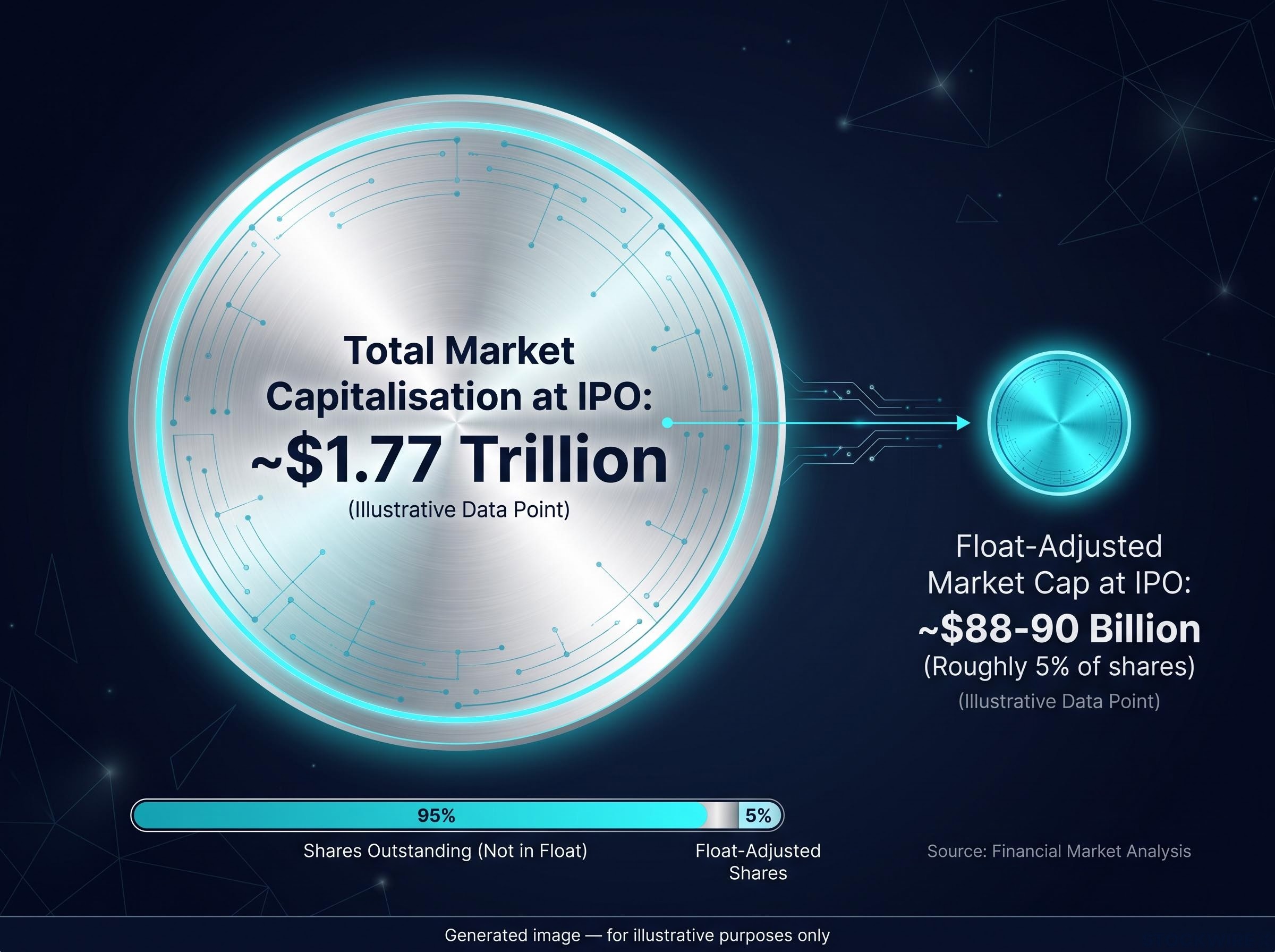
- Total market capitalisation at IPO: approximately $1.77 trillion, reflecting the price of every share outstanding
- Float-adjusted market capitalisation at IPO: approximately $88-90 billion, reflecting only the roughly 5% of shares available to trade publicly
That gap tells you something important. For index fund purposes, SpaceX started life as a mid-sized holding, not a top-five position. Every figure in the rest of this piece, including the buying estimates and the selling pressure, flows from that distinction. If you are reading headlines that imply SpaceX immediately became one of the largest positions in your index fund, the float-adjusted reality is far more modest.
When big ASX news breaks, our subscribers know first
The rule changes that got SpaceX into major indexes within two weeks of listing
Under normal circumstances, a company with only 5% of its shares in public hands would have waited months, possibly longer, before earning a meaningful place in major benchmarks. SpaceX did not have to wait. Five index providers rewrote their rules in May 2026, before the IPO, specifically to accommodate mega low-float listings:
- Nasdaq removed its 10% minimum float requirement and replaced it with a cap equal to the lesser of total market capitalisation or three times the float-adjusted market capitalisation
- FTSE Russell introduced a five-trading-day fast-entry window for qualifying large-cap IPOs
- MSCI modified its waiting period requirements for large-cap listings
- CRSP updated its inclusion criteria to accommodate low-float mega-cap IPOs
- S&P Dow Jones adjusted its eligibility rules for newly listed companies meeting size thresholds
The Nasdaq’s three-times float multiplier is worth understanding in plain terms. It means the index treats SpaceX as if its float-adjusted market cap is up to three times larger than it actually is, provided that inflated figure does not exceed the total market cap. The practical effect is to give large low-float IPOs a meaningfully bigger early index presence than their raw tradable share count would justify.
The result: SpaceX was added to the Nasdaq-100 approximately 15 trading days after listing, around 7 July 2026.
On 22 July 2026, the Invesco QQQ Trust had a position of approximately 39.7 million SpaceX shares on its books, with a market value of around $4.57 billion and a portfolio weighting of roughly 0.98%, up from an estimated 0.68% at fast-entry. No portfolio manager made an active decision to build that position. It was the automatic result of the fund’s obligation to track the index.
| Provider | Old rule | New rule (May 2026) |
|---|---|---|
| Nasdaq | 10% minimum float required | Cap at lesser of total market cap or 3× float-adjusted cap |
| FTSE Russell | Standard multi-week waiting period | Five-trading-day fast-entry for qualifying large-cap IPOs |
| MSCI | Standard waiting period | Modified waiting period for large-cap listings |
These rule changes mean passive buying started almost immediately. And because the buying ratchets higher as more shares unlock, this is not a one-time event. Every float expansion triggers a new round of forced purchases.
How lock-up expirations expand the float and force indexes to reweight
SpaceX’s float does not stay fixed at 5%. It grows in stages as successive lock-up windows expire. A lock-up is a binding agreement that bars pre-IPO shareholders from disposing of their stock for a defined period following a listing, with the primary aim of preventing an early glut of supply from destabilising the share price.
The major expiration window runs between approximately 70 and 180 days after listing, concentrating the largest releases between August and December 2026. Musk’s own shareholding is subject to a separate, later restriction; his stake first becomes eligible for sale in around June 2027, though he has indicated he does not intend to sell at that point.
The SpaceX lock-up schedule is more granular than the broad August-to-December window suggests: roughly 12 distinct unlock events are staggered across that period, and a performance trigger tied to the share price could have accelerated a portion of insider supply before most analysts were modelling for it.
- June 2026: IPO; approximately 5% float
- 7 July 2026: Nasdaq-100 addition
- August to December 2026: Major lock-up expirations (70-180 days post-IPO)
- June 2027: Musk eligible sale date
Each lock-up expiration creates two simultaneous effects. On one side, insiders and early investors gain the legal ability to sell. Many will choose to realise gains or reduce concentrated positions after years of private holding. On the other side, once index providers incorporate the larger float at their next quarterly review, SpaceX’s float-adjusted market capitalisation rises, automatically increasing its target weight in benchmarks and forcing index funds to buy additional shares.
The critical timing gap sits between those two events. Float updates at major indexes happen on a quarterly schedule, not daily. That means the passive buying arrives in concentrated waves, while selling pressure from newly unlocked shareholders can begin immediately. The window between when shares unlock and when index funds must buy creates a period where selling pressure can temporarily dominate.
Morningstar analysts have estimated that if SpaceX’s float-adjusted market capitalisation triples by the end of September 2026, a scenario considered achievable given the lock-up schedule, the figure would reach approximately $675 billion. At that valuation, the Nasdaq index would rank SpaceX somewhere between Walmart and Intel in terms of weighting; Walmart occupied the 12th position in the QQQ as of 22 July 2026.
The direction of the float is clear. What matters is whether the buying that follows can keep pace with the selling it enables.
Why the arithmetic of selling outweighs the arithmetic of buying
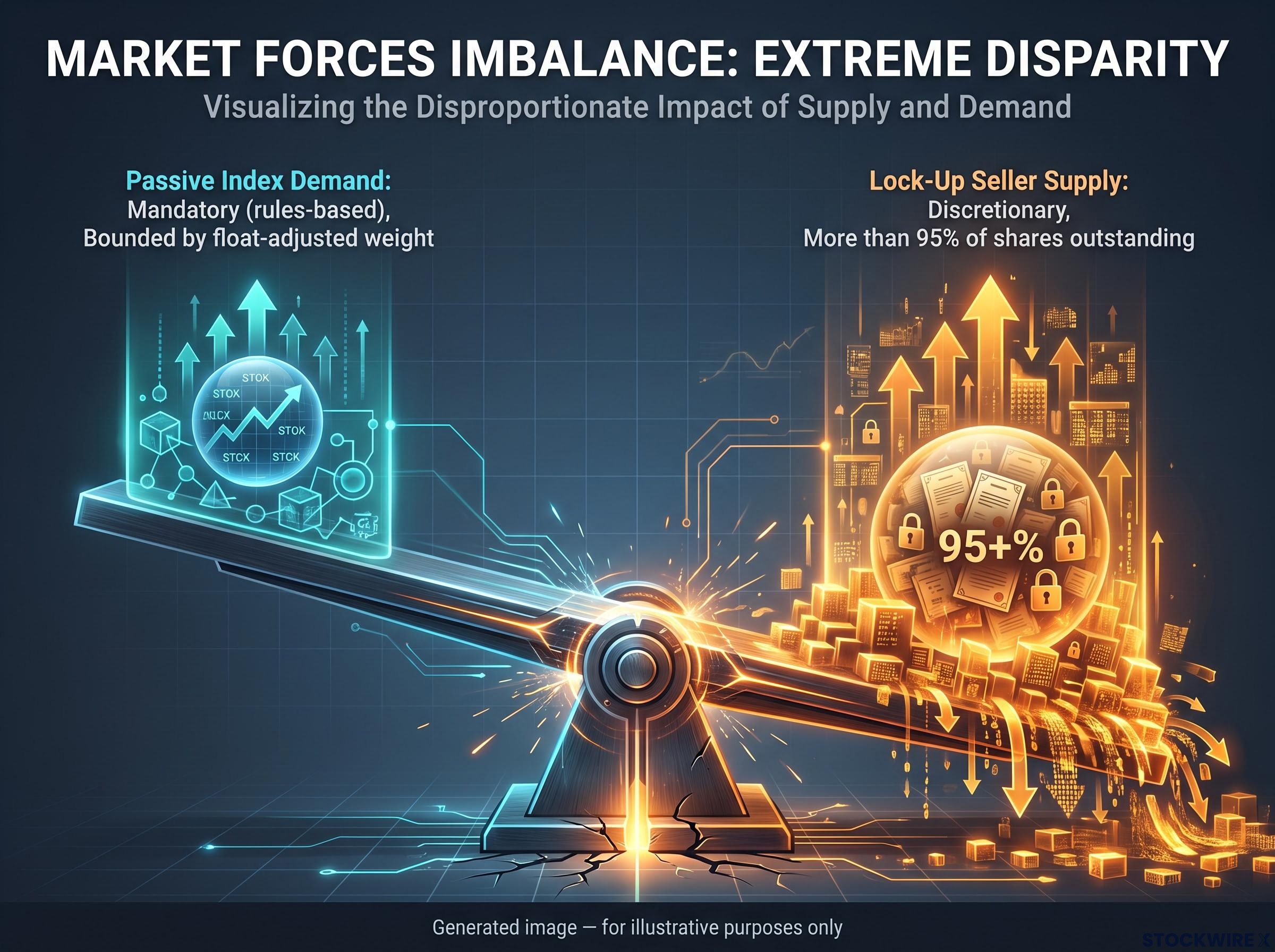
The pool of potential sellers dwarfs what passive funds are mechanically required to absorb. At its simplest, this is an arithmetic problem.
SpaceX floated approximately 5% of its shares at IPO. The remaining more than 95% are held by insiders, employees, and early investors, most subject to time-based lock-ups. As successive windows open between August and December 2026, billions of shares will gradually become eligible for sale, far more than the number index funds are required to own at each reweighting step.
| Force | Scale | Nature |
|---|---|---|
| Passive index demand | Bounded by float-adjusted weight at each quarterly rebalance | Mandatory (rules-based) |
| Lock-up seller supply | More than 95% of shares outstanding, unlocking in stages | Discretionary (insiders choose volume and timing) |
The asymmetry is structural. Passive index funds buy only what their methodology requires at each rebalance. Insiders can choose to sell any amount of their unlocked shares, at any time after their restriction lifts, with no cap on volume.
Zachary Evens, who covers passive strategies at Morningstar, has concluded that the volume of SpaceX shares index funds are required to absorb at each rebalancing step falls short of what would be needed to counterbalance the broader wave of selling that lock-up expirations are expected to generate.
Valuation concerns compound the imbalance. Morningstar equity analyst Nicolas Owens has concluded that SpaceX remains substantially overpriced relative to its fundamentals, even accounting for the fall in its share price since the post-IPO peak. If active, valuation-sensitive investors do not step in as incremental buyers at current prices, passive rebalancing remains the primary source of demand, and it is limited by float-adjusted weights.
SpaceX valuation concerns were flagged well before the IPO, with analyst assessments pointing to a 250x EBITDA multiple that prices in decades of future growth and approximately 30% overvaluation risk, a backdrop that shapes why valuation-sensitive active buyers have not stepped in to absorb the selling pressure that lock-up expirations are generating.
The price trajectory already tells part of this story. Opening at an IPO price of $135, SpaceX shares climbed past $201 before reversing sharply, reaching a trough of around $111 and settling at $118.24 as of 23 July 2026, a decline of approximately 45% from the high. The anticipated selling pressure from lock-up releases is considered a likely contributing factor to that decline.
For you, this means that any near-term price stability attributable to index buying is structural floor activity, not a signal of positive price momentum. The floor is real. It is also insufficient.
What this mechanic looks like for investors watching SpaceX in 2026
If you hold a broad-market ETF or a Nasdaq-100 tracker like QQQ, you already own SpaceX. The question is not whether to endorse the valuation. It is whether you understand that your fund’s SpaceX exposure will keep growing mechanically, and that this growth is a function of index rules rather than portfolio manager judgement.
What to watch in the months ahead
That understanding changes how you interpret the news. Here are the practical watch-points:
- Quarterly rebalance dates: Volume spikes and price swings around these dates are more likely to reflect mechanical index flows than any change in SpaceX’s underlying business outlook
- Major lock-up expiration window (August to December 2026): Each expiration simultaneously releases new selling supply and sets up the next round of forced passive buying at the following quarterly review
- Musk’s June 2027 eligible sale date: The single largest potential selling event on the calendar, well beyond the initial lock-up window
- Index provider announcements of float updates: These signal when reweighting calculations will formally incorporate new tradable shares
The August lockup expiry concentrates two distinct risk events into the same one-to-two week window: the first major insider tranche release of roughly 20% of eligible shares and SpaceX’s first-ever public earnings release, a pairing that was not widely modelled by day-one buyers.
The QQQ’s approximately 0.98% SpaceX weighting as of 22 July 2026 reflects index arithmetic, not active conviction. The three-times float multiplier provides meaningful early uplift, but the ceiling is still governed by the size of the actual tradable pool. SpaceX’s path to becoming a major index holding is measured in quarters and years, not days, and its weight rises only as more shares become freely tradable.
When you see a volume spike on a rebalancing date, you now know to ask whether it is genuine demand or a mechanical flow. That distinction is the difference between a signal about SpaceX’s prospects and noise generated by index plumbing.
A persistent structural bid, and why it may not be enough
The two forces operating on SpaceX’s share price are both real, and they are not equal. Passive index demand creates a persistent floor of buying activity that will accompany every float expansion. Each quarterly rebalance forces funds to purchase additional shares, and that bid is non-discretionary. It does not go away.
But the arithmetic on the other side is larger. More than 95% of shares remain locked as of late July 2026. A potential tripling of float-adjusted market capitalisation to approximately $675 billion by end of September 2026 would bring a significant increase in passive demand, yet the pool of shares becoming eligible for sale at each lock-up expiration dwarfs what index funds are required to absorb at each step.
Morningstar equity analyst Nicolas Owens has assessed SpaceX as materially overvalued even after its decline from its above-$201 peak to $118.24 as of 23 July 2026, a drop of approximately 45%.
Passive index demand is not a substitute for valuation-sensitive active buyers. In an environment where both Morningstar analysts and the price action itself suggest the market is not yet pricing SpaceX as attractively valued, the net balance of mechanical buying and discretionary selling is likely to resolve as continued price pressure rather than support.
For you, this is the distinction that matters. If you hold a passive fund that tracks a major index, your SpaceX exposure is growing whether you chose it or not. Understanding why it grows, and why that growth does not equal a bullish signal, is the prerequisite for evaluating what that exposure means for your portfolio. The structural bid is real. The selling pressure is larger. The indexing signal and the valuation signal are telling you different things, and now you know how to tell them apart.
This article is for informational purposes only and should not be considered financial advice. Investors should conduct their own research and consult with financial professionals before making investment decisions. Past performance does not guarantee future results. Financial projections are subject to market conditions and various risk factors.