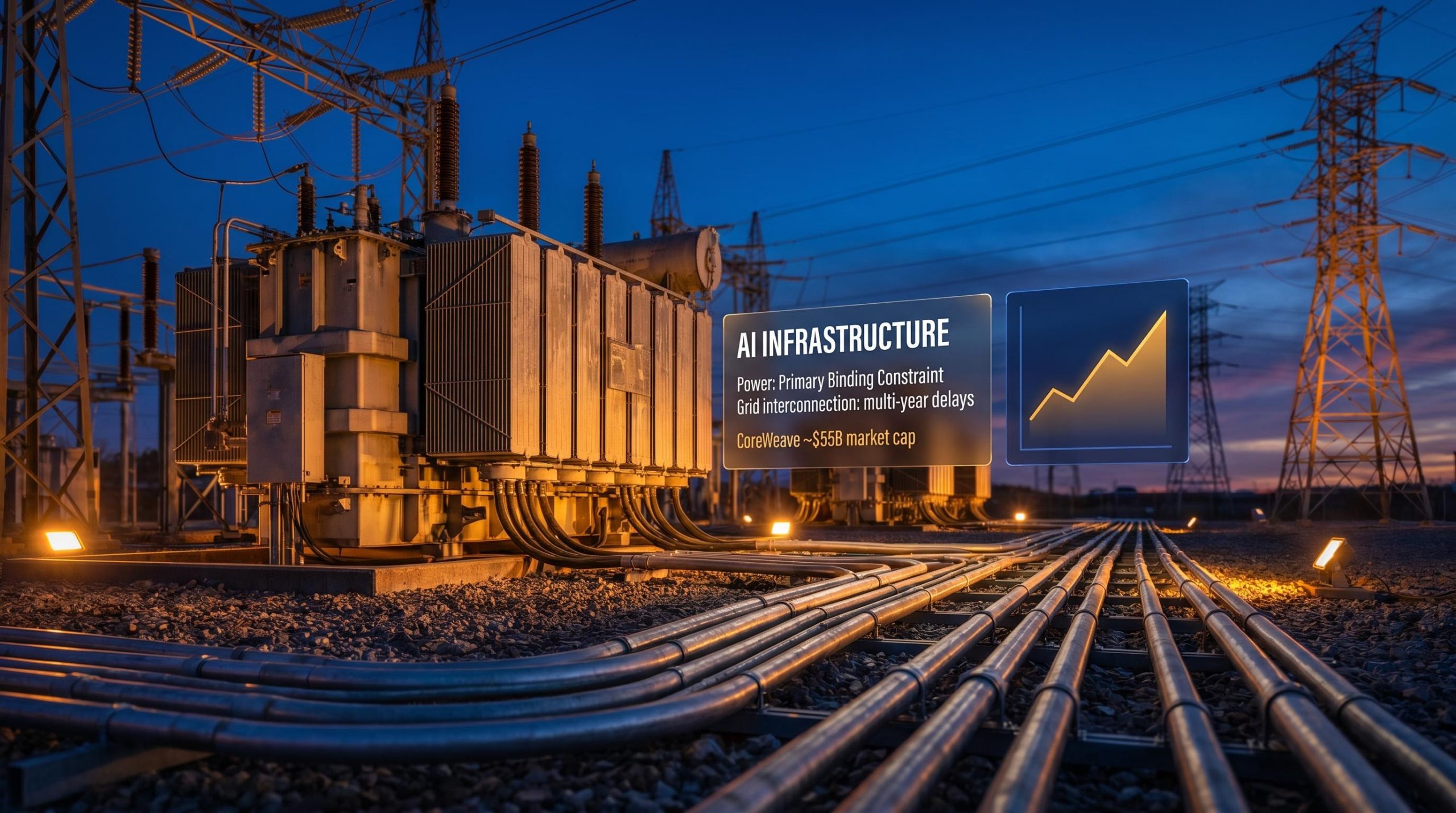
The companies absorbing the most media attention in the AI buildout are rarely the ones where the most durable value is being created. The chip designers and model developers command the headlines, the conference keynotes, and the market capitalisation milestones. Yet the binding constraints on AI adoption sit further down the stack, in infrastructure layers that most investors glance past on their way to the obvious names.
There is a reason for that asymmetry, and it is not new. Every major technological revolution of the past two centuries followed a consistent pattern: the investors who understood it early found value not in the headline technology but in the infrastructure resolving its binding constraints. The railroad era, electrification, and the internet buildout each produced their own version of this dynamic.
Here is the framework for identifying where that dynamic is playing out in the current AI cycle, and a structured checklist for evaluating whether a specific infrastructure stock is genuinely positioned at a binding constraint or simply adjacent to one.
What history actually shows about technological revolutions and where the money went
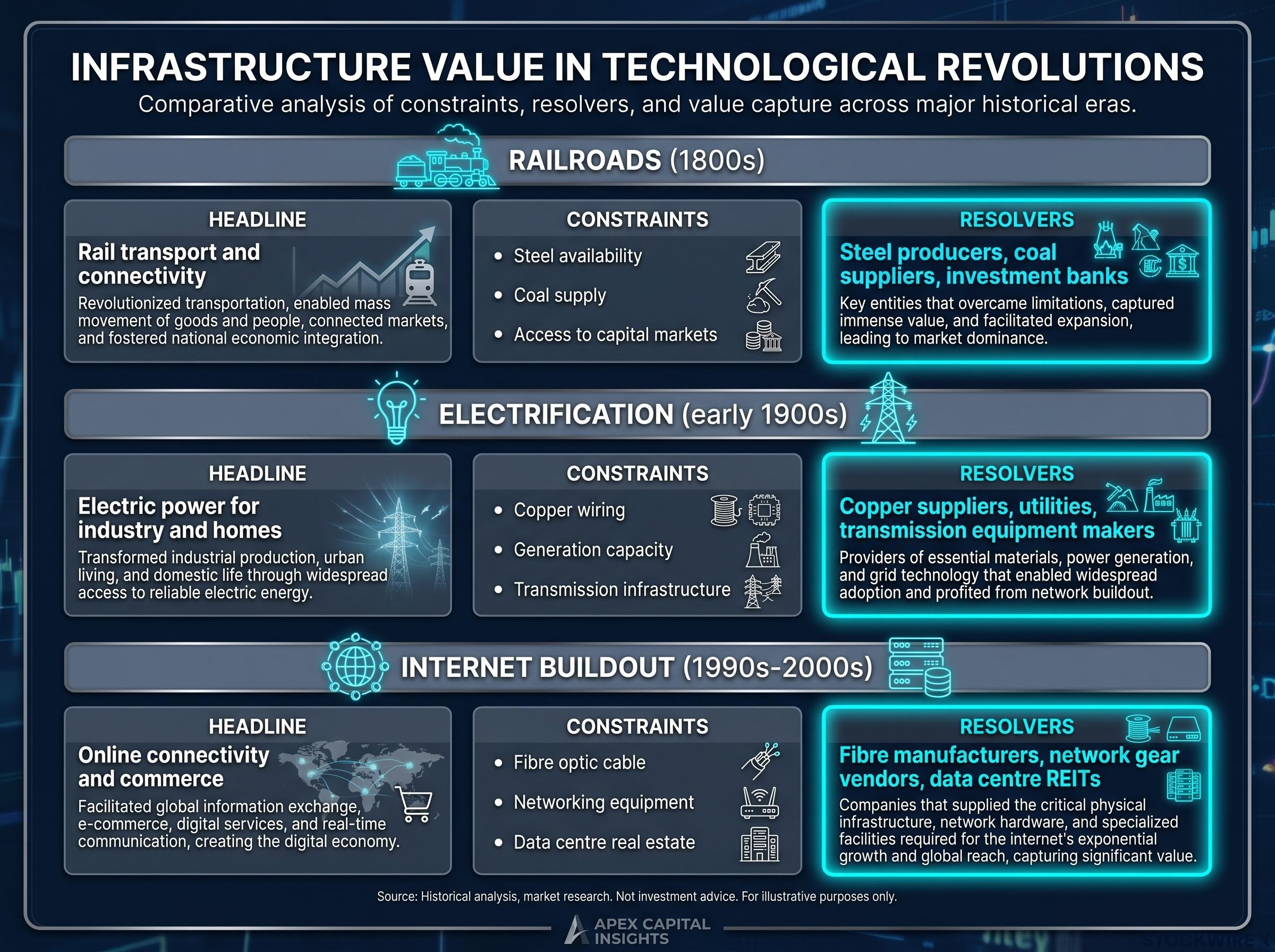
The pattern is remarkably consistent across eras. In each case, a headline technology captured public imagination and investor capital, while the companies resolving the physical and operational constraints on that technology’s adoption built durable, compounding positions.
| Era | Headline Technology | Key Binding Constraints | Constraint-Resolver Categories |
|---|---|---|---|
| Railroads (1800s) | Rail transport and connectivity | Steel availability, coal supply, access to capital markets | Steel producers, coal suppliers, investment banks |
| Electrification (early 1900s) | Electric power for industry and homes | Copper wiring, generation capacity, transmission infrastructure | Copper suppliers, utilities, transmission equipment makers |
| Internet buildout (1990s-2000s) | Online connectivity and commerce | Fibre optic cable, networking equipment, data centre real estate | Fibre manufacturers, network gear vendors, data centre REITs |
The structural logic behind the pattern
None of this was inevitable. Plenty of infrastructure providers in each era failed, overbuilt, or were commoditised before they could capture the value their positioning suggested. The pattern is not “infrastructure always wins.” It is narrower and more useful than that.
Adoption of any transformative technology is gated by its most binding physical or operational constraint. Whoever removes that gate captures value proportional to the scale of adoption. That makes the pattern a reusable lens: identifying where adoption is genuinely gated today tells you where durable value is most likely to concentrate, not which specific company will capture it.
The railroad analogy is not merely rhetorical: roughly three-quarters of historical general-purpose technology booms followed a cycle of massive overinvestment, capital destruction, and then extended productivity growth built on surviving infrastructure, a pattern that the AI bubble history of earlier technology waves traces with uncomfortable precision.
When big ASX news breaks, our subscribers know first
The AI buildout’s binding constraints are already visible and already binding
The AI cycle’s bottlenecks are not theoretical. They are already restricting deployment capacity in 2026, shaping where facilities can be built, how quickly they come online, and which operators can compete for new workloads. Four categories stand out.
- Power availability. Utilities are reporting multi-year delays for grid interconnections. Power has become the primary limiting factor for new AI data centre capacity, meaning the constraint is not demand or compute supply but finding electricity. Regional grids are being pushed to operational limits by dense AI workloads, and the lead times on transmission and generation upgrades mean this bottleneck is structural, not cyclical.
The multi-year grid interconnection delays utilities are already reporting represent more than a capacity planning problem; the structural grid crisis created by AI energy demand is reshaping where facilities can be built, which operators can compete, and which energy categories attract sovereign-scale capital commitments.
- Cooling and thermal density. AI clusters drive rack densities that traditional air cooling cannot handle. Once rack power exceeds roughly 50-100 kW per rack, operators must adopt liquid or immersion cooling. Facilities that cannot support these densities risk losing future AI workloads entirely.
- Physical buildout complexity. Shortages and long lead times affect transformers, switchgear, high-voltage gear, and backup generators. Local permitting, environmental concerns, and community opposition over water use and noise add further friction. Capital intensity and regulatory complexity favour scaled operators with better access to capital and regulatory expertise.
- Engineering skills gap. Industry analysis, including the DDN 2026 State of AI Infrastructure Report, indicates that a large majority of organisations report their AI environments as already too complex, and that skills gaps rank among the top drags on AI return on investment. This validates orchestration platforms, managed services, and operational tooling as infrastructure layers in their own right.
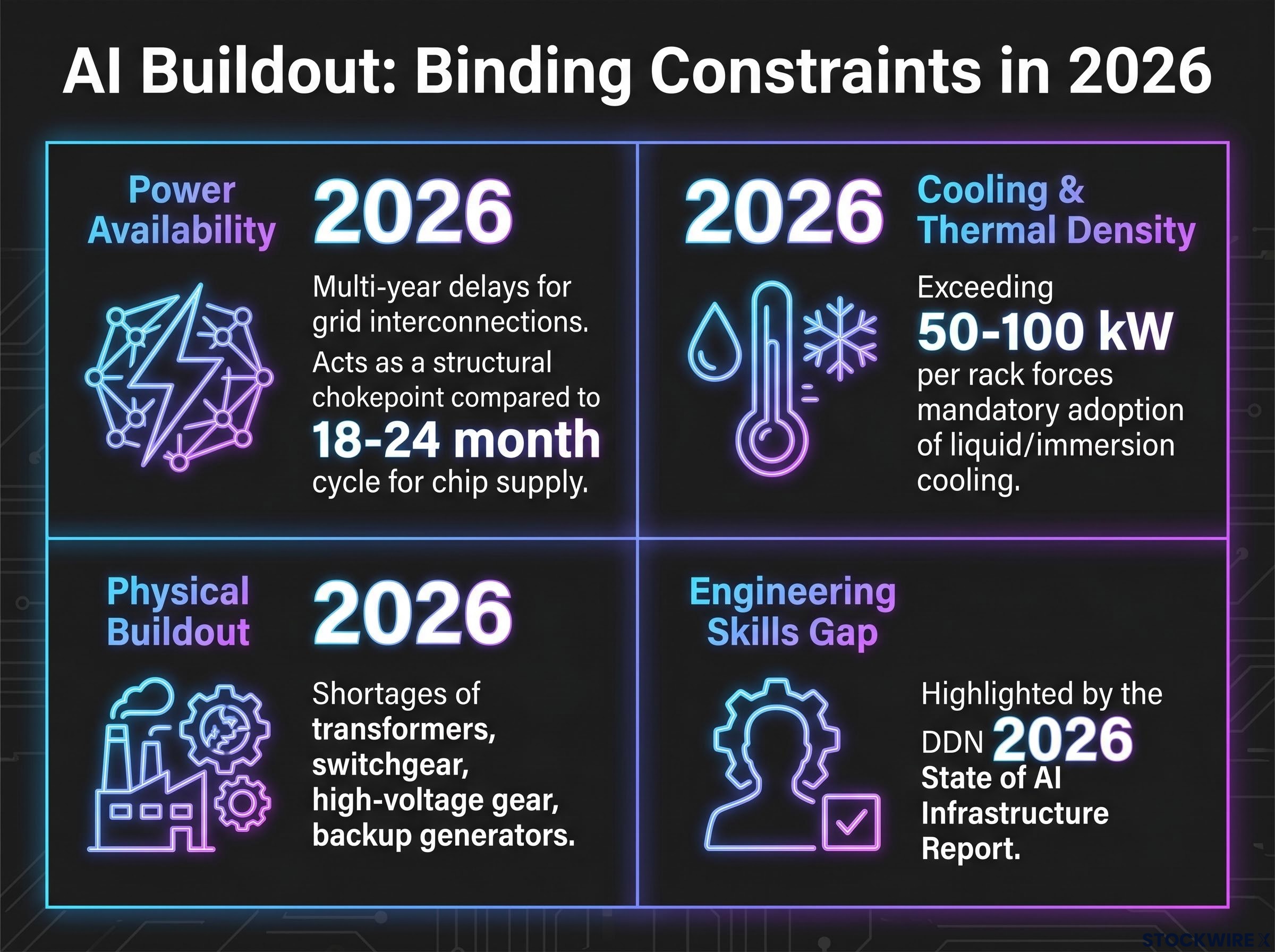
Power is likely the most structurally durable constraint of the four. Chip supply can respond via foundry expansion on a roughly 18-24 month cycle. Grid and transmission upgrades require multi-year regulatory, permitting, and construction timelines. That asymmetry in response time is what positions power at the structural chokepoint.
The investment opportunity in companies resolving these constraints is present-tense, not speculative. The bottlenecks are already binding.
Why the infrastructure layer matters more than the model layer for long-term value creation
Why infrastructure accumulates durable advantage
Companies that resolve binding constraints for their customers tend to accumulate competitive advantage in a compounding pattern. Customers become increasingly dependent on integrated workflows. Switching costs rise with each layer of integration. Regulatory barriers and capital scale requirements limit new entrants. This is why infrastructure layers in previous technology cycles produced not just winners but durable franchises.
Contrast that with the headline technology layer, where winner-takes-most dynamics and rapid iteration create higher uncertainty of outcome. The model that leads today may not lead in eighteen months. The chip architecture that dominates this generation may face an architectural challenge in the next.
How this widens the investment aperture
The focus here is not chip designers or model developers in isolation; the point is to extend the investment aperture across the full infrastructure ecosystem. CoreWeave’s market capitalisation of approximately $55 billion reflects how markets are already attributing significant value to infrastructure enablers. Broadening that aperture is not a dilution of conviction; it is an acknowledgement that durable value in previous technology revolutions spread across the infrastructure stack rather than accruing solely at the headline layer.
The market is already pricing this dynamic in real time: AI infrastructure stocks at the power and optical networking layer have outpaced the Nasdaq-100 in 2026, with niche suppliers like Bloom Energy posting 130% year-over-year revenue growth and returning to profitability after decades of losses, illustrating how constraint-resolving positions can produce returns that headline technology names do not.
CoreWeave as a case study in GPU cloud infrastructure enablement
CoreWeave operates as a purpose-built, GPU-powered cloud infrastructure provider. The analogy to an early electric utility is structurally precise: just as early utilities enabled factories to access electricity without building their own generators, CoreWeave enables AI labs and enterprises to access GPU compute capacity without constructing dedicated data centres.
What it actually provides goes beyond raw GPU access. CoreWeave offers cluster orchestration, developer tools, tuned networking, and optimised storage, specifically designed for workloads where general-purpose, CPU-centric clouds are insufficient. For organisations developing large language models or AI applications, renting pre-built GPU cluster infrastructure removes a multi-year, capital-intensive buildout process.
CoreWeave’s own operations illustrate the multi-layer infrastructure challenge. Bringing large-scale GPU clusters online means contending with each constraint the framework highlights:
- GPU and memory supply
- High-speed networking
- Cooling systems capable of handling extreme rack densities
- Substantial electricity supply
- Specialised engineering staff
The published analyst consensus puts CoreWeave’s 12-month price target at around $143 per share, which would represent approximately 50% upside from then-current trading levels. This is analyst consensus, not an editorial recommendation.
The risks deserve equal weight. CoreWeave shares lost around 40% of their value across the prior 12-month period, a decline that reflects the significant price swings characteristic of its market position. It is simultaneously a constraint resolver and heavily exposed to the same upstream constraints it helps customers avoid. It competes directly with hyperscalers. Customer concentration and capital discipline are central uncertainties.
CoreWeave illustrates both the opportunity and the complexity of the infrastructure-enabler model. It is useful as a case study precisely because it shows the framework working in practice alongside the risks that remain even when the business model is structurally well-positioned.
A four-question checklist for evaluating AI infrastructure stocks through the bottleneck lens
The historical framework and the case study give you orientation. These four screening questions give you a practical filter.
- Binding constraint test. Is the company solving a constraint that is genuinely limiting AI adoption, or one that sounds important but is not actually gating deployment? Constraint resolution value is only durable if the constraint is a real brake on adoption. Power availability and cooling density are binding right now. Not every infrastructure category is.
- Commoditisation resistance. What prevents the solution from being commoditised once competitors recognise the opportunity? The strongest positions are protected by regulation, scale advantages, intellectual property, or switching costs. If the only moat is being early, the position may not survive the next capital cycle.
- Customer dependency trajectory. Are customer integrations deepening over time, with workflows and data increasingly embedded in the platform? Or is this spot-market capacity that customers can move between providers? Deepening dependency creates compounding switching costs. Spot capacity does not.
- Capital return quality. Does incremental capital deployed earn attractive, defensible returns, or does it simply add capacity to a future price war? In previous infrastructure buildouts, companies that confused volume growth with value creation destroyed capital at scale.
The framework identifies where to look. It does not tell you what to buy. History shows infrastructure buildouts produce both spectacular winners and significant losers, and selectivity and valuation discipline remain the primary determinants of outcome even when the framework correctly identifies a structural bottleneck.
| Bottleneck Category | Industry Verticals Positioned at Constraint | Key Evaluation Consideration |
|---|---|---|
| Power | Utilities, IPPs, T&D equipment, grid-scale storage | Multi-year grid interconnection timelines create structural durability |
| Cooling | Liquid cooling vendors, industrial HVAC, data centre REITs | Rack density thresholds force technology adoption, not just preference |
| Compute and networking | Memory, interconnects, networking switches, optical components | Chip supply can expand faster than grid capacity, reducing constraint durability |
| Skills and complexity | MLOps, orchestration, managed services, observability tools | Deepening customer integrations vs. substitutable tooling |
Applying the framework without over-applying it
The railroad playbook identifies where to look, not what to buy. That distinction is the difference between a useful investment framework and a dangerous one. Infrastructure buildouts have historically produced overbuilding, commoditisation, regulatory capture, and capital misallocation alongside the genuine winners. The current AI cycle will not be exempt from any of these risks.
The constraints most worth monitoring through the second half of 2026 and beyond are power and grid interconnection timelines, cooling density thresholds in new facility design, and the degree to which orchestration and MLOps platforms deepen customer integrations rather than remaining substitutable. These are the pressure points where the binding-constraint thesis faces its most direct real-world tests.
Translating the bottleneck framework into a portfolio structure requires a view on how to weight the hardware, cloud, and software layers against each other; a three-tier AI infrastructure allocation approach, spanning roughly 50% hardware, 40% cloud, and 10% software, reflects both the capital concentration at the physical layer and the different risk profiles each tier carries in the current cycle.
The framework is a starting point for diligence, not a substitute for it. Historical analogies carry no guarantee that equivalent outcomes will follow, and financial projections for companies positioned at structural chokepoints are subject to prevailing market conditions and competitive dynamics that can shift materially. Readers should conduct independent research and seek guidance from qualified financial professionals before making any investment decisions.
This article is for informational purposes only and should not be considered financial advice. Investors should conduct their own research and consult with financial professionals before making investment decisions.
—