AI-linked companies now command nearly 45% of the S&P 500’s total market value, according to Goldman Sachs data. That is the kind of concentration figure that usually precedes a warning to trim exposure. HSBC Global Private Banking did the opposite: it added to equities heading into the final quarter of the year.
That apparent contradiction sits at the centre of HSBC’s Q4 2026 outlook, titled “AI-celeration” and published on 3 September 2026. It is not a simple bullish call. It is a structured multi-asset framework in which equities, bonds, and alternatives are each handed a defined role rather than a single directional bet on the AI trade continuing.
Here is what HSBC’s actual portfolio moves reveal about where institutional money currently sees risk and opportunity, and whether any of that logic transfers to a self-directed investor weighing their own allocation for the quarter ahead.
Why HSBC is adding to equities even as AI concentration risk builds
Adding equity exposure at the peak of AI concentration looks reckless on the surface. The internal logic is what makes it defensible.
HSBC has increased its allocation to global equities while keeping broad sector diversification. The overweight is not a doubling-down on the AI core. It deliberately reaches into sectors positioned to capture AI’s downstream effects and other structural spending trends.
The concentration backdrop AI-linked companies command nearly 45% of S&P 500 market cap (Goldman Sachs data). The “Magnificent 7” alone accounted for 34% of S&P 500 market value as of 10 June 2026, according to J.P. Morgan Asset Management.
Those figures are precisely why HSBC’s framework spreads equity exposure rather than sitting in the crowded centre. The house view, as articulated by HSBC’s Willem Sels and reported by the FXStreet Insights Team, is that corporate earnings growth will broaden beyond technology and beyond US-listed names into wider geographies and industries, including Europe, where AI-linked productivity gains are now observable.
The concentration numbers are not confined to the equity sleeve: hidden AI portfolio concentration runs through data-centre REITs, infrastructure funds, and investment-grade bond issuers simultaneously, meaning a standard multi-asset portfolio can carry the same thematic bet across every allocation without any individual decision triggering a warning.
The diversification is specific. HSBC’s overweight captures four sectors seen as beneficiaries of US re-industrialisation and defence spending, not just the technology names driving the headline index:
- Financials: positioned to benefit from broadening economic activity and capital deployment
- Materials: exposed to the physical inputs of re-industrialisation and infrastructure build-out
- Energy: supported by elevated energy prices and the power demands of AI infrastructure
- Defence: underpinned by sustained national defence expenditure across regions
This tracks a wider market shift. By early 2026, Reuters reported investors starting to rotate into cheaper cyclicals and financials to escape crowded AI positioning.
For a self-directed investor asking whether it is too late to join the AI equity cycle, HSBC’s framework reframes the question entirely. The concentration numbers are not an argument for abandoning equities. They are an argument for being deliberate about where within equities you sit. The institutional logic moves the decision from “should I own equities?” to “which equities, and why?”
When big ASX news breaks, our subscribers know first
The regional case: why HSBC prefers Asia and the US over developed Europe
HSBC’s regional tilt reads less like a geography bet and more like a supply-chain argument. That distinction changes how a global investor should assess the risk.
The overweight positions in mainland China, Hong Kong, Singapore, and South Korea are tied explicitly to the physical build-out of AI: data centres and the semiconductor supply chain, not a macroeconomic recovery story. HSBC cites three structural advantages Asia holds over the US in this build-out: stronger government policy support, competitive energy costs, and proximity to manufacturing.
The scale of the opportunity An HSBC market update dated 5 August 2026 projects global AI capital expenditure rising from below USD 400 billion in 2025 to over USD 1 trillion by 2028 (figures flagged as unverified in the source research).
The same note projects Asia’s data centre capacity to more than double by 2030, reaching roughly 40% of global capacity. That positioning directly benefits Asian chipmakers, memory producers, power equipment suppliers, and data centre operators.
Two other institutions arrive at convergent conclusions rather than competing ones. BlackRock, in a July 2026 insight, prefers emerging markets over developed international markets, expecting roughly 20% emerging market earnings growth over the next 12 months, with Taiwan and South Korea central to the memory and semiconductor supply chains. Morgan Stanley research indicates TSMC’s advanced packaging (CoWoS) capacity is expected to reach 160,000-170,000 wafers per month by 2027, implying greater than 50% annual capacity growth into 2026.
Asian chipmakers trading at roughly half the forward valuation of their US peers are generating earnings growth running nearly three times faster, a gap that directly supports the supply-chain framing HSBC uses to justify its regional overweight rather than a macroeconomic recovery argument.
| Region | HSBC Positioning | Primary Rationale | Key Risk |
|---|---|---|---|
| United States | Overweight | AI monetisation, re-industrialisation, defence spending | Elevated valuation and index concentration |
| Mainland China / Hong Kong | Overweight | AI supply chain, improving shareholder returns | Policy dependence and geopolitical exposure |
| Singapore | Overweight | Data centre growth, regional infrastructure hub | Sensitivity to global capex cycle |
| South Korea | Overweight | Memory and semiconductor manufacturing | Capital intensity and demand cyclicality |
Taken together, these figures tell you Asia’s AI exposure runs through physical infrastructure and component manufacturing, not software or platform ownership. That changes the risk profile. It is more capital-intensive and more policy-dependent, but potentially more insulated from the valuation compression that would hit US technology names if growth expectations soften. For a global investor weighing regional allocation, framing the Asia overweight as a capex infrastructure play rather than a bet on Chinese economic recovery is the distinction that actually matters for assessing downside.
Real yields and what bond markets are actually offering right now
The clearest number in HSBC’s fixed income case is a real yield of 2.93% on 30-year US Treasury Inflation-Protected Securities (TIPS), which adjust their value with inflation to preserve purchasing power.
That figure, quoted by HSBC’s Dhiraj Narula in The Star on 7 August 2026, had recently peaked at 3.04%, described as the highest level since 2008. A real yield above 2.9% on a 30-year inflation-linked instrument is a genuinely rare entry point for anyone wanting a positive inflation-adjusted return without taking equity risk. Narula recommended long-maturity US bonds specifically for that inflation protection.
The picture is not confined to the US. HSBC Private Bank noted in early March 2026 that real, inflation-adjusted yields around the 5-10 year UK gilt maturity sat “fractionally below 2 per cent,” which it characterised as a rare chance to lock in risk-free real returns ahead of Bank of England rate cuts projected to fall to 3% in Q3 2026.
| Instrument | Real Yield | HSBC Stance |
|---|---|---|
| 30-year US TIPS | 2.93% (peaked at 3.04%) | Recommended for inflation protection |
| 5-10 year UK Gilts | Fractionally below 2% | Rare chance to lock in real returns |
| US Dollar (real yield shift) | Trending lower | Challenges mildly bullish USD view |
There is a genuine problem the framework has to answer, and it is worth stating plainly.
The correlation challenge BlackRock found in April 2026 that since 2020, bond returns have been negative in 17 of the 19 months when equities fell by 2% or more, sharply limiting fixed income’s ability to hedge equity stress.
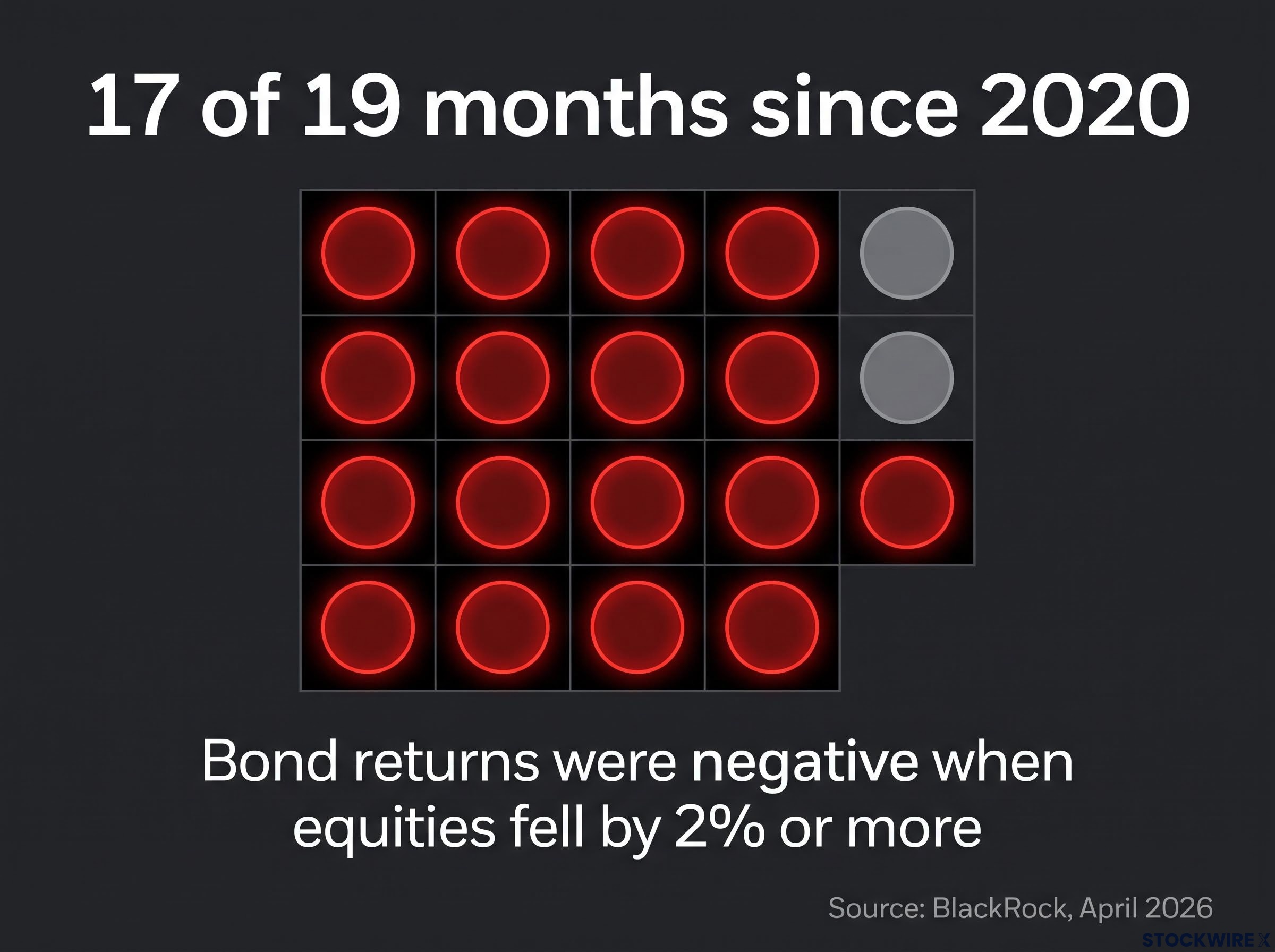
That finding undermines the traditional assumption that bonds cushion a portfolio when shares fall. HSBC’s answer is not to hold a broad bond index and hope. It is an active, medium-duration approach, targeting the middle of the maturity range and selecting positions rather than owning the whole market. The real yields on offer are what make bonds a positive contributor to return in this framework, not merely a defensive default.
The bond-equity correlation breakdown is not a 2022 anomaly: the same positive correlation dynamic that produced a 20% combined drawdown in 2022 is present in inflationary or supply-shock environments generally, and HSBC’s active medium-duration approach is a direct response to that regime-dependent structural flaw in passive multi-asset construction.
There is a currency dimension too. By 24 August 2026, an HSBC FX Viewpoint observed that lower US real yields were beginning to challenge the bank’s mildly bullish view on the US dollar, which reinforces the case for diversified currency and bond exposure rather than concentration in a single market.
For an investor uncertain whether bonds still belong in a modern portfolio, the specific yield data gives you a concrete basis for that decision. Whether a 30-year real yield near 3% suits you depends on your time horizon, but it is a real opportunity to weigh, not a generic income assertion.
Gold, infrastructure, and private assets: what alternatives actually do in this framework
It would be easy to present alternatives as a magic buffer. HSBC’s own research does not, and the honest reading is more useful than the promotional one.
Gold sits near USD 4,478 per troy ounce as of 3 September 2026, following its historic move above USD 4,000 for the first time in October 2025. HSBC’s Q2 2026 outlook overweighted gold as a tail-risk hedge, meaning protection against rare, severe market shocks. The caveat is significant: during recent Middle East volatility, HSBC noted gold traded largely in tandem with equities, dragged by elevated US real yields and dollar strength. The hedge is real over the medium term, but it does not switch on reliably in every stress episode.
Infrastructure offers steadier evidence. The MSCI Global Private Infrastructure Asset Index reported a 12-month total return of 12.2% for the period ending Q1 2026, and CBRE Investment Management noted private infrastructure delivering steady gross returns in the 10-13% range over the same quarter. HSBC Asset Management recommends a structured weighting: 60% or more in primary infrastructure investments and up to 40% in select secondaries and co-investments. Even here, the rate sensitivity is documented. The GI Hub 2023 Monitor warned that 2022 rate hikes hit listed infrastructure equity valuations by -6.3%.
The three alternative roles, and their limits, break down cleanly:
- Gold (tail-risk hedge): protects against severe shocks over the medium term, but can move with equities when real yields and the dollar are elevated.
- Infrastructure (income and stability): delivers steady real returns and income streams, but valuations are sensitive to rising rates.
- Private markets (long-horizon diversifier): reduces concentration risk across vintages, but returns are cyclical and illiquid.
Private equity and the illiquidity trade-off
Private equity is a genuine diversifier, but the cyclical risk is not something to gloss over. McKinsey’s review showed global private equity suffered a net internal rate of return (IRR), the annualised return on invested capital, of -9% through September 2022, before recovering to a modest 2.5% net IRR through September 2023.
That is why HSBC positions private markets as a long-horizon allocation rather than a near-term return source. State Street’s guidance points to the practical response: diversify broadly across vintages (the year an investment is made) and geographies to smooth out these drawdowns.
The institution’s own conclusion HSBC Singapore’s “Think Future 2026” stated plainly that there is “no silver bullet” for portfolio resilience.
Taken together, the alternatives data tells you these assets reduce concentration risk and provide income, but their stabilising effect is conditional on the rate environment and your holding period. HSBC’s framework acknowledges that conditionality rather than overselling the protection.
What this framework resolves, and where the genuine uncertainty sits
The “AI-celeration” outlook is internally coherent. Equities carry growth, diversified beyond the AI core. Bonds provide real income through an active, medium-duration approach. Alternatives offer conditional stability. The regional tilt toward the US and Asia is the structural expression of where the AI capex cycle is most legible.
Two things the framework does well, and one it cannot resolve:
- It reframes AI risk as a positioning question. By spreading equity exposure across Financials, Materials, Energy, and Defence, and toward Asia’s infrastructure supply chain, it avoids sitting in the crowded index centre.
- It restores fixed income as an active return source. Real yields near 3% on 30-year US TIPS give bonds a genuine contribution to return, not just a defensive role.
- It cannot guarantee the multi-asset buffer holds. BlackRock’s finding that bonds failed to hedge equities in 17 of 19 down months since 2020, plus HSBC’s own caveat that gold can move with equities, confirms the traditional diversification logic is weaker than it was.
The framework’s resilience rests on two conditions that are not guaranteed: AI earnings delivery and rate stability. Goldman Sachs warned that a 1 percentage-point cut in long-term growth expectations could reduce S&P 500 value by 15%, with high-growth tech down around 29%. That is the downside this positioning must survive.
It makes the most sense for an investor with a medium-to-long horizon who can absorb illiquidity in alternatives and tolerate regional concentration in equities. HSBC’s own “no silver bullet” conclusion is the honest note to end on.
Investors exploring the practical rebalancing implications of HSBC’s regional framework will find our dedicated guide to US equity home bias risks, which examines how raising non-US equity exposure and building a real-asset sleeve addresses the structural overweight most US-based portfolios carry into this cycle.
This article is for informational purposes only and should not be considered financial advice. Investors should conduct their own research and consult with financial professionals before making investment decisions.
Past performance does not guarantee future results. Financial projections are subject to market conditions and various risk factors. Several figures cited in this analysis were flagged as unverified in the underlying research and should be independently confirmed.