A stock that has fallen 40% is not automatically a bargain. It might be a bargain. It might also be a company whose problems the market has correctly priced and is still working through. In a live rate cycle, telling those two apart is the entire game.
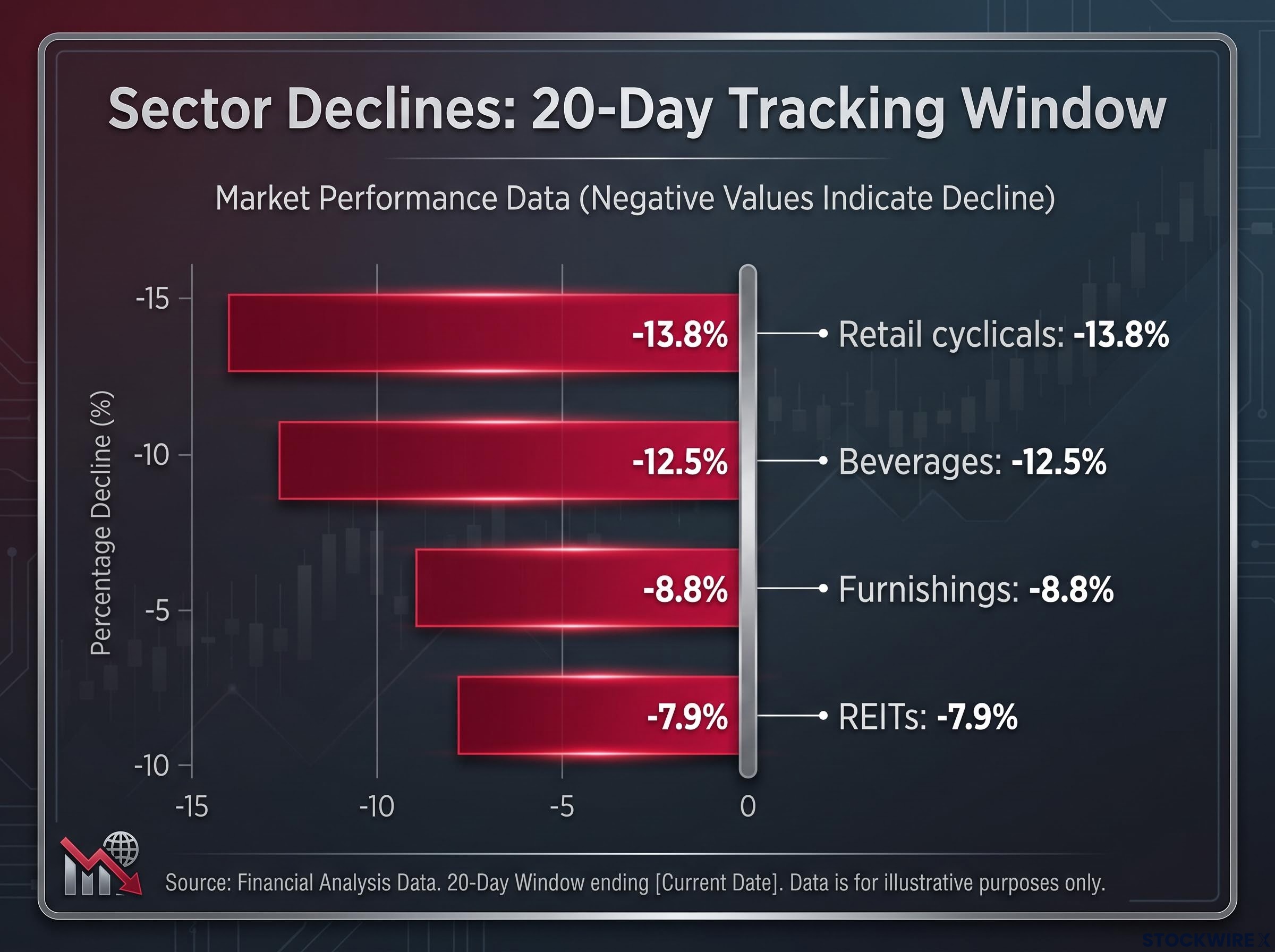
That is the tension facing anyone eyeing Australia’s most beaten down stocks right now. The most recent reporting season singled out consumer discretionary retailers and housing-related names as the clear laggards, with the retail cyclical sector down 13.8% and REITs down 7.9% over a 20-day tracking window. Names like JB Hi-Fi, Harvey Norman, and Pexa Group all sit well below where they traded a year ago.
The macro backdrop is not helping. The Reserve Bank of Australia (RBA) raised the cash rate to 4.35% in May 2026 and held it there in August, emphasising upside inflation risks and a longer stretch of restrictive policy.
The question is not whether these stocks have fallen. They have. The question is whether the reasons they fell are resolved or still live. Here is a structured way to work through that: what the earnings actually showed, where the valuations really sit, and what specific conditions would need to change before a recovery becomes the probable outcome rather than the hopeful one.
What reporting season actually revealed about these sectors
Before looking at any single company, it helps to see the shape of the damage across the sector, because the punishment was broad and it was co-ordinated.
Over the 20-day tracking window that framed reporting season, the declines clustered exactly where rate sensitivity is highest:
- Retail cyclicals down 13.8%
- Beverages down 12.5%
- Furnishings down 8.8%
- REITs down 7.9%
That is not three or four companies missing their numbers. That is capital pulling out of anything geared to housing turnover and discretionary spending, ahead of a rate decision the market feared. The individual company stories sit inside that pressure, not outside it.
What makes the sector reads difficult is that the headline annual numbers were, in several cases, genuinely strong. The weakness showed up in the fine print and in the trading updates that followed the results.
“The trading environment is highly uncertain, with customers increasingly prioritising value and concentrating purchases around major promotional events.”
JB Hi-Fi management, on the FY25 outlook
That kind of language from a CEO is a forward indicator worth weighting more heavily than a backward-looking profit line. It tells you the company is already seeing behaviour that erodes margin, and that management is bracing rather than accelerating.
JB Hi-Fi and Harvey Norman: reading past the headline numbers
JB Hi-Fi’s FY25 result, for the year ended 30 June 2025, was solid on the face of it. Group sales rose 10.0% to $10,554.8 million, underlying EBIT climbed 9.4% to $707.8 million, and underlying NPAT rose 8.5% to $476.1 million.
Then the July trading update landed, and the momentum picture changed. JB Hi-Fi Australia like-for-like sales were down 0.5%, and The Good Guys was down 1.7%. A strong full year, and a soft start to the next one. That gap is the whole warning.
Harvey Norman’s numbers looked even better at the top. FY25 profit before tax rose 39.0% to $753.10 million, and NPAT jumped 47.0% to $518.02 million, with aggregated Australian franchisee sales up 6.1%.
The franchise model is the reason those numbers held up. Harvey Norman collects franchise fees and property income, which insulates it from the direct margin pain of selling televisions. You can see the difference in the segment nobody quotes: company-operated retail posted just $64.89 million, down 4.5% on the prior year.
That is the tell. The structural buffer is real, but it does not make Harvey Norman immune to falling volumes, it just changes where the pressure shows up. A partial recovery is visible in early calendar 2026, with January system sales up 4.6% year-on-year, which is why the monthly updates matter more than usual from here.
The read you should take is straightforward. FY25’s good numbers describe a year that ended before the May 2026 hike bit. They are not a reliable guide to what FY26 delivers under a 4.35% cash rate.
When big ASX news breaks, our subscribers know first
Pexa and the housing sector: when cyclical becomes structural
Pexa is the case that breaks the framework you just applied to the retailers, and understanding why is the most useful thing in this analysis.
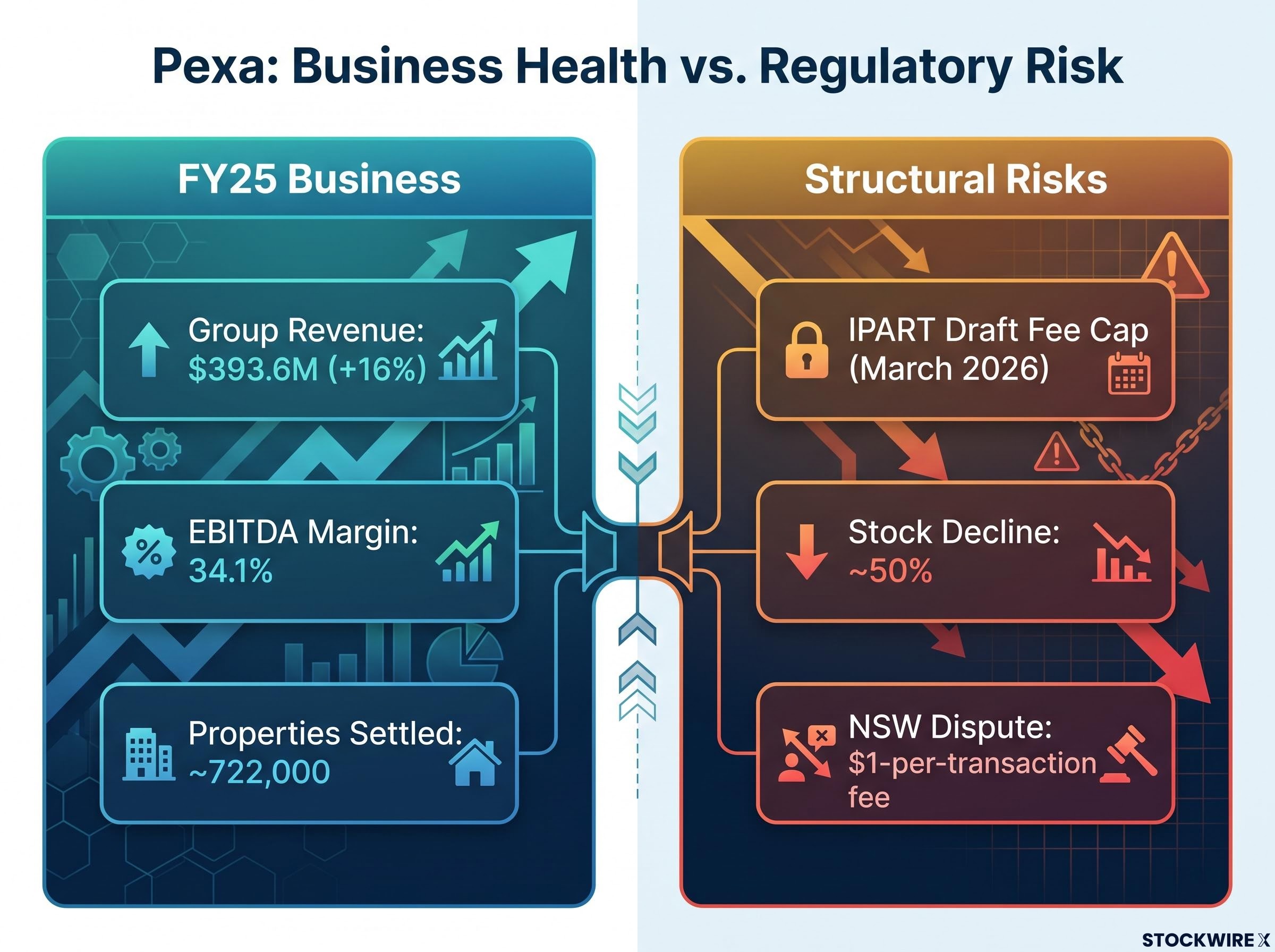
On the business itself, Pexa looks healthy. FY25 group revenue rose 16% to $393.6 million, with an EBITDA margin of 34.1%. This is a company that processes property settlements electronically, and it settled around 722,000 properties across the five mainland states in the period.
If Pexa’s problem were rate-driven housing volumes, you would treat it the same way you treat JB Hi-Fi: a cyclical drag that eases when the RBA eventually pivots. But that is not the problem.
In March 2026, the NSW pricing regulator IPART released draft plans to cap electronic conveyancing fees. Pexa flagged that, if implemented as drafted, it could face a breach of its debt covenants, the conditions attached to its loans. The stock has fallen roughly 50% since that draft, and the company recognised a non-cash impairment of $31-35 million in the second half of FY25.
That is not the market overreacting to a headline. A covenant breach warning and a 50% decline are the market telling you the regulatory outcome, not the business quality, is what has to resolve before the case is clean.
The regulatory risk is not a single event, either. It arrives in two parallel layers:
- The IPART draft fee cap, which threatens the margin structure directly and triggered the covenant warning
- A separate dispute with the NSW Registrar General, where Pexa has refused to pay a $1-per-transaction fee until all states approve customer pass-throughs, deferring NSW approval into next year
Here is the distinction that changes the buy thesis entirely. Cyclical risk is rate-sensitive housing volume that recovers when rates ease. Structural risk is a regulatory fee cap that could permanently impair the margin. A dovish RBA fixes the first. It does nothing for the second.
The analyst community is openly split on which risk dominates, which tells you the outcome is genuinely uncertain rather than mispriced.
| Analyst / Firm | Rating | Price Target | Primary Rationale |
|---|---|---|---|
| Macquarie | Buy | $19.60 | Views the sell-off as a buying opportunity; target implies roughly 50% upside |
| UBS | Neutral | $15.70 | Downgrade citing acute regulatory risk; call prompted a roughly 16% single-day drop |
| Consensus (aggregate) | Buy (skew) | $14-16 average | Range of $9 to $20 reflects the width of the regulatory uncertainty |
For context, June-quarter 2025 settlement volumes were down 1.6% year-on-year, so the volume backdrop is soft too. But volume is the cyclical part. The regulation is the part that determines whether Pexa is cheap or trapped.
Are these valuations compelling, or is the bad news still arriving?
Here is where honesty matters more than a clean answer, because the analysts covering these names do not agree, and pretending otherwise would not help you.
Take JB Hi-Fi. The stock is down 42.3% over 12 months and trades on a forward price-to-earnings ratio of roughly 15.1x. Morningstar raised its fair value estimate 25% to $57 in late 2025. LSEG data showed a median Street target near $99. Simply Wall St, in mid-2026, characterised the stock as around 25-30% below intrinsic value.
Those are not small differences of opinion. They are the market disagreeing about whether the earnings underneath that multiple are stable or falling.
That is the interpretive move you need to make yourself. A forward P/E of 15.1x looks reasonable in isolation. But a multiple applied to falling earnings is a very different thing from the same multiple applied to stable ones, and the July softness is exactly the kind of signal that makes the earnings estimate itself the variable to question.
Harvey Norman carries a different kind of complexity. Its property asset base and franchise cash flows act as an intrinsic value anchor, which is why some see deep value. Others argue the stock re-rated to expensive following the strong FY25 result. Both views can be held honestly because they are weighting different parts of the same business.
| Stock | Key Valuation Metric | Analyst Consensus Direction | Primary Risk to Thesis |
|---|---|---|---|
| JB Hi-Fi | Forward P/E ~15.1x; down 42.3% over 12 months | Undervalued on most models, wide target range | Earnings estimates unreliable if July softness persists |
| Harvey Norman | Property and franchise cash flows as anchor | Split: deep value versus expensive post re-rating | Volume-driven revenue pressure in a weak housing market |
| Pexa | Consensus target $14-16, range $9-20 | Buy skew but heavily contested | Regulatory fee cap could structurally impair margins |
Zoom out and the sector picture is more constructive than any single name.
Morningstar identifies consumer cyclicals as generally undervalued, with select consumer discretionary names carrying 14-40% total-return potential in the current environment.
That is the headline number for anyone treating this as an opportunity set rather than a single bet. It does not tell you which name works, but it tells you the sector is not being written off wholesale.
The caution is structural, not just cyclical. Online competition, direct-to-consumer disruption, and changing consumption habits are reasons the historical P/E multiples these stocks once earned may not apply cleanly to today’s business. The most recent data point, JB Hi-Fi’s H1 FY26 result with group sales of $6.10 billion up 7.3% and EBIT of $454 million up 8.1%, shows momentum has not collapsed. But one strong half does not resolve the multi-year question about whether the model itself is under pressure.
What would need to change for the recovery thesis to work
Weighing evidence is one thing. Knowing exactly what to watch is more useful, because it converts a vague sense that “things might improve” into a specific set of signals.
The RBA is the primary macro catalyst, and its recent path has been anything but smooth. The Board cut to 4.1% in February 2025, reversed course with a hike back to 4.35% in May 2026, and held at that level in August 2026 while stressing upside inflation risk. Market pricing currently implies roughly a 50% chance of one further hike by the end of 2026.
The transmission runs through mortgage stress, and the household data is where the pressure becomes real:
- Roy Morgan estimates around 25% of mortgage holders are at risk of mortgage stress, potentially rising toward 30% if further hikes arrive
- Finder reports more than half of mortgage holders spend over 30% of take-home pay on repayments
- NAB’s Q1 2026 Consumer Sentiment Survey identifies mortgagors as the most rate-stressed cohort
Stressed mortgage holders do not buy new furniture or upgrade televisions. That is the direct line from the cash rate to the retailers’ sales lines.
History, though, offers a counterweight to the gloom.
Wilsons Advisory notes that across the past five hiking cycles, the ASX 200’s median return in the 12 months before the first hike is about 8.4%, but consumer discretionary consistently lags into the tightening and then rallies strongly after the pivot.
There is a housing precedent too. Across five housing downturns since 1980 (excluding the GFC) where dwelling prices fell at least 5%, the S&P/ASX 200 still rose roughly 7.5% on average. The pattern favours patient buyers of quality, provided they buy the right names at the right point in the cycle.
For anyone sitting on these stocks or considering entry, here is the practical monitoring checklist:
- RBA forward guidance. A shift in the Bank’s language toward a neutral or dovish tilt would be the signal the market is waiting for to re-rate consumer discretionary. The tone matters as much as the rate decision itself.
- Mortgage stress data. Watch the Roy Morgan and Finder readings. A rollover in the stress percentages would confirm household budgets are loosening.
- The Pexa regulatory outcome. For that name specifically, the IPART resolution matters more than the rate path. A dovish RBA does nothing to lift the fee-cap overhang.
- Monthly retail trading updates. JB Hi-Fi and Harvey Norman both flagged monthly sales as the freshest indicator. These are your earliest read on whether the July softness was a blip or a trend.
The point is that the recovery is conditional, not automatic. Each of those four signals moves the probability, and knowing which one applies to which stock is what separates a considered entry from a hopeful one.
Selective exposure, not sector rotation: making the call with incomplete information
Pull the analysis together and it resolves into a tiered picture rather than a single verdict.
JB Hi-Fi is the highest-quality name with the clearest valuation case, offset by genuine uncertainty about its earnings trajectory. Its H1 FY26 result, group sales of $6.10 billion up 7.3% and EBIT of $454 million up 8.1%, is the most current evidence that the business is still executing.
Harvey Norman is the structurally resilient franchise model with property upside, sitting inside a more complicated institutional valuation debate. Its January 2026 system sales up 4.6% point to early calendar-year momentum, but the deep-value versus expensive argument is unresolved.
Pexa is the high-upside, high-risk name where the regulatory outcome is binary, not a factor to discount politely. Its FY26 guidance of $405-430 million sits slightly below consensus of around $432 million, which tells you the uncertainty is already compressing expectations.
Across all three, two filters are non-negotiable for distressed-sector exposure:
- Balance-sheet strength, so the company can survive a longer downturn than it expects
- Regulatory clarity, which for Pexa specifically is the difference between a bargain and a trap
The honest constraint is information. Reporting season data is backward-looking. July trading updates are the freshest forward read. The next RBA communication is the macro trigger. You are being asked to act before any of these fully clarify, which is why this is a decision spectrum, not a single recommendation.
Buying into a beaten-down sector during a live rate cycle is a thesis about what changes next, not about what has already happened. The two events most likely to resolve the current uncertainty are the RBA’s trajectory and the Pexa regulatory decision. Where you sit on the buy-now versus wait-for-clarity spectrum depends on your risk tolerance and time horizon, and both positions are defensible.
This article is for informational purposes only and should not be considered financial advice. Investors should conduct their own research and consult with financial professionals before making investment decisions. Past performance does not guarantee future results, and financial projections are subject to market conditions and various risk factors.
When the setup is right but the timing is not yet
The structural case for a consumer discretionary recovery is building, and it is worth taking seriously without overstating it. History strongly favours these stocks rallying once the rate cycle peaks, the valuation compression in the quality names is real, and Morningstar’s sector read leaves room for meaningful upside.
But the cycle is not resolved. The RBA is still emphasising inflation risk, roughly half the market expects one more hike, and the headwinds facing these names are not all cyclical. Online competition erodes retail margins regardless of rates, and Pexa’s regulatory overhang sits entirely outside the interest-rate story.
So the question is not whether a recovery comes. On the historical evidence, it usually does. The question is when the conditions align, and which of the signals you now know to watch, the RBA’s forward guidance, the mortgage stress data, the monthly retail updates, and the Pexa ruling, confirm that alignment first. Knowing what you are waiting for is the advantage. The setup may be right before the timing is.