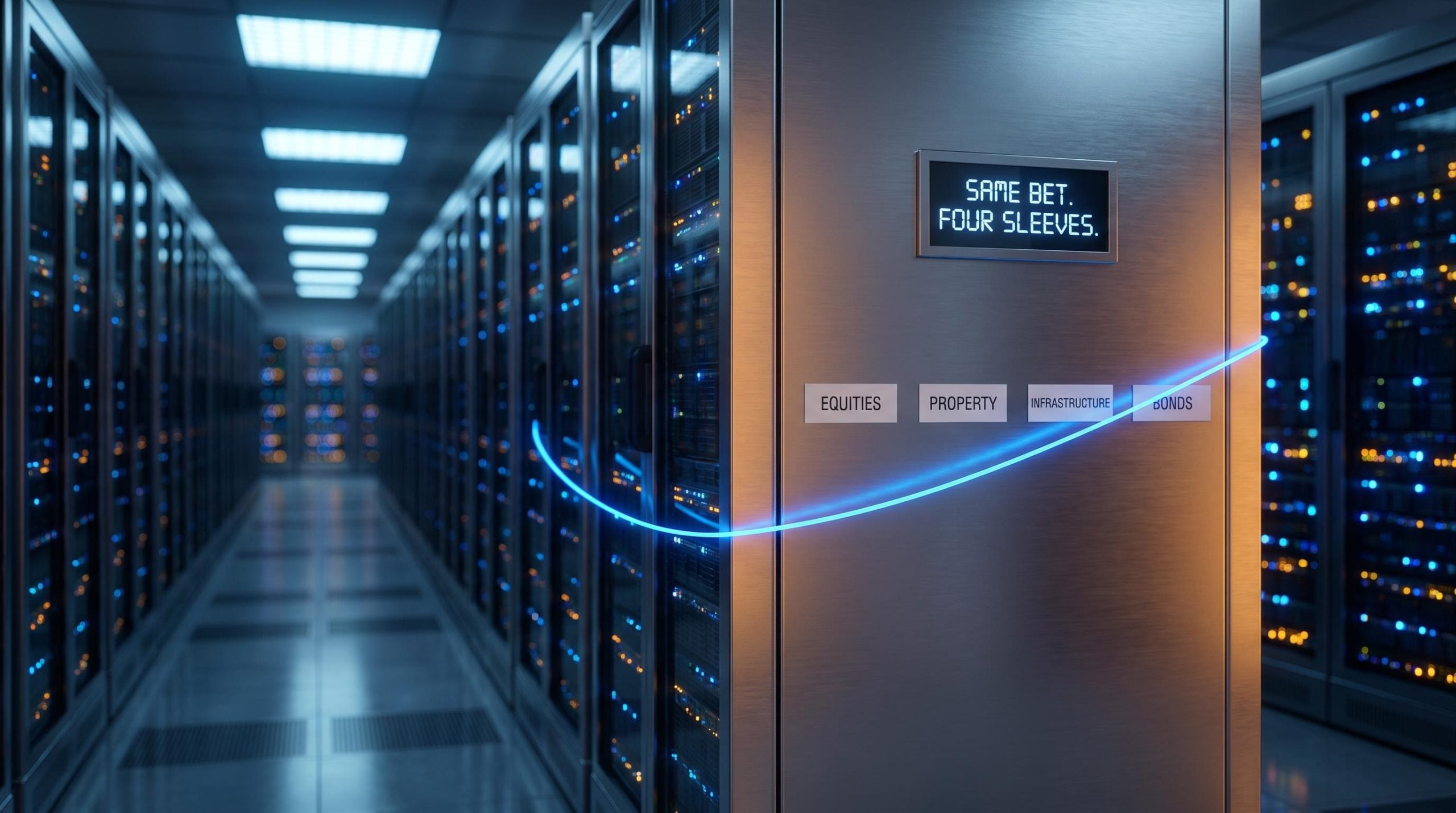
Most investors who spread their money across equities, property, infrastructure, and bonds believe they have built genuine diversification. Many have done the opposite. The same small group of technology companies now sits inside every one of those sleeves, wearing a different label in each, and the portfolio that looks diversified on paper may be running one of the most concentrated thematic bets in modern investing without anyone having chosen to make it.
The reason is straightforward: AI capital expenditure has reshaped the economics of asset classes that used to move independently. Microsoft, Alphabet, Amazon, Meta, and Apple are no longer just equity holdings. They are tenants in listed property, power customers in infrastructure, and bond issuers in fixed income, all at the same time. The hyperscaler footprint now touches every sleeve a multi-asset portfolio is built from.
Here is what this piece gives you: a clear map of where hidden AI concentration sits in a typical multi-asset portfolio, an explanation of why it creates a structurally different risk from ordinary sector overweights, and a concrete five-step audit you can apply to your own holdings today. By the end, you will know whether your diversification is real or cosmetic.
The diversification assumption that no longer holds
The logic behind multi-asset investing is simple and, until recently, reliable. Each asset class responds to different economic drivers, so when one sleeve falls, others should hold steady or rise. Equities move on earnings and sentiment. Property moves on rents and interest rates. Infrastructure moves on regulated revenues and long-duration contracts. Bonds move on credit quality and rate expectations. The whole point is that these drivers are largely independent.
That independence is what has quietly eroded. A small number of hyperscaler companies now have operating footprints that straddle all four of those categories simultaneously. They are top weights in equity indices. They are the largest tenants in data-centre real estate. They are the biggest customers of new power infrastructure. They are major investment-grade bond issuers funding hundreds of billions in capital expenditure. The same firms, the same capital-spending cycle, the same AI theme, appearing in every sleeve.
The 2022 experience provided the clearest modern evidence of this failure mode: when inflation drove a positive stock-bond correlation, portfolios that assumed bonds would cushion equity losses discovered that both sleeves fell simultaneously, exposing how dependent the traditional diversification logic was on a single macroeconomic regime.
The risk here is not that these companies are weak. Most are among the strongest businesses in the world. The risk is that their ubiquity creates thematic concentration that asset-class labels do not reveal. Your portfolio dashboard shows you how much is in equities versus property versus bonds. It does not show you how much of all three depends on the same handful of companies continuing to spend aggressively on AI infrastructure.
Joel Grosvenor, portfolio manager at Morningstar Investment Management (August 2026), frames AI exposure as a “total-portfolio question,” not an equity-sleeve question, noting that the same hyperscaler firms can appear as equity holdings, investment-grade issuers, data-centre tenants, offtake counterparties in infrastructure contracts, and borrowers in private credit, all at the same time.
That framing matters for you directly. The asset-class labels on your portfolio dashboard may be giving you false confidence that your exposures are more independent than they actually are. If you assume your property allocation hedges your technology risk, and that property allocation is full of data-centre REITs leasing to the same firms dominating your equity sleeve, the hedge is not doing what you think it is.
When big ASX news breaks, our subscribers know first
Where the same bet is hiding in four different places
The best way to understand how AI concentration accumulates is to walk through each asset class and see the mechanism that lets hyperscaler exposure in through the door.
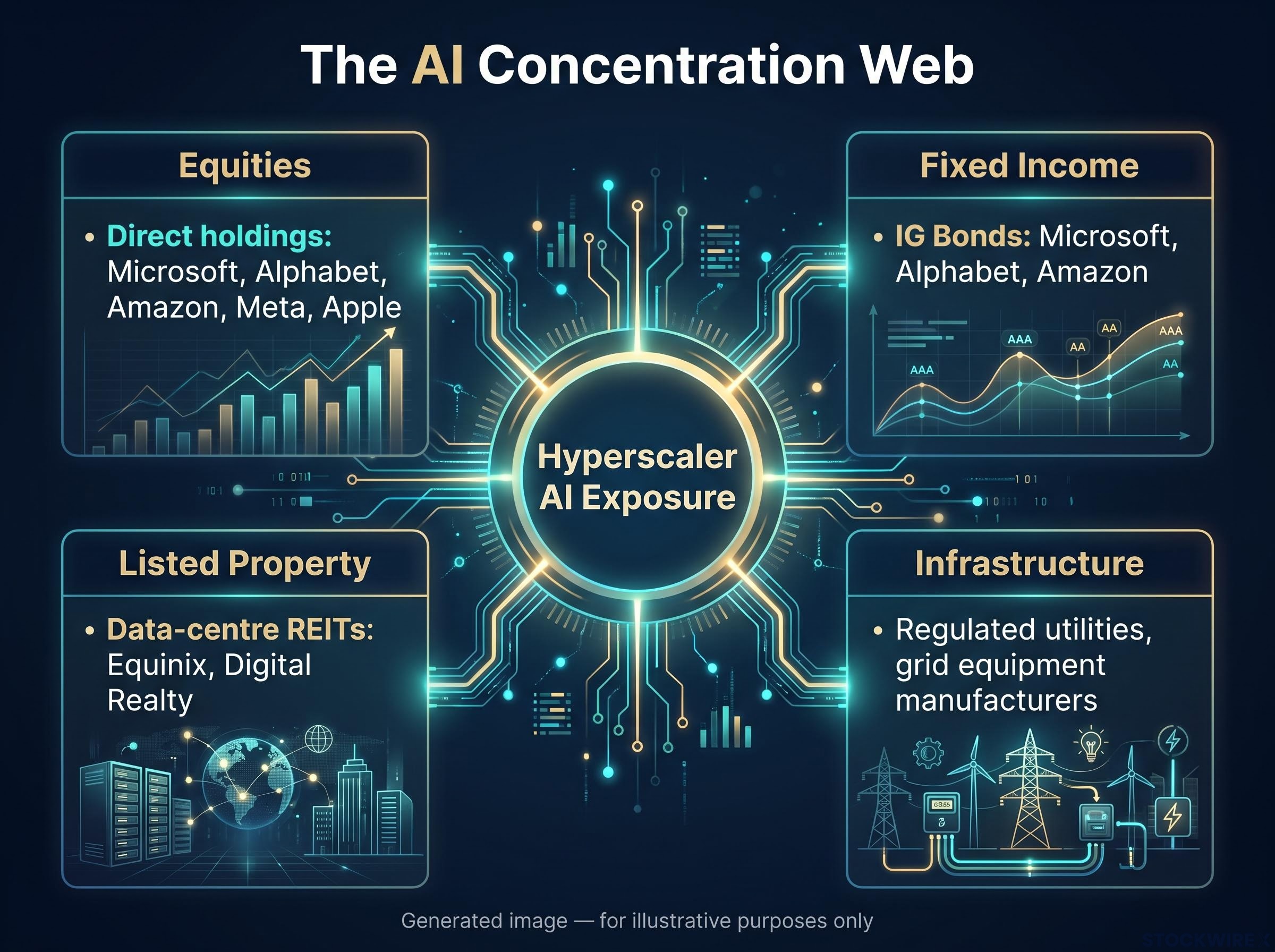
In equities, the channel is direct and visible. The largest hyperscalers are top weights in every major market-cap-weighted index, so any broad global equity fund or S&P 500 tracker carries substantial AI exposure by default. If you also hold a thematic AI or digital-infrastructure ETF alongside that core allocation, you have doubled up.
In listed property, the mechanism is less obvious. Data-centre Real Estate Investment Trusts (REITs), companies that own and lease the physical buildings housing cloud and AI computing, derive a large and growing share of their leasing demand from hyperscale tenants. Equinix and Digital Realty are two of the largest, and their revenue depends heavily on the same firms that dominate the equity sleeve. A property allocation chosen for defensive characteristics may be economically reliant on hyperscaler capital spending.
In infrastructure, the connection runs through power. AI data centres require continuous, massive electricity. Utilities and grid operators signing long-term power contracts with data-centre operators now carry AI-correlated cash flows, even though they sit in an infrastructure sleeve. Asset managers are explicitly marketing infrastructure and utilities as AI-adjacent exposures through power-purchase agreements and grid investment linked to data-centre demand. Infrastructure chosen for its historically low correlation to technology sentiment may, in this configuration, behave more like a technology bet than you realise.
In fixed income, the channel is corporate debt. Hyperscalers are large investment-grade bond issuers using corporate borrowing to fund their enormous capital-expenditure plans. Broad investment-grade corporate bond funds carry hyperscaler credit risk alongside traditional industrial and financial names. This means stress at these companies could widen credit spreads and reduce bond prices in the portion of your portfolio that was supposed to provide ballast.
| Asset Class | Exposure Mechanism | Named Examples | Original Diversification Assumption | Why That Assumption May Be Weakened |
|---|---|---|---|---|
| Equities | Direct holdings via index weight and thematic ETFs | Microsoft, Alphabet, Amazon, Meta, Apple | Equity risk is offset by other asset classes | Same firms appear across all other sleeves |
| Listed Property | Data-centre REITs leasing to hyperscale tenants | Equinix, Digital Realty | Property provides defensive, low-correlation income | Rental income depends on the same hyperscaler tenants |
| Infrastructure | Utilities and grid operators under long-term AI power contracts | Regulated utilities, grid equipment manufacturers | Infrastructure cash flows are stable and independent of tech sentiment | Cash flows now partly tied to AI data-centre power demand |
| Fixed Income | Investment-grade bonds issued by hyperscalers to fund capex | Microsoft, Alphabet, Amazon bonds in IG indices | Bonds provide ballast against equity drawdowns | Credit spreads could widen on same hyperscaler stress that hits equities |
The private-markets extension
The four listed-market channels above are not the full picture. If your portfolio includes private-market allocations, a fifth route exists:
- Private credit strategies may lend directly to data-centre construction projects and energy infrastructure tied to AI workloads.
- Infrastructure equity funds may own stakes in power-generation and transmission assets whose contracted revenues depend on data-centre demand.
- Infrastructure debt strategies may finance the same projects from the lending side, creating fixed-income-like exposure to AI-correlated cash flows.
These allocations may be labelled “real assets” or “income funds,” but their underlying economics can be tightly coupled to hyperscaler capital-spending decisions.
The accumulation is the point. If AI capital expenditure were to slow sharply or hyperscaler margins compressed, that shock could arrive through your equity sleeve, your property sleeve, your infrastructure sleeve, and your bond sleeve at roughly the same time. That is precisely the scenario diversification is supposed to prevent.
The ECB Financial Stability Review identifies this concentration risk explicitly, warning that a shift in technology sector earnings expectations, particularly those tied to artificial intelligence, could trigger spillovers across markets and generate losses for investors whose portfolios carry significant exposure to the same underlying theme across multiple asset classes.
Why this matters more than ordinary sector concentration
Most investors understand sector concentration within equities. If 40% of your equity sleeve is in technology stocks, you know that sleeve is exposed to a tech downturn. Portfolio dashboards surface this clearly. You can see it, size it, and decide whether you are comfortable with it.
What makes AI concentration across asset classes structurally different is that standard asset-class reporting does not capture it. Your dashboard shows you how much is in equities versus property versus infrastructure versus bonds. It does not show you that a meaningful portion of each sleeve may depend on the same underlying economic driver: hyperscaler AI capital expenditure.
The AI investment cycle now sits at a scale that has no modern precedent: US IT hardware and software spending reached 4.9% of GDP in Q1 2026, surpassing both the dot-com peak of approximately 4.2% and the cloud buildout peak of approximately 3.8%, which helps explain why the footprint of hyperscaler spending has become large enough to reshape the economics of infrastructure, property, and credit simultaneously.
Grosvenor (August 2026) notes that the underlying nature of certain asset classes may have shifted materially, which could alter the risk profile investors originally counted on when building their allocations. The protective assumptions embedded in a multi-asset structure, specifically which exposures offset which risks, may therefore warrant careful re-examination.
The distinction matters when you think about stress scenarios. Traditional sector concentration, say an overweight to financials within equities, affects one sleeve. AI thematic concentration could affect multiple sleeves in the same direction under the same stress scenario:
- Equity valuations compress as hyperscaler earnings expectations are revised down.
- Credit spreads widen on investment-grade hyperscaler bonds.
- Data-centre REIT occupancy or rent growth slows as leasing demand softens.
- Infrastructure cash-flow projections weaken as power contracts tied to data-centre demand lose certainty.
Real assets and bonds still respond to many drivers beyond AI, so diversification is not broken entirely. But the cross-sleeve transmission of a hyperscaler-specific shock is what warrants your attention. The standard portfolio-monitoring tools showing asset-class weights and sector tilts within equities are likely not surfacing this risk, which means you cannot rely on your usual dashboard to know whether the problem applies to you.
This article is for informational purposes only and should not be considered financial advice. Investors should conduct their own research and consult with financial professionals before making investment decisions.
A five-step audit for your own portfolio
The concern is real, but the response is practical. Here is a five-step audit that moves from mapping your exposures to deciding what, if anything, to change.
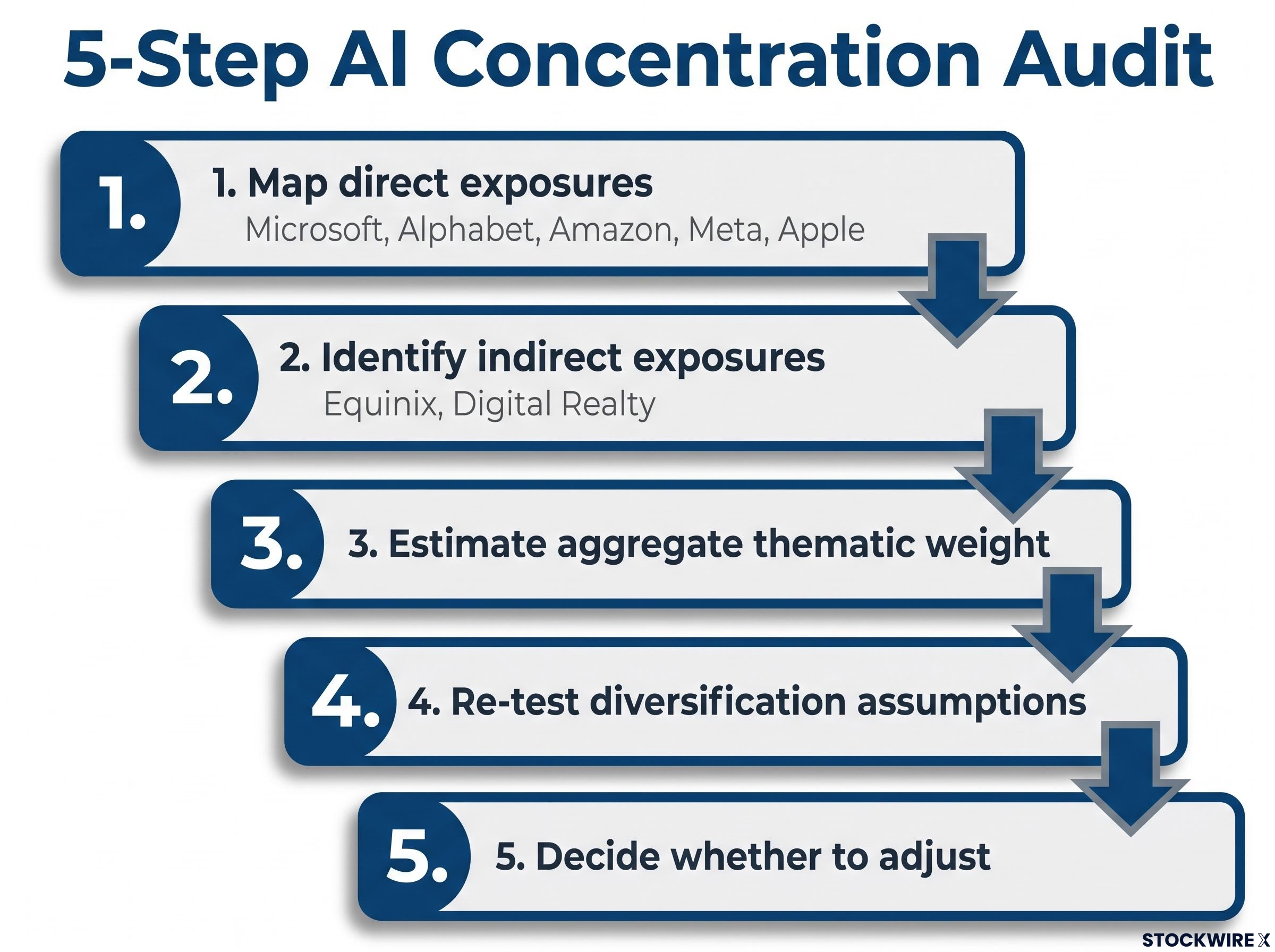
- Map direct exposures across every sleeve. Pull the top-holdings lists for each fund or mandate you own, including equities, listed property, infrastructure, corporate bonds, and any private-market vehicles. Flag repeated appearances of hyperscaler names: Microsoft, Alphabet, Amazon, Meta, Apple, and close peers. Pay particular attention to core index trackers, sector funds in technology and communication services, thematic AI or digital-infrastructure ETFs, and broad investment-grade corporate bond funds.
A practical ETF overlap audit — downloading holdings CSV files from each fund issuer and cross-referencing them in a spreadsheet — typically reveals a unique stock count 30-40% lower than investors initially estimate, making it one of the most efficient first steps in the mapping exercise described above.
- Identify indirect exposures. Direct holdings are only half the picture. For property and infrastructure funds, look for:
- Data-centre REITs and operators (such as Equinix and Digital Realty) where leasing demand is heavily hyperscale or AI-driven.
- Utilities, grid operators, and energy-infrastructure assets whose growth plans or contracted revenues are tied to data-centre power demand.
- Funds whose marketing material emphasises AI power demand, data-centre infrastructure, or digital real assets, even if individual holdings are not household technology names.
- Estimate your aggregate thematic weight. Combine direct and indirect exposures to form a rough picture of how much of your total portfolio depends on hyperscaler health and AI capital expenditure. Sum the weights of hyperscaler equities and bonds, then add approximate contributions from data-centre REITs, utilities with large data-centre contracts, and infrastructure funds positioned to benefit from AI power demand.
From mapping to deciding
Steps 1-3 tell you what you own. Steps 4 and 5 are where you decide what to do with that information. Mapping is diagnosis. Deciding is portfolio governance.
- Re-test your diversification assumptions. Compare your thematic map with the original goals behind each allocation. If listed property was meant to offset technology risk but now contains heavy data-centre and hyperscaler-tenant exposure, that assumption may no longer hold. If infrastructure was chosen for low correlation to tech sentiment yet is positioned as an AI power play, its behaviour under stress may be more pro-cyclical with technology valuations than you originally anticipated.
- Decide whether to adjust. If the audit reveals more AI concentration than you are comfortable with, options include:
- Shifting to property or infrastructure strategies with more diversified tenant bases and revenue drivers, such as transport, social infrastructure, or broader commercial real estate.
- Complementing corporate credit with sovereign or securitised exposures to reduce the tilt toward large technology issuers.
- Treating AI-linked assets as an explicit theme with a defined target allocation, rather than allowing exposure to accumulate implicitly across multiple sleeves.
Grosvenor’s guidance (August 2026) is that you need not exit AI-related exposures, but you should have a clear grasp of each holding’s role in the portfolio and the reasoning behind it. The goal is to avoid owning the same underlying bet in multiple ways without realising it. Completing this audit moves you from passive exposure that accumulated by default to active, sized, monitored AI concentration that you have chosen. That is the difference between a portfolio risk and a portfolio decision.
What deliberate AI exposure looks like versus accidental concentration
The question facing most multi-asset investors right now is not whether to have AI exposure. In a modern portfolio, the answer is almost certainly yes. The question is whether that exposure is something you chose or something that happened to you.
Accidental concentration builds up invisibly. Each fund manager optimises their own sleeve. The equity manager holds hyperscalers because they dominate the index. The property manager holds data-centre REITs because leasing demand is strong. The infrastructure manager holds AI-adjacent utilities because contracted cash flows look attractive. The bond manager holds hyperscaler credit because the issuers are investment-grade. Each decision is rational in isolation. In aggregate, they create a portfolio with a single thematic bet running through every layer.
Deliberate concentration looks different. You know it is there. You have sized it. You monitor it. And it fits within your actual return expectations and drawdown tolerance.
| Characteristic | Accidental AI Concentration | Deliberate AI Concentration |
|---|---|---|
| Visibility | Hidden behind asset-class labels | Mapped and quantified across all sleeves |
| Sizing | Accumulated by default, unknown total | Defined target range, actively managed |
| Monitoring | Not tracked as a theme | Reviewed alongside other risk factors |
| Portfolio fit | May exceed drawdown tolerance under stress | Aligned with return and risk expectations |
Grosvenor’s framing (August 2026) captures this precisely: the concern is not that hyperscalers are inherently fragile, but that their ubiquity across portfolio sleeves creates thematic concentration that traditional asset-class frameworks do not automatically reveal. The investors best positioned for this environment are not those with minimal AI exposure, but those who understand where it sits, how large it is, and how it might behave under different scenarios.
That reframe applies beyond AI. Any theme powerful enough to reshape the economics of multiple asset classes simultaneously, whether it is decarbonisation, demographic shifts, or the next structural trend, can create the same pattern. The skill you are building here is not just about auditing AI exposure. It is about learning to look through asset-class labels to see what you actually own.
The mathematical case for building genuinely uncorrelated return streams is precise: Dalio’s framework shows that 15-20 streams with correlations below approximately 0.3 can reduce portfolio volatility by around 80% without sacrificing expected returns, but that benefit disappears when streams that appear independent actually respond to the same underlying economic driver.
Past performance does not guarantee future results. Forward-looking scenarios described in this article are speculative and subject to change based on market developments and company performance.