ComfortDelGro’s first-half 2026 numbers landed with a thud: underlying profit fell 14.3% year-on-year to S$84.8 million, a figure that represents just 44% of what analysts had penned in for the full year. The engine behind the miss was a collapse in the transport giant’s global taxi business, which is bleeding cash faster than the company’s recent acquisitions can heal it.
Revenue actually rose 5.7% to S$2,561.6 million, so this is not a story about a shrinking top line. It is a story about margins vanishing underneath it.
The pressure is coming from three fronts at once. Cost of living strain and relentless ride-hailing competition are hollowing out taxi demand across Singapore, the UK, and Australia simultaneously, and no single market is offering a soft landing.
For investors, the ComfortDelGro earnings 1H26 result raises one urgent question: if the core taxi business is decaying this quickly, why is management still writing cheques to expand it? After reading this, you will understand exactly which segments are bleeding, why the acquisition strategy is masking rather than fixing the problem, and when a recovery might actually arrive.
Tracking the global fleet contraction and Australian impact
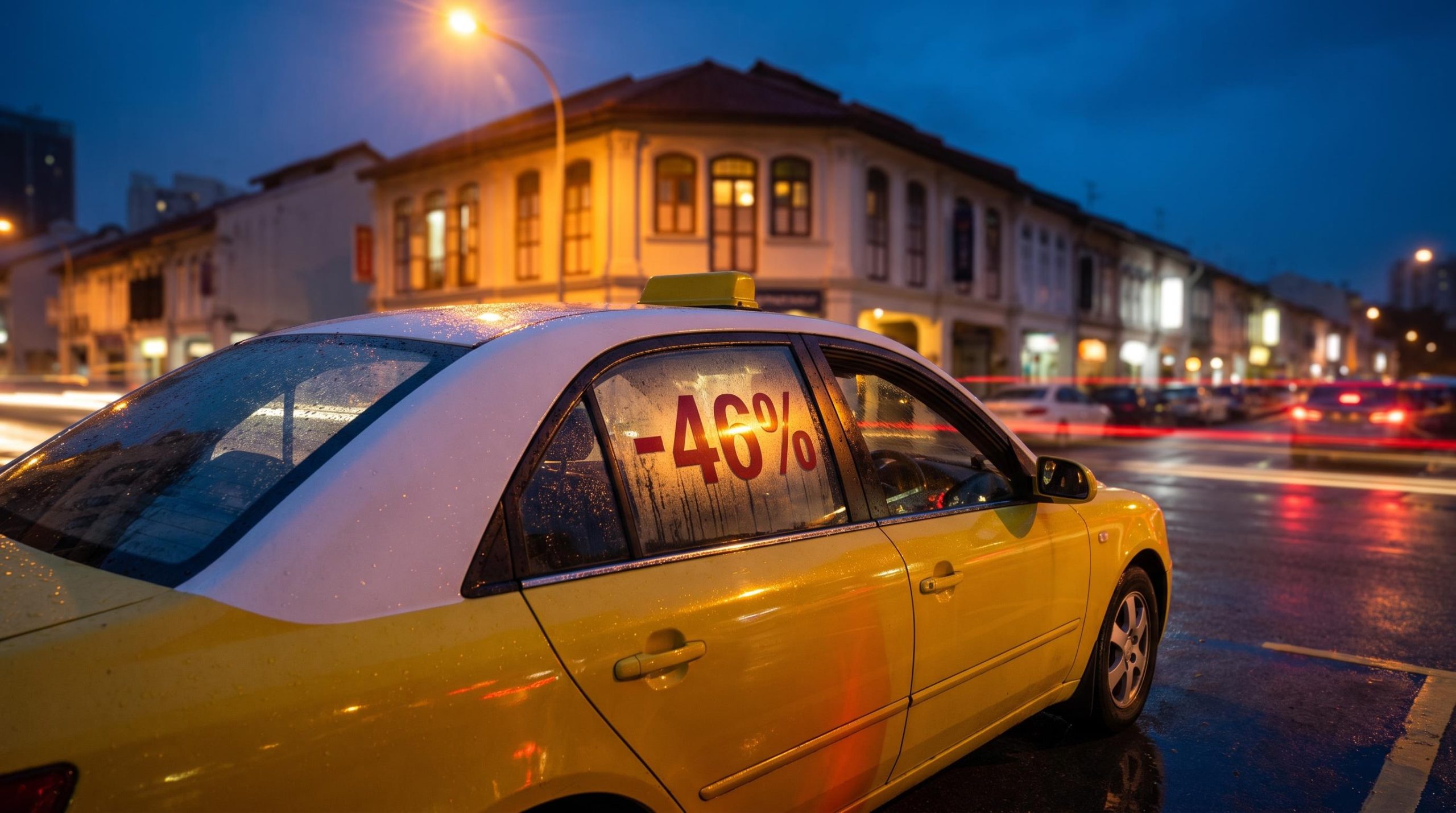
The scale of the taxi decline is the number that matters most, and it is severe. Taxi and private-hire earnings before interest and tax (EBIT), which measures operating profit before financing and tax costs, fell 46% year-on-year to S$36.6 million in the first half, according to Phillip Securities Research. This is now the company’s most troubled segment by a wide margin.
What makes the number alarming is that it is not confined to one geography. The weakness hit Singapore, Australia, and the UK at the same time, which points to a shared structural cause rather than a local operational stumble.
The structural forces compressing ComfortDelGro’s taxi margins are the same forces reshaping point-to-point transport globally; ride-hailing competition in cities where Waymo and Uber both operate has accelerated fleet contraction even for incumbents with established brand recognition and government contracts.
Australia is a clear symptom of the wider problem. The Australian taxi fleet, anchored by A2B Australia, contracted approximately 10% year-on-year in the first quarter of 2026, hit by cost of living pressure squeezing consumer spending and by ride-hailing platforms pulling both riders and drivers away.
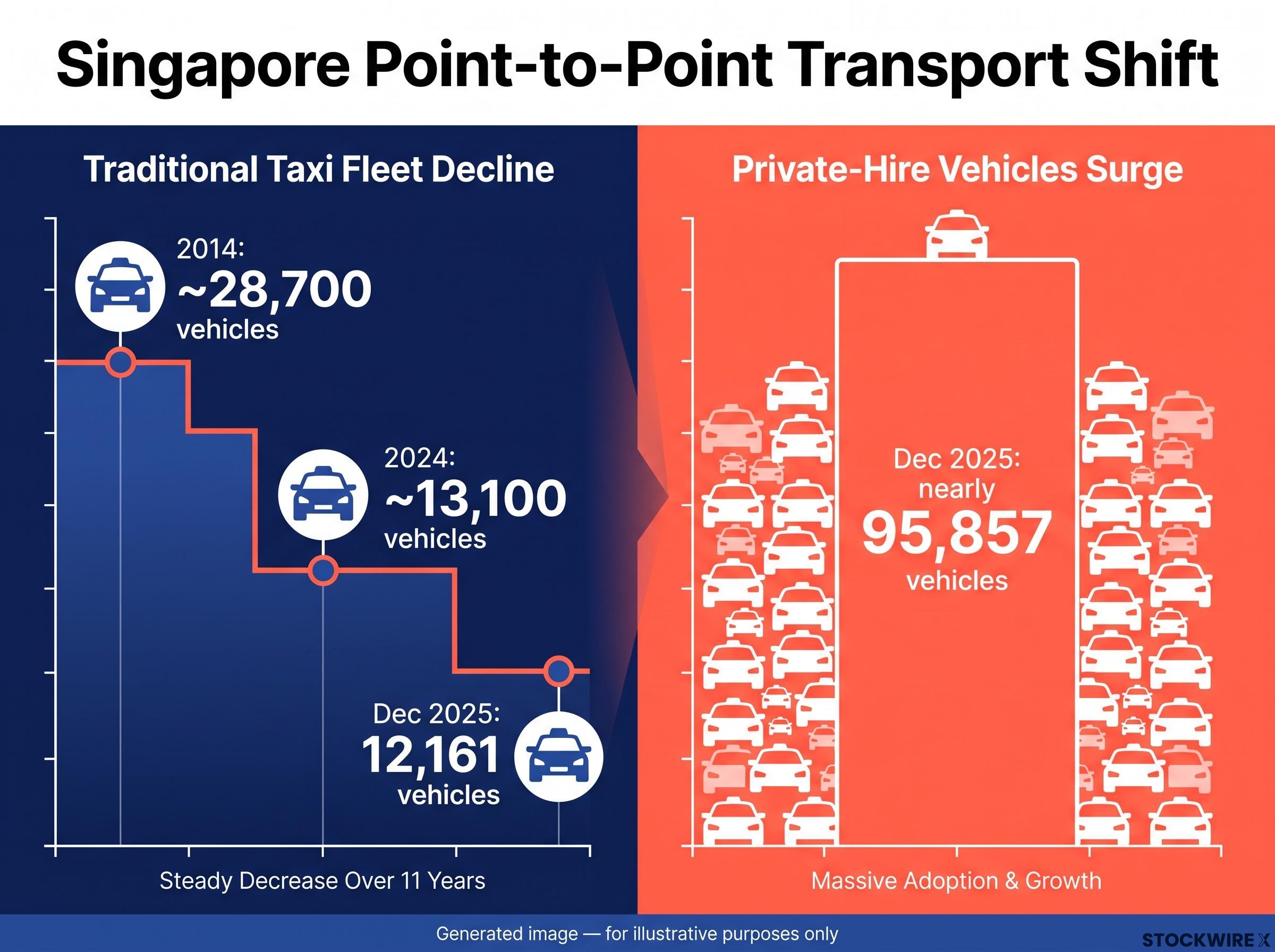
Singapore tells the same story in slow motion. The taxi fleet dropped to 12,161 vehicles as of December 2025, down from around 13,100 in 2024 and roughly 28,700 a decade ago in 2014, according to Land Transport Authority DataMall data. Set against nearly 95,857 private-hire vehicles in the same month, the traditional taxi has become a rounding error in Singapore’s point-to-point transport market.
For your investment thesis, this is the part that should reframe how you read the headline miss.
| Metric | 1H26 Actual | Year-on-Year Change | % of FY26 Forecast |
|---|---|---|---|
| Revenue | S$2,561.6M | +5.7% | 46% |
| Underlying PATMI | S$84.8M | -14.3% | 44% |
| Taxi/P2P EBIT | S$36.6M | -46% | n/a |
The Australian fleet shrinkage is not a temporary blip waiting to reverse once conditions improve. It is one node in a global, structural shift away from traditional fleet economics, and that shift shows no sign of pausing.
Why the aggressive acquisition blitz is masking core decay
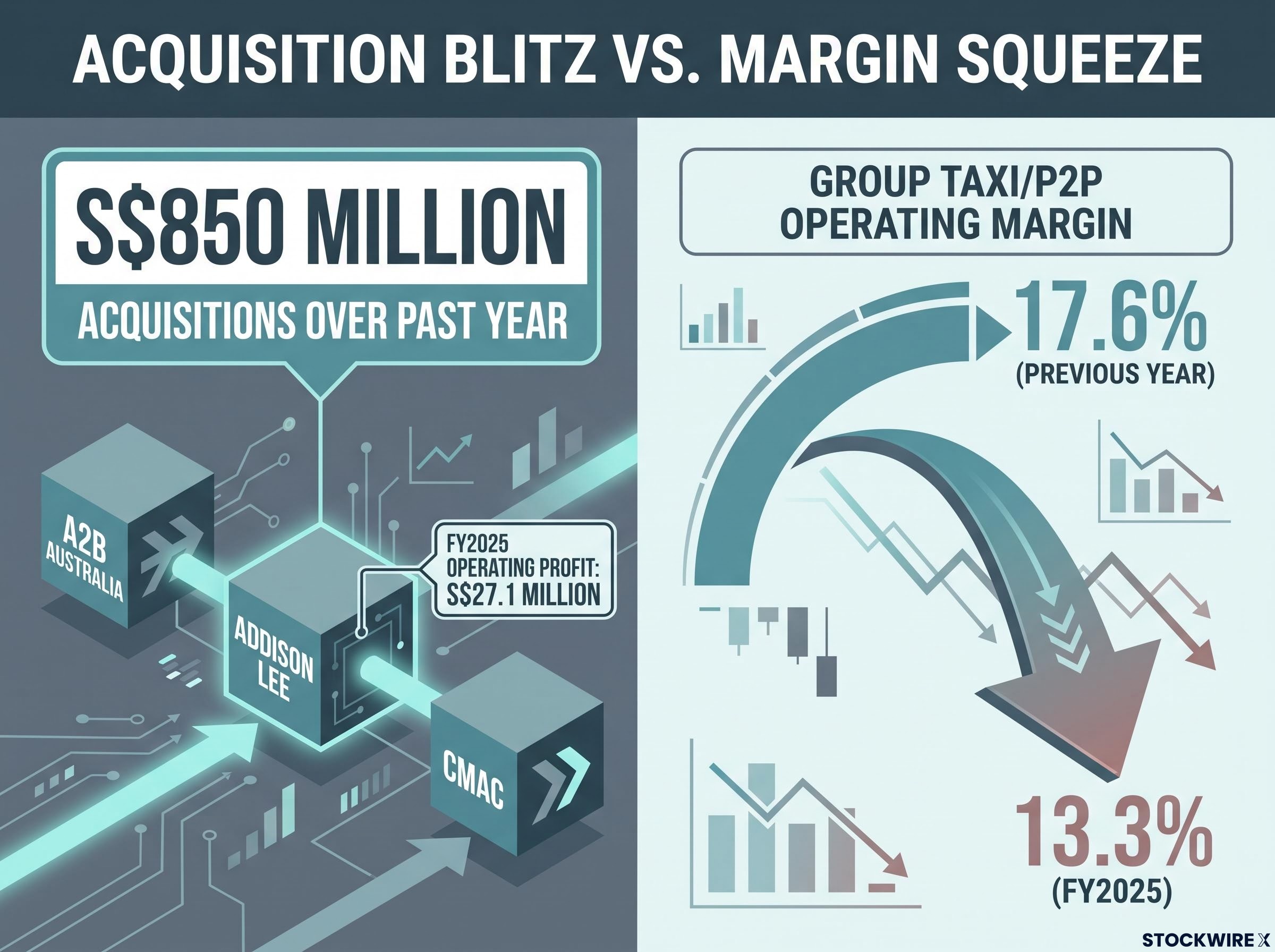
Here is the strategic tension the earnings report exposes. ComfortDelGro has deployed roughly S$850 million on acquisitions over the past year, including A2B Australia, London premium operator Addison Lee, and UK managed transport specialist CMAC. The idea was to diversify away from a dying Singapore taxi business and buy growth abroad.
The revenue arrived. The margins did not.
Group taxi and private-hire operating margin fell to 13.3% in FY2025, down from 17.6% the year before. The businesses ComfortDelGro bought operate in structurally lower-margin, fiercely competitive markets, so scaling up the top line has come at the direct cost of profitability.
The clearest way to see what is really happening is to strip out the acquisitions and look at what remains. Addison Lee contributed S$27.1 million in operating profit to the taxi segment in FY2025. Take that away, and the rest of the legacy taxi business would have posted an operating profit decline of approximately 30% for the year.
The margin problems are specific to each acquired unit:
- A2B Australia: faces the same ride-hailing competition and cost of living squeeze as Singapore, but on lower baseline taxi margins to begin with.
- Addison Lee (UK): trip values fell as UK consumers turned cautious, and a major Middle Eastern airline customer cut flights amid regional conflict, disrupting its lucrative airport transfer bookings.
- CMAC (UK): operates in managed ground transport, another low-margin, contract-driven segment offering limited pricing power.
What this tells you is that ComfortDelGro’s top-line growth is currently something of an illusion, built on acquired revenue rather than organic strength. Before you trust the company’s expansion narrative, you have to look past the headline growth and interrogate the margin compression underneath it. Right now, the acquisitions are dressing up a business that is deteriorating at its core.
Acquisition-led growth strategies that prioritise top-line scale over margin quality have a consistent failure mode: the revenue arrives before the integration economics are understood, and by the time the margin compression is visible in earnings, the capital has already been deployed.
UK bus repricing and the timeline for recovery
Not everything in the report was grim, and the bright spot is worth understanding because it defines the recovery timeline. The public transport division, mostly buses and rail contracts, lifted operating profit approximately 4% to S$79.7 million and now accounts for around 67% of group revenue. It was the only segment providing a meaningful offset to the taxi bleed.
Regulated bus contracts in Australia have increasingly been structured with government-supplied fleets and built-in revenue indexation, a model that protects operators from the input cost volatility battering ComfortDelGro’s unregulated taxi division.
The engine here is London. ComfortDelGro’s Metroline subsidiary has been renegotiating its London bus contracts at higher margins, and that repricing is now roughly 70% complete.
That leaves a 30% pipeline of contract improvements still to be recognised in future periods, which is the single most important forward-looking number in the report. It effectively tells you when the tailwind fully arrives.
Analysts are pointing to the same conclusion. Both Maybank and RHB flagged UK public transport momentum as the reason to look toward the 2027 financial year for a more meaningful earnings recovery, once the London repricing is fully baked in.
That optimism came with a price cut, however. Phillip Securities Research analyst Paul Chew lowered his target price to S$1.21, down from S$1.35, and trimmed his FY26 earnings estimate by 7% to S$177 million, while keeping a neutral rating.
Phillip Securities Research downgraded its target price to S$1.21 and retained a neutral stance, citing deteriorating earnings prospects, particularly in the taxi segment, and worsening conditions across multiple business areas.
For you, this sets the terms of the decision. The recovery is real but delayed, and 2027 is the window analysts are watching for public transport gains to finally outrun the taxi losses. Any decision to hold means holding through several more quarters of taxi weakness first.
Balancing a robust dividend against structural headwinds
Strip away the noise and the investment case comes down to a single tension: strong cash generation on one side, deteriorating operating margins on the other. Core operating free cash flow turned positive at S$96.9 million in the first half, a genuine improvement from the negative figure a year earlier.
That cash is what anchors the shareholder proposition. The interim dividend was held steady at 3.91 cents per share, which works out to an annualised yield of approximately 5.8% at the current share price.
A near 6% dividend yield looks attractive on the surface, but dividend yield rises automatically when a share price falls, which means the current yield partly reflects capital depreciation rather than a management decision to reward shareholders more generously.
So the choice in front of you is fairly clean. You can accept a near 6% yield and wait for the 2027 public transport recovery to arrive, betting that international scale eventually replaces vanishing taxi revenue. Or you exit now to avoid the continued bleed from a legacy taxi division with no visible bottom.
The stock has become a waiting game, and how you value that wait depends entirely on your appetite for income today versus your tolerance for capital depreciation risk while the recovery plays out.
This article is for informational purposes only and should not be considered financial advice. Investors should conduct their own research and consult with financial professionals before making investment decisions.
Past performance does not guarantee future results. Financial projections and analyst targets are subject to market conditions and various risk factors, and these forward-looking views are speculative and subject to change based on market developments and company performance.