UK politics in early 2026 delivered the kind of drama that financial headlines typically treat as a market-moving event: a prime ministerial resignation, a parliamentary scandal, cabinet walkouts, and sustained speculation over a Chancellor who might unsettle the fiscal settlement. The media narrative practically wrote itself.
And yet the data tells a quieter story. UK gilt yields in mid-2026 tracked US Treasuries, German Bunds, and French OATs through an almost identical arc, regardless of whatever was happening in Westminster on any given week. That alignment is the analytical puzzle this piece works through, because understanding why politics failed to move bonds in 2026 is at least as useful as understanding why it did in 2022.
Here is a concrete, data-grounded framework for separating political noise from genuine bond market drivers, tested against a live case study with cross-country evidence. After working through it, you will know exactly what questions to ask the next time a political crisis is framed as a yield-moving event.
What gilt yields actually did across the six months
Opening the year near 4.5%, the UK 10-year gilt yield edged downward through January and February, settling at a period low of around 4.3% in the final days of that month, close to when Peter Mandelson’s arrest took place on approximately 23 February 2026.
A sharp reversal then followed. From March onwards, yields climbed steeply, surpassing 4.9% before the month was half done, and carried on rising into April and beyond. The 5% level was breached in late April, shortly after Keir Starmer’s admission around 20 April that he had misled Parliament. A further leg higher brought yields to a six-month peak just above 5.1% in mid-May, after which a gradual pullback took hold, returning the yield to around 4.7% by late June 2026.
The mid-May peak above 5.1% marked the highest point for the UK 10-year gilt across the entire six-month period, a level not sustained for more than a few sessions before yields began retreating.
| Period | Approximate yield level |
|---|---|
| End-December 2025 | ~4.5% |
| Late February 2026 | ~4.3% (low point) |
| Mid-March 2026 | Above 4.9% |
| End of April 2026 | Above 5% |
| Mid-May 2026 (peak) | Above 5.1% |
| Late June 2026 | ~4.7% |
Source: Fisher Investments Editorial Staff; FactSet data as of 26 June 2026.
A political story fits this arc comfortably. Yields rose as Starmer’s position weakened. They peaked around maximum uncertainty. They retreated as an orderly transition appeared more likely. The narrative is tempting, which is precisely why it needs to be tested against what happened in other bond markets over the same window.
When big ASX news breaks, our subscribers know first
A political timeline that looked like it should have shaken markets
The political inputs were not trivial. Taken together, the sequence from January through June 2026 amounted to one of the most turbulent stretches in recent UK political history:
- Peter Mandelson arrested in late February, adding scandal to an already fractured party image.
- Keir Starmer admitted to misleading Parliament around 20 April 2026, with gilt yields crossing 5% by month-end.
- Labour suffered heavy local election losses on 7 May 2026, its worst council results since the party returned to power.
- Wes Streeting departed the Health Secretary role around mid-May, with Andy Burnham simultaneously launching his Makerfield by-election campaign and emerging as the frontrunner to succeed Starmer.
- Market commentary focused on Ed Miliband as a potential Chancellor, with concerns rooted in the economic positions he had advocated as Labour leader between 2010 and 2015, including his stances on private enterprise, redistributive taxation, and capital levies.
- By late June, Miliband had attracted little institutional endorsement from trade unions, business groups, or Labour’s own parliamentary party, making his appointment to the chancellorship appear increasingly unlikely.
A conventional markets-react-to-politics framework would have predicted sustained selling pressure on gilts through this period: leadership vacuum, fiscal policy uncertainty, and a possible leftward shift in economic management. The question is whether gilts reacted to Westminster specifically, or whether something else was driving the bus.
The same arc, four countries, different political stories
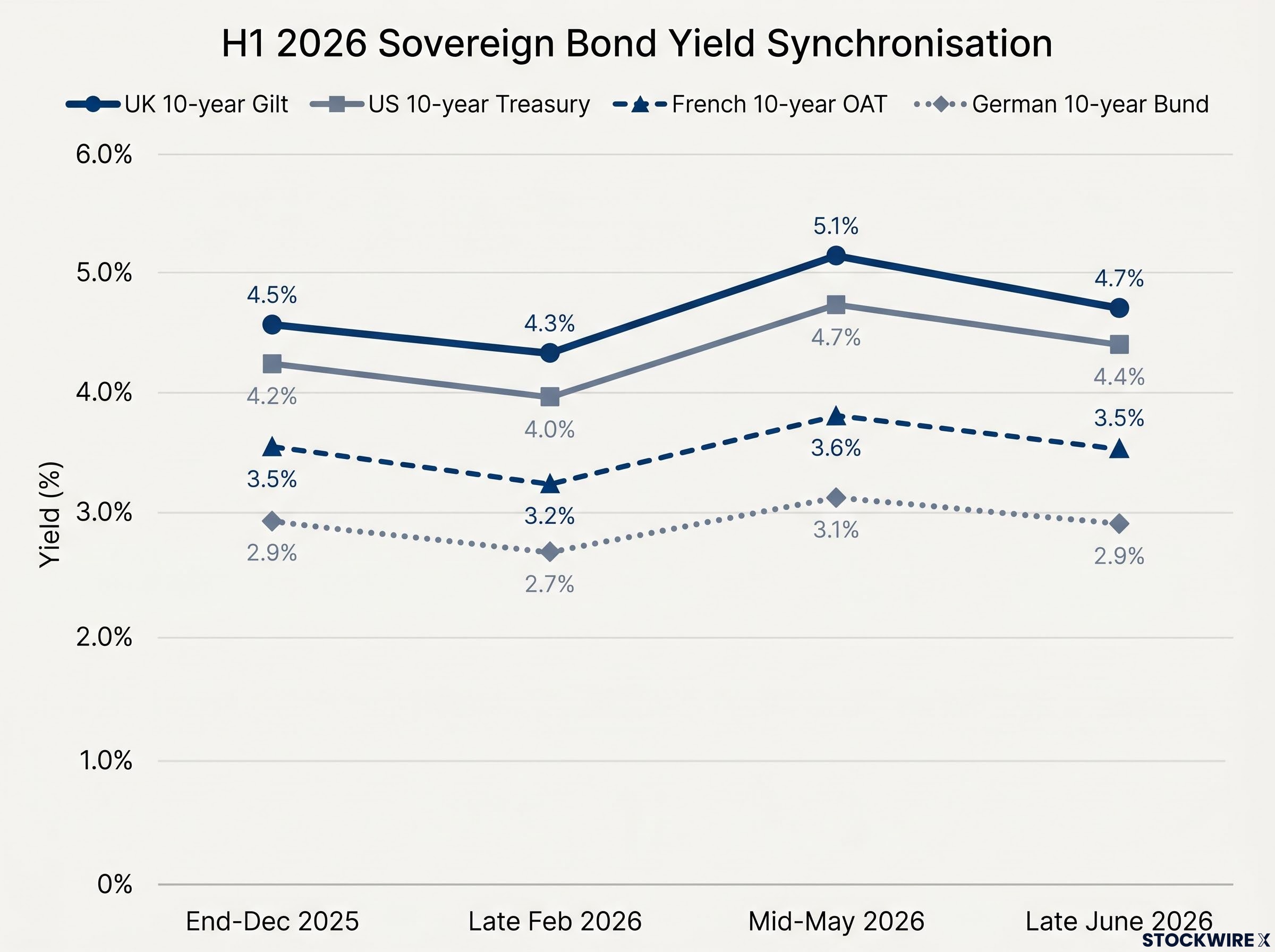
Here is where the political narrative runs into trouble. When the same December-to-June window is examined across US Treasuries, German Bunds, and French OATs, the pattern in gilts stops looking like a UK-specific story.
| Country / Instrument | End-Dec 2025 | Late Feb 2026 | Mid-May 2026 | Late June 2026 |
|---|---|---|---|---|
| UK 10-year Gilt | ~4.5% | ~4.3% | Above 5.1% | ~4.7% |
| US 10-year Treasury | ~4.2% | Just under 4.0% | ~4.7% | ~4.4% |
| French 10-year OAT | ~3.5% | ~3.2% | 3.6%-3.8% | ~3.5% |
| German 10-year Bund | ~2.9% | Below 2.7% | 2.9%-3.1% | ~2.9% |
Source: Fisher Investments Editorial Staff; FactSet data as of 26 June 2026.
All four markets dipped into late February, rose from March through mid-May, then partially retreated through June. The UK, the US, France, and Germany each had distinct domestic political circumstances during this period. None of them shared a political story. All of them shared a yield pattern.
The divergence test: what the data would need to show
For domestic politics to be the primary driver of a country’s bond yields, those yields would need to break meaningfully away from the peer group, a sustained divergence that cannot be explained by the shared macro backdrop. In 2026, gilt yields remained within a globally elevated but internally consistent band. No sustained break from US Treasuries, Bunds, or OATs appeared at any point across the six months.
The UK-Germany spread is the most direct real-time measure of country-specific fiscal risk: when gilts sell off in line with Bunds, the spread holds roughly steady and the signal is global; when gilts sell off while Bunds stay anchored, the spread widens and investors have grounds to treat the move as a domestic warning.
Why 2022 is the right benchmark, not a distraction
If 2026 did not clear the threshold for country-specific yield divergence, the natural question is: what does clear it? The answer sits four years back.
The September 2022 mini-budget was the last time UK politics genuinely moved gilts independently of the global backdrop, and the mechanism was entirely different from anything that happened in 2026:
- Unfunded tax cuts were announced into an already-inflationary environment, directly threatening fiscal sustainability.
- Gilt yields blew out relative to US Treasuries and Bunds; the yield curve dislocated.
- The credibility of the government-central bank relationship came under immediate question.
The Bank of England was forced to intervene in the long-end gilt market in September 2022, purchasing bonds to prevent a self-reinforcing spiral in pension fund liabilities. That intervention remains the clearest modern example of domestic politics overriding global bond market forces in a developed economy.
The Bank of England gilt market operation, announced on 28 September 2022, confirmed that the purchases were designed to restore orderly market conditions and reduce risks to UK financial stability, with the Bank explicitly citing the significant repricing of UK and global financial assets as the triggering condition.
Every one of those elements was absent in 2026:
- No announced, concrete plans to abandon fiscal rules or dramatically alter the deficit path.
- Miliband’s thin institutional backing made the most market-unfriendly Chancellor scenario increasingly low-probability by late June.
- The Bank of England’s mandate and institutional independence remained untouched throughout the leadership transition.
The structural lesson is straightforward. Markets respond to policy and institutions, not personalities. A change of prime minister without a credible, near-term threat to fiscal or monetary frameworks does not justify sustained repricing of a sovereign’s risk relative to peers.
What actually drives government bond yields: the macro layer explained
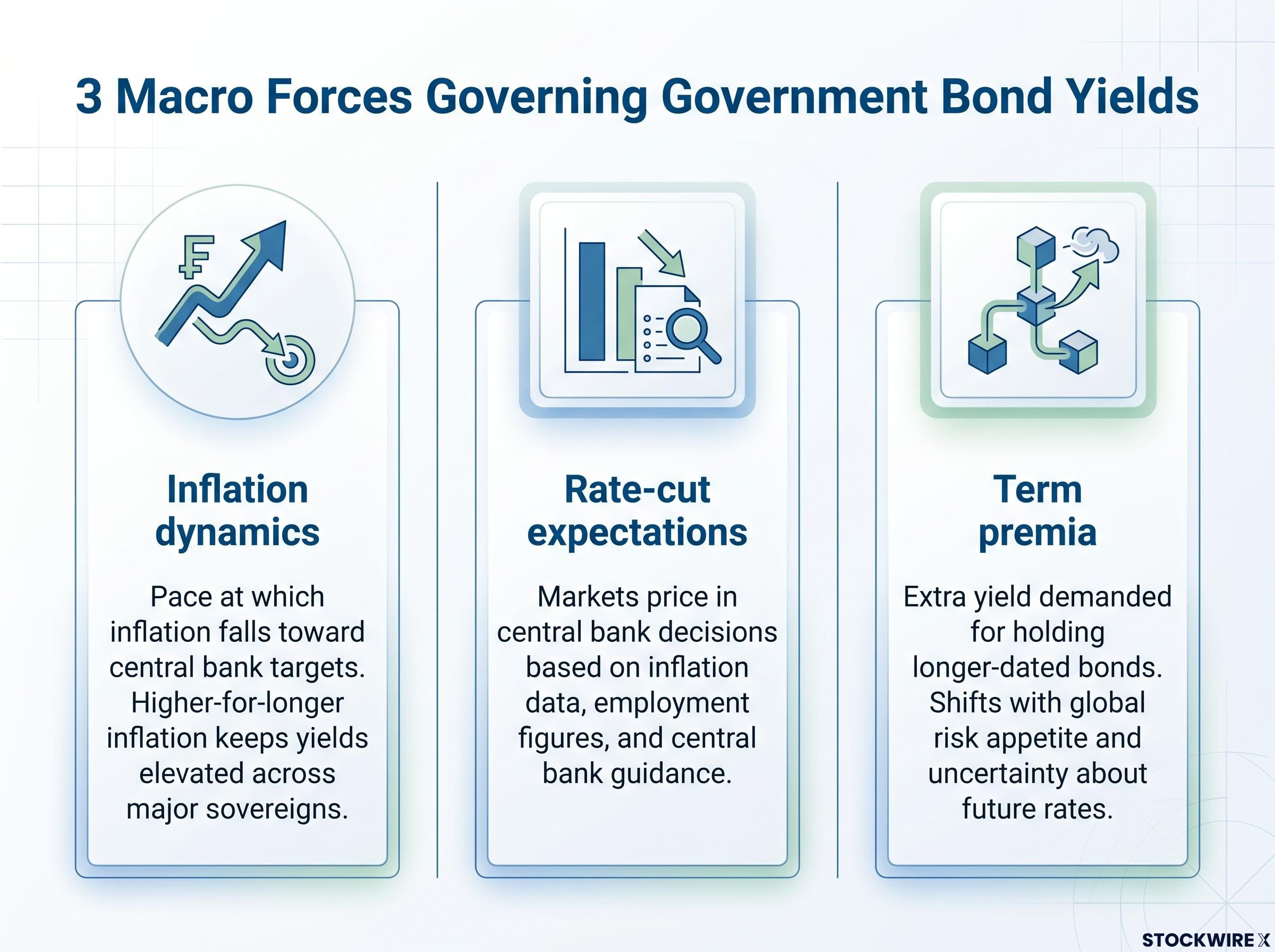
The cross-country data points to a common conductor. Institutional fixed-income analysis for 2026 consistently identifies three macro forces governing developed-market yield movements:
- Inflation dynamics: The pace at which inflation is falling (or not falling) toward central bank targets shapes the baseline yield level. Higher-for-longer inflation keeps yields elevated across all major sovereigns simultaneously.
- Rate-cut expectations: Markets price in expected central bank rate decisions months in advance. When those expectations shift, whether because of new inflation data, employment figures, or central bank guidance, yields across the US, UK, and eurozone move together.
- Term premia: The extra yield investors demand for holding longer-dated bonds rather than rolling short-dated ones. Term premia, or the compensation for duration risk, shifts with global risk appetite and uncertainty about future rates, not with individual country headlines.
These three forces operated simultaneously across Treasuries, Bunds, gilts, and OATs throughout the first half of 2026, producing the synchronised pattern the data showed. For domestic politics to override this coordination, a country would need to generate a fiscal or institutional shock large enough to reprice its bonds independently. That is a high bar, and 2026 Westminster did not come close to clearing it.
The inverse relationship between price and yield is central to reading any sovereign market: bond yield mechanics mean that a fixed coupon payment produces a higher return when the purchase price falls, which is why a broad sell-off in government debt automatically pushes yields upward across all markets simultaneously.
How the 2026 pattern maps to these drivers
The late-February dip across all four markets aligns with a period when rate-cut expectations were relatively elevated, pulling yields lower. The March-through-May rise aligns with those expectations being pushed back as inflation data proved more persistent than anticipated. The June retreat reflects some stabilisation in the outlook. The analytical consensus view, drawn from institutional commentaries, is that this macro backdrop explains the shared pattern more completely than any single country’s domestic politics.
Post-QE yield normalisation provides an important backdrop for reading the 2026 arc: a decade of artificially suppressed yields through central bank asset purchases created an abnormally low baseline, meaning the return toward 4.5-5% territory across developed markets in 2025 and 2026 is consistent with pre-QE historical norms rather than a signal of structural fiscal stress.
Four questions to ask before trusting a political risk narrative
The 2026 UK episode distils into four practical questions you can apply the next time a political crisis is framed as a bond market event:
- Are peer yields moving in the same direction? If a country’s bonds are tracking US Treasuries, Bunds, and OATs through the same arc, global macro is the dominant force. Any political explanation needs to clear a higher bar of evidence before it earns your attention, let alone a portfolio decision.
- Is the feared scenario probable, or merely possible? Commentary will fixate on worst-case outcomes. Markets price probabilities, not possibilities. Miliband’s thin institutional backing by late June is a live example: the feared Chancellor appointment generated sustained headlines, but the probability was falling even as the coverage intensified.
- Does the event credibly threaten fiscal sustainability or monetary independence? Leadership battles, scandals, and cabinet reshuffles generate dramatic coverage. They become primary bond drivers only when they create a credible, near-term path to fiscal rule abandonment or central bank interference. If neither is on the table, the macro layer almost certainly dominates.
- Does the same yield pattern appear across countries with different political stories? A political narrative that fits the timing is not automatically causal. When four countries with four different political environments trace the same yield arc, a global explanation is more robust than a domestic one. Post-hoc narrative fitting is one of the most common traps in political risk analysis.
For investors wanting to go further and build a pre-event framework for mapping political announcements onto portfolio exposures before yields move, our deep-dive into policy-driven market risk examines three 2026 case studies where the transmission from policy announcement to asset price was faster and more asset-specific than broad political risk narratives anticipated.
The global macro floor holds, until it does not
In 2026, the macro floor held across developed markets. UK political drama played out above it, generating headlines and commentary, but never breaking through to produce the kind of country-specific yield divergence that would justify treating Westminster as the primary driver.
That finding comes with an honest conditional. Global macro dominance is not permanent. The 2022 mini-budget proved that a credible, near-term fiscal shock can override the shared macro backdrop and produce real, measurable divergence in a single country’s bond market. The framework is a default presumption, not a guarantee.
The macro floor holds until fiscal or institutional credibility is directly threatened. At that point, country-specific repricing is warranted, and the peer-yield comparison will show you the divergence in real time.
The late-June gilt yield of approximately 4.7%, broadly consistent with contemporaneous market quotes, sits in line with the peer group’s partial retreat. The signal is not that UK politics never matters. The signal is that you can identify in advance the specific conditions under which it would matter: a credible fiscal commitment that diverges materially from peers, or a genuine threat to central bank independence. Until those conditions are met, the macro layer deserves your analytical weight, and the political headlines deserve your scepticism.
This article is for informational purposes only and should not be considered financial advice. Investors should conduct their own research and consult with financial professionals before making investment decisions.