
Most investors holding Ethereum through a U.S. spot ETF are leaving yield on the table. Direct ETH holders who stake their tokens earn protocol rewards automatically; ETF shareholders, until now, have not. Fidelity’s amended registration statement, filed on 24 July 2026, is the first serious attempt to close that gap from inside a regulated fund structure.
The filing is pre-effective, meaning the Fidelity Ethereum Fund (FETH) still functions as a pure price tracker. But the proposed mechanics are specific enough to analyse in detail: an 85/15 reward split, named institutional node operators, quarterly cash distributions, and a 0.25% annual fee sitting alongside the staking layer. If you hold or are evaluating any Ethereum exchange-traded product, the economics of this proposal matter before it becomes live.
Here is what the filing actually proposes, how the fee waterfall works, what risks it introduces, and which regulatory signals should change your evaluation of Ethereum ETPs going forward.
From price tracker to yield product: what Fidelity’s filing actually proposes
FETH’s original prospectus was explicit: neither the trust nor its agents would participate in any staking programme. The 24 July 2026 amendment reverses that prohibition entirely.
The fund’s stated objective now tracks ETH price plus staking rewards (net of expenses and liabilities), a structural shift from pure price tracking to a yield-plus-price mandate.
Under the amended terms, the sponsor may stake up to 100% of the trust’s ether through custodians and node operators under normal conditions, holding back a reserve for redemptions, expenses, and liquidity. The named node operators are institutional-grade validators:
- Blockdaemon, a leading enterprise blockchain infrastructure provider
- Figment, one of the largest institutional staking operators globally
- Galaxy Digital Trading Cayman, the digital asset arm of Galaxy Digital
FETH is structured as a Delaware statutory trust, trades on Cboe BZX, and held approximately $898-903 million in net assets at the time of the filing. A fund of that size shifting from pure price exposure to a yield-generating mandate is not a cosmetic update. It redefines the product category FETH competes in, and if you hold shares today, you should understand that what you own may behave materially differently once the amendment takes effect.
When big ASX news breaks, our subscribers know first
How the reward economics are structured: fees, splits, and what reaches the investor
The reward flow from the Ethereum protocol to your brokerage account passes through several deduction layers, and each one matters.
The trust retains 85% of gross staking rewards. The remaining 15% is paid as a flat staking fee, split among the sponsor, custodians, and node operators. That is the first cut.
Separately, the sponsor charges a unified annual fee of 0.25% on the trust’s ether holdings, covering most ordinary fund expenses. This fee applies regardless of whether staking is active, meaning it sits on top of the staking fee, not inside it.
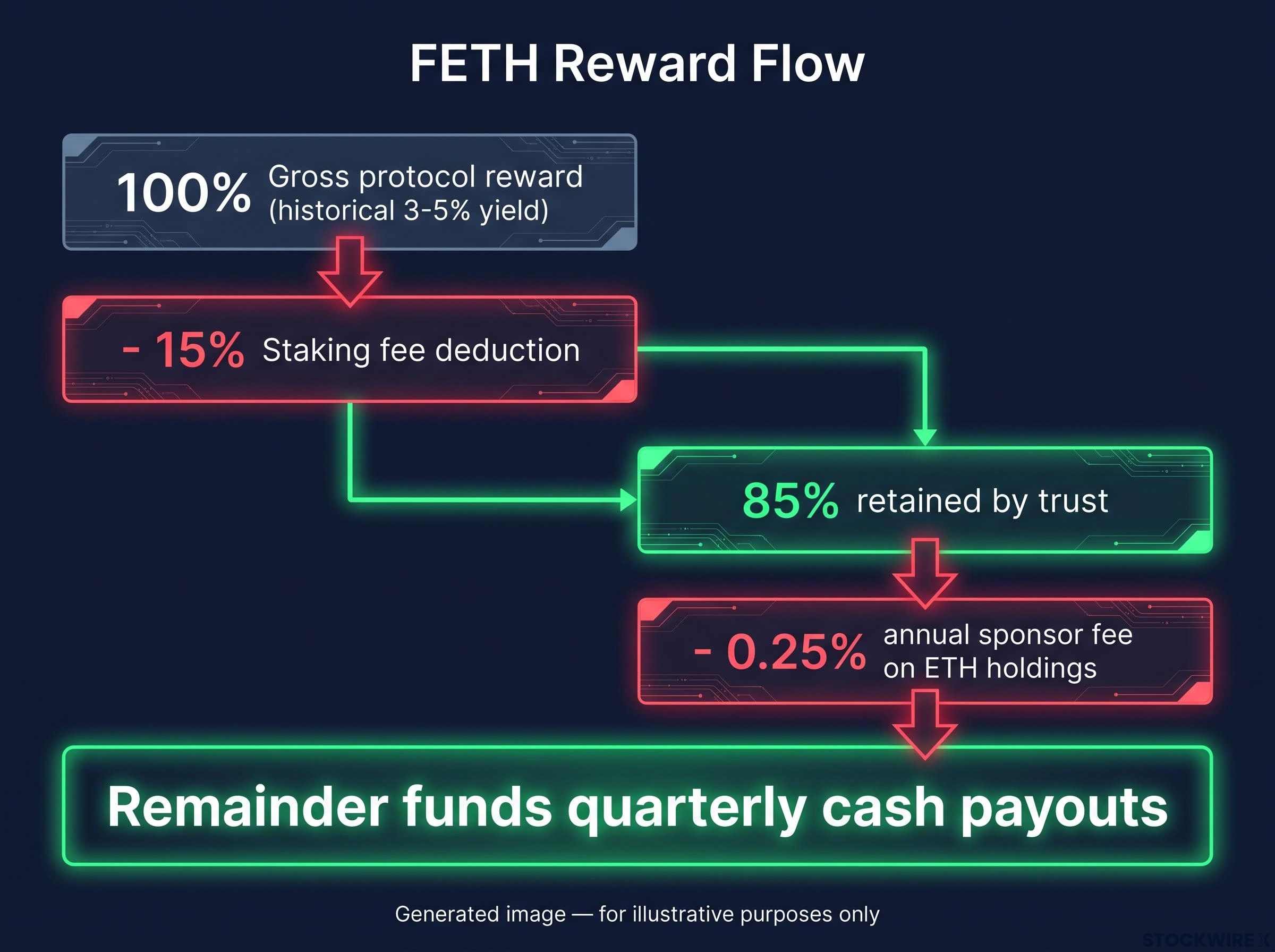
| Layer | Description | Illustrative impact |
|---|---|---|
| Gross protocol reward | Raw staking yield from Ethereum’s proof-of-stake network | 100% of rewards |
| Staking fee deduction | 15% to sponsor, custodians, and node operators | Reduced to 85% |
| Sponsor fee deduction | 0.25% annual fee on ETH holdings | Further reduced |
| Available for distribution | After expenses, remaining rewards fund quarterly cash payouts | Net investor yield |
Staking rewards first offset fund expenses, then flow to quarterly cash distributions. Those distributions are not guaranteed.
If the trust needs to sell ETH to raise cash for distributions, that sale could generate capital gains or losses inside the fund, adding another layer of friction between the gross protocol yield and what actually reaches your account.
The practical consequence: never compare raw Ethereum staking yields (historically in the 3-5% range) to what FETH would deliver. The net figure after staking fee, sponsor fee, expense drag, and potential tax impact is the only number that matters when evaluating whether this product adds real income.
Why staking belongs inside an ETF wrapper: the access case for retail investors
The criticism from crypto-native investors has been consistent since spot Ethereum ETFs launched: these products strip out the yield that makes ETH a productive asset. That criticism has been accurate. Understanding why the ETF wrapper now changes the equation requires seeing what direct staking actually demands.
To stake ETH directly, you need to:
- Manage private keys and secure your own custody
- Set up a validator node or delegate to a centralised exchange staking service
- Monitor validator performance and network conditions continuously
- Navigate activation and exit queues when you want to unstake
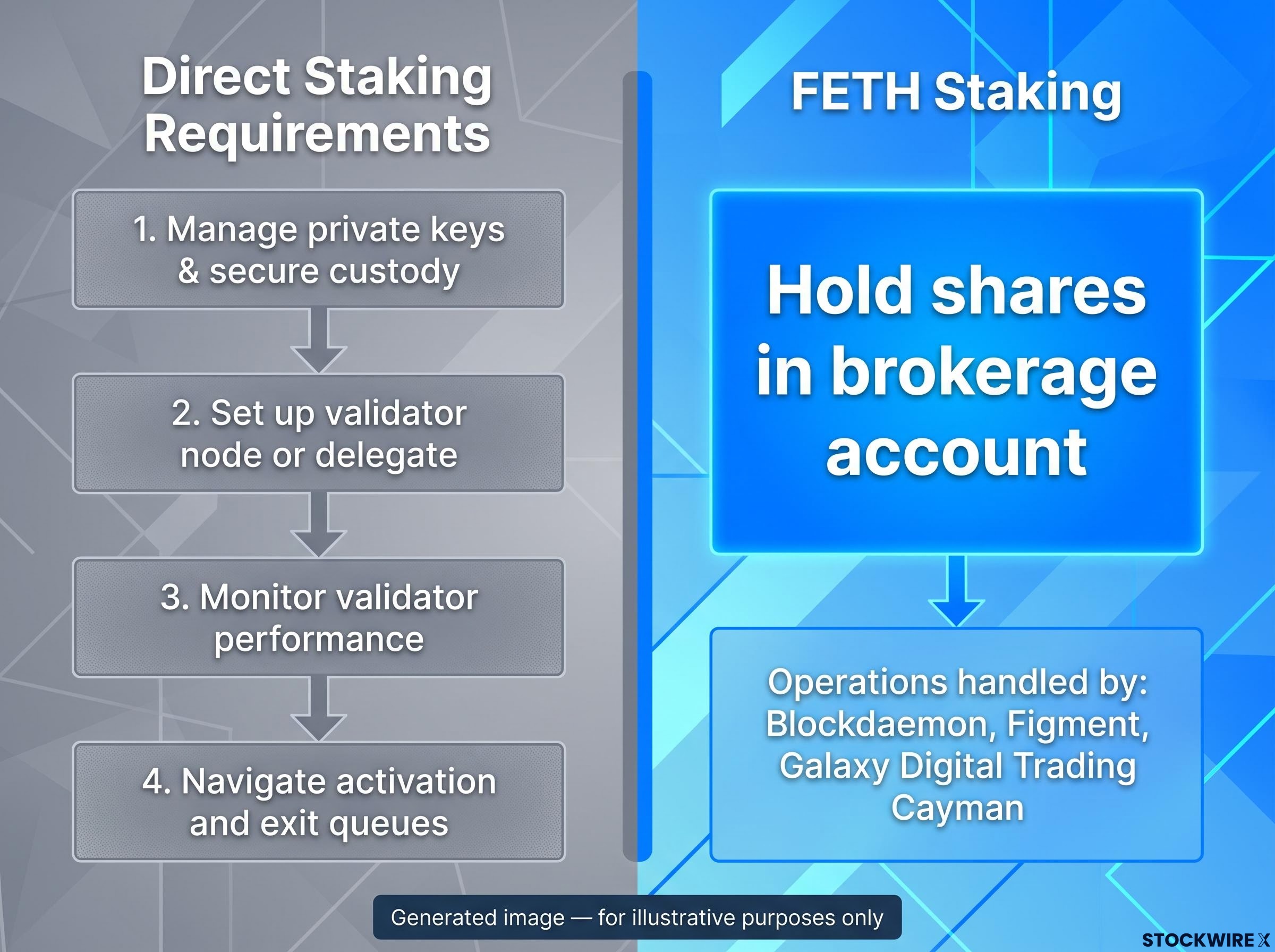
With FETH, the process reduces to one step: hold shares in your existing brokerage account. Custody, validator selection, and operations are handled institutionally by the named node operators.
That convenience matters, but the structural access point is more significant.
Staking in tax-advantaged accounts
IRAs and similar retirement accounts generally cannot hold spot cryptocurrency directly. Most advisory platforms restrict direct crypto custody entirely. FETH trades on Cboe BZX and can be held in standard brokerage accounts, trusts, and tax-advantaged retirement plans.
Under the amended structure, shareholders would be compensated based on ETH price plus staking rewards net of fees. For a retirement-account investor who wants Ethereum exposure but cannot or will not self-custody, this filing proposes to close the yield gap that has made spot ETH ETFs feel like an incomplete product since launch. Self-directed IRA holders, in particular, gain access to both price exposure and staking income through infrastructure they already use.
Risks the filing does not minimise: slashing, liquidity, and tax uncertainty
The yield story is real, but so are three distinct risk categories that the filing itself highlights:
ETF wrapper mechanics, including the creation and redemption process and the separation of fund assets from the sponsor’s balance sheet, matter here because the trust structure that protects shareholders in a conventional equity ETF is the same structure that must absorb slashing penalties or unstaking delays in a staking-enabled product.
- Slashing and technical risk: validator penalties that directly reduce the fund’s ETH holdings
- Liquidity and redemption management: delays between unstaking and full ETH liquidity
- Tax treatment uncertainty: limited IRS guidance on staking inside a regulated fund wrapper
Ethereum’s proof-of-stake design includes slashing penalties, which are financial punishments imposed on validators that misbehave or suffer serious downtime. Blockdaemon, Figment, and Galaxy Digital Trading Cayman are institutional-grade operators built to minimise this risk. But slashing risk is not zero. Any slashing event would directly reduce the trust’s ETH holdings, and by extension, the value of your shares.
Ethereum proof-of-stake rewards and penalties are calculated at the protocol level based on validator participation rates and network conditions, meaning the gross yield available to a fund like FETH will fluctuate with overall validator set size and network activity rather than remaining fixed.
Staked ETH is also subject to activation and exit queues, the network’s built-in mechanism for managing how many validators can enter or leave at once. That means delays can occur between a decision to unstake and the ETH becoming fully liquid. The sponsor has an explicit duty to maintain adequate unstaked ETH for redemptions and obligations, but stress scenarios involving large simultaneous redemptions or network congestion could test that framework.
Tax treatment: what the IRS has not yet clarified
This is the risk that matters most for investors in taxable accounts. Staking rewards allocated via quarterly distributions may be taxed as ordinary income, not as qualified dividends or long-term capital gains. The distinction is significant: ordinary income rates for high-bracket investors could materially reduce after-tax yield.
Additionally, if the fund sells ETH to raise cash for distributions, those sales could generate capital gains or losses inside the trust, which then affect the tax character of what you receive.
IRS guidance on staking within a regulated ETP wrapper is currently limited. Until clearer direction arrives from the IRS or Treasury, the after-tax yield cannot be assessed with confidence, and tax-sensitive investors should track reporting carefully.
Capital gains tax treatment of crypto distributions sits in a broader context of unresolved federal tax policy; while no unrealized gains tax exists at the federal level as of mid-2026, the constitutional ambiguity left open by Moore v. United States has kept long-term investors and planners alert to how staking income and future sale proceeds from crypto holdings could be reclassified under future legislative or regulatory action.
This article is for informational purposes only and should not be considered financial advice. Investors should conduct their own research and consult with financial professionals before making investment decisions.
Competitive pressure and regulatory precedent: what approval would trigger industry-wide
Until now, U.S. spot Ethereum ETPs have competed primarily on two dimensions: expense ratios and sponsor brand. A staking-enabled product introduces a third, highly visible dimension: net total return.
The arithmetic is straightforward. If FETH generates persistent staking income and a competing non-staking ETH ETP charges a similar 0.25% fee, the staking product will systematically outperform over time. That performance gap compounds as long as Ethereum’s proof-of-stake rewards remain positive, creating pressure for other issuers to file similar amendments or risk losing assets.
Bitcoin-linked ETF performance in June 2026, which shed more than 20% while Singapore equities gained 3%, illustrates the category-level volatility spread that investors in any crypto ETP structure must price in alongside fee and yield comparisons.
| Product feature | FETH (proposed) | Non-staking ETH ETP |
|---|---|---|
| Staking rewards | 85% of gross rewards to trust | None |
| Expense ratio | 0.25% annual | ~0.25% annual |
| Distribution mechanism | Quarterly cash (not guaranteed) | N/A |
| Regulatory status | Pre-effective; pending SEC review | Approved; no staking |
The regulatory precedent extends beyond FETH. Two parallel SEC review windows are active:
Cboe BZX rule change: 45-day SEC review window, extendable. Amended registration statement: 90-day SEC review window. Both must conclude before staking can begin.
A smooth approval could open the path for staking in other ETH products and eventually in other proof-of-stake crypto ETPs. A heavily conditioned or negative response would signal ongoing concern about mixing staking operations with exchange-traded retail products. If the SEC approves this structure with minimal conditions, anyone holding a non-staking Ethereum ETP should treat that as a signal to reassess, because the performance gap will compound over time.
What investors holding or evaluating Ethereum ETPs should monitor before acting
The decision to adjust a position in any Ethereum ETP on the basis of this filing should wait until the SEC’s response is known. Acting on a pre-effective proposal introduces regulatory risk that the staking mechanics may change materially or may not be approved at the proposed structure. Five specific signals, in priority order, should guide your timing:
The broader question of how to size proof-of-stake crypto assets within a risk-tolerant portfolio sits alongside the ETP structure debate; Bitcoin’s 3-4x higher annualised volatility relative to US equities illustrates why position sizing and pre-commitment to drawdown tolerance matter before any crypto allocation, staking-enabled or not.
- SEC response and timeline: comment letters, extension notices, and any conditions placed on the staking programme or reward distribution mechanics
- Prospectus and SAI updates: final language on reward calculation, allocation methodology, and tax treatment, which will appear in the Statement of Additional Information
- Fee structure changes: any adjustment to the 0.25% sponsor fee or additional costs tied to staking operations, directly affecting net yield
- Competitive issuer filings: rival spot Ethereum products proposing similar staking programmes would signal a broader industry shift, not a one-off
- IRS and Treasury guidance: clarification on how staking rewards inside an ETP should be taxed, the slowest-moving but most consequential signal for taxable-account investors
FETH’s public product page still describes the fund as not engaging in staking, reflecting its pre-effective status. That page will update once the regulatory process concludes. Understanding which signals matter, and in what order, helps you avoid two common errors: acting too early on an unconfirmed proposal, or ignoring a confirmed structural shift that changes the relative attractiveness of competing products.
What the FETH filing settles, and what it leaves open for the industry
The filing is technically sound and commercially logical. It solves a genuine access problem for investors who want Ethereum yield without self-custody, and it introduces competitive dynamics that could reshape the entire Ethereum ETP market. Those are the settled questions.
The unsettled ones are the ones that matter for your investment decision. SEC approval is not guaranteed. IRS treatment of staking distributions inside a regulated fund wrapper remains unclear. And the net yield after all fees and taxes is the only figure that justifies a product choice; the gross protocol number is not the one you will receive.
The broader structural question the filing raises is whether staking yield will become a standard feature of proof-of-stake crypto ETPs in the U.S. market, not a differentiating add-on. If it does, how you evaluate digital asset ETPs shifts permanently: total return, not just price tracking, becomes the baseline expectation.
Past performance does not guarantee future results. Financial projections are subject to market conditions and various risk factors.