Fed Chair Kevin Warsh spoke for roughly 30 minutes at the Jackson Hole Economic Policy Symposium on 28 August 2026. Within the same window, two of three simultaneously released US data points argued against further tightening. The dollar strengthened anyway, and the futures market crossed a threshold it had not crossed before in this rate cycle.
That combination is worth unpacking because it exposed something currency and rate traders understand in theory but often underestimate until a vivid example forces the point: central bank communication operates at a different tier of market-moving power than data prints. When a Fed chair redefines the reaction function in real time, backward-looking payroll revisions and one-month sentiment surveys become noise, not signal.
Here is the framework for understanding why this particular hawkish signal moved markets so decisively, what the repricing reveals about the dollar’s structural position against a range of currencies, and what the technical setup in USD/CAD tells you about where the policy-driven trend may run from here.
How Warsh shifted the Fed’s reaction function at Jackson Hole
Warsh’s remarks constituted his most direct acknowledgement to date that additional rate increases could be warranted. In his view, the committee does not yet have adequate confidence that core inflation is travelling back toward the 2% target in a durable way. Underlying trends have not “meaningfully improved.” The Fed must be “confident” that inflation is moving toward target “clearly and at sufficient speed,” or, as Warsh put it:
“We have work to do.”
That single framing shift carries more weight than any data release published yesterday. Previously, markets needed a reason to expect the Fed to hike. Now, markets need a strong reason to expect the Fed not to hike. The burden of proof flipped, and it flipped at Jackson Hole, the venue where the Fed chair speaks directly to the global market community without FOMC committee filtering.
Warsh’s rejection of forward guidance, formally announced at his first FOMC press conference on 17 June 2026, is the institutional context behind yesterday’s shift in the Fed’s reaction function; without a guidance framework to anchor expectations, every meeting is live and every Jackson Hole keynote carries outsized pricing weight.
The inflation numbers behind the hawkish stance
The data grounding Warsh’s stance arrived two days before the speech. The Fed’s preferred PCE inflation measure came in at approximately 3.7% year-on-year for July 2026, released on 26 August. The six-month rate was running near 4.1%.
The core inflation trajectory that Warsh cited as insufficiently convincing has been contested in the data since at least June 2026, when energy price reversals created a visible gap between headline and core readings that complicated the committee’s confidence assessment.
Set those figures against the 2% target. The gap is not closing at a pace the committee finds convincing, and Warsh made that explicit.
What this reaction-function shift means in practice: the USD retains a structural bid until a sequence of convincingly soft inflation prints forces a reversal. The bar for that reversal just got higher, not lower. Understanding the difference between a Fed that needs a reason to hike and a Fed that needs a reason not to hike is what separates reactive positioning from anticipatory positioning in rate markets.
When big ASX news breaks, our subscribers know first
Why soft data released at the same moment failed to stop the dollar rally
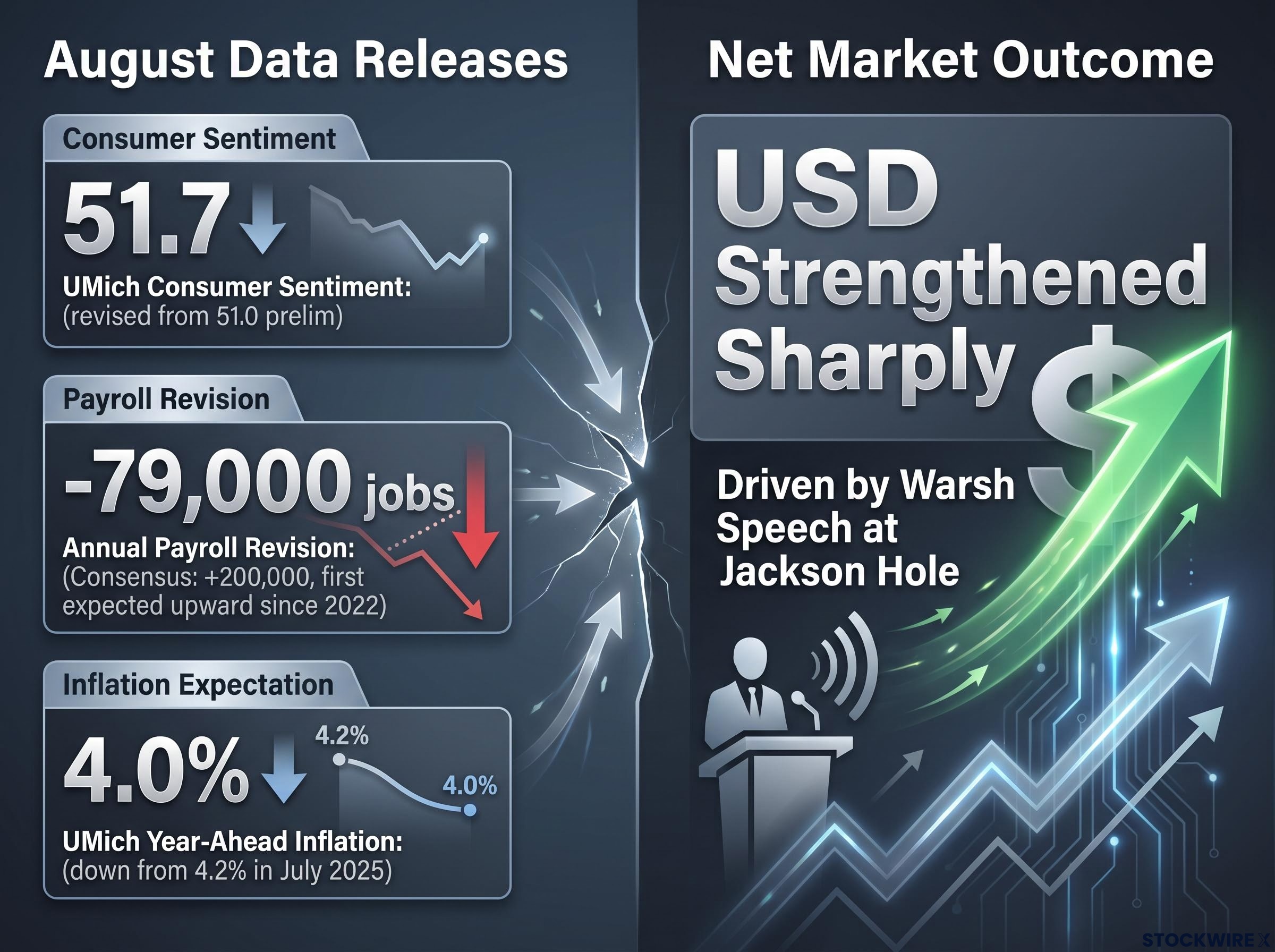
Three US data releases landed at the same time as Warsh’s remarks. Two of the three were individually dollar-negative. The dollar strengthened sharply anyway.
| Data release | Reading vs expectations | Individual USD signal | Net market outcome |
|---|---|---|---|
| UMich Consumer Sentiment (final August) | 51.7 (revised up from 51.0 preliminary) | Mildly positive | USD strengthened sharply, driven by Warsh speech |
| Annual payroll benchmark revision | -79,000 jobs vs consensus of +200,000 | Dollar-negative | |
| UMich year-ahead inflation expectations | 4.0%, down from 4.2% in July 2025 | Dollar-negative (argues against hikes) |
The payroll benchmark revision was the most significant potential dollar-negative print. Consensus had anticipated the first upward revision to the count since 2022, with forecasters expecting a net addition of around 200,000 jobs. The actual figure ran in the opposite direction, cutting 79,000 jobs from the historical total. In normal circumstances, that softer read on the labour market, alongside easing inflation expectations (five-year expectations had sat at 3.3% without moving for three consecutive months), would have built a credible case against any additional rate increases.
It did not matter. The speech dominated for three structural reasons:
- Forward-looking versus backward-looking: Warsh’s remarks define the policy path ahead. A payroll revision corrects a historical count. Markets price the future, not the past.
- Reaction-function-defining: The speech did not just provide guidance. It redefined what the Fed is reacting to and the threshold required to change course. That makes it the input that governs how every subsequent data release gets interpreted.
- Chair-level authority: A Jackson Hole keynote from the Fed chair carries more informational weight than any single monthly data print. The venue and the speaker both sit at the top of the event-risk hierarchy.
When a Fed chair redefines what the committee is reacting to, that statement is itself the most relevant piece of information in the room. The practical takeaway: not all inputs arrive with equal authority, and knowing the hierarchy in advance is how you weigh event risk on days when multiple releases land simultaneously.
What the repricing means across currency markets, not just USD/CAD
The driver of USD strength here is not the current posted rate level. It is the expected divergence in policy paths between the Fed and every other major central bank. That distinction determines which currency pairs face the most pressure.
Start with the immediate expression. Within about 30 minutes of the 14:00 GMT speech, USD/CAD had gained approximately 50 pips, pushing the pair to just under 1.3900. On the Bank of Canada side, the September 2 meeting was fully priced for no change, with odds of a hike sitting in single digits. The September 15-16 FOMC meeting, by contrast, shifted to a hike probability in the mid-to-high 50s percent range, climbing from around 50% on 10 August and marking the first time in this rate cycle that the tightening side commanded an outright majority. Further out, pricing implied at least one hike by October 28 at roughly 85% probability, and by December 9 a second hike was running at around 38%. Two-year US Treasury yields reached their highest level in a month.
The divergence between the Fed’s expected path and the Bank of Canada’s expected path, not the current rate spread, was the central driver of CAD weakness on the day. That same logic applies to every major pair.
| Currency pair | Counterpart central bank stance | Expected-path divergence | Implied USD bias |
|---|---|---|---|
| USD/CAD | BoC: hold expected, hike odds in single digits | Widening (Fed hiking, BoC paused) | Bullish USD |
| EUR/USD | ECB: near plateau, clearer euro area disinflation | Widening (Fed hiking, ECB pausing) | Bullish USD |
| USD/JPY | BoJ: short-term rates near zero, tentative YCC exit | Wide and persistent | Bullish USD |
| EM FX (broad) | Mixed; many pausing or easing | Widening where domestic inflation is sticky | Bullish USD, selective pressure |
Yield-curve control, referenced in the BoJ column, is a policy in which the central bank caps long-term government bond yields at a specific level; the Bank of Japan has only taken tentative steps away from this framework, keeping the US-Japan rate gap wide.
The EM dimension of a hawkish Fed
Emerging-market currencies face compounded pressure when Fed rate expectations rise. Higher US yields tighten global financial conditions and reduce the relative appeal of carry trades, a strategy where investors borrow in low-yield currencies to invest in higher-yielding EM assets. EM currencies with fragile fundamentals, specifically current account deficits, limited reserves, and sticky domestic inflation, face the sharpest pressure.
The read-through for you is direct: the Fed’s repricing sets a policy-divergence backdrop that favours the USD against any central bank seen as pausing or easing. If you are watching a specific currency pair, the question to ask is how far your counterpart central bank’s expected path sits below the Fed’s. That gap is where the pressure concentrates.
USD/CAD technical structure after the policy-driven move
The macro driver is clear. The chart tells you where the specific decision points sit.
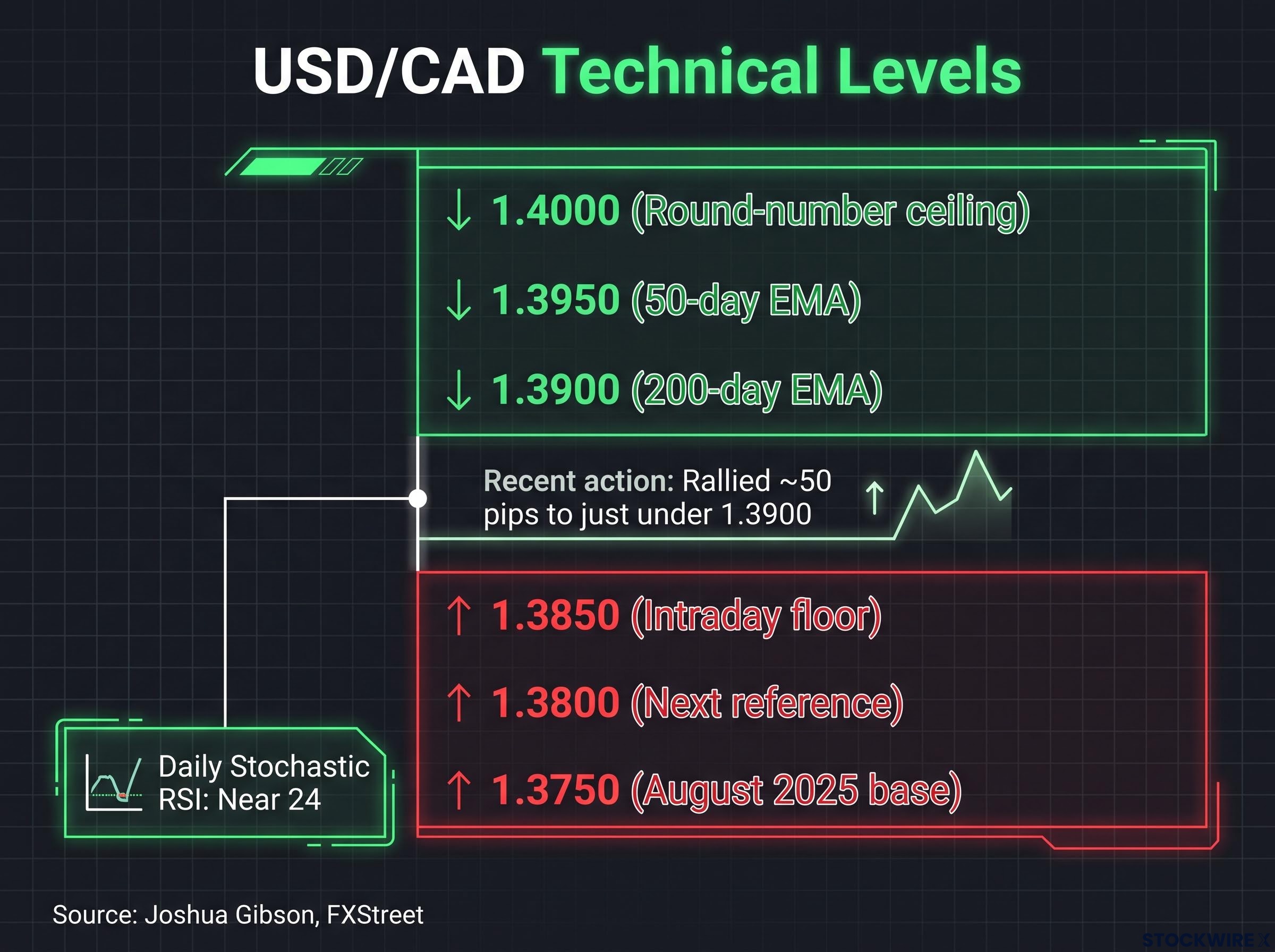
USD/CAD rallied to just below 1.3900 on the day, and the near-term bullish bias holds as long as the 1.3850 session floor is maintained on a daily close basis. Above current levels, resistance is layered at three distinct price points. The 1.3900 level is where the 200-day EMA (exponential moving average, a smoothed average of the past 200 trading days’ closing prices that tracks the long-term trend) sits, coinciding with a key psychological round number; this is the primary barrier sellers have so far defended. At 1.3950, the 50-day EMA is the next hurdle, currently angled lower, representing the secondary resistance zone that would need to give way for the recovery to extend. The 1.4000 level acts as a round-number ceiling; a sustained close beyond it would confirm a more significant shift in USD/CAD’s direction.
On the downside, the support structure defines where the bullish bias would come under threat. The 1.3850 intraday floor is the level to hold; a daily close beneath it weakens the near-term case. 1.3800 is the next reference below that, and a close under this level would invalidate the bullish bias entirely. Further down, the August 2025 base sitting just under 1.3750 represents the summer range low and the level a sustained Canadian Dollar recovery would need to break through.
The daily Stochastic RSI, a momentum indicator that measures whether a currency pair is overbought or oversold relative to its recent range, is near 24 and appears to be turning upward from oversold territory. In the context of a policy-driven trend, that turn supports the near-term bullish bias.
Technical levels and momentum analysis sourced from Joshua Gibson, FXStreet.
The 1.3900 level is the fulcrum. A confirmed daily close above it opens the path to 1.3950 and 1.4000. That level is the near-term binary decision point for the bullish thesis, and it is where you should be watching most closely as the policy narrative develops.
What changes the dollar’s structural advantage, and when to watch for it
The bullish case for the dollar is real, but it is conditional. The conditions under which it unravels are specific and measurable.
Structural dollar headwinds from fiscal-driven term premium erosion, coordinated intervention, and declining foreign capital demand place a ceiling on how far rate-premium arguments can push the DXY — the Warsh repricing must work against these forces rather than alongside them.
The primary risk: a sequence of clearly soft US inflation prints that restores market confidence that no further hikes are needed. That would reprice rate expectations lower, ease two-year Treasury yields, and remove the structural bid beneath the dollar. The December 9 second hike probability, currently at approximately 38%, is the market’s pricing of the outer scenario. A full unwind would require that number to collapse toward zero.
- Incoming CPI prints below expectations would be the most direct challenge to the Warsh thesis, particularly if core measures decelerate alongside the headline.
- A shift in tone from other FOMC members could fragment the hawkish consensus before a formal pivot, creating a period of narrative uncertainty that pauses the USD trend.
- PCE deceleration in the next monthly release would test whether the six-month rate near 4.1% is a peak or a plateau.
- EM stress severe enough to trigger safe-haven flows into non-USD assets (such as the yen or Swiss franc) could complicate the dollar-positive picture, though this is the least likely of the four conditions.
The data calendar to watch between now and September 15
The next high-priority Fed data inputs fall between Jackson Hole and the September 15-16 FOMC meeting. The August CPI release, due in mid-September, is the single most important number in the window. If it comes in soft, it challenges the Warsh thesis directly. If it confirms sticky inflation, it reinforces the repricing that occurred yesterday.
Any PCE data released in the window functions the same way: either confirmation or challenge.
With the UMich survey showing year-ahead inflation expectations at 4.0% and the five-year reading at 3.3% for the third consecutive month, the picture is one of Fed credibility that is holding without meaningfully strengthening. That is the fragile equilibrium Warsh’s speech was designed to reinforce.
The dollar’s strength is a conditional bet on the Fed’s credibility holding through the next two inflation reports. It is not a permanent structural shift. Watch the August CPI and the September PCE release as the first real tests. A clear-eyed risk framework prevents you from holding a directional view past the point at which the underlying thesis has changed, and that is the error most commonly made after a high-conviction event like Jackson Hole.
Investors wanting the broader valuation context for the dollar’s current position will find our full explainer on the dollar’s 2026 valuation outlook, which covers Morningstar’s estimate that the DXY is approximately 15% overvalued and what that overvaluation implies for the rate-narrative thesis through year-end.
This article is for informational purposes only and should not be considered financial advice. Investors should conduct their own research and consult with financial professionals before making investment decisions. Past performance does not guarantee future results. Financial projections are subject to market conditions and various risk factors.