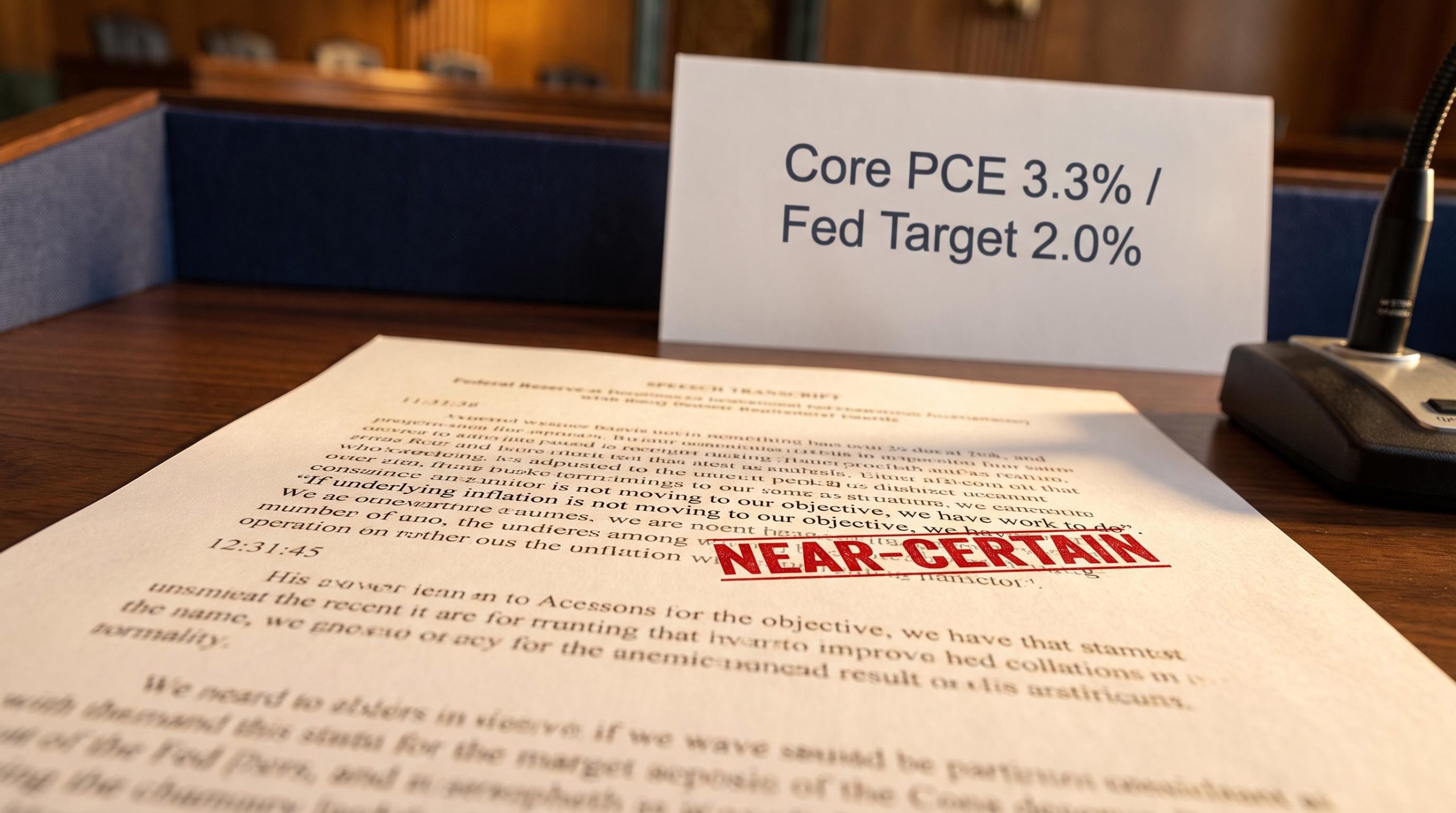
Within hours of Kevin Warsh’s speech at Jackson Hole on 28 August 2026, the headlines arrived with their usual confidence. A September rate hike was “near-certain.” The Fed chair had “signalled” his intent. The market needed to prepare.
One problem: almost nothing in the speech supported that reading. Warsh gave a principles-based address, deliberately withheld forward guidance, and used conditional language where the headlines inserted declarative certainty. The gap between what he said and how it was characterised is not a small editorial disagreement. It is a case study in how financial media manufactures predictions from raw material that does not contain them.
Here is what the speech actually said, what the July inflation data actually shows, and why neither adds up to a September certainty. More importantly, here is why chasing that kind of prediction is the wrong game for you to play, and what to focus on instead.
What Warsh actually said at Jackson Hole
The speech, titled “In Our Time,” ran long on principles and short on anything resembling guidance. Warsh reaffirmed the Fed’s 2% inflation target, measured by the Personal Consumption Expenditures (PCE) price index, the broad measure of how prices are changing across the economy. He held to his pledge not to provide forward guidance about the near-term rate path. And his inflation language was conditional in structure, not declarative.
“If underlying inflation is not moving to our objective, we have work to do.”
That formulation describes the criteria for action. It does not announce a decision. The difference is the entire basis on which “near-certainty” headlines fail. Warsh was telling the audience what would have to be true for the Fed to act, not that the Fed had decided to act.
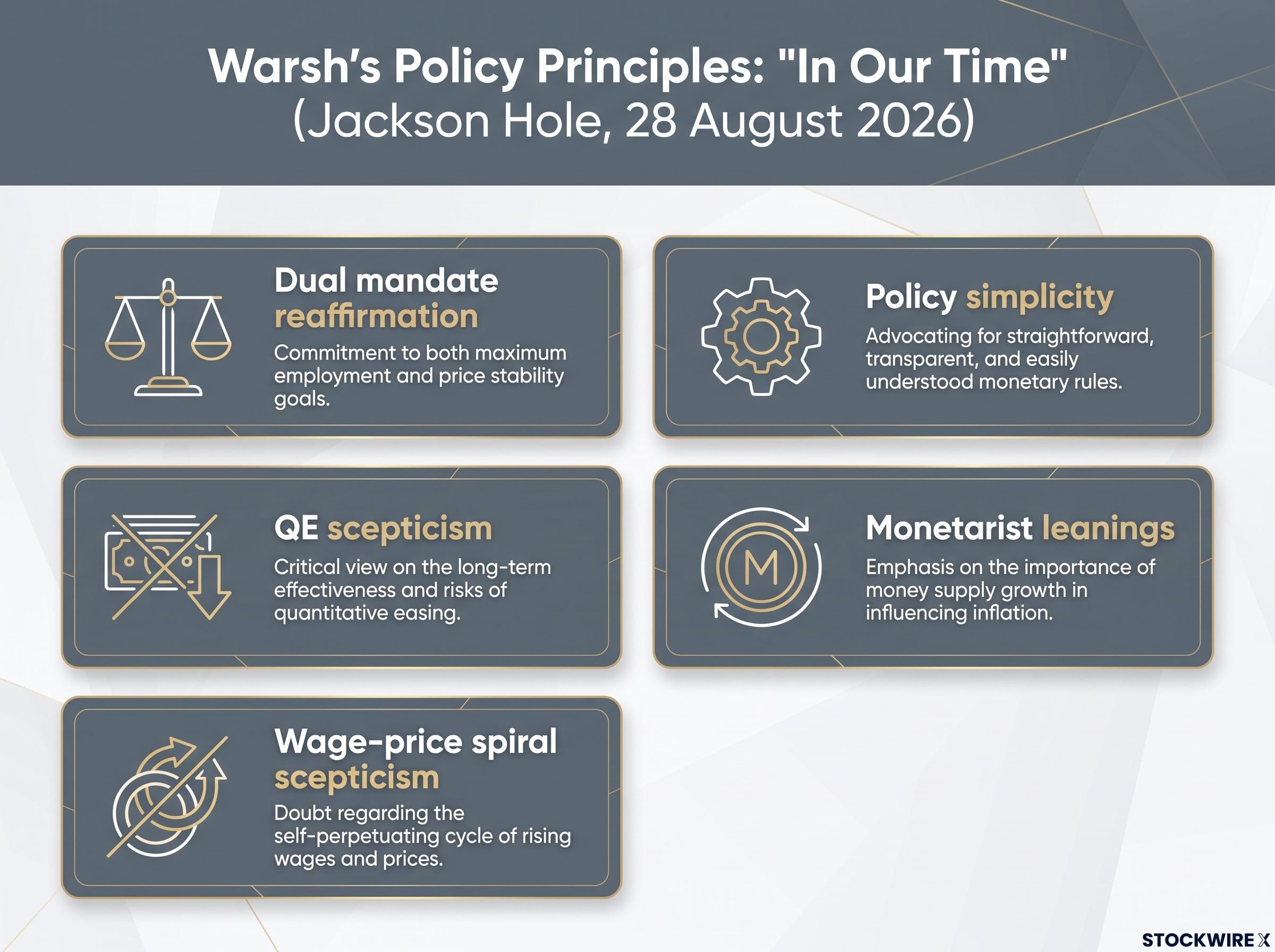
Beyond the inflation commitment, the speech articulated a set of foundational monetary policy principles:
- Dual mandate reaffirmation: Warsh upheld the Fed’s twin obligations to keep prices stable and support full employment
- Policy simplicity: Short-term interest rates should serve as the Fed’s primary lever, with unconventional tools reserved for exceptional circumstances
- Quantitative easing (QE) scepticism: QE, where the central bank purchases long-term assets to ease financial conditions, is a measure Warsh believes should be avoided or used only as a last resort
- Monetarist leanings: Warsh holds that shifts in the money supply are the dominant force behind inflation and economic growth
- Wage-price spiral scepticism: Warsh cast doubt on wages as a forward indicator of inflation, noting that wage growth has not served as a consistent or trustworthy signal of where prices are headed
Warsh’s monetarist inflation framework, his stated belief that money supply shifts are the dominant force behind price levels, has direct implications for how investors should read PCE data: broad M4 money growth running near historical norms in 2026 is the structural signal, and commodity-driven headline moves are the noise that obscures it.
These are philosophical commitments about how the Fed should operate, not signposts pointing to a specific meeting outcome. Understanding that distinction gives you the ability to evaluate Fed coverage critically rather than reactively, a skill that compounds over every future rate cycle.
When big ASX news breaks, our subscribers know first
The inflation picture is elevated, not urgent
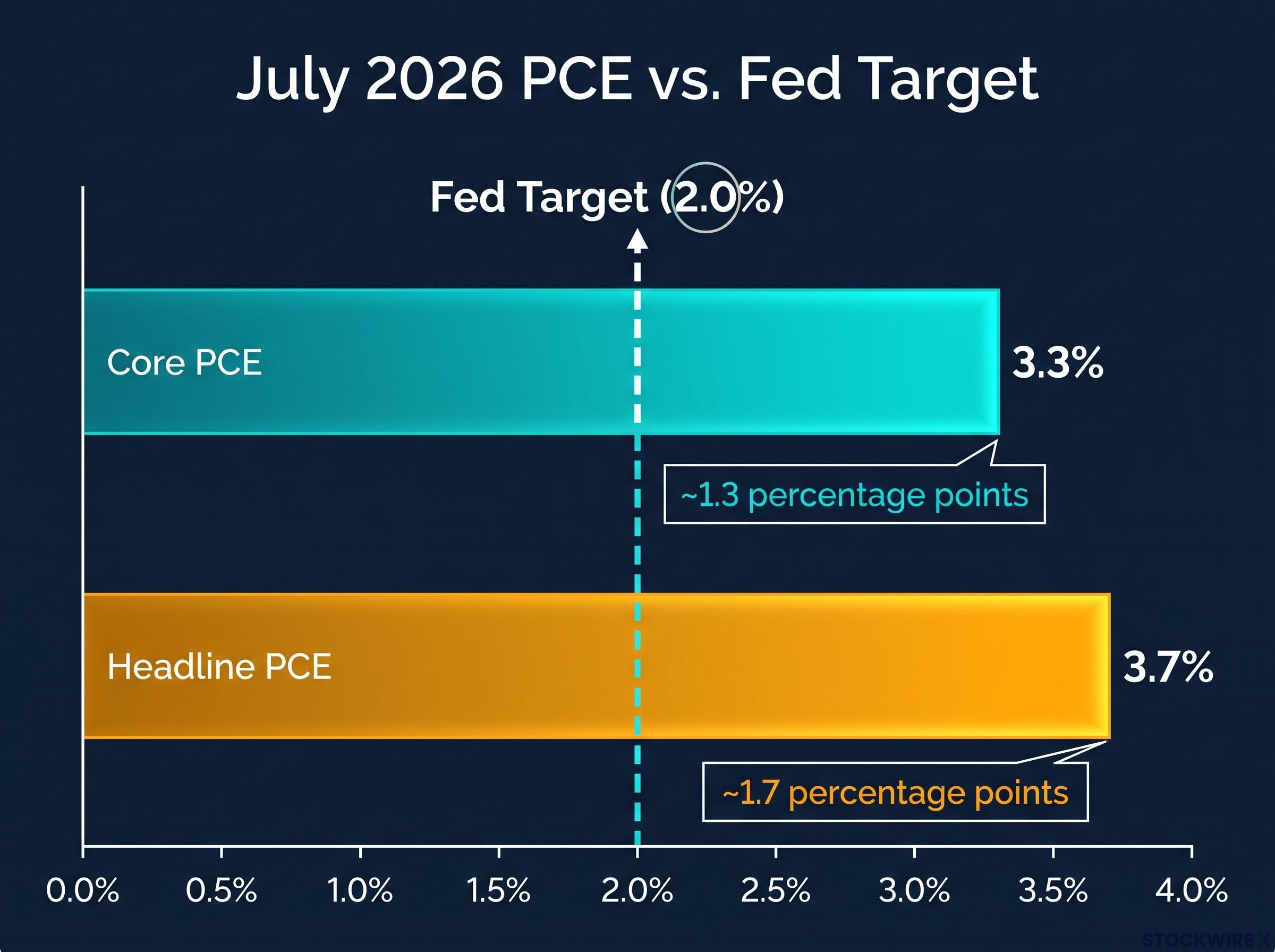
The July 2026 PCE data, released the same week as the speech, gave commentators the number they needed to complete the narrative. Core PCE, which excludes volatile food and energy prices and serves as the Fed’s preferred gauge of underlying price pressures, came in at 3.3% year-over-year. Headline PCE, the broader measure including food and energy, registered 3.7%.
| Metric | July 2026 Reading | Fed Target | Gap from Target |
|---|---|---|---|
| Core PCE (excl. food & energy) | 3.3% | 2.0% | ~1.3 percentage points |
| Headline PCE | 3.7% | 2.0% | ~1.7 percentage points |
Those gaps are real and persistent. Nobody should dismiss them. Core PCE sitting 1.3 percentage points above target confirms that the Fed has work remaining, exactly as Warsh said. Headline PCE at 1.7 percentage points above target reinforces the point.
But “above target” and “forces a September decision” are two different claims, and the data supports only the first. Inflation has been hovering well above 2% for an extended period rather than sharply accelerating. There is no inflection point in the July reading that uniquely singles out the September meeting over any subsequent one.
The July PCE trend carries a detail the headline number obscures: core PCE has held at 3.3% for two consecutive months, confirming a gradual drift lower rather than a decisive break, the distinction between a patient hold and the beginning of a cutting cycle that single-meeting predictions routinely collapse into a binary.
A single month’s PCE release cannot force a specific meeting outcome when the trend is persistent rather than escalating. If you understand that, you avoid the trap of treating each new inflation number as a binary hike trigger and making reactive portfolio moves based on something the data simply cannot tell you.
Why the Fed’s own communication structure makes prediction unreliable
The problem with predicting Fed decisions from speeches is not just that commentators misread this particular speech. It is that the institution’s communication structure is designed to resist exactly this kind of prediction.
Warsh’s data-dependent, guidance-free framework deliberately keeps options open meeting-to-meeting. Every decision hinges on whatever the data shows at the time of the decision, not on what was said at a podium weeks earlier. That means any single speech has far lower informational content about the next move than headline writers assume.
The FOMC structure itself shapes why any single speech carries less informational weight than markets assume: only 12 members vote at each meeting, and public comments from non-voting regional presidents are context rather than binding policy signals, a distinction that gets lost when headlines treat any Fed official’s remarks as forward guidance.
Fisher Investments’ editorial staff have argued on this point in a wider context: central bank communications, whether packed with forward guidance or deliberately sparse, offer no reliable map to forthcoming policy decisions. That limitation holds across different chairs and different communication frameworks. The forecasting problem is embedded in how the institution functions, not something that better reading of any one speech can solve.
Research on forward guidance and financial stability has documented how central bank communication can become a source of market distortion in its own right, creating expectations the institution then feels constrained to honour regardless of incoming data.
Warsh’s approach represents no sharp break from how the Fed has historically conducted itself. Before the global financial crisis, forward guidance was not part of the standard toolkit, and markets navigated policy without it.
What less Fed noise could mean for markets
Fisher Investments’ editorial staff raised a counterintuitive implication: if Warsh successfully reduces Fed communication volume, markets may actually benefit. Less noise does not mean more uncertainty. It means market participants are forced back to reading actual economic conditions, elections, regulatory developments, and corporate fundamentals rather than parsing central bank language for hints that were never intended to be there.
There is a caveat. Warsh’s credibility depends on consistency with his stated principles. If he were to move away from those principles, perhaps by steering the Fed into areas outside its core monetary remit as some predecessors did, the resulting inconsistency could generate precisely the confusion and uncertainty his framework seeks to prevent.
The structural takeaway here matters more than the September-specific one. The Fed’s calendar-style prediction problem does not go away with better analysis of speeches or more sophisticated parsing of language. It is built into how the institution makes decisions. Once you accept that, you stop wasting energy on an unwinnable guessing game and redirect your attention to signals that are actually durable.
What you should actually be watching instead
The persistent elevation of both core and headline PCE confirms the direction of Fed intent: restrictive, or at least non-expansionary, policy for some period. That is genuinely knowable. What is not knowable is which meeting, which increment, or which pivot date to position around.
The September rate hike speculation is a representative example of a broader cognitive trap. A compelling-sounding speech and a fresh PCE number create an illusion of predictive precision that the underlying reality does not support. The data tells you where the Fed is pointed. It does not tell you when it arrives.
Fisher Investments’ editorial staff have characterised speculation on a single Fed meeting as noise, and recommended anchoring instead on the signals that actually drive long-run equity returns.
Those signals are more reliable inputs for your portfolio thinking than any next-meeting prediction:
- Corporate earnings: Revenue and margin trends across the companies you own
- Productivity trends: Whether the economy is getting more efficient, which determines sustainable growth rates
- Regulatory and legislative changes: Policy shifts that alter the operating environment for specific sectors
- Multi-month inflation trajectory: The direction of inflation over several readings, not a single release
Building a portfolio decision around a September hike call is not just uncertain. It is a category error. Even if the hike happens, the next move may not follow the predicted path, and the cumulative error compounds with each prediction cycle. You reduce transaction costs, avoid unnecessary tax events, and eliminate timing errors by focusing on what is knowable rather than what is merely guessable.
The discipline that outlasts any rate cycle
Three layers of evidence point in the same direction. Warsh said something conditional, not declarative. The PCE data confirms direction, not timing. And the Fed’s communication structure makes single-meeting prediction unreliable regardless of who chairs it.
Warsh’s data-dependent, guidance-free approach is a feature for long-term investors, even if it frustrates short-term traders. It means the Fed is anchored to economic reality rather than to its own prior statements.
The practical discipline is straightforward. Core PCE at 3.3%, sitting 1.3 percentage points above the 2% target, tells you the policy environment remains restrictive. Warsh’s conditional formulation, “if underlying inflation is not moving to our objective, we have work to do,” tells you decisions will follow data, not a pre-announced calendar.
Distinguishing between what is knowable and what is not is the foundation of durable portfolio thinking. The direction of policy intent is knowable. The exact timing and magnitude of the next move is not. Investors who hold that distinction clearly make fewer reactive moves and build returns that compound over full cycles rather than fragmenting across prediction-driven trades.
For investors who accept the case against single-meeting prediction but find it difficult to hold that discipline when fresh data arrives, our dedicated guide to staying invested through rate cycles examines the specific behavioural mechanisms, including loss aversion and panic-selling patterns, that cause investors to abandon sound frameworks at exactly the wrong moments.
This article is for informational purposes only and should not be considered financial advice. Investors should conduct their own research and consult with financial professionals before making investment decisions. These statements are speculative and subject to change based on market developments and company performance.