The Bangko Sentral ng Pilipinas (BSP) is running a policy rate of 5.0% against an inflation target band of 2-4%. July’s consumer price index (CPI) print of 6.2% sits more than two percentage points above the ceiling of that band. The gap between where prices are and where the central bank wants them to be is not narrowing fast enough, and the BSP’s response tells you exactly how seriously it reads the risk.
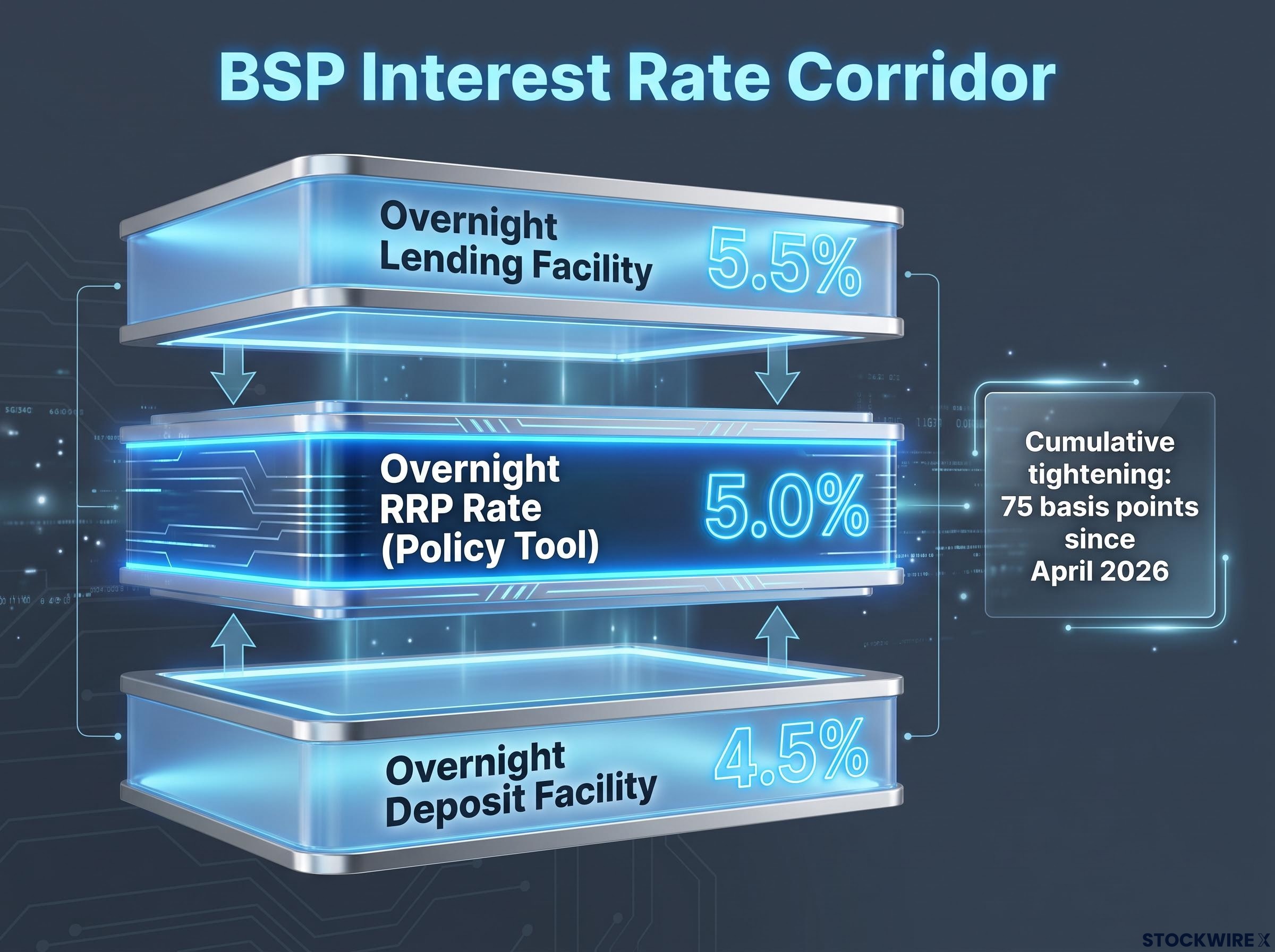
This is the third consecutive 25 basis point hike since April 2026, bringing cumulative tightening to 75 basis points. The BSP is not just fighting inflation. It is simultaneously trying to stabilise a weakening peso, a currency whose decline feeds directly back into the inflation problem through more expensive imports. That dual mandate makes every rate decision a balancing act between cooling demand and defending the currency, neither of which can be pursued in isolation.
Here is the framework for understanding not just what the BSP decided on 27 August, but what its decision architecture means for anyone holding Philippine assets or tracking emerging-market central bank behaviour in 2026. The data points, the analyst split, and the asset-class implications covered below will equip you to interpret what comes next as each new inflation print arrives.
The logic behind three consecutive hikes
Start with the inflation numbers. July 2026 CPI came in at 6.2%, easing marginally from June’s 6.4%. That looks like progress until you measure it against the BSP’s 2-4% target band. The headline rate is still more than two percentage points above the ceiling. Marginal improvement is not the same as resolution.
The structural drivers explain why the BSP cannot treat this as a temporary overshoot:
- El Niño agricultural disruption has pushed food prices higher and constrained domestic supply chains
- Potential wage adjustments are building as workers seek compensation for eroded purchasing power
- Volatile global oil and commodity prices continue to feed imported inflation through the Philippines’ significant fuel and food import dependence
Then there is the peso. A weaker currency makes every barrel of imported oil and every tonne of imported rice more expensive in peso terms, which feeds directly back into domestic CPI. The peso problem is not a separate concern from inflation; it is an amplifier of it. The BSP’s decision to tighten addresses both channels simultaneously: higher rates compress domestic demand while improving the carry attractiveness of peso-denominated assets.
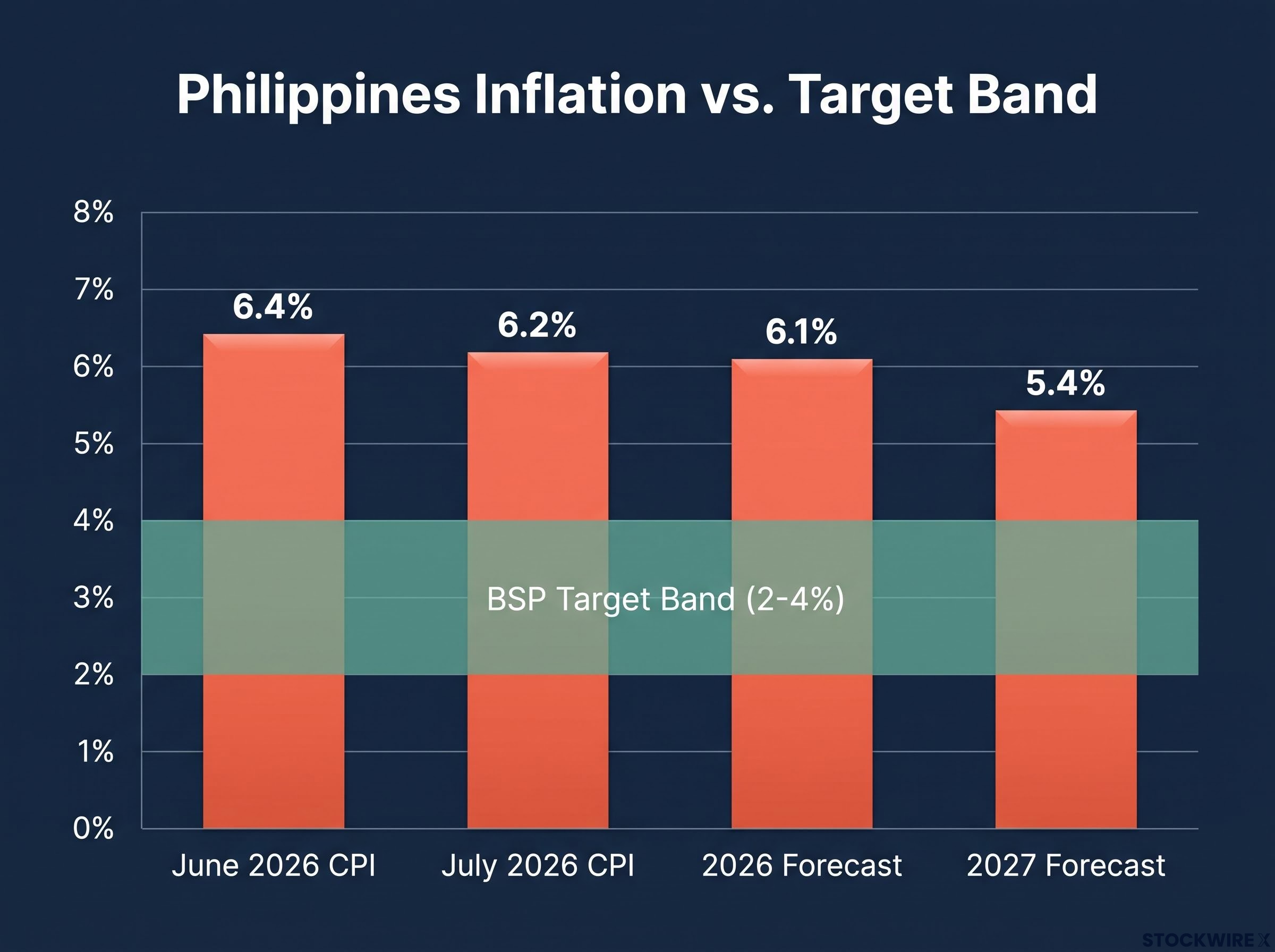
The BSP’s own post-meeting forecasts tell the rest of the story. It projects inflation at 6.1% for 2026 and 5.4% for 2027. That 2027 figure still sits above the top of the target band. Even on the central bank’s own numbers, inflation normalisation will extend well into next year, and the policy task is far from complete.
BSP Governor Eli Remolona characterised the August move as pre-emptive, signalling that the Monetary Board would rather act early and decisively than chase inflation after it becomes entrenched.
| Metric | Value | Significance |
|---|---|---|
| BSP overnight RRP rate (post-27 August) | 5.0% | Third consecutive 25 bp hike; highest since cycle began |
| July 2026 CPI | 6.2% | Still 2.2 percentage points above the target ceiling |
| June 2026 CPI | 6.4% | Marginal improvement, not a trend reversal |
| BSP 2026 inflation forecast | 6.1% | Full-year above-target inflation expected |
| BSP 2027 inflation forecast | 5.4% | Normalisation extends beyond 2026 even in base case |
| Cumulative tightening since April 2026 | 75 bp | Three moves in four months signals urgency |
When big ASX news breaks, our subscribers know first
What central bank rate hikes actually do to currencies and inflation
The instinct is straightforward: higher interest rates make a currency more attractive, money flows in, the currency strengthens. That instinct is correct, but it is incomplete.
Here is the mechanism. When the BSP raises rates, peso-denominated assets (government bonds, deposit accounts, money-market instruments) offer better yields. For foreign investors comparing returns across emerging markets, the improved carry, the extra yield earned by holding peso assets rather than lower-yielding alternatives, draws capital inflows. Those inflows create demand for the peso, supporting its value.
The overnight reverse repurchase (RRP) rate, the BSP’s primary policy tool, now sits at 5.0%. The full interest rate corridor runs from 4.5% (the overnight deposit facility) to 5.5% (the overnight lending facility). That corridor sets the floor and ceiling for short-term borrowing costs across the Philippine financial system.
But the transmission from rate hike to currency stability depends on three conditions:
- The rate differential relative to peers. If the US Federal Reserve is on hold or cutting while the BSP stays at 5.0%, the gap narrows in the peso’s favour. That configuration is actually more supportive than it sounds, because the differential is moving in the right direction.
- Global risk appetite. In a risk-on environment, investors seek yield in emerging markets. In risk-off episodes, they flee to US Treasuries and the dollar regardless of rate differentials.
- Commodity price trajectory. The Philippines imports a large share of its fuel and food. A renewed spike in global commodity prices can sustain domestic inflation even with tight monetary policy, because the inflation is being imported rather than generated domestically.
DBS Group Research economists Radhika Rao and Chua Han Teng framed the BSP’s 2026 stance as front-loaded, pre-emptive tightening, a description that captures the central bank’s intent to act decisively early rather than incrementally later.
When the rate-currency link breaks down
The primary mechanism that overrides BSP’s rate support for the peso is a global dollar-strength episode. When investors globally move into safe-haven assets, the US dollar benefits from capital flows that no emerging-market rate differential can offset. The Philippines’ commodity import exposure compounds the problem: a stronger dollar makes oil and food imports more expensive in peso terms, feeding back into the very inflation the BSP is trying to contain.
Is 5.0% the ceiling, or is there more to come?
The market is split, and the split is genuine rather than cosmetic.
The base case among several institutions treats 5.0% as the terminal rate, the peak of the cycle, assuming inflation moderates gradually from here. The logic is that 75 basis points of cumulative tightening since April, combined with the lagged effect of prior hikes, should begin pulling inflation lower through the second half of 2026.
On the other side, DBS Bank (led by Radhika Rao) has kept the door open to a further 25 basis point increase before the year closes, contingent on inflation remaining stubbornly above target. Their framing treats the August move as necessary but not necessarily final.
Governor Remolona threaded the needle in his post-meeting communication: the August hike was pre-emptive, he hopes no further action is needed, but the BSP remains open to additional tightening if the data demands it. That is not ambiguity; it is deliberate optionality.
The key insight is not which forecast turns out to be correct. It is that the BSP’s own language has preserved maximum flexibility. Every monthly CPI print between now and the next Monetary Board meeting is a rate-path signal worth reading carefully.
Three data variables will shape whether the cycle is over or has further to run:
- Monthly CPI prints relative to the BSP’s 6.1% full-year 2026 forecast: consistently below that pace supports the terminal-rate view; prints that match or exceed it keep additional hikes alive
- Peso and FX stability: renewed peso weakness would increase pressure for further tightening regardless of the inflation trajectory
- GDP growth data: a sharper-than-expected slowdown could force the BSP to weigh the growth cost of additional hikes against the inflation benefit
If you hold Philippine bonds or rate-sensitive equities, the policy path is genuinely open-ended. Pricing in a definitive pause may leave your portfolio exposed if inflation proves stickier than the base case assumes.
What this tightening cycle means across asset classes
The macro picture translates into specific, and sometimes opposing, dynamics across Philippine asset classes.
Fixed income is the most mechanically straightforward. Existing bonds with lower coupons face mark-to-market pressure as yields reset higher. But the other side of that coin matters more for forward positioning: new issuances now carry better yields than anything available at the start of the year. The cumulative 75 basis points of tightening since April has meaningfully improved the entry level on peso-denominated bonds. The tactical preference while policy uncertainty persists is short-to-intermediate maturities, which limit mark-to-market volatility if an additional hike materialises.
Equities and FX: winners, losers, and the peso question
Equities split along clear lines. Banks benefit from wider net interest margins (the gap between what they charge borrowers and what they pay depositors) as lending rates reset higher faster than deposit costs. That margin expansion is most pronounced in the early stages of a tightening cycle, which is where the Philippines sits now.
On the other side, highly leveraged real estate developers, utilities, and consumer companies with significant floating-rate debt face higher interest expenses that compress earnings. Domestic demand plays also feel the squeeze as tighter financial conditions and elevated inflation weigh on consumer purchasing power.
The peso receives modest support from the hike. If the Fed is on hold while the BSP stays at 5.0%, the rate differential favours the peso. But this is not a one-way trade. Global dollar-strength episodes can overwhelm the positive differential, and the Philippines’ commodity import exposure means external price shocks transmit quickly into domestic costs.
The overseas Filipino worker (OFW) and remittance dimension adds a socioeconomic layer. A stronger or more stable peso means each unit of foreign currency remitted converts into fewer pesos, reducing near-term purchasing power for remittance-receiving households. The medium-term trade-off, however, favours stability: if the BSP successfully contains inflation, recipients benefit from more predictable domestic prices and economic conditions.
One important nuance: this hike was widely anticipated and well telegraphed. Strong pre-meeting consensus means equity markets likely absorbed most of the impact before 27 August. The incremental risk now is not the hike itself but whether the policy path turns more hawkish than what is currently priced.
| Asset Class | Near-Term Outlook | Key Risk | Positioning Consideration |
|---|---|---|---|
| Philippine Bonds | Higher yields offer better entry levels on new issuances | Further hikes compress existing bond prices | Favour short-to-intermediate maturities |
| Philippine Equities (Banks) | Net interest margin expansion supports earnings | Growth slowdown weighing on credit quality | Tilt toward well-capitalised financials |
| Philippine Equities (Rate-Sensitive) | Higher borrowing costs compress margins | Sustained tightening beyond 5.0% deepens pressure | Remain cautious on leveraged real estate and utilities |
| Philippine Peso (FX) | Modestly supported by improved rate differential | Global risk-off episodes overwhelming the differential | Size positions for possible dollar-strength episodes |
Risks that could upset the positioning framework
Four risks deserve a place on your monitoring checklist over the coming quarter:
- Stubborn or re-accelerating inflation forcing further hikes beyond what markets price, triggering sharper repricing in bonds and rate-sensitive equities
- A growth slowdown deeper than expected, weighing on corporate earnings and credit quality across the Philippine market
- Global risk-off episodes driving investors into US Treasuries and the dollar, overwhelming the rate-differential support for the peso
- A renewed commodity price shock, particularly oil, feeding back into domestic CPI and keeping the BSP on a tightening footing even at already elevated rates
These are not predictions. They are the variables that, if they move against the base case, would force a material reassessment of positioning across Philippine assets.
Reading the next chapter before the data arrives
The BSP has front-loaded tightening to address both inflation and the peso simultaneously. Its own forecast trajectory, 6.1% in 2026 and 5.4% in 2027, tells you normalisation is a multi-year project, not a near-term event. The dual-mandate pressure does not ease simply because rates are higher; it eases when the data confirms that higher rates are working.
Three variables give you a structured way to update your own read as each data point arrives:
- Monthly CPI relative to 6.1%: prints consistently below pace support a terminal rate at 5.0%; prints that match or exceed it keep further tightening on the table
- Peso stability: sustained weakness would force BSP’s hand regardless of the inflation trajectory
- GDP growth: a sharper slowdown raises the cost-benefit question of further tightening and could shift the Monetary Board’s calculus
The broader analytical lesson extends beyond the Philippines. The BSP cycle is a live case study in how emerging-market central banks manage the tension between imported inflation, currency defence, and growth support. The framework you use to interpret BSP’s next move applies equally to central banks across Southeast Asia and the broader emerging-market universe.
This article is for informational purposes only and should not be considered financial advice. Investors should conduct their own research and consult with financial professionals before making investment decisions. Past performance does not guarantee future results. Financial projections are subject to market conditions and various risk factors.