Every currency in Southeast Asia’s six largest economies is strengthening against the US Dollar this quarter. Every currency except one.
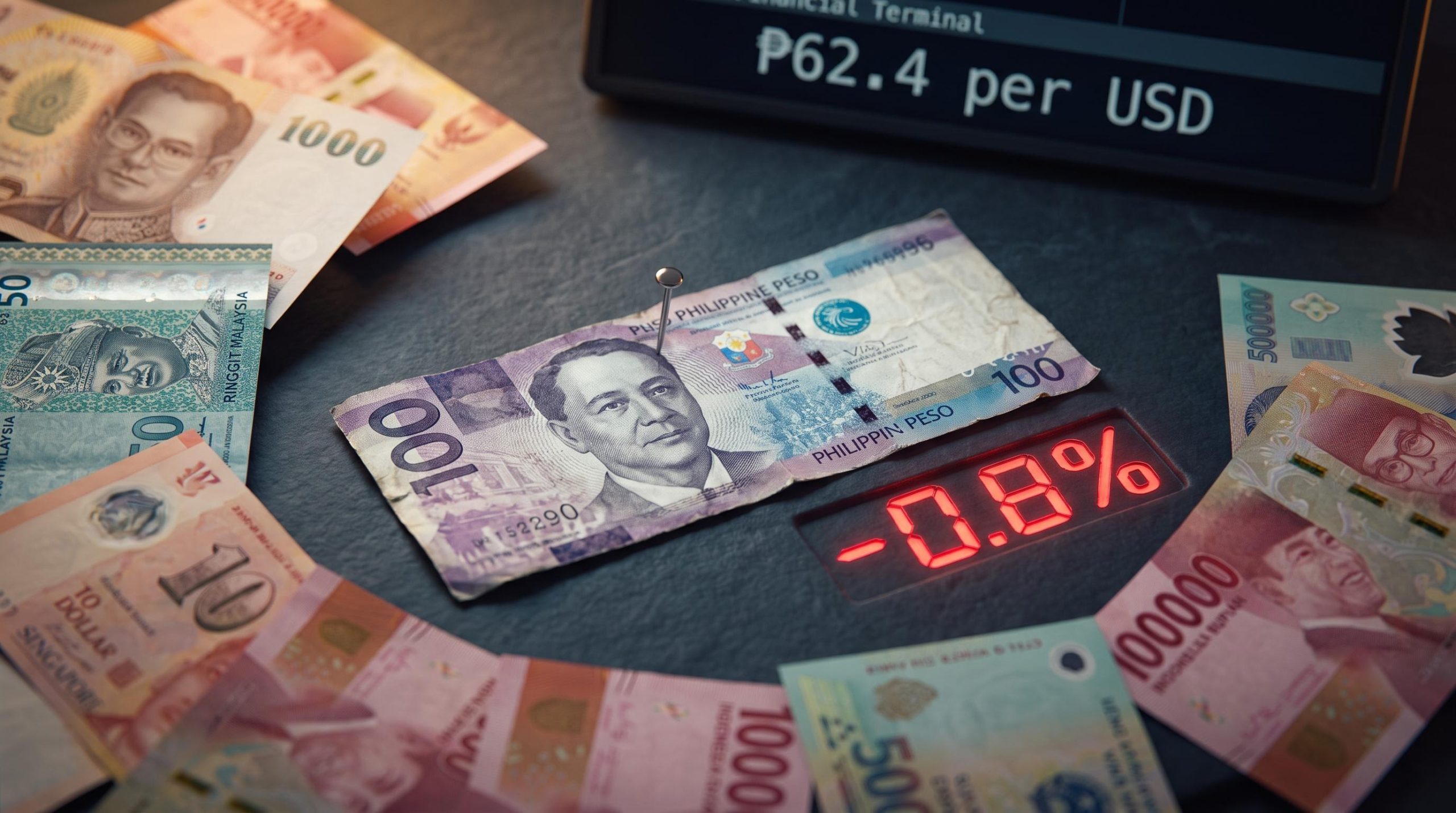
Alone among its ASEAN-6 peers, the Philippine Peso has shed around 0.8% against the Dollar since the start of Q3, even as the other five regional currencies have each posted gains of 0.9% to 1.7% over the same period. The Peso is now hovering near record lows around ₱62.2-62.4 per US Dollar, and the Bangko Sentral ng Pilipinas (BSP) has hiked rates three times since April without arresting the slide.
That divergence is the signal. When a single currency weakens against a backdrop of broad regional strength, the cause is domestic, not regional. And when rate hikes fail to provide support, the standard playbook for emerging market currency analysis is breaking down.
This is the framework for understanding why higher Philippine yields are a warning rather than an opportunity, and how to position your Southeast Asian exposure accordingly before Q4.
The stark Q3 performance gap across ASEAN-6 markets
The numbers leave no room for ambiguity. Through late August 2026, the five non-Philippine ASEAN-6 currencies, the Thai Baht, Malaysian Ringgit, Indonesian Rupiah, Singapore Dollar, and Vietnamese Dong, have each posted gains of 0.9% to 1.7% against the US Dollar. The Peso, alone, has moved in the opposite direction.
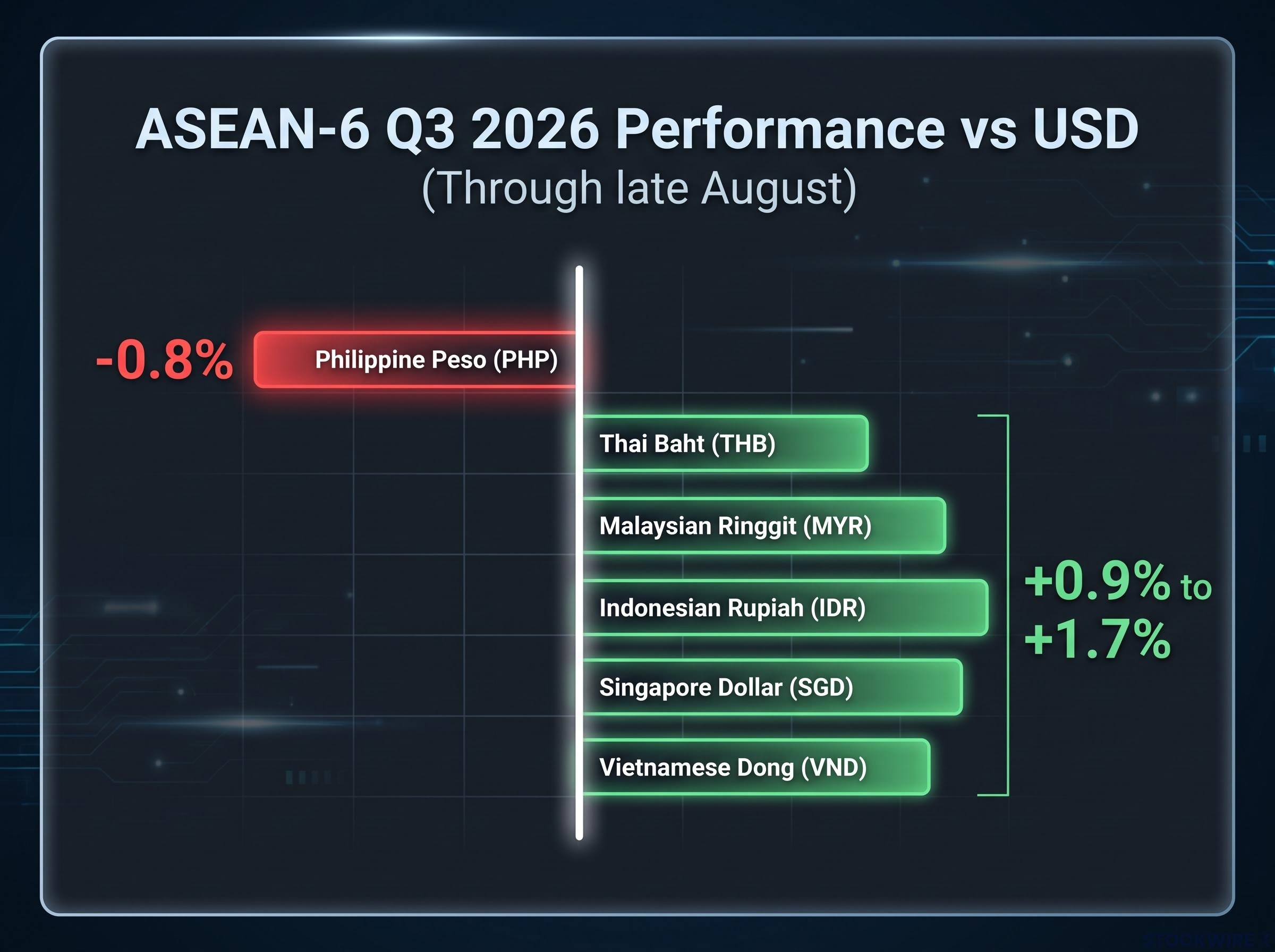
| Currency | Q3 2026 Movement vs USD | Central Bank Stance |
|---|---|---|
| Philippine Peso (PHP) | −0.8% | Active tightening cycle |
| Thai Baht (THB) | +0.9% to +1.7% | Holding steady |
| Malaysian Ringgit (MYR) | +0.9% to +1.7% | Holding steady |
| Indonesian Rupiah (IDR) | +0.9% to +1.7% | Holding steady |
| Singapore Dollar (SGD) | +0.9% to +1.7% | Holding steady |
| Vietnamese Dong (VND) | +0.9% to +1.7% | Holding steady |
According to DBS Group Research economists Radhika Rao and Chua Han Teng, most ASEAN-6 central banks are forecast to keep policy rates unchanged through the rest of 2026, with the Philippines standing apart as the one market where above-target inflation keeps another rate increase on the table. That distinction matters: regional peers are delivering currency appreciation without additional rate hikes, while the Philippines is hiking aggressively and still losing ground.
What this tells you is that broad Southeast Asian exposure strategies will not mask your Philippine-specific downside. A regional basket trade that worked in Q1 and Q2 is now carrying a currency-level drag that requires individual risk management.
Regional currency divergence within Asia is not a uniform phenomenon: while the Korean won has rallied sharply on semiconductor investment inflows and a credible Bank of Korea rate hike, the Peso is weakening for structurally opposite reasons, confirming that broad ASEAN basket exposure masks meaningfully different country-level risk profiles.
When big ASX news breaks, our subscribers know first
Why aggressive rate hikes are failing to provide support
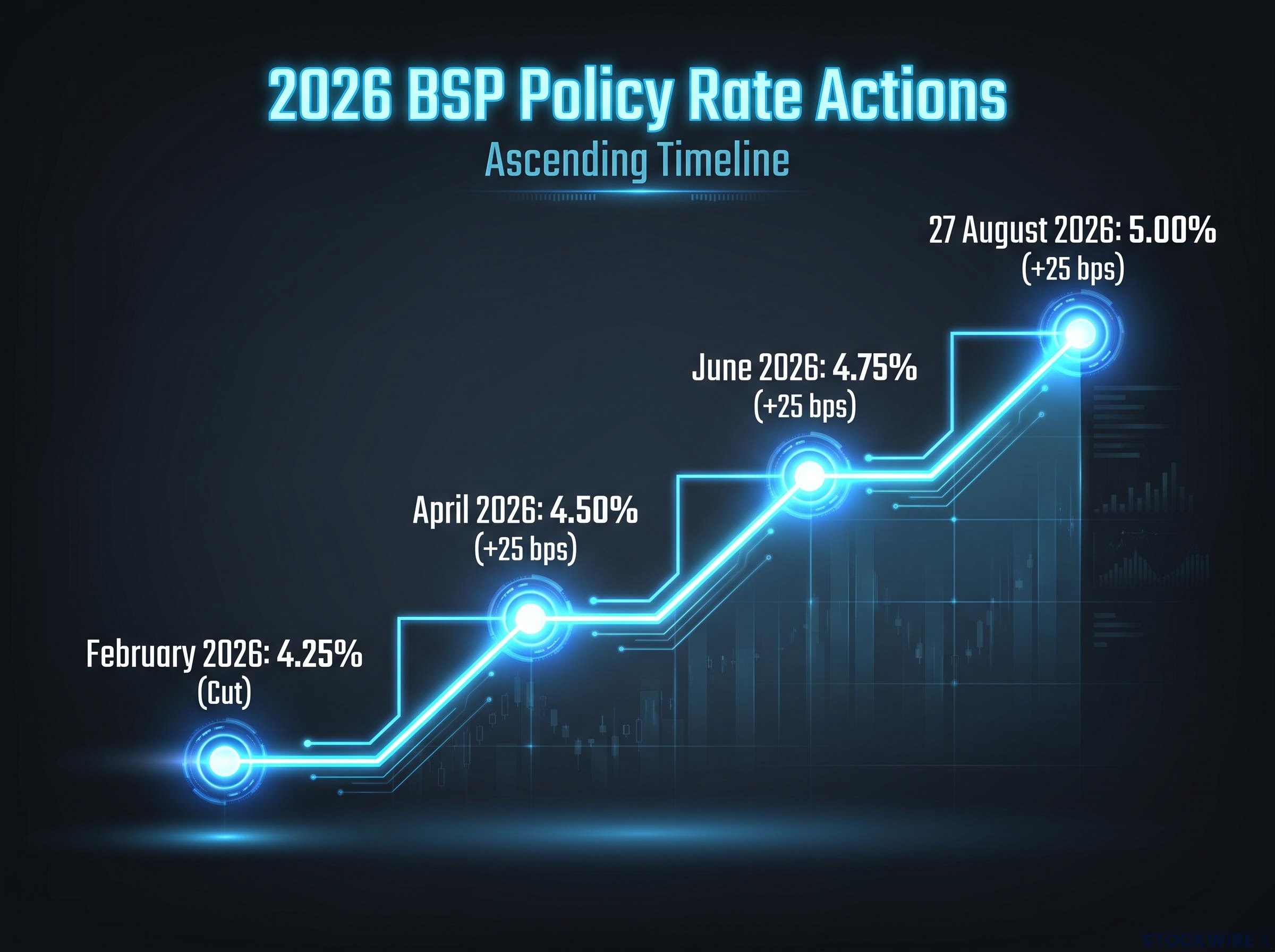
The BSP has raised its policy rate three times since April, pushing it from 4.25% to 5.00% by 27 August 2026. By any standard macro framework, that should be pulling capital into Peso-denominated assets and supporting the currency. It is doing neither.
The BSP’s August rate decision confirmed the third consecutive 25 basis point hike of 2026, lifting the benchmark overnight rate to 5.00%, alongside revised inflation forecasts of 6.1% for full-year 2026 and 5.4% for 2027, both well above the 2-4% target band the central bank is mandated to defend.
The carry trade problem
A carry trade is a strategy where investors borrow in a low-yielding currency and invest in a higher-yielding one, pocketing the difference. It works when two conditions hold: a meaningful yield advantage and a stable or appreciating target currency.
Carry trade dynamics in emerging market FX are governed by rate differential direction, funding currency trajectory, target currency valuation, and the quality of implied volatility signals; when any one of those variables moves against the position, the others cannot compensate, which is precisely the configuration the Peso is demonstrating in Q3.
The Philippines currently meets the first condition but fails the second. UOB Global Economics & Markets Research projects the Peso could weaken to around ₱63 per Dollar before any stabilisation, meaning the currency depreciation would erode or exceed the yield pick-up. Investors chasing the higher policy rate are not collecting carry; they are subsidising currency losses.
| Date | Policy Rate | Action |
|---|---|---|
| February 2026 | 4.25% | Cut (tail end of easing cycle) |
| April 2026 | 4.50% | +25 bps hike |
| June 2026 | 4.75% | +25 bps hike |
| 27 August 2026 | 5.00% | +25 bps hike |
The reason this is happening sits in the inflation data. Headline inflation averaged 5.0% from January to July 2026, well above the BSP’s 2-4% target band. Core inflation, which strips out volatile food and energy prices, printed at 4.2% in July. That tells you price pressures are broad-based, not confined to a single commodity shock that will pass on its own.
When a central bank hikes rates to fight sticky inflation rather than from a position of economic strength, markets read the tightening as defensive. Rising yields in that context signal macro distress, not an attractive entry point. The Peso’s depreciation is functioning as part of the adjustment mechanism to elevated consumer prices, not a mispricing that rate hikes alone can correct.
Energy dependency and structural headwinds compounding the slide
The BSP’s inflation problem does not exist in a vacuum. Structural vulnerabilities specific to the Philippines are amplifying global shocks in ways that peer economies are better insulated against.
UOB’s analysis underscores the Philippines’ high reliance on imported oil and fuel, noting that this exposure makes the Peso particularly sensitive to global energy price swings and geopolitical developments. UOB explicitly expects the Peso to remain “weak” in Q3 2026 before stabilising as broader Asian foreign exchange markets recover.
That energy dependency means every spike in global oil prices flows directly into Philippine consumer prices, widening the trade deficit and forcing the BSP into further tightening that markets already view as reactive. The compounding pressures are stacking:
- Higher energy import costs feeding through to transport, electricity, and consumer goods prices
- El Niño disruptions with impacts expected to peak in late 2026, threatening agricultural output and food prices
- Domestic inflation pass-through reinforcing both headline and core readings, keeping the BSP locked into its hawkish stance
MUFG Global Markets Research notes that inflation has stayed above the target band for several consecutive months and emphasises “upside” risks linked to energy prices and El Niño effects. These are not temporary pressures. The BSP has revised its own inflation forecasts sharply higher, now projecting 6.1% for full-year 2026 and 5.4% for 2027, both well above the 2-4% target range.
End-of-Q3 forecasts from institutional desks range from ₱61.6 to ₱63 per Dollar, reinforcing the consensus that relief is not imminent.
Your portfolio’s exposure to Philippine assets is directly tied to global energy markets and climate events. Oil prices are a leading indicator for further Peso depreciation, and El Niño headlines in Q4 deserve the same attention as BSP rate decisions.
Calibrating your Southeast Asian currency exposure for Q4
The Q3 data distils into three distinct investment signals.
- The divergence is domestic, not regional. Other ASEAN-6 currencies have gained 0.9-1.7% while the Peso has fallen 0.8%. That 1.7-2.5 percentage point gap reflects Philippine-specific inflation, policy, and structural vulnerability, not a shared ASEAN headwind. Standard regional basket allocations will not hedge this risk.
EM local-currency bond positioning offers a structurally cleaner expression of Southeast Asian exposure than broad equity baskets, with direct FX appreciation, a carry yield near 6.9%, and domestically-driven yield curves that can partially insulate a portfolio from the country-specific currency drag the Peso currently represents.
- Inflation is the key variable to watch. Markets will focus on whether inflation credibly moves back toward the 2-4% target band and whether the BSP can eventually shift from tightening to a neutral stance without undermining growth. A convincing disinflation path would give the Peso room to realign with regional peers. Further upside inflation surprises, particularly from energy or El Niño, could extend the tightening cycle and prolong the currency’s underperformance. MUFG projects a potential terminal policy rate of 5.25% by year-end 2026.
- Near-term positioning will likely be cautious. UOB’s base case sees stabilisation only from Q4 onward, after the Peso potentially tests the ₱63 level. Until the BSP demonstrates a credible, sustained path back to its inflation target, tactically underweighting Peso exposure or employing targeted hedges on Philippine-denominated assets is the more defensible position.
This article is for informational purposes only and should not be considered financial advice. Investors should conduct their own research and consult with financial professionals before making investment decisions. Forward-looking statements regarding inflation, exchange rates, and central bank policy are subject to change based on market developments and macroeconomic conditions.
What this localised divergence means for emerging market allocations
The Philippine Peso’s Q3 isolation proves that local structural vulnerabilities currently outweigh regional tailwinds. A supportive Asian foreign exchange environment has lifted every peer currency; the Philippines is sinking regardless.
Yield alone is an insufficient metric for currency attractiveness when inflation remains unanchored. The BSP’s 5.00% policy rate looks generous on a spreadsheet. The 5.0% average inflation rate and the Peso’s record-low spot levels tell you that generosity comes with a cost that erodes the carry.
Dollar-weakness transmission to emerging market currencies is not automatic: BNY iFlow data showed all five major commodity currencies rotating to net selling within a week of the Fed’s dovish pivot, confirming that a softer dollar index is a necessary but insufficient condition for EM currency appreciation, a pattern the Peso’s Q3 isolation reinforces from the other direction.
Q4 2026 is the next decision point. If inflation begins a credible descent toward the 2-4% band and the BSP signals a pause, the Peso has room to recover alongside regional peers. If inflation stays sticky, the tightening cycle extends, and the divergence widens. Monitor the October and November inflation prints, the BSP’s next rate decision, and global oil markets. Those three inputs will determine whether this is a tactical underweight or a structural one.
—