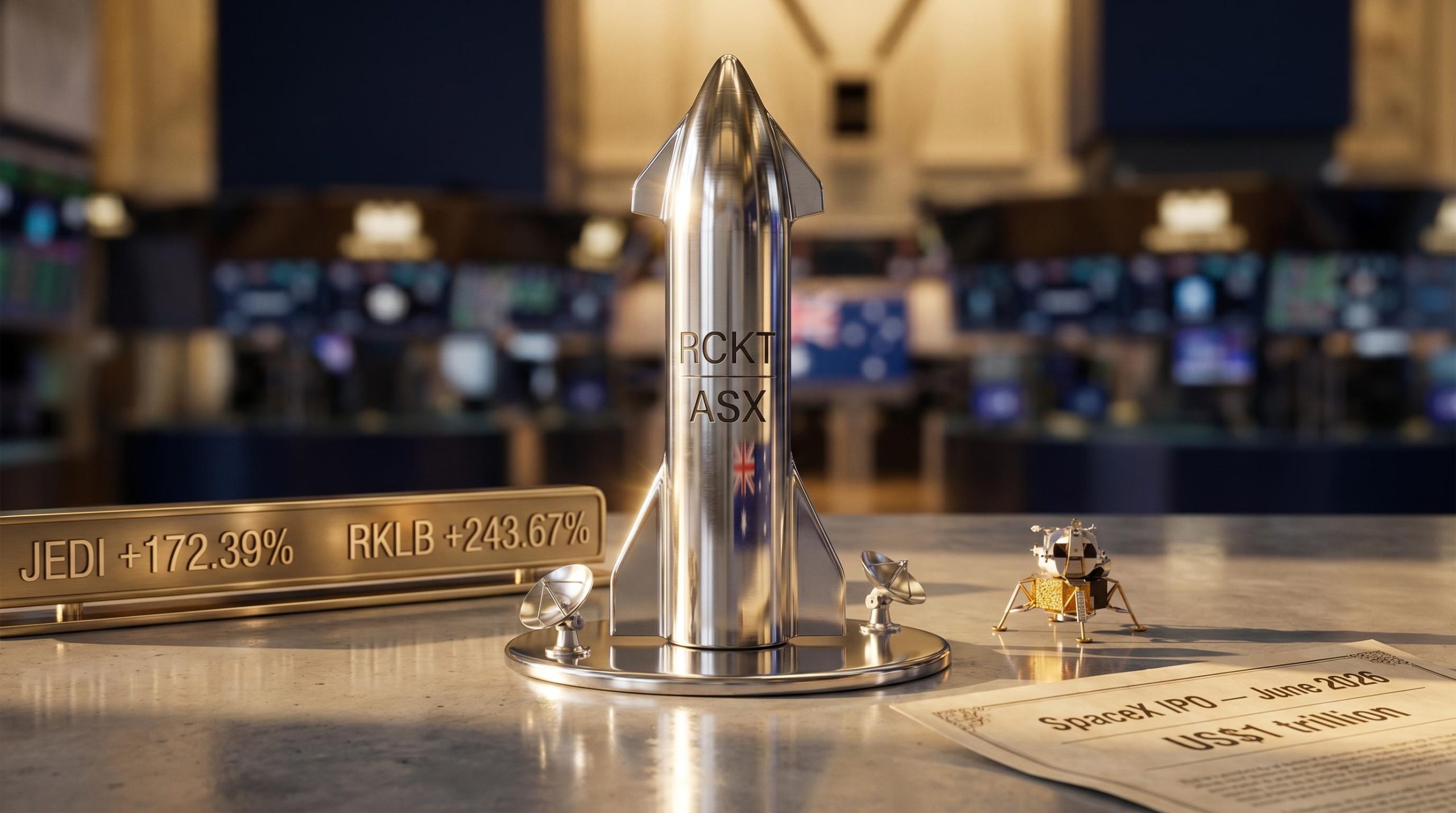
BetaShares is preparing to launch RCKT, Australia’s first space industry exchange-traded fund, on the ASX. The fund arrives weeks after SpaceX confidentially filed for what could become the largest initial public offering in history, with a target listing date of June 2026. For Australian investors who have tracked the commercial space sector’s acceleration from the sidelines, RCKT represents the first dedicated, ASX-listed vehicle to access the theme without navigating foreign exchanges. What follows covers the fund’s confirmed details, the SpaceX catalyst driving its timing, how comparable global space ETFs have performed, which stocks are likely to appear in the portfolio, and the specific risks that warrant attention before committing capital.
Australia’s first space ETF is heading to the ASX
No space-focused ETF has previously listed on the ASX. RCKT changes that.
BetaShares, the issuer behind existing thematic products spanning cybersecurity, cryptocurrency, uranium, and esports, has confirmed the fund as part of a deliberate expansion into emerging global themes. CEO Alex Vynokur has framed the launch around a “new era of commercial space exploration.”
International ETF inflows into Australian platforms tell the same story from a different angle: global equity ETFs attracted $17.3 billion in net flows through October 2025 compared with $10.6 billion into domestic Australian equity ETFs, and 65% of ETF investors identified global equities as their next intended purchase, figures that frame the commercial logic behind a space-sector fund timed to a landmark IPO filing.
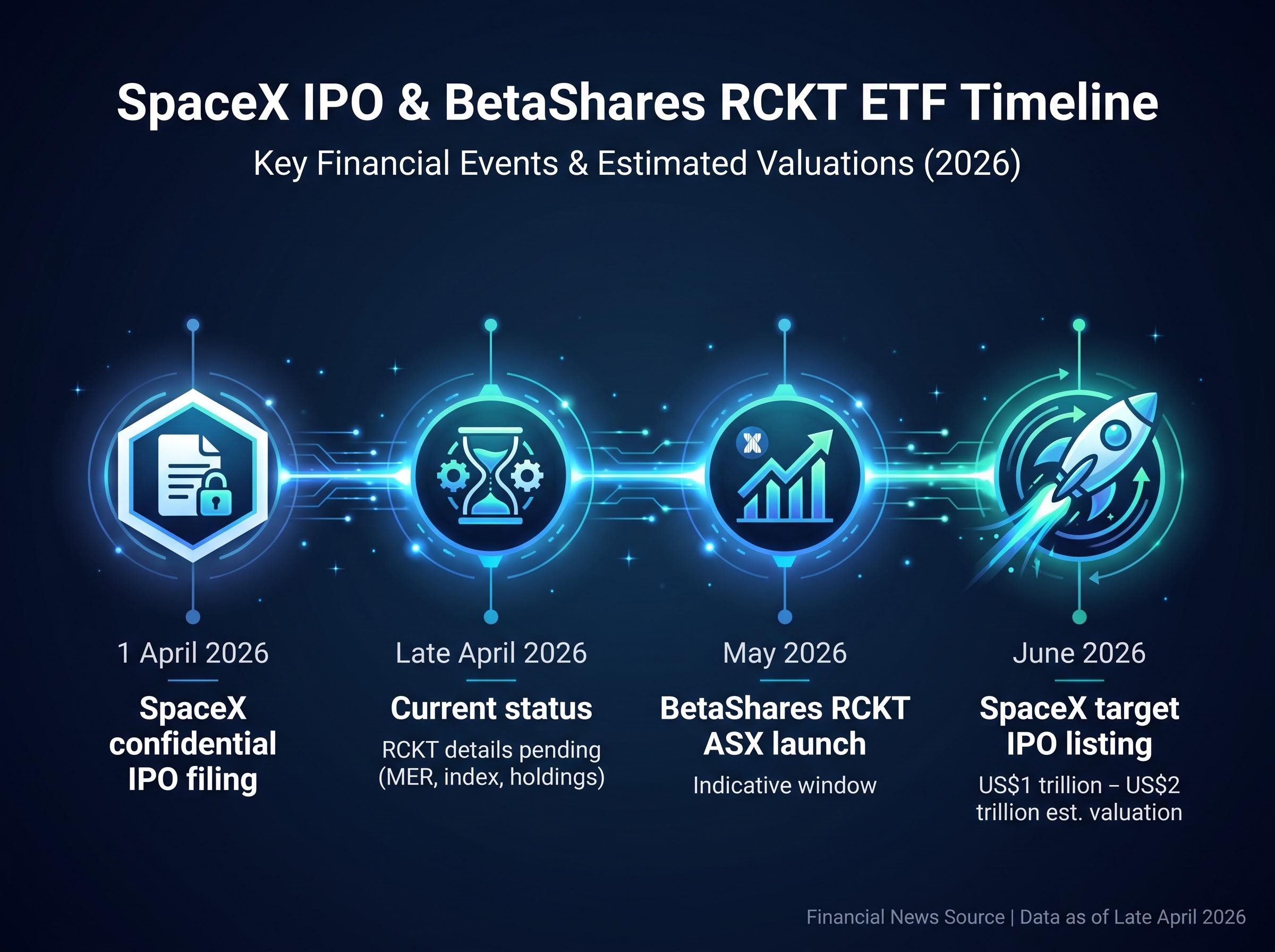
A specific listing date has not been confirmed as of late April 2026, though multiple sources point to a May 2026 launch window. Several details remain undisclosed:
- Ticker: RCKT
- Provider: BetaShares
- Asset class: Thematic equity ETF
- Indicative launch window: May 2026
- Disclosure status: No confirmed management expense ratio (MER), index methodology, or full holdings count released
The information gap matters. Investors considering an allocation on day one will be doing so without the full product disclosure that typically informs a positioning decision.
When big ASX news breaks, our subscribers know first
SpaceX’s IPO filing is the catalyst this fund is built around
RCKT’s timing is not coincidental. SpaceX confidentially filed for an IPO on 1 April 2026, targeting a June 2026 listing, a development that shifted the company’s public market debut from long-running speculation to active preparation.
The valuation expectations are staggering. Current estimates place SpaceX at over US$1 trillion, with some projections reaching as high as US$2 trillion. At either end of that range, the listing would represent the largest IPO in history.
A SpaceX IPO at current estimates could be valued at over US$1 trillion, potentially the largest public market debut in history.
SpaceX, led by Elon Musk and best known for its Starlink satellite internet service alongside its reusable rocket programme, is listed as a potential future RCKT holding contingent on a successful listing. BetaShares has explicitly positioned the fund to capture investor interest in the event.
If the IPO proceeds on schedule, it could reshape the composition and performance profile of any space-focused fund globally, including RCKT.
What the commercial space sector actually is, and why it is attracting capital now
Commercial space, as an investable category, refers to the ecosystem of private companies operating outside traditional government programmes. The sector spans several distinct segments:
- Launch services: Companies building and operating rockets for orbital and suborbital missions
- Satellite infrastructure: Operators deploying communication, imaging, and internet satellite constellations
- Lunar operations: Firms delivering payloads and conducting surface missions on the Moon
- Enabling technology: Suppliers of components, software, and ground systems that support space operations
The sector’s credibility rests on more than projections. Firefly Aerospace’s Blue Ghost Mission 1 completed a successful commercial moon soft landing on 2 March 2025, followed by 14 days of surface operations concluding on 16 March 2025. That milestone, now more than a year old, established a commercial operator’s ability to deliver on a mission profile previously reserved for government agencies.
Thematic ETFs like RCKT exist to solve a specific access problem: they allow retail investors to gain diversified exposure to an emerging sector without needing to select individual stocks listed on foreign exchanges. For Australian investors, the ASX listing removes the friction of currency conversion, international brokerage accounts, and unfamiliar regulatory environments.
How global space ETFs have performed, and what RCKT’s holdings may look like
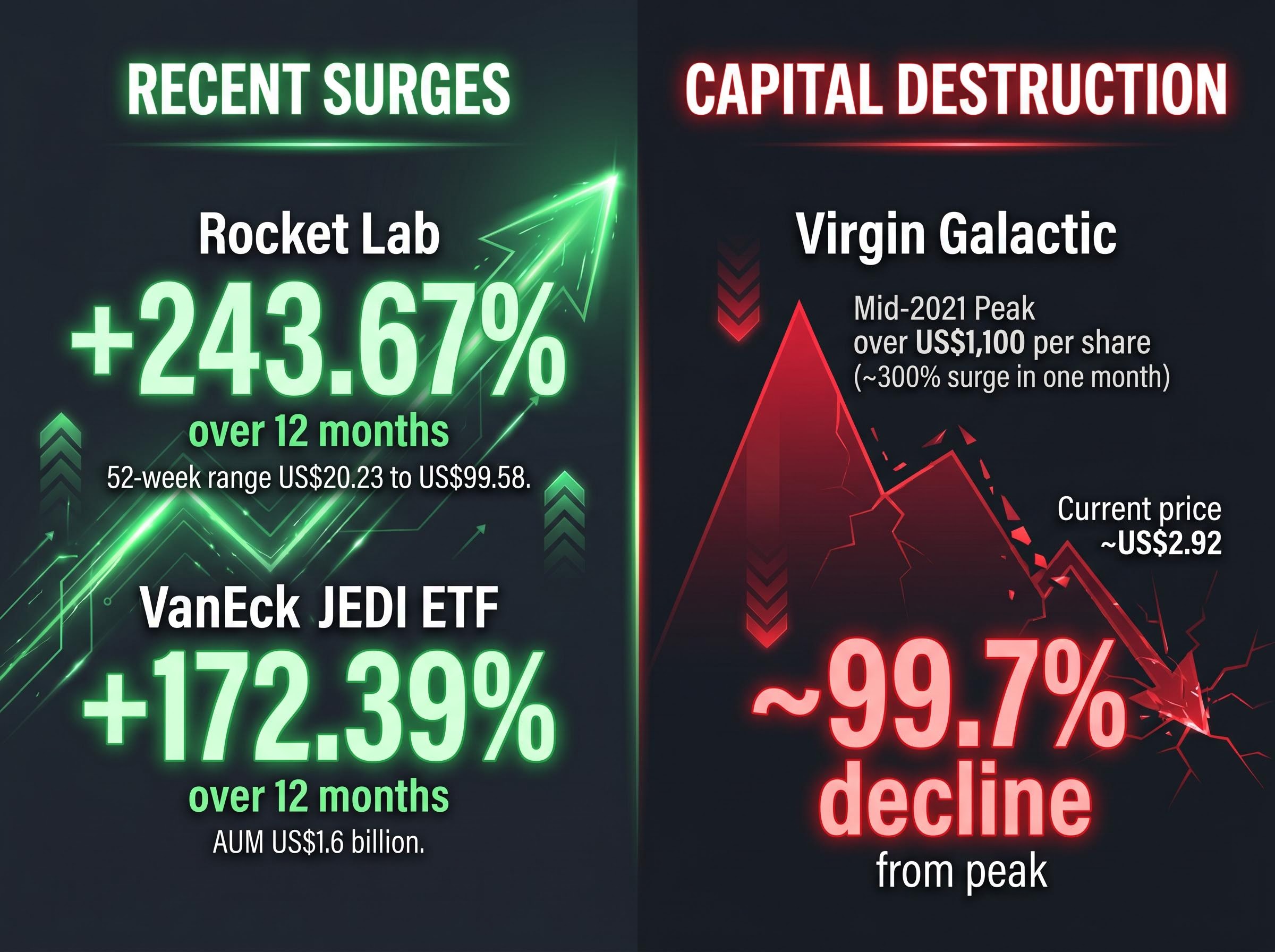
The numbers from comparable funds are difficult to ignore. The VanEck Space Innovators UCITS ETF (JEDI) returned +172.39% over the 12 months to late April 2026, with assets under management reaching US$1.6 billion.
| Fund Name | Ticker | Exchange | 12-Month Performance | AUM |
|---|---|---|---|---|
| VanEck Space Innovators UCITS ETF | JEDI | LSE / Xetra | +172.39% | US$1.6 billion |
| ARK Space Exploration & Innovation ETF | ARKX | NYSE | Not independently confirmed | Not available |
JEDI is primarily a European-listed product, and its availability to Australian retail investors has not been verified. ARKX, managed by ARK Invest, holds Rocket Lab and Teradyne but trades on the NYSE.
RCKT’s indicative holdings disclosed so far include:
- Rocket Lab
- EchoStar
- Firefly Aerospace
Rocket Lab alone has gained approximately +243.67% over the past 12 months, with a 52-week range of US$20.23 to US$99.58. Those returns provide calibration for the sector’s recent trajectory, though RCKT’s full holdings, MER, and tracked index remain undisclosed.
The risks Australian investors need to price in before launch day
Triple-digit returns make for compelling headlines. Virgin Galactic is a reminder of how quickly the narrative can reverse.
The stock surged approximately 300% in a single month during mid-2021, peaking at over US$1,100 per share. It now trades at approximately US$2.92, a decline of roughly 99.7% from its peak. The space sector’s capacity for spectacular destruction of capital is not hypothetical.
Valuations across the sector reflect similar tension. Rocket Lab trades at a revenue multiple of approximately 65.3x, based on a market capitalisation of roughly US$45 billion against roughly US$684 million in revenue. Thomas Rice, portfolio manager at Minotaur Capital, has expressed a preference for Firefly Aerospace over Rocket Lab on valuation grounds.
Cash runway dynamics in emerging deep-tech sectors follow a recognisable pattern: companies with compelling technology but limited revenue generation face recurring dilution risk as they raise capital to bridge development timelines, and the eVTOL sector in 2026 provides a live case study in how quickly liquidity stress can override narrative momentum for stocks trading on future milestones.
David Tuckwell, Chief Investment Officer at ETF Shares, has warned that SpaceX hype is driving speculation over fundamentals, with valuations across the sector requiring “planet-sized” growth to justify current pricing.
What investors still do not know about RCKT
Several pieces of information that would typically inform a buy decision remain unavailable as of late April 2026:
ASIC’s RG 282 disclosure requirements for ETPs establish what issuers must provide to retail investors before and at launch, including portfolio composition, fee structures, and index methodology, which is precisely the information that remains outstanding for RCKT as of late April 2026.
- Management expense ratio (MER)
- Tracked index and methodology
- Full holdings list and total number of positions
- Geographic concentration and weighting
Investors should monitor BetaShares’ dedicated RCKT product page and ASX lodgements for formal product disclosure before making any allocation decision.
What RCKT’s arrival signals about where Australian thematic investing is heading
RCKT is not an isolated product. It extends a pattern BetaShares has established across cybersecurity, cryptocurrency, uranium, and esports: identifying global thematic momentum and packaging it into ASX-accessible vehicles for Australian retail investors.
The SpaceX IPO filing, if it results in a June 2026 listing, would represent a structural inflection point for space-sector funds globally. A company valued at over US$1 trillion entering public markets would reshape index composition, fund flows, and the investable universe available to thematic products like RCKT.
Key dates and events to monitor:
- SpaceX IPO: Target listing June 2026
- RCKT launch window: Approximately May 2026
- Product disclosure: BetaShares’ RCKT page for MER, index methodology, and full holdings confirmation
The fund has not listed yet. Full product disclosure is pending. Current information should be treated as indicative only.
Eyes on the launchpad: RCKT arrives at a defining moment for space investing
Australia’s first space ETF arriving at the same moment as the world’s most anticipated IPO filing is not timing by accident. BetaShares has positioned RCKT to capture a specific window of investor attention, and the commercial space sector’s recent performance provides the backdrop.
Three things merit attention. The structural opportunity in commercial space is real, anchored by operational milestones and accelerating private investment. The valuation and disclosure risks are equally real, with sector pricing that demands sustained, exceptional growth. And the near-term calendar, spanning the SpaceX IPO target, RCKT’s launch, and formal product disclosure, will determine whether the fund’s thesis holds.
Investors who wait for the full product disclosure statement before acting will be better equipped than those who chase the ticker on day one.
For investors who want to understand how RCKT fits within a broader ASX ETF portfolio rather than as a standalone allocation, our dedicated guide to ASX ETF selection across income, diversification, and liquidity categories examines six established funds and the portfolio construction logic that determines how much thematic exposure is appropriate alongside more defensive positions.
This article is for informational purposes only and should not be considered financial advice. Investors should conduct their own research and consult with financial professionals before making investment decisions. Past performance does not guarantee future results. Financial projections are subject to market conditions and various risk factors.