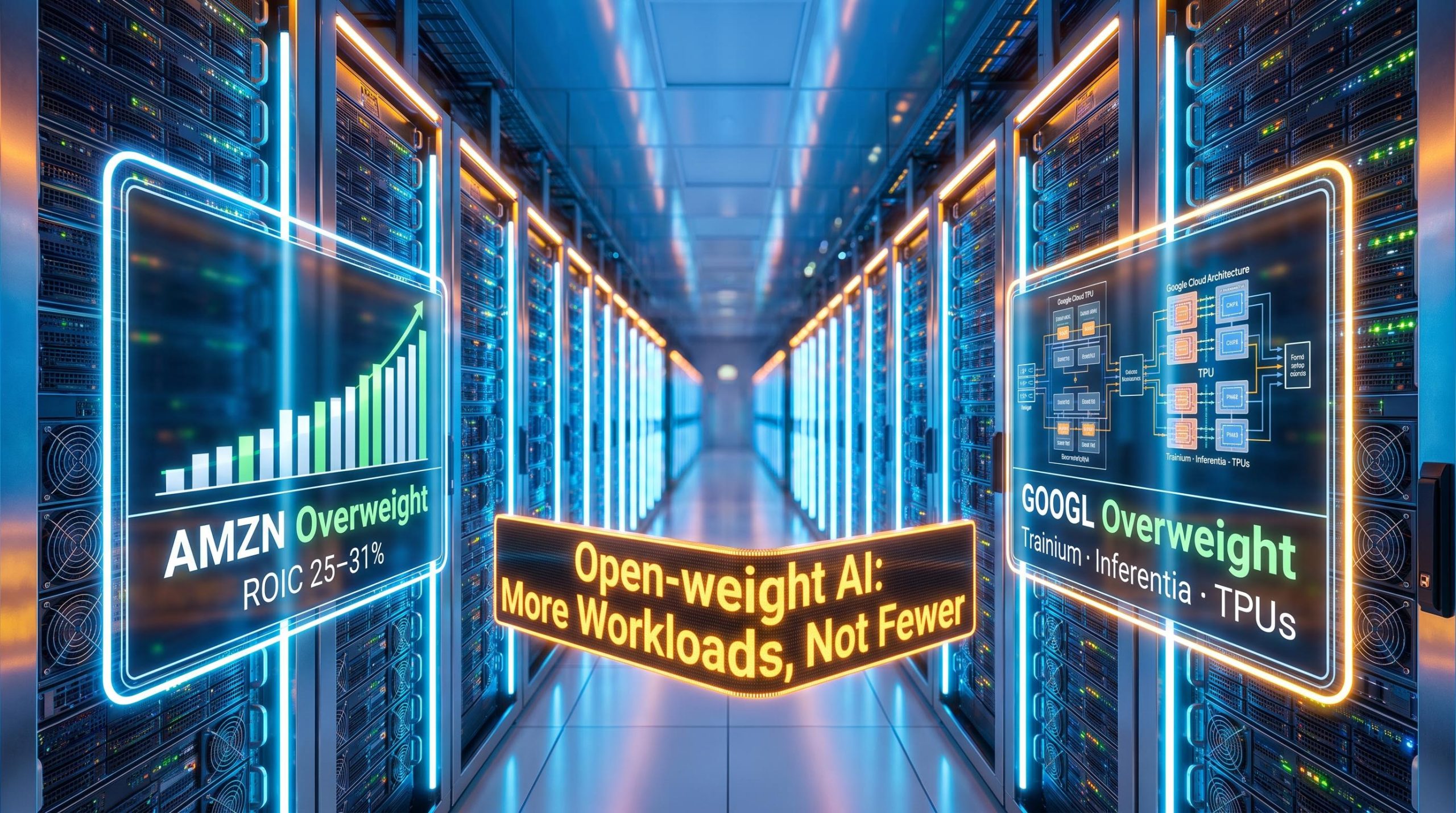
Morgan Stanley reaffirmed Overweight ratings on both Amazon (NASDAQ: AMZN) and Alphabet (NASDAQ: GOOGL) on 15 August 2026, and the argument goes beyond the observation that AI spending is rising. The firm’s thesis is that the cheapest models in the market are actively working in these two companies’ favour.
Open-weight AI models are proliferating, and the conventional worry is that free or near-free model weights will commoditise the AI stack and compress margins across the cloud sector. Morgan Stanley’s analysis inverts that assumption. Lower model costs expand total compute demand rather than shrinking it, and both Amazon and Alphabet are structurally positioned to capture that expansion through proprietary chips, adjacent cloud services, and sheer infrastructure scale.
Here is the framework Morgan Stanley built around four specific advantages, what they mean for AMZN and GOOGL individually, which products to watch as live tests of the thesis, and where the real risks sit for investors thinking about adding exposure.
Why open-weight AI is not the threat investors feared
The prevailing concern runs like this: if model weights are free, enterprises need less expensive cloud compute, and hyperscaler revenue growth slows. It is a clean, logical narrative. It is also, according to Morgan Stanley, built on a static demand assumption the data does not support.
Open-weight model proliferation from Chinese developers, including Kimi K3’s frontier-class performance at approximately $3 per million input tokens, is the specific competitive dynamic that makes Morgan Stanley’s price-elasticity argument timely rather than theoretical.
The firm’s counter-argument rests on price elasticity. When model costs fall, the total revenue pool does not simply contract; rather, AI becomes financially practical for a far broader set of applications, pulling more workloads onto hyperscaler infrastructure than would otherwise exist. Because volume rises alongside falling per-unit prices, aggregate profit growth can outpace what margin percentages alone would indicate.
The loss-leader logic: Morgan Stanley frames low-cost model access as an entry point that draws enterprises into broader cloud spending stacks, covering storage, databases, networking, and security, where margins are materially higher than on compute alone.
The implication for investors is that the “open-weight kills cloud” narrative assumes demand is fixed. Morgan Stanley’s thesis gives you a concrete mechanism for why it is not: cheaper tokens create more workloads, and those workloads sit inside a monetisation stack far wider than inference alone.
When big ASX news breaks, our subscribers know first
How hyperscaler economics stay attractive as model costs fall
Compute scarcity and proprietary chip economics
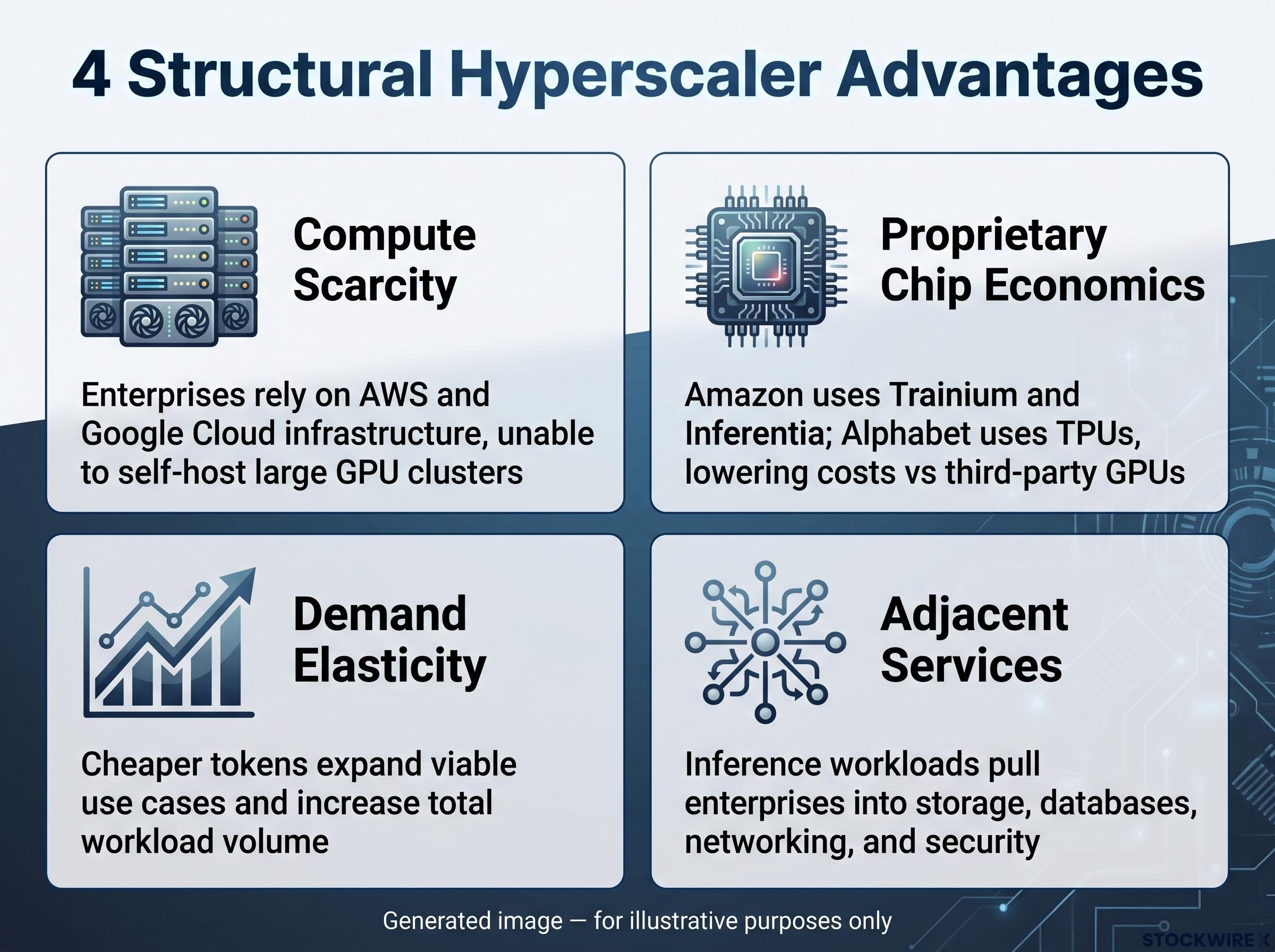
Even when model weights are freely available, most enterprises cannot build and operate their own large GPU clusters. They depend on public cloud infrastructure. That compute scarcity keeps hyperscalers in a structurally advantaged position, with estimated returns on invested capital (ROIC) for GPU rental in the approximate range of 25-31%.
Both companies are widening that advantage through proprietary silicon. Amazon deploys its Trainium and Inferentia chips while Alphabet relies on tensor processing units (TPUs), custom silicon built specifically for AI workloads, and both cut the expense of providing compute capacity to customers relative to relying on third-party GPUs. Competitors relying on third-party GPUs face a structural cost gap that would take years and billions of dollars to close.
Both companies are widening that advantage through custom AI chips designed specifically for inference and training workloads, with Broadcom’s $4.1 billion Q1 2025 AI semiconductor revenue confirming the market is already operating at material scale.
Demand elasticity and the adjacent services flywheel
When inference tokens become cheaper, the effect is not simply to sustain existing workloads at lower cost. Reduced pricing brings entirely new categories of AI applications within commercial reach, which pushes the aggregate volume of workloads running across hyperscaler infrastructure materially higher. Morgan Stanley highlights this price-elasticity dynamic as the mechanism through which both companies grow aggregate profits even as per-unit pricing falls.
Those inference workloads then function as an entry point into adjacent, higher-margin services. AI does not run in isolation; it sits inside a broader stack of storage, databases, networking, and cybersecurity. Hyperscalers monetise deeply across all of those layers.
| Advantage | Mechanism | Amazon/Alphabet Asset |
|---|---|---|
| Compute scarcity | Enterprises cannot self-host large GPU clusters; reliance on public cloud persists | AWS infrastructure; Google Cloud infrastructure |
| Proprietary chip economics | Custom silicon lowers cost of delivering compute vs third-party GPUs | Trainium, Inferentia (Amazon); TPUs (Alphabet) |
| Demand elasticity | Cheaper tokens expand viable use cases, increasing total workload volume | AWS and Google Cloud pricing flexibility |
| Adjacent services flywheel | Inference workloads pull enterprises into storage, databases, networking, security | Full AWS and Google Cloud service stacks |
For investors, these four advantages collectively mean that both companies have built structural positions that competitors would need years and billions of dollars to replicate. That is what justifies paying for durable earnings power rather than treating these as momentum trades.
Key products to monitor as early indicators of the thesis
Watching Meta’s Muse for enterprise deployment patterns
Meta Platforms’ (NASDAQ: META) Muse model family is positioned as open-weight and multimodal, with permissive licensing that lets enterprises download and run the weights wherever they choose. That makes Muse a direct test case for the on-cloud versus on-prem question at the heart of Morgan Stanley’s thesis.
- What to watch: Where Muse inference workloads land, specifically whether enterprise adoption runs predominantly on AWS or Google Cloud, or migrates to on-prem and sovereign infrastructure.
- Why it matters: If Muse workloads concentrate on hyperscaler clouds, it is early empirical confirmation that open weights expand cloud demand rather than shifting it elsewhere.
- What a positive signal looks like: Growing Muse-related compute consumption on AWS and Google Cloud in quarterly disclosures or third-party usage data.
Watching Gemini Flash for TPU-to-pricing translation
Alphabet’s Gemini Flash is explicitly positioned for coding, agents, and web and app workflows, and is becoming a benchmark in comparisons against open-weight alternatives.
- What to watch: Speed improvements, cost per token, and throughput metrics across Gemini Flash iterations.
- Why it matters: These metrics are the direct translation layer between Alphabet’s TPU investment and competitive inference pricing that wins enterprise workloads.
- What a positive signal looks like: Gemini Flash consistently matching or beating open-weight alternatives on cost per token while maintaining quality benchmarks.
If Muse adoption predominantly runs on public clouds rather than on-prem, that is confirmation. If it migrates to sovereign or edge infrastructure, that is your first signal to reassess the position.
What the thesis means specifically for AWS and Google Cloud
Morgan Stanley does not treat AMZN and GOOGL as a single undifferentiated hyperscaler trade. The bull cases are distinct.
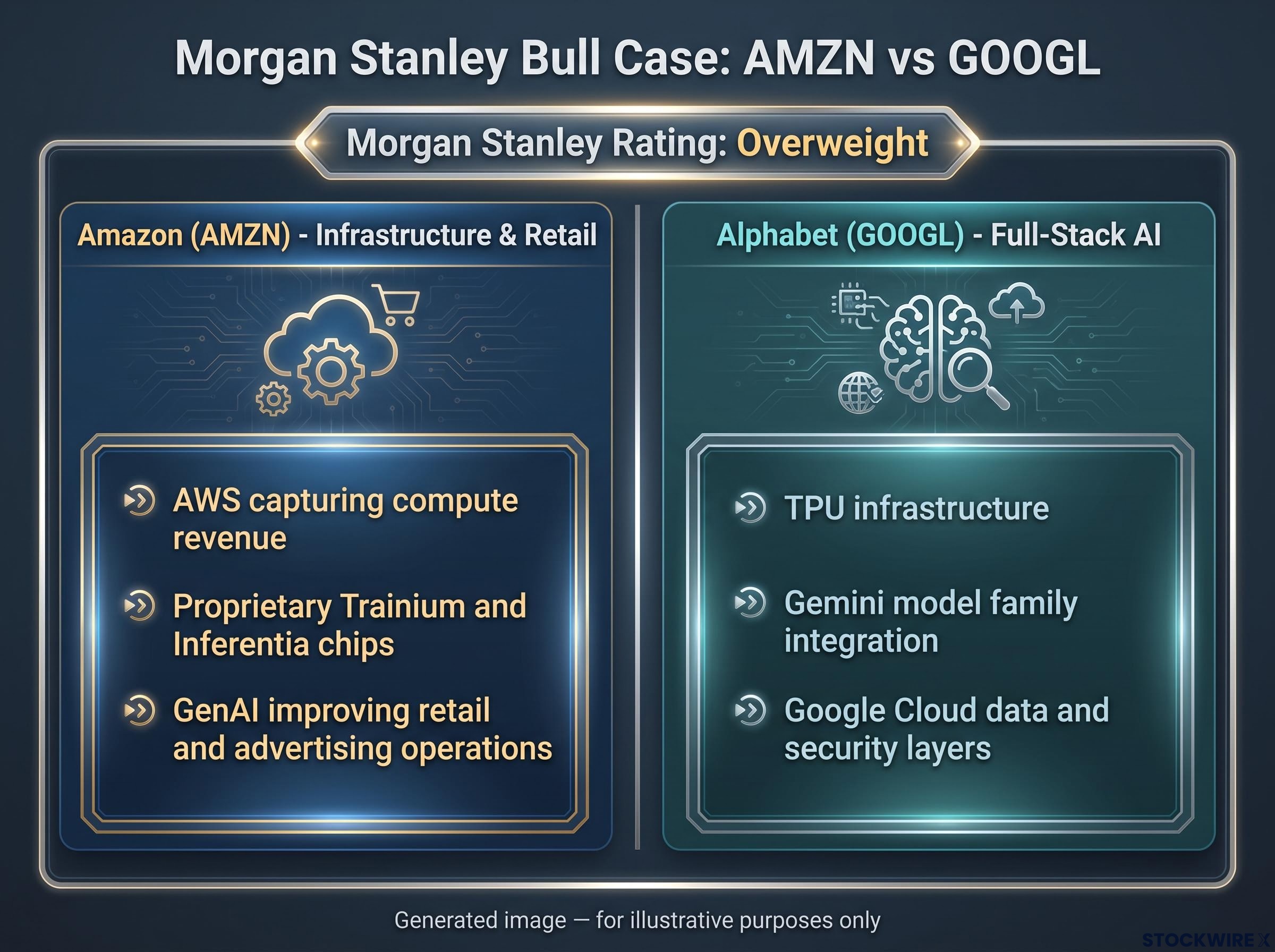
For Amazon, the thesis centres on AWS as the primary earnings driver, with AI workloads and proprietary chip cost advantages generating expected upside. Morgan Stanley also flags an under-appreciated angle: GenAI is improving Amazon’s own retail and advertising operations, using the same infrastructure to sharpen recommendations, logistics, and campaign performance.
For Alphabet, Morgan Stanley characterises the company as a “full-stack AI winner,” combining TPU infrastructure, the Gemini model family, and Google Cloud’s data and security layers. Product launches through 2026 are expected to deepen enterprise lock-in across that stack.
The Google Cloud backlog reached $460 billion in Q1 2026, with operating margins expanding from approximately 18% to 32.9% in a single quarter, giving the full-stack AI platform argument quantitative grounding beyond model benchmarks.
The cross-model thesis ties them together:
- Amazon offers infrastructure-and-retail optionality, where AWS captures compute revenue and the retail and advertising businesses benefit from the same AI capabilities.
- Alphabet offers full-stack AI platform concentration, where TPUs, Gemini, and Google Cloud form an integrated offering that deepens with each product cycle.
Regardless of whether enterprises choose closed, open, or hybrid model architectures, training and inference still flow through these two companies’ infrastructure. That means the investment case does not depend on any single model family winning.
Where the thesis can break down
Morgan Stanley’s thesis is not risk-free. Four specific pressure points deserve attention, each with a clear mechanism for how it would damage the case.
- GPU supply normalisation: If supply expands faster than demand or new architectures sharply increase efficiency, hyperscaler pricing power and the 25-31% ROIC range compress. This is the primary structural risk.
- Competitive pressure: Microsoft, specialised GPU clouds, colocation providers, and regional sovereign cloud operators all compete for open-weight inference workloads, particularly in regulated or latency-sensitive markets.
- On-prem and edge migration: If open-weight models drive deployment toward sovereign, on-prem, and edge infrastructure faster than expected, public cloud growth caps relative to current projections.
- Capex and regulatory risk: High data centre and chip capital expenditure, combined with potential regulation on AI and cloud concentration, could slow earnings growth or force pricing changes.
Morgan Stanley’s own scenario analysis acknowledges that a strongly open-weight future could accelerate on-prem and edge deployment at the expense of public cloud growth, framing it as a range-of-outcomes risk rather than a thesis invalidator.
None of these risks eliminates the bull case. But they define the conditions under which you should revisit position sizing. GPU supply trends and on-prem migration data are the two leading indicators worth tracking.
For investors wanting to stress-test the Morgan Stanley bull case against a contrarian view, our full explainer on BofA’s AI stock warning examines how compressed risk premiums and open-source commoditisation pressures interact to create downside scenarios the base case does not fully price.
What belongs in an AI portfolio right now
Morgan Stanley’s framework positions AMZN and GOOGL as infrastructure anchors in AI-exposed portfolios, not just software beneficiaries. Training and inference run on their infrastructure regardless of which model family an enterprise selects. That structural positioning is the foundation of the thesis.
Three portfolio considerations follow directly from the research:
- Focus on ROIC, not headlines. Track returns on invested capital for AI infrastructure, cost per token trends, and open-weight model cloud adoption rates rather than headline model announcements.
- Use Muse and Gemini Flash as forward indicators. Where Muse workloads land and how Gemini Flash’s cost profile evolves are real-time proxies for whether the volume-driven thesis is materialising.
- Size positions around the risk conditions, not the base case. GPU supply normalisation and on-prem migration are the two variables that would narrow the thesis; monitor both before committing to concentrated exposure.
The practical question is not “should I buy AMZN or GOOGL today” but whether the four structural advantages Morgan Stanley identified represent durable moats or temporary positioning. That is the question to answer before sizing any position.
This article is for informational purposes only and should not be considered financial advice. Investors should conduct their own research and consult with financial professionals before making investment decisions. Past performance does not guarantee future results. Financial projections are subject to market conditions and various risk factors.