Most investors watching the AI disruption debate in software are asking whether artificial intelligence will erode the competitive positions of their holdings. It is the wrong question. The question that actually separates winners from losers in this sector is not whether AI disrupts software, but what kind of software it disrupts.
The distinction matters right now. AI-assisted development is already compressing the cost of building and maintaining code, and that compression is showing up unevenly across ASX software stocks. Some categories are structurally insulated from the pressure. Others are more exposed than their switching cost narratives suggest. The investors who can tell the difference before consensus catches up are the ones positioned to benefit.
Here is a framework for separating ASX software businesses with structurally defended moats from those whose competitive advantages are thinner than they appear, applied to four names you are likely already watching: WiseTech Global, Technology One, SiteMinder, and FINEOS Corp.
The flaw in the standard AI-disruption argument
The blanket case against software moats in the AI era runs like this: AI makes code cheaper to write, therefore incumbents lose their edge. It sounds intuitive. It is also imprecise in a way that leads investors to mispriced conclusions.
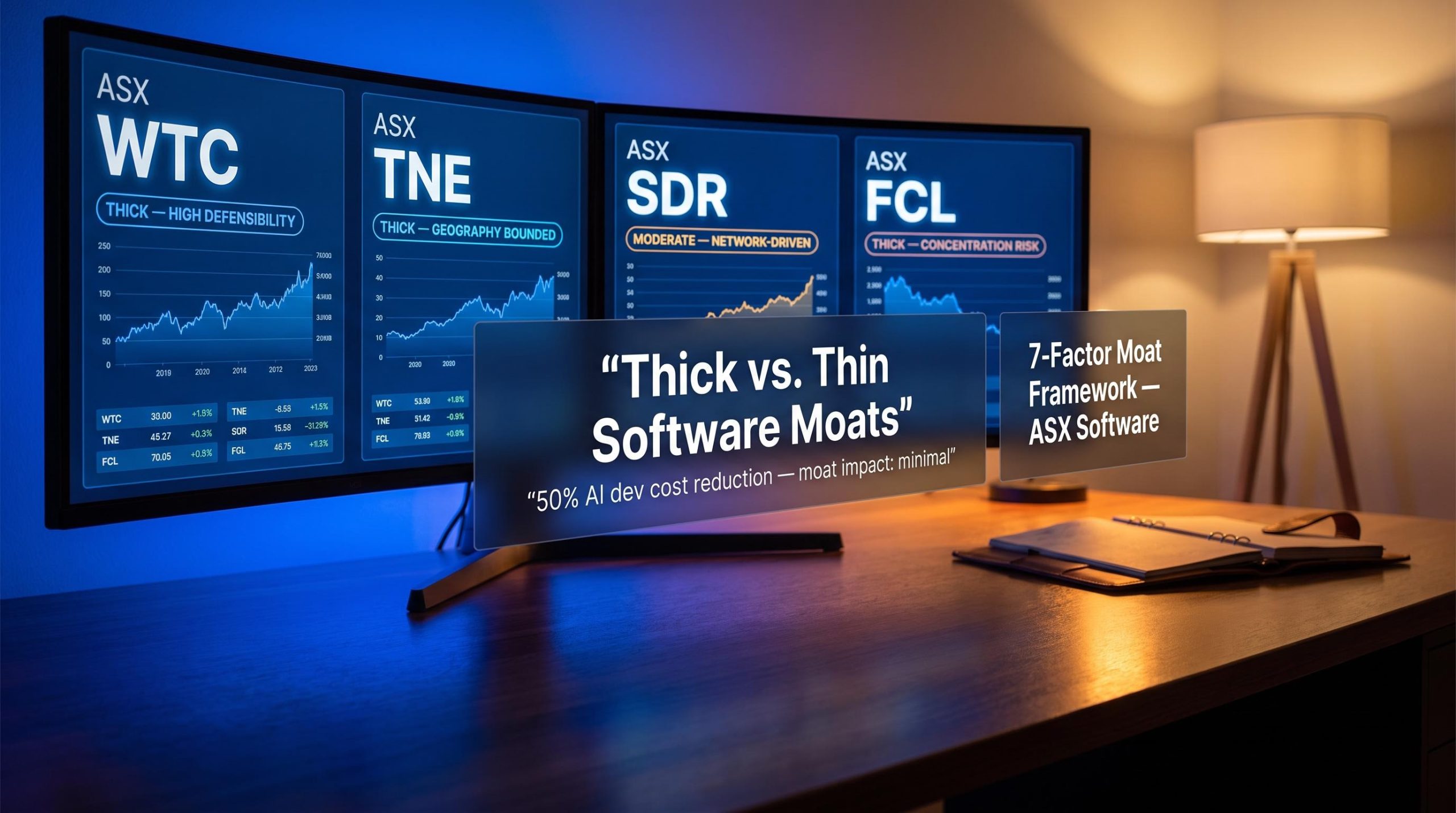
Morningstar equity analyst Roy Van Keulen, writing in the Australian Equity Market Outlook Q3 2026, draws a formal distinction between “thick” and “thin” software that sharpens the picture considerably. Thin software is a product where the competitive advantage rests primarily on having written and maintained the code. Thick software is a product where the advantage sits in accumulated domain logic, regulatory depth, integration complexity, and operational embeddedness inside the customer’s business.
The thick/thin framework sits within a broader tradition of economic moat investing that Morningstar formalised into five distinct sources: intangible assets, switching costs, network effects, cost advantage, and efficient scale, with multiple reinforcing sources considered structurally more durable than any single driver.
AI’s specific mechanism is lowering the cost of the first category: writing and maintaining code. In thin software, that lowers barriers for incumbents and challengers equally, eroding relative advantage. In thick software, the coding cost was never the binding constraint. Even a hypothetical 50% reduction in development expense does not meaningfully reduce the regulatory knowledge, production data, and institutional trust a challenger would need to compete.
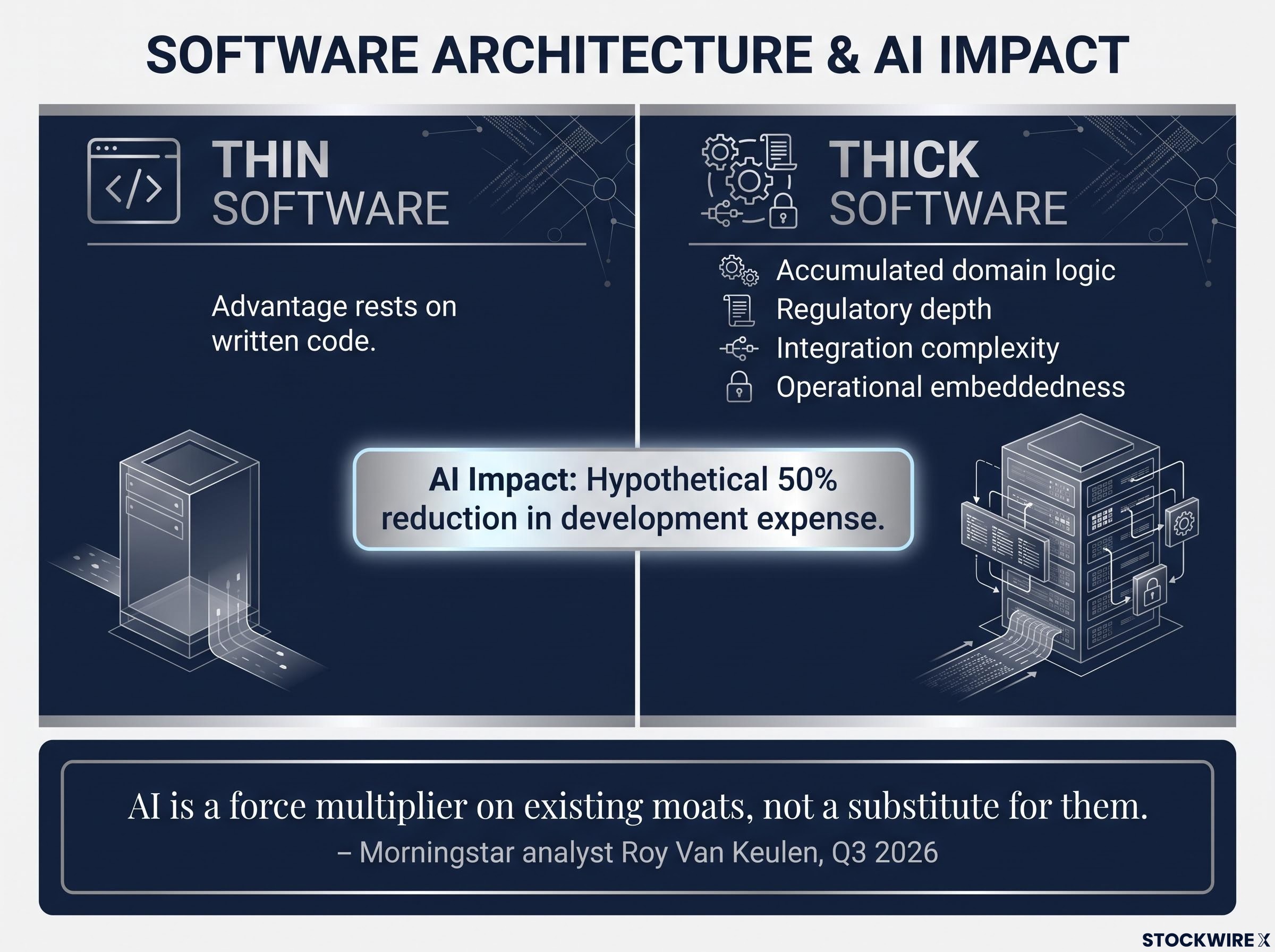
AI is a force multiplier on existing moats, not a substitute for them. Morningstar analyst Roy Van Keulen, Q3 2026
The implication for your portfolio: blanket pessimism about software moats in the AI era is likely mispriced. If you can identify genuine thickness, you are looking at a category the market may be discounting on a concern that does not apply.
When big ASX news breaks, our subscribers know first
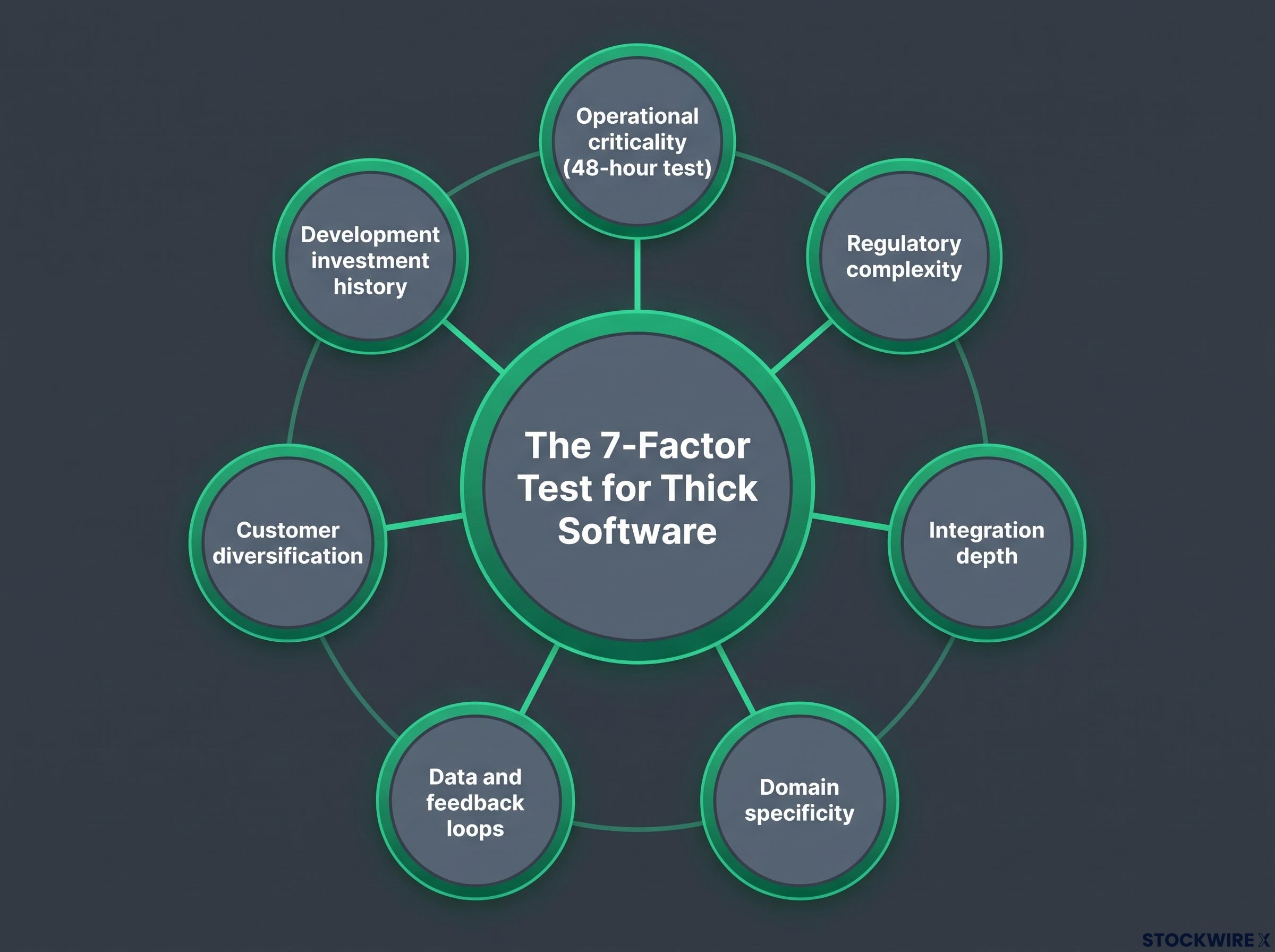
What actually makes software thick: the seven-factor test
The thick/thin distinction is only useful if you can score it. The framework works best when each determinant is framed as a question you can ask about a specific company, not as an abstract label.
Here are the seven determinants, each with the investor-facing question that makes it diagnostic:
- Operational criticality: If this system went down for 48 hours at a key customer, would it be an inconvenience, a serious problem, or an existential crisis?
- Regulatory complexity: How many distinct regulatory regimes does this software encode, and how frequently do those regimes change?
- Integration depth: How many internal and external systems does a typical implementation touch?
- Domain specificity: Could a generic horizontal product plausibly compete, or is this a specialised vertical with unique workflows and compliance requirements?
- Data and feedback loops: Does the product benefit from proprietary production data and years of customer feedback refining edge cases?
- Customer diversification: How concentrated are revenues in the top five customers, and how long are typical contracts?
- Development investment history: Has this platform been built and extended steadily over a decade or more with substantial sustained R&D?
The scoring produces degrees, not a binary verdict. But the first question is the one that does the most work. If a 48-hour outage means regulatory failure and business interruption for the customer, the switching cost is not commercial friction. It is risk. That distinction separates thick software from merely sticky software, and most publicly available analyst commentary on switching costs undersells it.
CargoWise and the replication problem no AI can solve
WiseTech Global (ASX: WTC) is the benchmark case for this framework on the ASX. Its CargoWise platform spans freight forwarding, customs, warehousing, and landside logistics on a single-platform architecture, operating across a large number of jurisdictions and customs regimes and serving a significant share of the world’s top global freight forwarders.
The replication cost figure is what makes this case so instructive. Morningstar analyst Roy Van Keulen’s analysis indicates that a prospective challenger, even one benefiting from a hypothetical 50% fall in development costs through AI, would still need to commit hundreds of millions of dollars and spend many years simply arriving at a first version that remains far less proven than the platform WiseTech’s customers already run in production.
Morningstar estimates a challenger would require hundreds of millions of dollars and multiple years to replicate CargoWise, even at 50% reduced development cost.
But the number is almost beside the point. The deeper barrier is not money or code.
Replication cost is the challenger’s problem
A new entrant faces the capital requirement, the extended timeline, the need for deep domain expertise, and the task of solving thousands of regulatory and operational edge cases across borders. AI speeds up generic coding and refactoring, but those are not the binding constraints. AI does not supply historical production data built through years of real-world enterprise deployments. It does not supply institutional knowledge from large, complex implementations across diverse regulatory environments. It does not supply the battle-tested compliance logic that comes only from operating in production at scale.
RBC Capital Markets research supports the position that vertical SaaS platforms with deep regulatory knowledge are structurally resistant to AI displacement because replicating embedded compliance context and years of configuration is far harder than rebuilding a feature interface.
Switching risk is the customer’s problem
Even if a challenger completed the build, customers would face existential switching risk. A customs compliance failure is not a software inconvenience; it is a potential business interruption event. That makes willingness to switch structurally low, independent of product quality.
WiseTech itself can apply AI to its own proprietary data and workflows, creating advantages a new entrant simply cannot replicate on day one. For the investor, this means the threat most commonly cited against WiseTech’s moat, that AI will let someone build a cheaper CargoWise, misunderstands where the moat actually sits. The code is not the asset. The regulatory logic, production data, and customer trust are.
Applying the framework across the ASX: TNE, SDR, and FCL
The framework produces meaningfully different verdicts when applied to three other ASX software names, and the differences matter for both conviction and position sizing.
| Company (ASX code) | Moat verdict | Primary moat driver | Key limitation | Thickness vs. WiseTech |
|---|---|---|---|---|
| WiseTech Global (WTC) | Thick, high defensibility | Cross-border regulatory depth, single-platform architecture | Valuation premium | Benchmark |
| Technology One (TNE) | Thick, high defensibility within geography | ANZ public sector regulatory depth, procurement friction | TAM ceiling (ANZ public sector) | Comparable per-customer, geographically bounded |
| SiteMinder (SDR) | Moderate to thick, network-driven | Integration breadth across GDS, OTAs, and booking platforms | Hotel tech is competitive; failure is disruptive but not existential | Thinner; network breadth rather than regulatory encoding |
| FINEOS Corp (FCL) | Thick product in a niche, with concentration risk | Insurance claims regulatory and workflow complexity | Small size, high customer concentration | Comparable per-customer; binary portfolio risk elevated |
Technology One scores highly on the thickness test within its geography. ANZ public sector change-aversion and procurement friction create structural resistance to switching, and the regulatory and reporting depth is genuine. The limitation is addressable market: the ANZ public sector is a defined opportunity with a meaningful ceiling, and concentration in one regulatory jurisdiction means the moat is geographically bounded in a way WiseTech’s cross-border model is not.
SiteMinder’s moat is real but structurally different. The operational necessity of inventory synchronisation across global distribution systems and online travel agencies (platforms that connect hotels to booking channels) means a failure creates immediate revenue loss for hotel operators. But hotel technology failure is operationally disruptive, not existential in the way customs compliance failure is. The moat rests on network breadth and integration reliability rather than regulatory encoding, making it somewhat more vulnerable to competitive displacement over time.
The pricing regime shift compounds the thickness question: analytical SaaS vendors built on per-seat models face concurrent pressure from AI-native competitors entering with consumption-based pricing designed to undercut incumbent costs by 80-90%, a dynamic that hits thin software hardest but spares vertically embedded platforms where value derives from regulatory depth rather than seat count.
FINEOS is the instructive edge case. The per-customer moat is genuine: regulatory and workflow complexity in insurance claims administration, combined with long implementation cycles, creates high switching costs. But the company is small with a concentrated customer base. A single large customer loss could materially alter the investment thesis. This is thick but fragile, a distinction that matters for position sizing even when moat quality per customer is strong.
Where the framework breaks down: four caveats every investor needs
No analytical tool works everywhere, and the thick/thin framework has specific failure modes worth naming directly.
- Value traps: A genuine thick moat on a fully priced stock does not protect your investment returns. Moat quality and entry price are separate assessments requiring separate work. An expensive thick stock can still deliver poor returns.
- Execution risk: A strong moat with weak management or poor capital allocation can still destroy value. Product quality and management quality are distinct variables, and this framework only addresses the first.
- Category risk: Thick software in a structurally low-growth segment may have a durable moat attached to a declining opportunity. The moat protects the position; it does not guarantee the market grows.
- Regulatory overhaul: A shift in customs regimes directly affects WiseTech’s accumulated advantage. A change in insurance regulation affects FINEOS. A reform of ANZ public sector procurement rules affects Technology One. Regulatory depth is a moat until the regulations change.
Structural moat assessment pairs directly with earnings quality analysis, because the 48% ASX tech drawdown between August 2025 and March 2026 revealed that companies with demonstrated profitability and positive cash flow before the trough recovered materially faster than high-growth but unprofitable peers, regardless of their moat narrative.
Each of these caveats applies directly to the companies covered in this analysis. Identifying a thick software moat is the beginning of the investment case, not the end of it. The framework is a lens for identifying where competitive advantages are structurally robust. It is not a valuation tool and should be paired with standard financial analysis, management assessment, and disciplined entry price work.
This article is for informational purposes only and should not be considered financial advice. Investors should conduct their own research and consult with financial professionals before making investment decisions.
What the thick/thin framework changes about how you research ASX software
In an AI-driven environment, the most structurally defensible software cash flows are likely to come from vertically specialised, regulation-dense, mission-critical platforms where competitive advantage resides in embedded complexity rather than in code cost. That is the research tilt the framework points you toward.
Prioritise companies with long documented R&D histories, multi-jurisdiction regulatory depth, and meaningful customer diversification. Be cautious with horizontal tools and businesses where “we built it first” was the primary moat, because AI-assisted competition is closing those gaps faster and at lower cost. And be particularly careful with thick-seeming products that carry high customer concentration; the moat per customer may be genuine, but the binary portfolio risk is elevated.
WiseTech remains the clearest current ASX example of the thick software model. Technology One, SiteMinder, and FINEOS are useful calibration points along the same spectrum, each with a different risk profile that the same seven questions can diagnose.
The question to ask before investing in any ASX software company is not “can AI replicate this?” but “where does the moat actually live, and is that location structurally protected from AI development economics?”
That single reframe, applied consistently, changes how you evaluate every software position from here.
Past performance does not guarantee future results. These assessments are based on current structural analysis and are subject to change based on market developments and company performance.