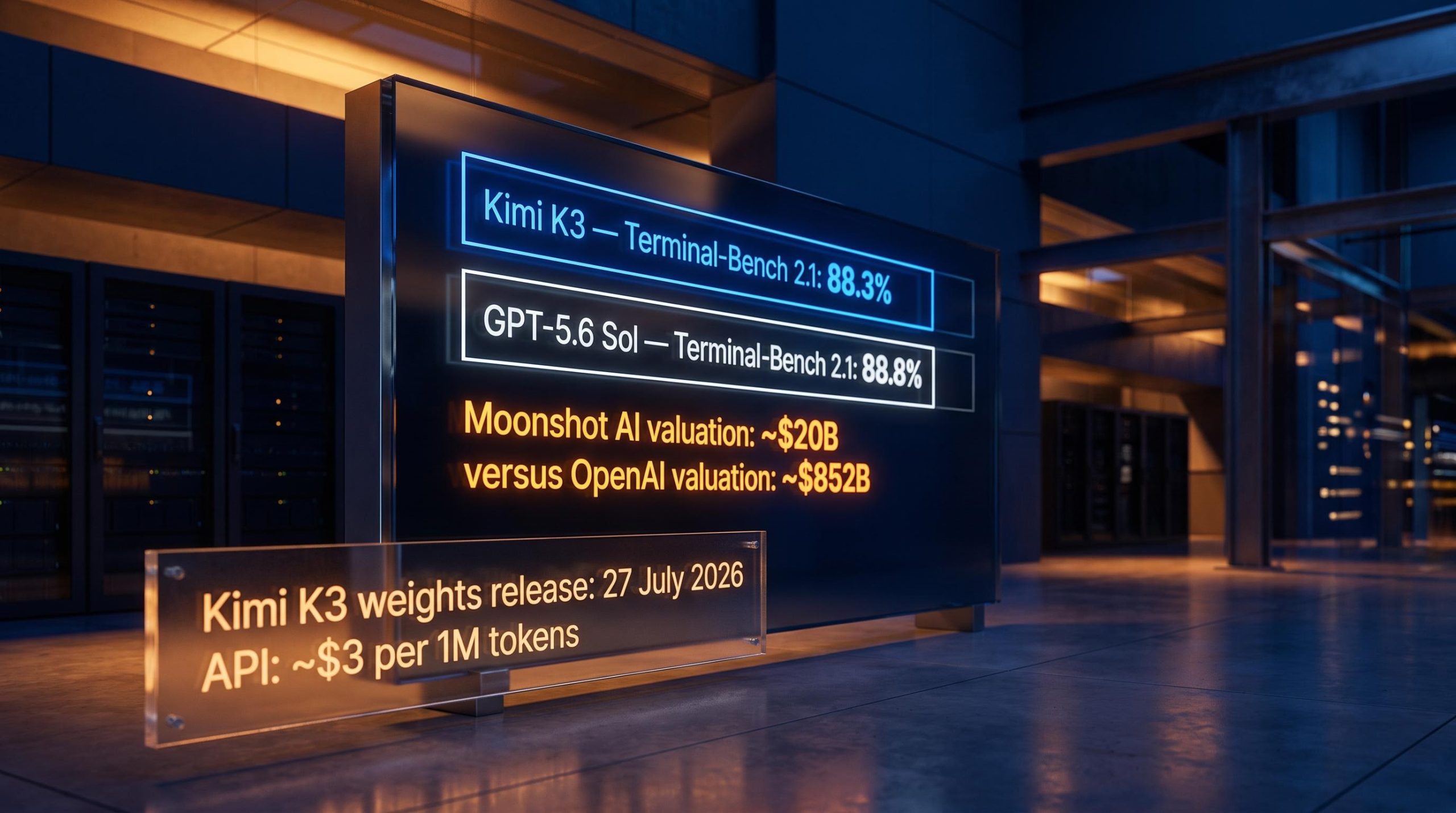
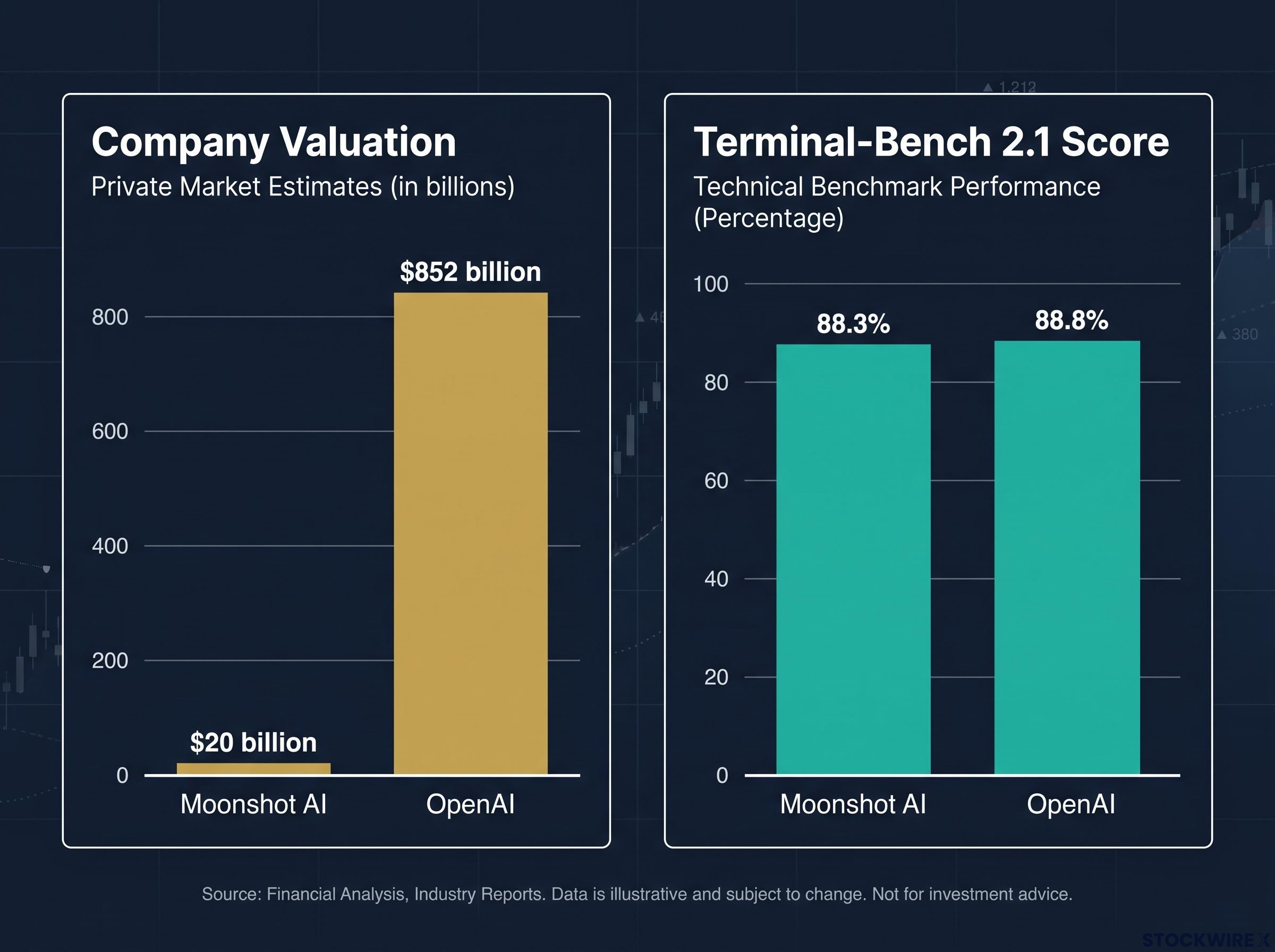
Moonshot AI, a Chinese startup valued at roughly $20 billion, released a model this week that scores 88.3% on Terminal-Bench 2.1. GPT-5.6 Sol, OpenAI’s flagship, scores 88.8%. Half a percentage point separates a company worth $20 billion from one worth $852 billion.
That gap is the sharpest version of a pattern that has been accelerating since DeepSeek rattled markets earlier in 2026. Kimi K3, released on 16 July 2026, is not the first Chinese model to close in on the frontier. It is the first to do so while promising to release its full weights for free. The question for investors is not whether a Chinese model “wins” in some abstract sense but whether the pricing and margin assumptions baked into near-trillion-dollar private valuations can survive a world where frontier-capable AI weights are distributed at zero licensing cost.
Here is a clear framework for understanding who actually captures value as model costs collapse, and what that means if you hold or are evaluating any AI-exposed equity.
What Kimi K3 actually is, and why the numbers matter
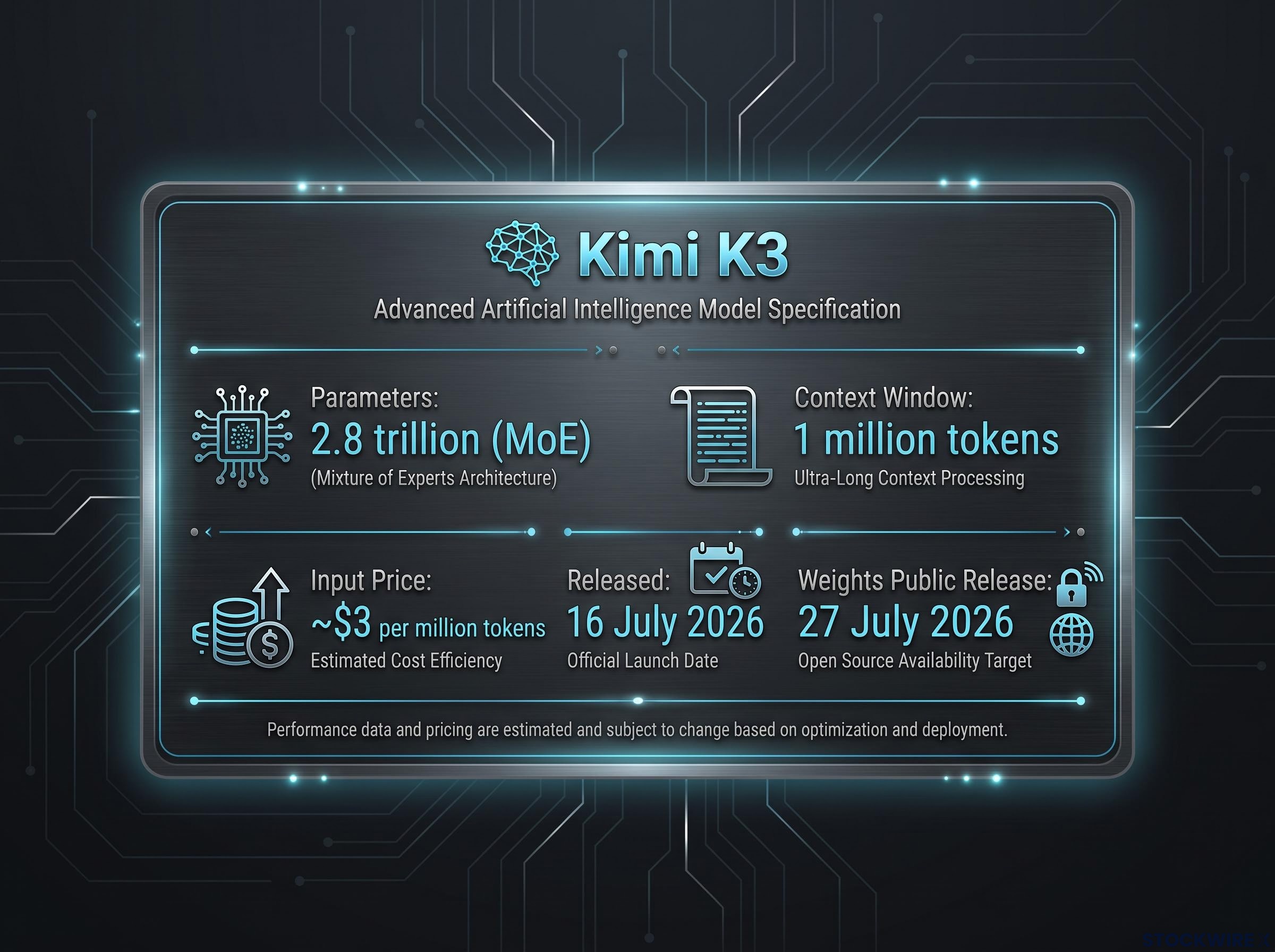
Start with the architecture. Kimi K3 is a sparse mixture-of-experts (MoE) model, a design that routes each input to a subset of the model’s total capacity rather than activating every parameter on every query. Its total parameter count: 2.8 trillion, the largest open-weight model announced to date.
Then the context window. K3 supports 1 million tokens of input context, meaning it can process entire codebases, lengthy legal documents, or multi-hour video transcripts in a single pass. It handles text, images, and video natively. These are specifically the capabilities enterprise buyers need for coding assistance and agentic workflows, the automated multi-step task chains that represent the fastest-growing commercial AI use case.
Now the benchmark that matters.
Kimi K3 scored approximately 88.3% on Terminal-Bench 2.1. OpenAI’s GPT-5.6 Sol scored 88.8%. The gap is half a percentage point.
This is not a second-tier model claiming relevance on a favourable test. Terminal-Bench 2.1 is the industry’s consensus measure for frontier coding and reasoning performance, and K3 sits functionally at the frontier by that standard.
Moonshot prices the API at approximately $3 per million input tokens and $15 per million output tokens, undercutting most Western flagships. Full model weights are scheduled for public release on 27 July 2026 under a modified MIT-style licence.
| Model | Parameters | Terminal-Bench 2.1 | API Input Price (per 1M tokens) |
|---|---|---|---|
| Kimi K3 | 2.8 trillion (MoE) | ~88.3% | ~$3 |
| GPT-5.6 Sol | Undisclosed | ~88.8% | Higher (varies by tier) |
| Claude (Anthropic flagship) | Undisclosed | Below K3 | Higher (varies by tier) |
The capital efficiency here is striking. A company valued at $20 billion is producing frontier-class benchmarks that companies valued at $852 billion and $965 billion are not meaningfully outperforming. That tells you something specific about how far ahead Chinese AI development efficiency is running relative to what Western private market pricing has assumed.
Chinese AI development efficiency extends well beyond the model benchmark scorecard: a parallel compounding advantage is accumulating in physical AI through approximately 2 million deployed industrial robots, generating real-world training data at a scale that software-only benchmarks like Terminal-Bench do not capture.
When big ASX news breaks, our subscribers know first
Why open-weight models are a different kind of competitive threat
This is not ordinary price competition. The distinction is structural and it matters for how you evaluate the financial exposure.
- Closed models (Claude, GPT-class) expose only an API surface. Weights remain proprietary. Customers pay per token or per subscription. The model developer captures revenue on every inference call.
- Open-weight models (Kimi K3, DeepSeek variants) make weights downloadable. Enterprises can self-host, fine-tune, and run inference without paying the developer anything after the initial download. Marginal licensing cost: zero.
Once K3’s weights go public on 27 July, any enterprise with sufficient compute can download 2.8 trillion parameters of frontier-class capability and run it internally. Moonshot collects nothing from that inference. The revenue model shifts entirely to API pricing for customers who choose not to self-host.
That removes the structural premium closed labs can charge for basic inference access. When the best open-weight alternative was meaningfully behind the frontier, that premium was defensible. When it sits within half a percentage point, the premium competes against free.
Foundation model economics may structurally resemble the airline industry: extreme capital intensity combined with interchangeable, commoditised output leaves margin capture dependent on switching costs and proprietary data rather than raw capability, a parallel that gains force each time an open-weight release narrows the benchmark gap.
The legal asymmetry that makes this harder to reverse
US labs operate under a more constrained legal and regulatory environment than their Chinese counterparts. Training data litigation, content policy obligations, and safety compliance requirements all impose costs and capability restrictions on Western frontier labs that Chinese developers are not subject to in the same way. The result is an asymmetric burden: US labs face binding constraints on what they can train, release, and allow their models to generate, while Chinese open-weight models are distributed globally with no practical enforcement mechanism that limits how enterprises deploy them downstream.
This is not purely a geopolitical framing. It is a structural cost and capability constraint with direct commercial consequences. Once K3’s weights are publicly distributed globally, there is no practical enforcement mechanism that restricts how enterprises deploy them. Policy constraints on US labs are relatively more binding than those on open-weight Chinese models, even where the latter technically carry licence terms.
The Anthropic and OpenAI valuation problem
Anthropic reached a post-money valuation of approximately $965 billion following its Series H round in May 2026. OpenAI reached approximately $852 billion post-money following its March 2026 funding round. These are private market valuations, not public prices.
Anthropic’s $965 billion valuation is the largest private AI lab valuation on record, assigned just two months before a frontier-class open-weight rival emerged at half a percentage point behind its core benchmark category.
Investors underwriting valuations of this magnitude are implicitly requiring three conditions:
- Rapid revenue growth: Enterprises must keep expanding their spending on closed-model API access. K3 gives enterprises a credible path to cap that spend by self-hosting a comparable model, directly pressuring this assumption.
- Improving margins through efficiency: Labs may need to lower prices or increase training investment to restore a capability lead. Either response compresses margins or increases capital intensity. Both delay profitability.
- A durable pricing premium over alternatives: This is the condition K3 hits hardest. Coding and agentic workflows are where Anthropic has concentrated its commercial efforts, and they are precisely where K3’s benchmark performance is sharpest. After 27 July, the premium competes against a zero-cost alternative at near-equivalent capability.
The concern for investors is not that Anthropic or OpenAI will fail. It is that the conditions justifying near-trillion private market prices may not survive the scrutiny that public markets, venture secondaries, or future funding rounds will apply as the open-weight frontier closes further.
AI IPO valuation stress-testing becomes considerably more rigorous once public markets apply revenue multiple discipline and profitability path analysis: the 22x forward price-to-sales multiple implied by Anthropic’s Series H is derived entirely from third-party projections, not company-disclosed financial data.
Where value actually goes when model costs collapse
Model commoditisation does not destroy AI value. It redistributes it, and the redistribution follows a clear directional logic once you understand the infrastructure economics.
The major cloud providers, AWS, Azure, and Google Cloud, occupy a structurally advantaged position in this stack. Their revenue from compute, storage, and managed AI services is model-agnostic: it accrues regardless of whether the customer’s workload runs on a closed proprietary model or a self-hosted open-weight alternative. Each has built product lines (Bedrock, Azure AI Studio, Vertex AI) specifically designed to support both approaches, allowing them to capture infrastructure spend whichever model vendor gains share in any given period.
Open-weight models increase this demand rather than reducing it. Self-hosting a 2.8-trillion-parameter MoE model at enterprise scale requires substantial GPU and memory capacity. Most enterprises will source that from cloud providers rather than building equivalent on-premises infrastructure. Cheaper AI capability tends to drive more total compute demand, not less; revenue flows to infrastructure even as per-unit model prices fall.
Why application-layer companies benefit most cleanly
For software companies that use models as inputs, including developer tools, SaaS applications, and fintech platforms, falling inference costs behave like falling raw material costs in manufacturing. Margins expand without requiring any change to the revenue line. As high-quality inference becomes cheaper, more workflows become economically viable at lower price points, broadening the addressable market.
Execution risk remains real: cheap models benefit every competitor in a given software category equally. But the structural tailwind from lower input costs is clear and durable.
| Value Chain Tier | Representative Companies | Why They Benefit | Primary Risk |
|---|---|---|---|
| Hyperscalers | AWS, Azure, Google Cloud | Collect compute and storage revenue regardless of model vendor | Capital expenditure intensity; custom silicon competition |
| Downstream Software | AI-native SaaS, dev tools, fintech | Lower inference costs expand margins and addressable market | Competitors benefit equally from the same cost reduction |
| Frontier Labs | Anthropic, OpenAI, Moonshot | Brand, safety tooling, enterprise trust | API revenue directly exposed to open-weight substitution |
| AI Hardware | Nvidia, AMD, DRAM suppliers | Total compute demand may rise via increased usage | Mix shift between training/inference and GPU/custom silicon |
For anyone constructing or evaluating an AI equity portfolio, this reframes the question. Exposure to AI infrastructure and application-layer companies may offer a more durable risk-reward profile than direct exposure to frontier lab valuations, given the commoditisation trajectory now visible.
The countervailing case: what US labs still have
The competitive pressure is real, but so are three genuine differentiators that open-weight Chinese models do not easily replicate:
- Compliance and safety tooling: Anthropic and OpenAI invest heavily in alignment research, auditability, and regulated-industry integrations. For buyers in finance, healthcare, and government, these are requirements, not preferences, and they remain a real barrier to switching.
- Ecosystem lock-in: Deep integration into developer tools, productivity suites, and proprietary data platforms creates switching costs that raw model capability alone cannot erase.
- Data sovereignty reluctance: Some Western enterprises, particularly in regulated or sensitive sectors, may refuse to deploy Chinese open-weight models on geopolitical, security, or compliance grounds, partially insulating US lab revenues in specific verticals.
Business Insider characterised Kimi K3 as “putting fresh pressure on Silicon Valley and Washington,” capturing how policy, national security, and market narratives are now entangled with model competition.
These soft moats are real. Their dollar value, however, is uncertain. The burden of proof has shifted: investors now need affirmative evidence that these differentiators justify the premium, rather than assuming it. Once raw benchmark scores converge, competition shifts to agent tooling, ecosystem integration, reliability, and vendor trust, areas where US labs retain genuine advantages but where the valuation math demands those advantages translate into durable pricing power over free alternatives.
What the IPO window tells investors about timing
If open-weight Chinese models are going to compress margins and slow growth over a two-to-three-year horizon, there is a logic for Anthropic and OpenAI to list before that reality is fully priced in by public markets. When and whether these companies pursue an IPO is itself a signal about how insiders are reading the competitive trajectory, not just a corporate finance scheduling question.
The scrutiny gap between private and public markets
Late-stage private rounds are structured with less continuous public information and fewer short-seller dynamics than public markets. The investors who underwrote $852 billion and $965 billion valuations did so with relatively constrained competitive disclosure. Public markets operate differently. Investors who have watched the DeepSeek and Kimi K3 episodes will apply three categories of scrutiny that private rounds did not:
- Revenue multiple discipline: What multiple of current revenue justifies a near-trillion valuation, and how does that multiple compare to public SaaS and cloud companies?
- Profitability path analysis: What is the timeline to positive operating margins, and how does competitive pricing pressure from free alternatives affect that timeline?
- Competitive positioning stress-testing under open-weight scenarios: Can the company demonstrate that its technical lead and soft moats will sustain premium pricing in a market where a frontier-class model is freely downloadable?
The gap between current private valuations and what public markets would likely assign given this competitive context is the central valuation risk. For anyone with indirect exposure through venture funds, secondaries, or AI-adjacent public equities, a public market repricing that resets private-round implied values downward would flow through those structures in ways worth anticipating now.
What the commoditisation cycle means for AI equity positioning now
The value chain logic from this analysis points in a clear direction. Hyperscalers and application-layer companies carry structurally more durable AI equity exposure than frontier labs at current private valuations, given the open-weight commoditisation trajectory now visible.
Three specific variables are worth monitoring to assess how this plays out:
- Pricing response from US labs: If Anthropic or OpenAI announce material price cuts or begin disclosing margin data, that is evidence they are feeling competitive pressure from open-weight alternatives in their core commercial segments. Watch for it in the weeks following K3’s weight release.
- Enterprise adoption of Chinese open-weight models in regulated sectors: If deployment data shows meaningful uptake of K3 or similar models in finance, healthcare, or government, the data sovereignty differentiator weakens. If adoption stays minimal in those verticals, the soft moat holds.
- IPO filings with revenue and profitability disclosure: Any S-1 or equivalent filing from Anthropic or OpenAI would provide the first public dataset for stress-testing whether private valuations survive contact with public market scrutiny.
The 27 July weight release is the near-term event. It converts K3 from a pricing competitor to a zero-cost alternative, and it will be the first real-world test of enterprise willingness to self-host a frontier-class model at this scale. Meanwhile, Moonshot AI’s fundraising discussions at approximately $31.5 billion suggest Chinese AI capital formation continues to accelerate.
Chinese AI competition is not a one-event risk. It is a structural condition of the AI value chain going forward. The framework here, infrastructure captures rent, the application layer benefits from lower input costs, and the model layer competes on soft moats, will apply to every future open-weight release beyond Kimi K3. Monitor the three variables, watch the 27 July event, and resist the temptation to treat any single model release as definitive in what is clearly a multi-year structural shift.
For investors wanting to translate this value chain analysis into actual portfolio adjustments, our dedicated guide to AI stock concentration risk covers position-sizing discipline, rebalancing triggers, and the four-layer AI investment stack with distinct volatility profiles for each tier.
This article is for informational purposes only and should not be considered financial advice. Investors should conduct their own research and consult with financial professionals before making investment decisions. Past performance does not guarantee future results. Financial projections and valuation assessments are subject to market conditions and various risk factors.