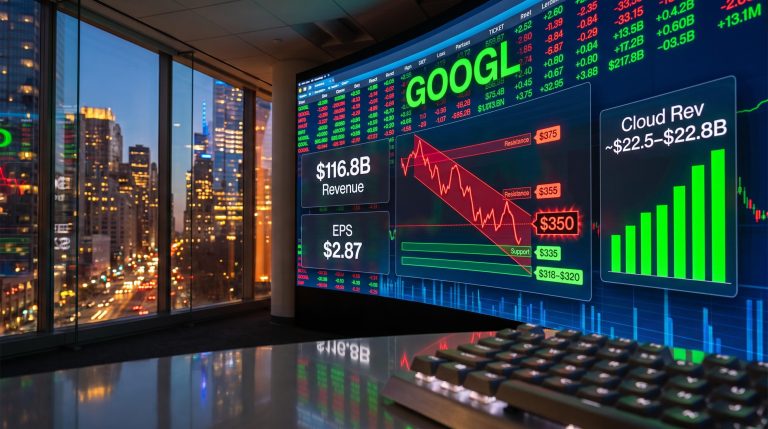
The question investors should be asking ahead of Wednesday’s big tech earnings is not whether Alphabet beats consensus by a few cents. It is whether the $800 billion figure now circulating across Wall Street, representing the estimated scale of AI-related capital expenditure in 2026, still has room to grow. That number did not exist as a market-moving category five years ago. If you are still reading these reports through the lens of earnings per share, you are watching the wrong dial.
This earnings cycle, beginning with Alphabet and Tesla reporting after market close on 22 July 2026, has become a referendum on the AI infrastructure super-cycle. Hyperscaler capital expenditure is no longer just a cost line buried in a balance sheet. It functions as private-sector stimulus for semiconductors, data centres, cloud software, and the Nasdaq itself. A revision in either direction ripples far beyond any individual ticker.
Here is what this piece gives you: the specific numbers, phrases, and management signals to track on Wednesday evening, and a framework for understanding what movements in those signals mean for the broader portfolio, not just for Alphabet or Tesla in isolation.
The $800 billion figure that now moves markets more than earnings per share
AI-related capital expenditure across the hyperscaler complex has reached a scale where it no longer behaves like a collection of individual corporate spending decisions. It behaves like a macro variable.
Across Microsoft, Alphabet, Amazon, Meta, and Oracle, research estimates place aggregate capex at $660-$690 billion for 2026. Add in second-tier cloud providers, telecoms, and specialised AI infrastructure operators, and the sector-wide figure reaches approximately $800 billion. That is roughly double the $380 billion estimated for 2025.
The AI investment boom has already pushed US IT spending to 4.9% of GDP in Q1 2026, surpassing both the dot-com era peak and the cloud buildout cycle, a scale that explains why individual capex guidance revisions now carry macro-level weight rather than company-specific weight.
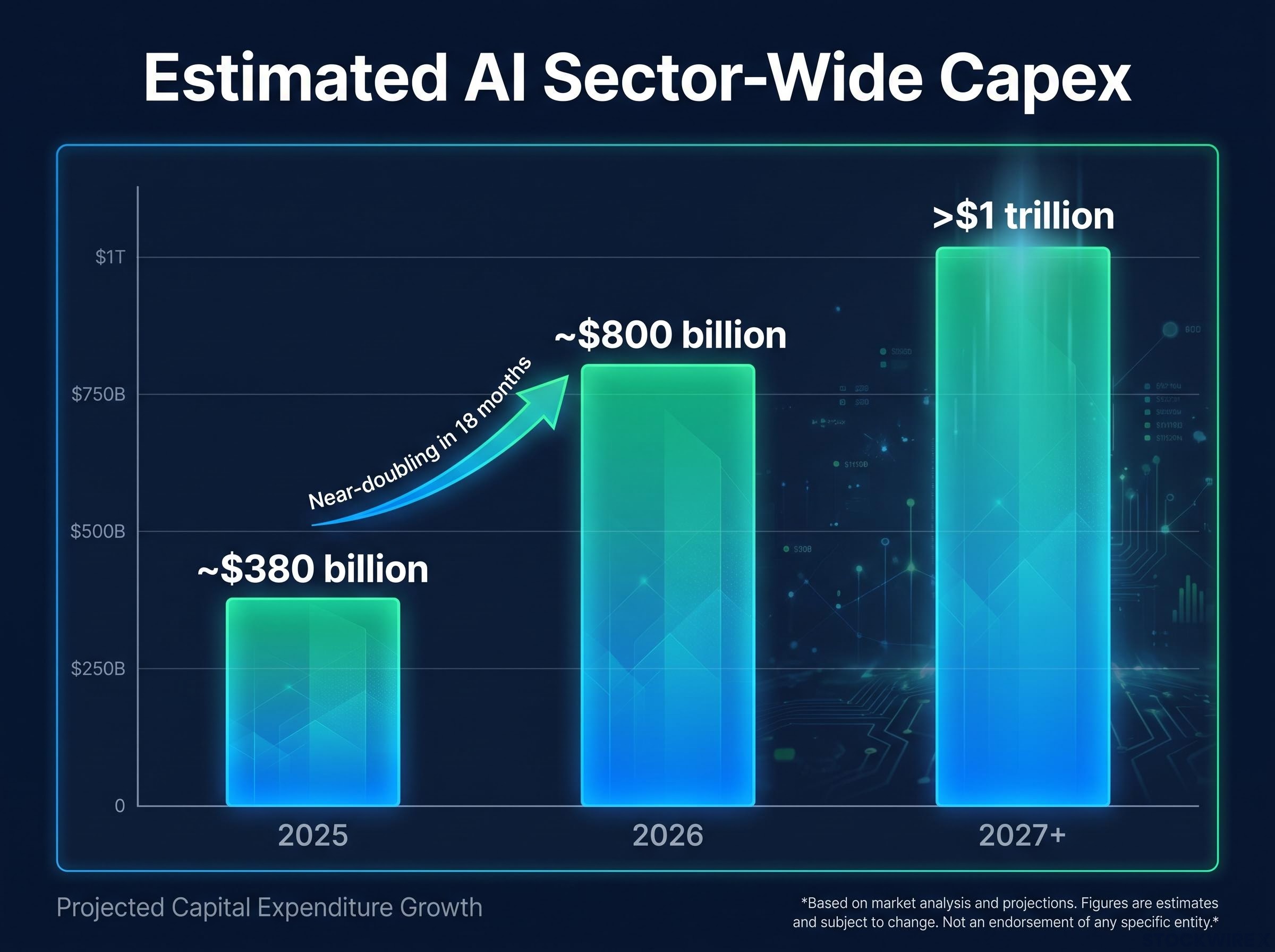
Some Wall Street economists cited by Vantage Markets analyst Jamie Dutta forecast that the sector-wide total could climb to approximately $1.2 trillion the following year.
The trajectory tells the story:
| Year | Estimated aggregate capex | Key observation |
|---|---|---|
| 2025 | ~$380 billion | Baseline year before the doubling |
| 2026 | $660-$725 billion (top five); ~$800 billion sector-wide | Near-doubling in 18 months |
| 2027+ | Projections above $1 trillion per year | Acceleration still expected, not flattening |
What makes this qualitatively different from a normal corporate spending cycle is the downstream dependency. Industries tethered to hyperscaler capex decisions include:
- Semiconductors (GPU makers, memory suppliers, fabrication plants)
- Data-centre REITs and construction firms
- Networking equipment manufacturers
- Cloud software providers
- Power utilities serving data-centre clusters
Because so many business models now assume AI workloads will consume every available unit of compute, any change in the capex trajectory functions as a macro signal. A revision downward would not just move one stock. It would ripple through equity markets far beyond the company that made the call.
When big ASX news breaks, our subscribers know first
What Alphabet’s numbers actually tell you about the health of the AI cycle
If you want a single data point that captures the current state of the AI infrastructure boom, it sits inside Alphabet’s earnings report.
Alphabet occupies a dual role that makes it uniquely informative. It is simultaneously a hyperscaler funding the AI build-out (through Google Cloud and its core data-centre network) and a direct beneficiary of AI through search, advertising, and enterprise services. When Alphabet raises capex guidance, it is both investing in the cycle and signalling that demand from its own customers justifies the spend.
Google Cloud margins expanded from 31.6% to 32.9% in Q1 2026 even as Alphabet’s capex nearly doubled year-over-year, a combination that professional investors read as evidence that infrastructure spending is converting into durable operating leverage rather than compressing returns indefinitely.
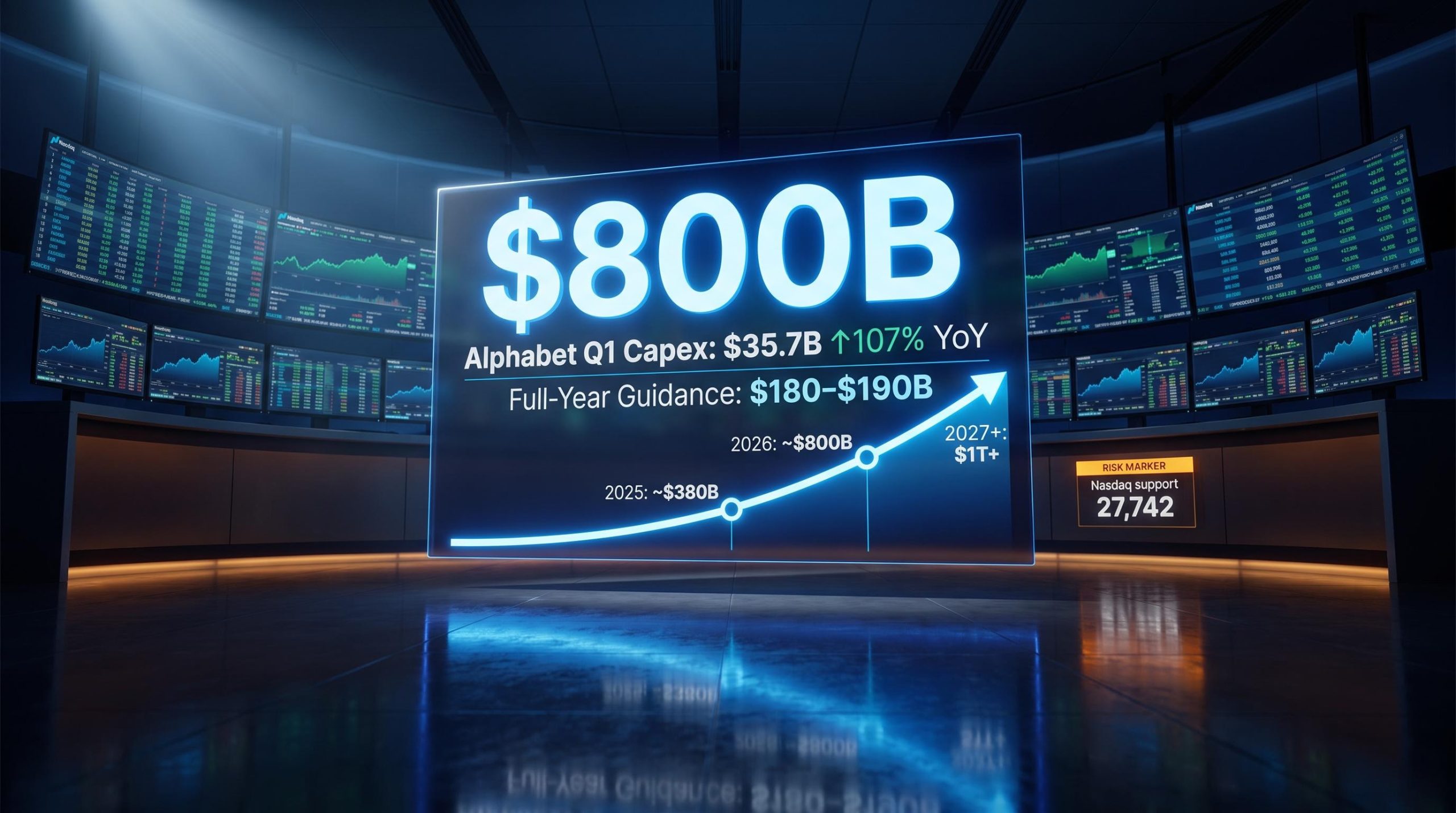
The baseline numbers are already aggressive. Q1 2026 capex came in at $35.7 billion, up 107% year-over-year. Full-year 2026 guidance was raised to $180-$190 billion, up from a prior range of $175-$185 billion. CFO Anat Ashkenazi has guided that 2027 capex will “significantly increase” beyond 2026.
CEO Sundar Pichai has characterised AI compute demand as “outstripping supply,” justifying what he described as substantial capital outlays for expansion.
That is the bullish case in three words. The question on Wednesday is whether that language holds, softens, or strengthens.
What management language signals beyond the raw numbers
The capex figure itself matters, but the language around it may matter more. There is a spectrum between specific, quantified commitments and broad optimism that lacks detail. Ashkenazi’s “significantly increase” phrasing sits at the high-confidence end. If that kind of specificity persists or escalates, markets will read it as confirmation that the super-cycle is still accelerating.
What to listen for on the call:
- Whether full-year guidance is raised, maintained, or trimmed versus the $180-$190 billion range
- Language on whether demand continues to outstrip supply, or whether any supply-demand balance is emerging
- Any new caution around monetisation timelines or the pace of build-out
Any introduction of hedging language around demand would likely be treated by markets as more material than the headline capex number itself. There are indications that aggressive AI spending has already compressed Alphabet’s free cash flow margins meaningfully, and if Alphabet cannot demonstrate improving monetisation alongside elevated spend, the sustainability question sharpens.
For you, Alphabet’s guidance on Wednesday is not a company-specific update. It is a real-time verdict on whether the AI infrastructure boom is still in full sprint or beginning to mature, with direct implications for how to read every subsequent hyperscaler report this season.
Why Tesla’s AI story is a different kind of risk
Tesla’s earnings report on the same evening poses a fundamentally different question. Where Alphabet tests whether the AI capex super-cycle is still accelerating, Tesla tests whether long-duration AI narratives can survive contact with deadlines.
The market increasingly prices Tesla as an AI and robotics company that happens to make cars. Its three AI-intensive initiatives carry the weight of that valuation premium:
- Dojo supercomputer: Investors need evidence that Tesla’s in-house training infrastructure is producing measurable improvements in autonomous driving models, not just processing benchmarks
- Autopilot / Full Self-Driving (FSD): Concrete data on attach rates, subscription uptake, and real-world usage metrics would validate the recurring-revenue thesis
- Optimus humanoid robot: Any named customer pilots or specific deployment timelines would signal the programme is moving from research into commercial reality
The distinction matters. For Alphabet, the question is spending volume and trajectory. For Tesla, the question is commercialisation timeline credibility. Investors have been patient with the AI narrative, but patience has a shelf life.
What happens if the AI narrative misses its proof points
If Tesla delivers vague or disappointing milestones on Wednesday, the pressure extends beyond its own stock. The market uses Tesla as a temperature check on whether speculative, long-duration AI valuations across the tech complex are still being rewarded. A stumble here could trigger re-pricing not just in Tesla but in autonomy-adjacent and robotics-exposed names that carry similar narrative premiums.
For anyone holding exposure to autonomy or robotics themes, Tesla’s guidance on commercial milestones is effectively a signal about whether the market will continue to price these stories generously or begin demanding nearer-term proof.
Understanding AI capex as an earnings metric
If you have ever watched a company beat earnings estimates and then seen its stock fall, or miss consensus and rally, AI capex is often the explanation. Professional investors have shifted attention from earnings per share to capex guidance because the two metrics answer different questions. EPS tells you what happened last quarter. Capex guidance tells you what management believes about the next several years.
The logic unfolds in a chain:
- A hyperscaler raises capex guidance, committing to build more AI compute infrastructure
- Chip and hardware orders increase as suppliers fill that commitment
- Data-centre construction accelerates to house the new capacity
- Cloud software demand rises as enterprises build applications on the expanded infrastructure
- Sector-wide revenue forecasts adjust upward across the entire supply chain
Alphabet CFO Anat Ashkenazi has explicitly linked higher capex to “significant cloud customer demand,” connecting the spending directly to a revenue justification rather than framing it as speculative.
Capital expenditure, the money a company spends on physical assets like servers, data centres, and networking equipment, compresses current-period earnings because it shows up as a cost. But in a high-growth infrastructure cycle, sophisticated investors weight the forward signal more heavily than the current-period compression. The spending is not a drain; it is a commitment to future revenue-generating capacity.
The semiconductor supply chain is not a monolithic beneficiary of rising hyperscaler capex: Nvidia posted 85% revenue growth in Q1 2026 while Qualcomm contracted 3.5% in the same quarter, a divergence driven entirely by end-market exposure rather than sector membership.
When you see an EPS beat alongside rising capex and margin compression, you are not necessarily looking at a deteriorating company. You may be looking at one building a durable revenue advantage. Interpreting those signals correctly changes how you assess the quarter, and it is the lens that institutional capital is already using.
A practical framework for reading Wednesday’s reports
Four signals matter most across both reports on Wednesday evening. Here is what each looks like in a bull case versus a risk case:
| Signal | Bull-case reading | Risk-case reading |
|---|---|---|
| Capex guidance direction | Raised or firmly reaffirmed above $180-$190 billion (Alphabet) | Trimmed, softened, or left unchanged with cautious framing |
| Management language on demand | “Demand outstripping supply” language maintained or strengthened | New hedging phrases around pace, demand maturity, or monetisation timelines |
| Cloud/AI revenue vs capex growth | Cloud and AI revenue accelerating at or above capex growth rate | Revenue decelerating while capex continues rising |
| Operating margin and free cash flow | Margin stabilisation or improvement alongside high capex | Further margin compression with no clear monetisation offset |
The Alphabet baseline is clear: $35.7 billion in Q1 capex and $180-$190 billion in full-year guidance. Wednesday’s figures will be measured directly against those numbers. Any movement, up or down, will be interpreted as a signal about the trajectory of the entire AI spending cycle.
Vantage Markets analyst Jamie Dutta has highlighted the technical risk that any material pullback in AI spending could see the Nasdaq decline toward a key support level in the vicinity of 27,742.
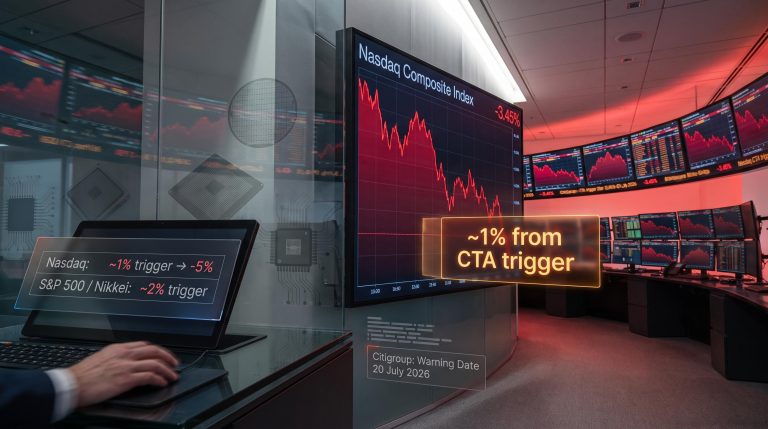
AI repricing dynamics in late June 2026, when the Nasdaq 100 fell 3.3% against a 1.4% S&P 500 decline, demonstrated precisely the kind of sector-isolated selloff that a capex guidance miss from a major hyperscaler can trigger, with the gap between index moves confirming that AI infrastructure and semiconductors absorbed the repricing rather than the broader market.
If you hold diversified tech exposure, knowing which direction AI capex guidance moves on Wednesday tells you whether to expect follow-through strength or sector-wide pressure in semiconductors, cloud software, and data-centre REITs in the days that follow. This is not a single-stock event.
What the AI capex verdict means beyond Wednesday’s close
Wednesday’s reports set a template for the rest of earnings season. Every subsequent hyperscaler filing, from Microsoft to Amazon to Meta, will be read against the benchmark that Alphabet and Tesla establish this week.
Two outcomes frame what comes next:
- Bull case: Both companies reaffirm aggressive, well-justified AI investment plans. Demand language remains strong. Alphabet shows improving or stabilising monetisation alongside elevated capex. Tesla offers specific, credible commercialisation milestones. Markets treat the result as confirmation that the AI super-cycle has further to run, and the Nasdaq rally finds its next leg of support.
- Risk case: Either company introduces softer guidance, cautious demand language, or margin pressure without a clear monetisation offset. Markets begin to re-examine whether ever-rising AI capex is genuinely justified, and sector-wide volatility follows as the foundational assumption behind the current rally comes under scrutiny.
The competitive dynamics add a structural dimension. No major hyperscaler can easily cut AI capex without risking market share loss to rivals. That mutual commitment can sustain the cycle longer than fundamentals might otherwise allow. But it also means a later correction, if it comes, could be sharper precisely because the pullback was delayed. The trajectory toward $1 trillion-plus per year by 2027 is not just a projection; it is a commitment that companies are making to each other as much as to their own shareholders.
For you, the stakes on Wednesday are not about two stocks. They are about whether the foundational assumption powering the current Nasdaq rally, that AI capex will keep rising and keep generating downstream demand, survives contact with actual reported numbers. Understanding that structural dynamic is what separates reacting emotionally to a single quarter’s surprise from recognising a genuine inflection point when it arrives.
This article is for informational purposes only and should not be considered financial advice. Investors should conduct their own research and consult with financial professionals before making investment decisions. Past performance does not guarantee future results. Financial projections referenced in this article are subject to market conditions and various risk factors.