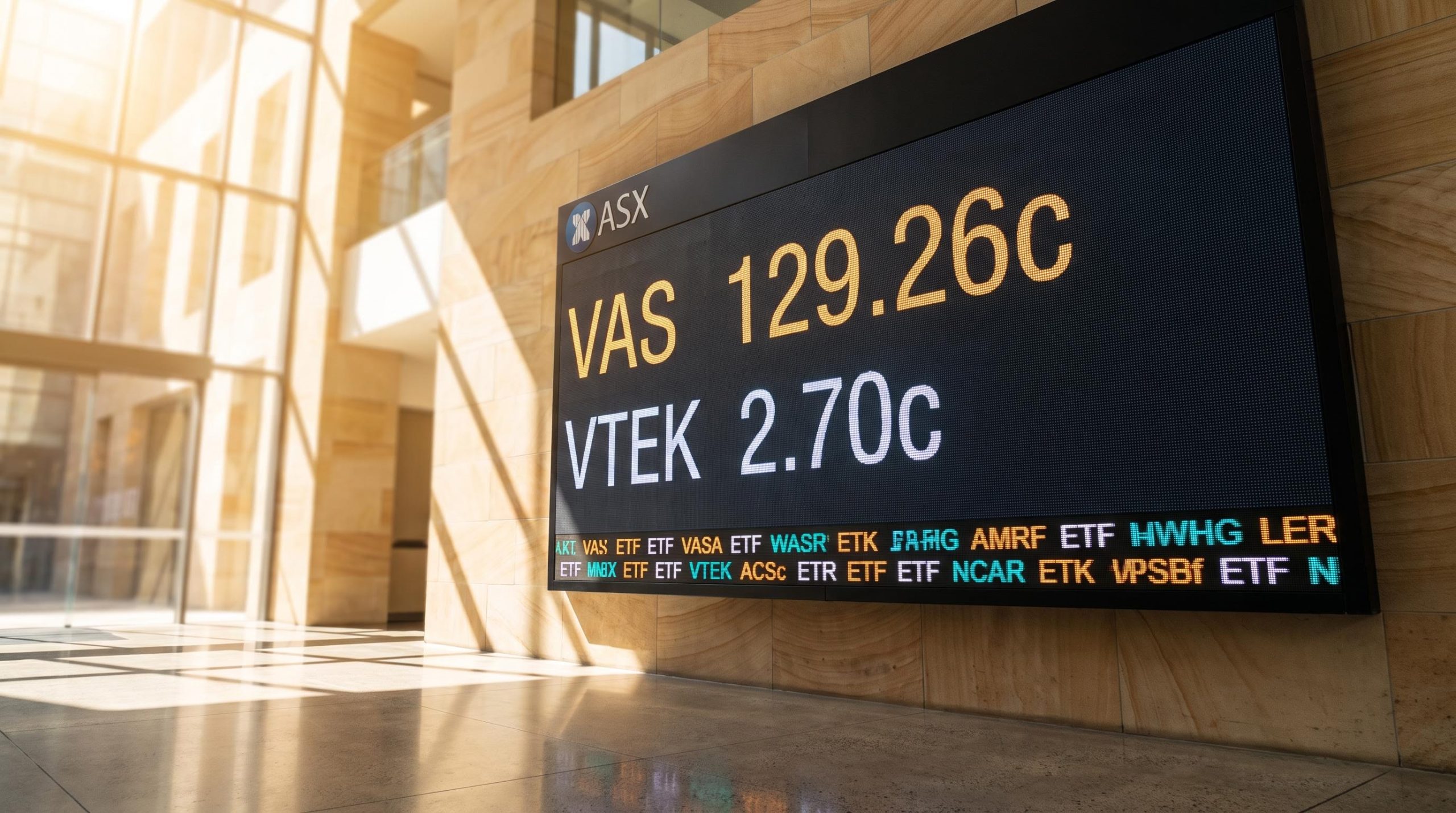
Vanguard has just published estimated payout figures for all 28 of its ASX-listed exchange traded funds, and if you hold any of them, the clock is already running. The ex-distribution date is 1 October 2026. That is days away.
This is Vanguard’s regular quarterly distribution round, not a one-off event. It covers six fund categories: Australian shares, international shares, fixed income, property and infrastructure, diversified multi-asset, and active ETFs. The cash lands on 16 October 2026.
One detail matters more than any single number here. Every figure Vanguard published on 24 September 2026 is an estimate, not a final amount. As at today, 25 September 2026, no finalised announcement has been lodged with the ASX. That distinction changes how you should use these figures for planning.
Here is the full breakdown of what each fund is estimated to pay, what drives the differences between categories, whether you are still eligible, and how to think about the tax before you touch your return.
The full estimated payout table: all 28 Vanguard ETFs for October 2026
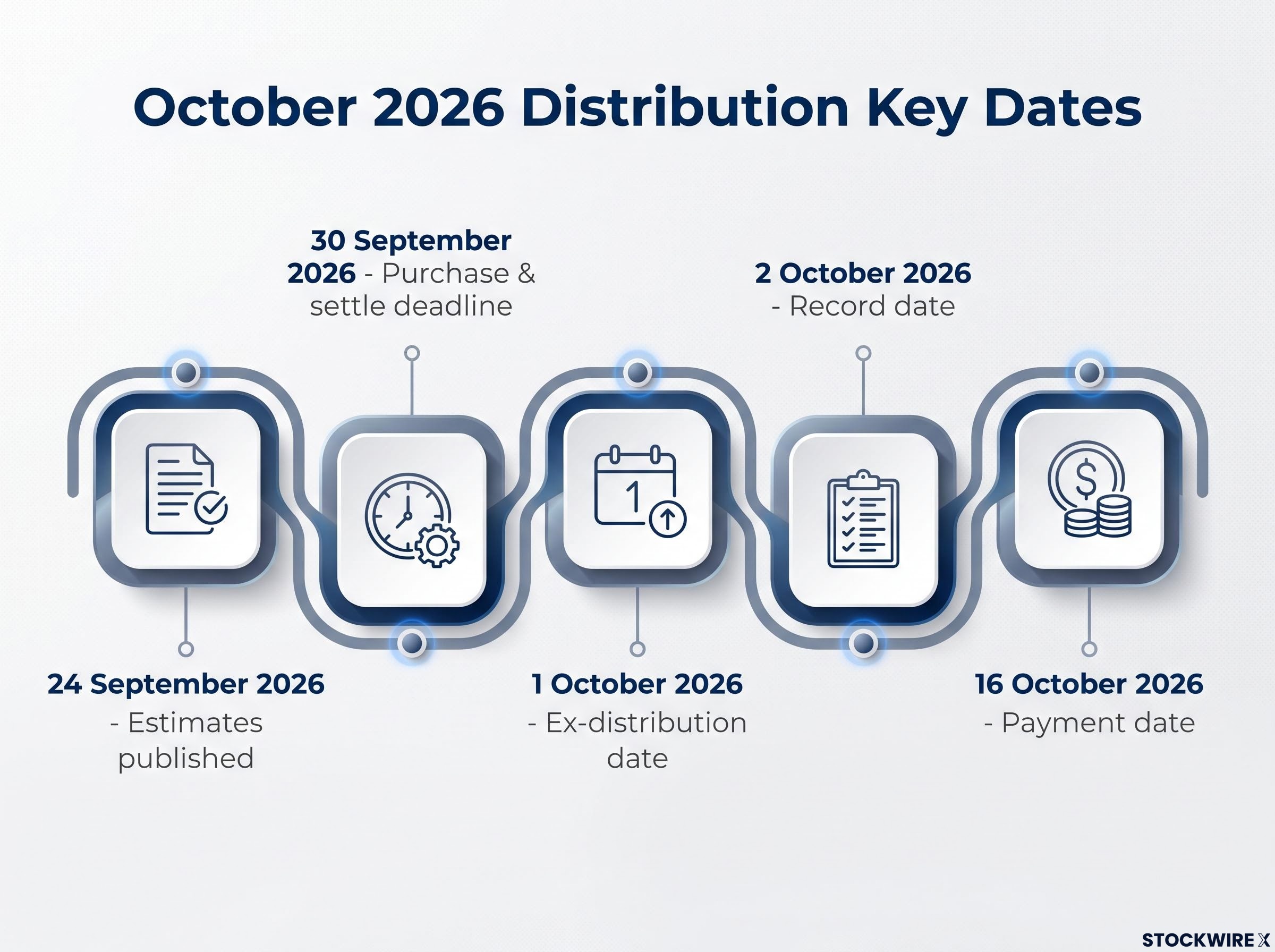
Before the numbers, hold onto the three dates that govern this entire round. They determine whether you receive anything at all.
- Ex-distribution date: 1 October 2026
- Record date: 2 October 2026
- Payment date: 16 October 2026
Every figure below is an estimated cents-per-unit (CPU) amount, current as at Vanguard’s announcement on 24 September 2026. No final version has been published as at 25 September 2026, so treat these as working numbers.
One thing to keep in mind as you scan: the spread runs from 2.70c (VTEK) all the way to 131.58c (VLC). That gap does not tell you which fund is better. It reflects structural differences in the type of income each fund throws off, which the next section unpacks. A high CPU is not a report card.
Australian shares ETFs
| Fund Name | ASX Code | Estimated CPU |
|---|---|---|
| Vanguard Australian Shares Index ETF | VAS | 129.26c |
| Vanguard Australian Shares High Yield ETF | VHY | 120.86c |
| Vanguard MSCI Australian Large Companies Index ETF | VLC | 131.58c |
| Vanguard Ethically Conscious Australian Shares ETF | VETH | 58.30c |
International shares ETFs
| Fund Name | ASX Code | Estimated CPU |
|---|---|---|
| Vanguard MSCI Index International Shares ETF | VGS | 28.89c |
| Vanguard FTSE Emerging Markets Shares ETF | VGE | 3.33c |
| Vanguard FTSE Asia ex Japan Shares Index ETF | VAE | 66.46c |
| Vanguard FTSE Europe Shares ETF | VEQ | 12.29c |
| Vanguard International Shares High Yield Index ETF | VIHY | 23.52c |
| Vanguard MSCI International Small Companies Index ETF | VISM | 16.55c |
| Vanguard S&P 500 US Shares Index ETF | V500 | 10.16c |
| Vanguard Global Technology Index ETF | VTEK | 2.70c |
| Vanguard Ethically Conscious International Shares Index ETF | VESG | 21.28c |
Fixed income ETFs
| Fund Name | ASX Code | Estimated CPU |
|---|---|---|
| Vanguard Australian Fixed Interest Index ETF | VAF | 31.43c |
| Vanguard Australian Government Bond Index ETF | VGB | 27.58c |
| Vanguard Australian Corporate Fixed Interest Index ETF | VACF | 41.55c |
| Vanguard Global Aggregate Bond Index (Hedged) ETF | VBND | 26.43c |
| Vanguard Ethically Conscious Global Aggregate Bond Index (Hedged) ETF | VEFI | 19.00c |
Property and infrastructure ETFs
| Fund Name | ASX Code | Estimated CPU |
|---|---|---|
| Vanguard Australian Property Securities Index ETF | VAP | 34.93c |
| Vanguard Global Infrastructure Index ETF | VBLD | 34.99c |
Diversified multi-asset ETFs
| Fund Name | ASX Code | Estimated CPU |
|---|---|---|
| Vanguard Diversified Conservative Index ETF | VDCO | 37.15c |
| Vanguard Diversified Balanced Index ETF | VDBA | 36.75c |
| Vanguard Diversified Growth Index ETF | VDGR | 40.31c |
| Vanguard Diversified High Growth Index ETF | VDHG | 43.88c |
| Vanguard Diversified All Growth Index ETF | VDAL | 31.20c |
| Vanguard Diversified Income ETF | VDIF | 40.71c |
Active ETFs
| Fund Name | ASX Code | Estimated CPU |
|---|---|---|
| Vanguard Global Minimum Volatility Active ETF | VMIN | 33.84c |
| Vanguard Global Value Equity Active ETF | VVLU | 31.86c |
When big ASX news breaks, our subscribers know first
Why payouts differ so much: what drives each category’s distribution
The gap between VTEK’s 2.70c and VLC’s 131.58c looks jarring until you understand what sits underneath each figure. Distributions are not a quality score. They are a direct reflection of the kind of income the fund’s holdings generate.
Here is the quick framework before the detail:
- Australian equity ETFs: franked dividends from banks and resources stocks, plus occasional capital gains from index changes.
- International equity ETFs: foreign dividends net of withholding tax, no franking credits, and currency translation effects.
- Fixed income ETFs: interest income tied to prevailing bond yields, relatively stable quarter to quarter.
- Property and diversified ETFs: REIT rental income for property, and a blend of everything for the multi-asset funds.
VAS and VHY sit at the high end because they pay out domestic dividend flows from Australia’s dividend-heavy banks and miners, along with the franking credits attached. That income concentration is exactly why their CPU figures dwarf a global technology fund’s.
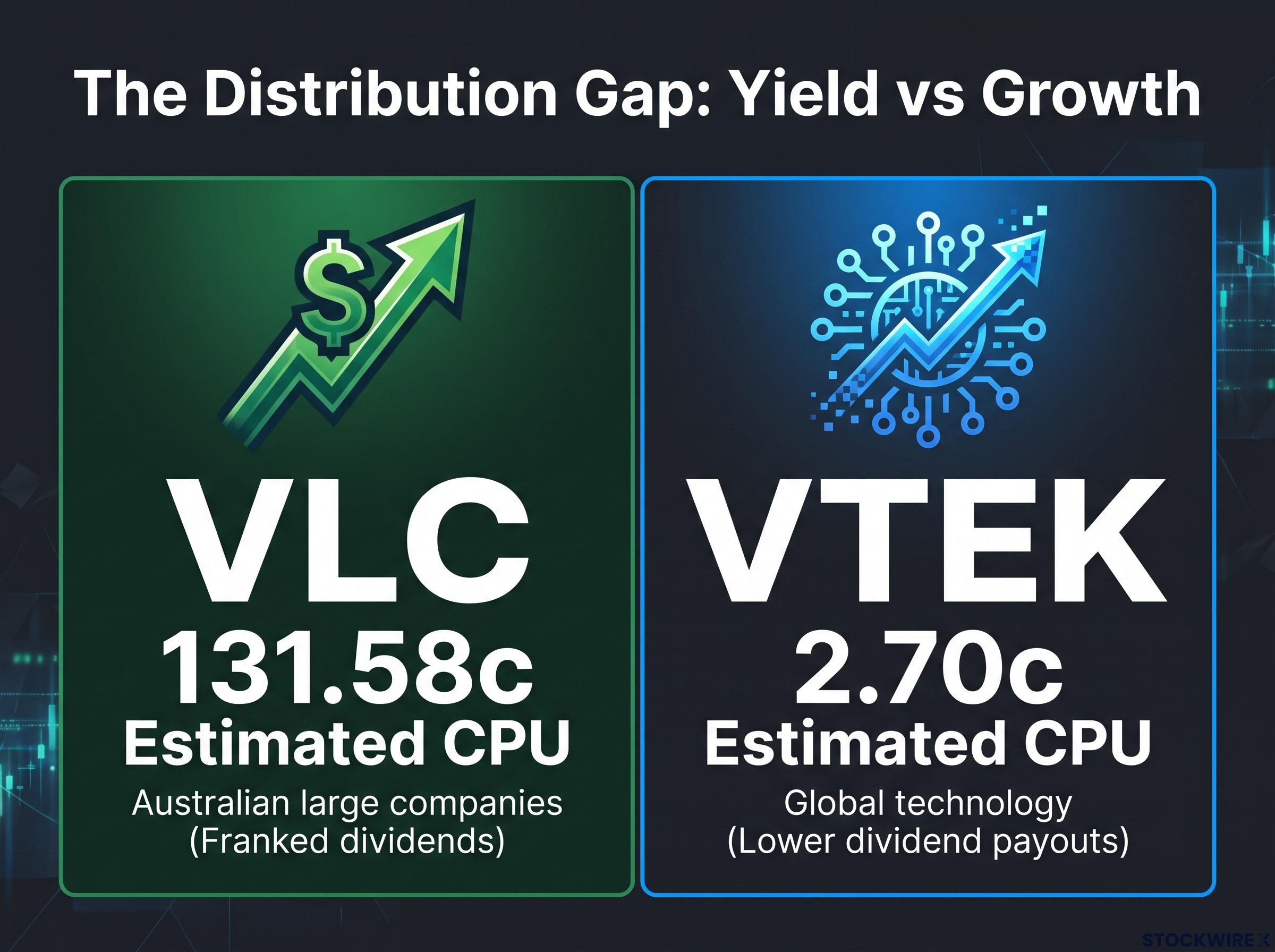
The low international numbers tell the opposite story. VTEK at 2.70c and VGE at 3.33c are not underperforming. Technology and emerging market companies simply pay out less of their earnings as dividends, so there is less cash to distribute. You are holding those funds for growth, not income.
The diversified funds are where the picture gets genuinely complex. VDHG’s estimated 43.88c and VDGR’s 40.31c are not yield figures at all. They blend franked dividends, interest, foreign income, and realised capital gains from rebalancing across asset classes. Treating VDHG’s payout as though it were a bond fund’s yield would be a planning error.
That capital-gains element is easy to underestimate. When a diversified fund rebalances or manages its creation and redemption baskets, it can realise gains that then flow through to you as part of the distribution.
Morningstar observation Analysis of VDHG has noted that distribution differences between the ETF and the unlisted fund versions of Vanguard’s strategies are driven largely by different treatment of capital gains. Investors who extrapolate from unlisted-fund data can be caught out by outcomes they did not expect.
Fixed income sits at the calmer end. VAF, VGB and VACF distribute interest income closely tied to prevailing yields, which makes their payouts more stable and predictable than any equity fund.
One calendar quirk worth flagging: not every Vanguard ETF runs on the 1 October ex-date. VEU operated on a separate ex-date of 18 September 2026 while still paying on 16 October, a reminder that CDI-structured funds can run their own schedule inside the same payment cycle.
Am I eligible? How the ex-distribution date and settlement work
This is the part that decides whether any of those numbers apply to you. And for this round, the honest answer is that the decision window has effectively closed.
The ASX settles trades on a T+2 basis, meaning a purchase takes two business days to settle and place you on the register. With an ex-distribution date of 1 October 2026 and a record date of 2 October 2026, you needed to have bought and settled your units by 30 September 2026 to qualify.
The ASX T+2 settlement rules require that equity trades, including ETF purchases, clear two business days after execution, which is the mechanical reason why buying on or after the ex-distribution date leaves you off the register for that payment round.
Buying on or after 1 October gives you no entitlement to this distribution. If you are reading this on 25 September and have not yet purchased, you are at the very edge of that window, and for most practical purposes past it once settlement is factored in.
There is also a common mistake worth naming directly. Buying just before the ex-date purely to grab the distribution is usually self-defeating.
The same logic that makes buying just before the ex-date self-defeating also underlies the broader dividend trap problem on the ASX, where ETF trailing yields can be temporarily inflated by one-off capital gains from index rebalancing events, overstating the repeatable income a position actually delivers.
The dividend trap (ASIC MoneySmart) On the ex-distribution date, the unit price typically falls by roughly the amount of the distribution. Buying in to capture the payout leaves you no better off before tax and transaction costs. The market has already priced it in.
If you already hold the units, your eligibility is settled and your focus shifts to logistics. Work through this short checklist before the payment date:
- Confirm your units were purchased and settled before 1 October 2026, which secures your place on the register.
- Verify your bank account details or distribution reinvestment plan (DRP) election are current with Vanguard’s registry, so the payment or reinvestment goes through cleanly.
- Record the payment date of 16 October 2026 for your cash-flow planning, and keep every tax statement for correct reporting later.
For eligible holders, that is genuinely all there is to do right now. For anyone who missed the window, the calmer play is to wait rather than force a rushed purchase that the ex-date pricing will neutralise anyway.
Tax treatment, AMIT attribution, and the franking credit rules
Once the cash arrives, the tax question begins, and this is where investors with larger holdings tend to lose money to avoidable mistakes. The single most important idea to grasp is that the amount you receive and the amount you are taxed on are not always the same figure.
That is because Vanguard’s ETFs operate under the Attribution Managed Investment Trust (AMIT) regime. Under AMIT, the fund attributes taxable income to you, which can differ from the cash actually distributed.
The AMIT caveat (Vanguard PDS) Distributions may be based on estimates and may exclude certain income types, so the taxable income attributed to you can diverge from the cash you receive. This is the one thing to understand before you report anything on your return.
For the Australian equity funds, there is a specific hurdle for franking credits. If you hold VAS, VHY or VLC, the 45-day holding rule applies.
According to ATO guidance, you must have held your units at risk for at least 45 days, excluding the day you bought and the day you sold, to be eligible to claim franking credits on the franked portion of your distribution. Miss that threshold and the credits are off the table.
The 45-day holding rule is only one dimension of franking credit eligibility; the broader mechanics of how credits are calculated, grossed up, and refunded to zero-tax investors involve rules that catch many ETF holders off guard when they first review their tax statement.
International equity funds work differently again. VGS, VGE, VEQ, V500, VTEK and VESG distribute foreign dividends net of withholding tax, with no Australian franking credits attached. You may be able to access foreign income tax offsets, but only careful review of your annual tax statement will confirm what applies.
The diversified funds produce the most complex statements of all. Here is how the categories compare:
| ETF category | Key tax characteristic |
|---|---|
| Australian shares ETFs | Franked dividends; 45-day rule applies for franking credit eligibility |
| International equity ETFs | Foreign dividends, withholding tax deducted, no franking credits, foreign income tax offsets may apply |
| Fixed income ETFs | Interest income, fully assessable, no franking |
| Diversified ETFs | Mixed income and capital gains, complex AMIT statement, wait for the annual tax statement |
If you hold VDHG, VDGR, VDBA, VDCO, VDAL or VDIF, do not report the cash received as a single income line. Vanguard provides an annual tax statement itemising dividends, interest, capital gains, foreign income and franking credits, and that statement, not the estimated CPU, is the document your tax decisions should rest on.
Report a VDHG distribution as plain income without checking that statement, and you risk both overpaying and underpaying, because capital-gain components are taxed differently and foreign income may carry offsets you are entitled to claim.
What the October estimates mean for your planning (and when final figures arrive)
The most useful frame to leave with is this: these numbers are helpful, but they are provisional. The 24 September 2026 announcement is explicitly labelled as an estimate, and no finalisation has been lodged with the ASX as at 25 September 2026.
Final CPU amounts can still shift. If late-arriving dividend data, foreign tax adjustments, or currency movements differ from the assumptions Vanguard used, the numbers can move, particularly for international and multi-asset funds where more variables are in play.
This round is part of Vanguard’s standard quarterly cadence, governed by the Indicative Distribution Calendar lodged on 23 March 2026. Here is the sequence to keep in view:
For context on how this October round compares, the mid-year distribution cycle that closed on 30 June 2026 saw VVLU pay 626.68 cents and V500 pay just 11.80 cents, a spread driven by the same structural dynamics now producing the October gap between VLC and VTEK.
- Ex-distribution date: 1 October 2026
- Record date: 2 October 2026
- Payment date: 16 October 2026
- Next ex-distribution date: 4 January 2027 (payment 19 January 2027)
So how should you actually use the estimates? The line advisers tend to draw is between rough planning and precise decisions.
- Treat the estimated CPU figures as indicative for rough cash-flow planning only, not as locked-in income.
- Monitor ASX announcements for the final distribution release ahead of the 16 October 2026 payment date.
- Wait for your annual tax statement before making any precise tax calculations or adjusting your income reporting.
If you are a retiree or income-focused investor leaning on these distributions for quarterly spending, this matters practically. Treat VDHG’s 43.88c as a working estimate, not a confirmed deposit, and build a small buffer into your cash-flow plan for the period before the final figure lands.
This article is for informational purposes only and should not be considered financial advice. Investors should conduct their own research and consult with financial professionals before making investment decisions. Past performance does not guarantee future results, and estimated distribution figures are subject to change based on market conditions and various risk factors.
Acting on Vanguard’s October distributions with clear eyes
The two takeaways worth carrying forward are simple. Your eligibility for this round is already settled, because the 30 September 2026 purchase-and-settle window has passed, so the job now is logistics and tax preparation, not a last-minute trade.
Keep the estimated-versus-final distinction front of mind right through to payment. Watch the ASX feed for a finalisation announcement before 16 October 2026, and treat your annual tax statement as the authoritative document when you file.
Here is what to do now:
- Confirm your bank details and DRP election are current before the record date.
- Track the ASX for the final distribution figures ahead of the 16 October payment.
- Note the next ex-date of 4 January 2027 if you are planning a future entry or reinvestment around the quarterly cycle.
For investors planning a new entry around the January 2027 ex-date and wanting a structured framework before selecting which Vanguard fund to buy, our dedicated guide to evaluating ETF exposure and costs walks through the eight-step due diligence process, including how fund names can mask concentration risk and why distribution reinvestment plans still trigger a tax bill.