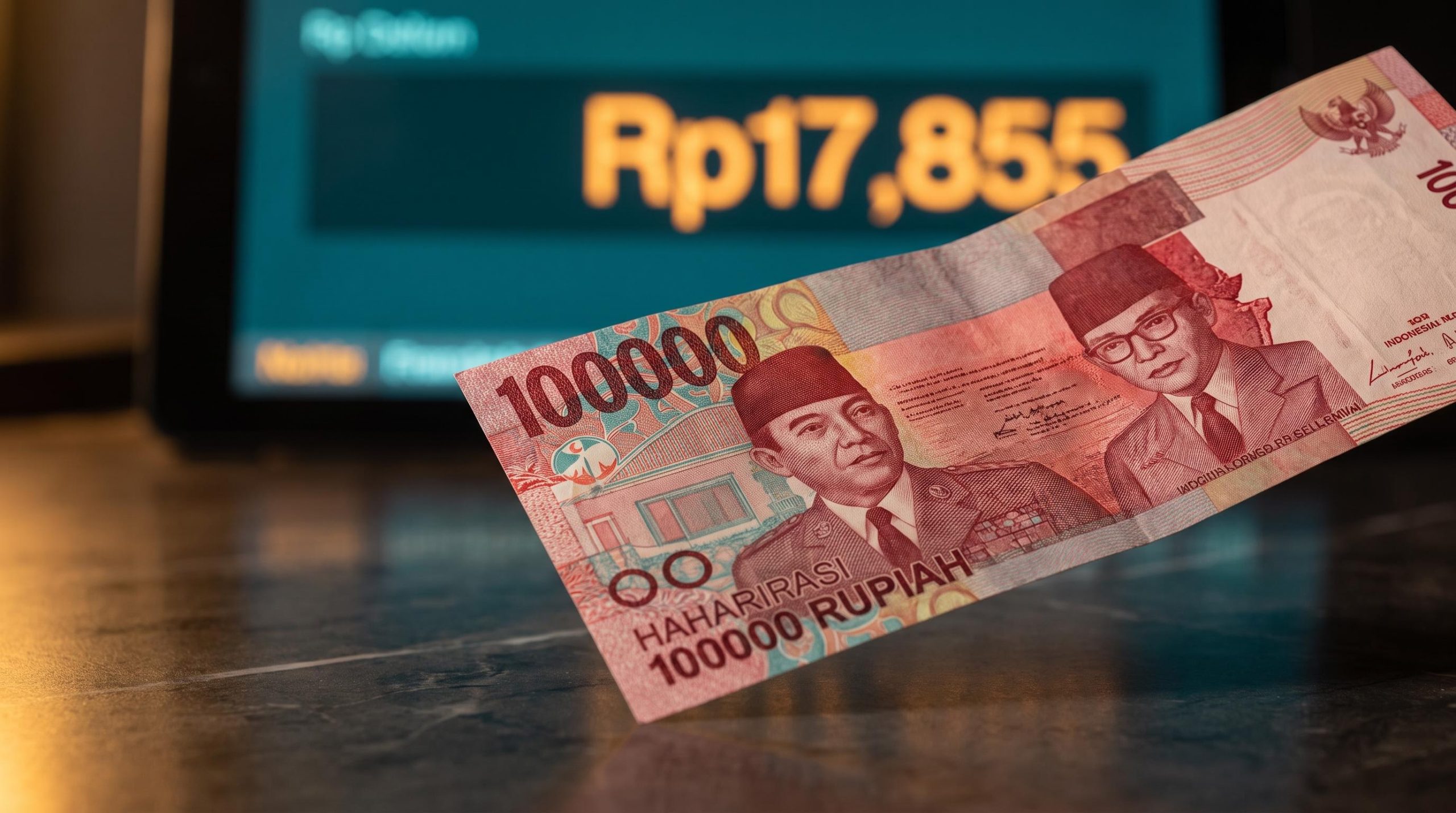
Here is a currency losing ground and a central bank that decided the last thing it needed was higher interest rates. That decision, and the tool Bank Indonesia reached for instead, is the reason this policy meeting is worth understanding.
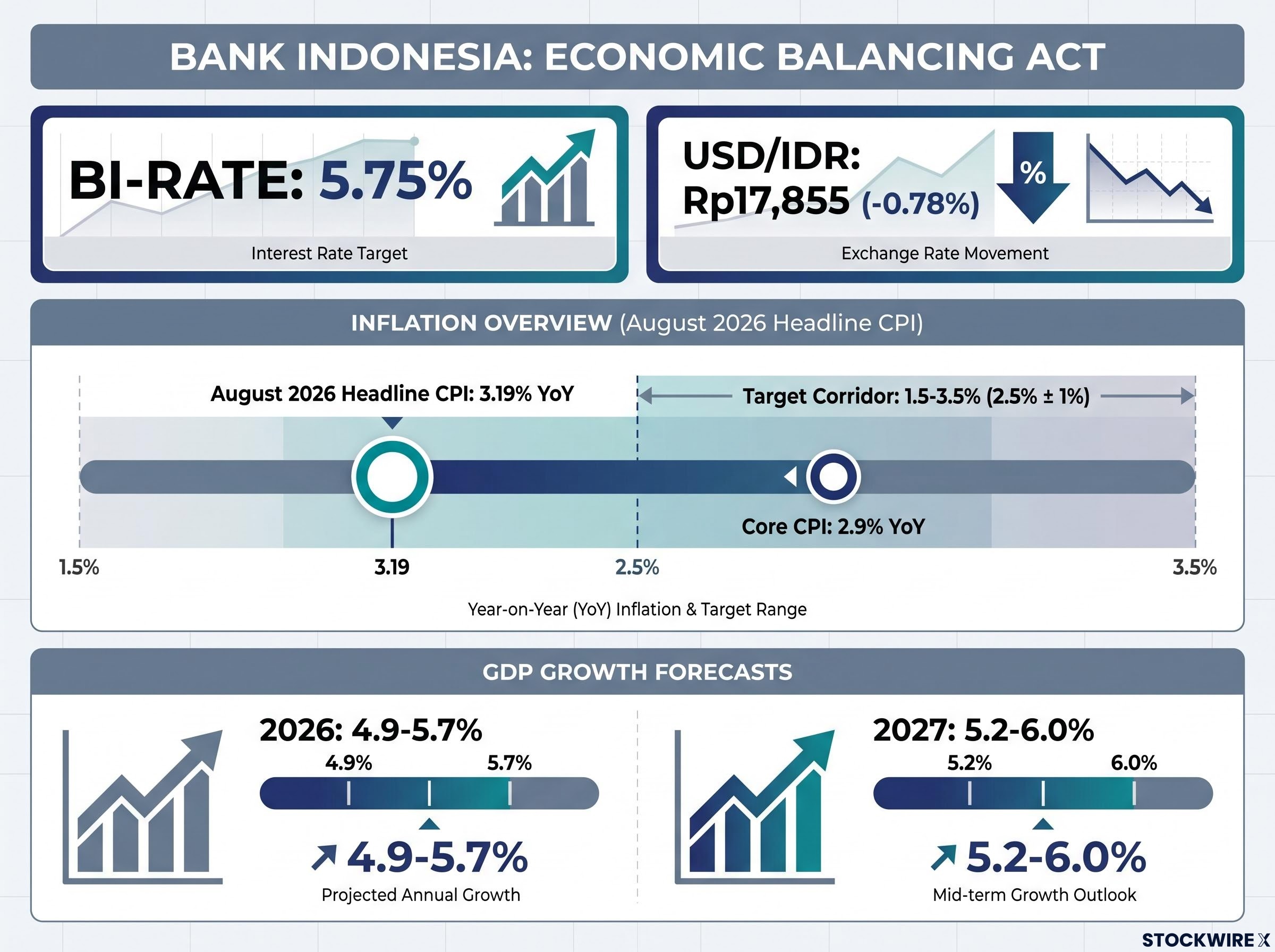
In September 2026, Bank Indonesia (BI) held its benchmark rate at 5.75% for the third meeting in a row, even as the rupiah sat at Rp17,855 per US dollar, having weakened 0.78% against the previous month-end. The core tension is not hidden: BI is trying to support a domestic economy running below its potential, with a 2026 GDP growth forecast of 4.9-5.7%, while also defending a currency under steady external pressure.
Understanding Bank Indonesia’s monetary policy right now means understanding a choice about instruments, not just interest rates. What follows maps the decision, the hedging tool BI deployed instead of tightening, and the specific conditions that would push the central bank off its current path.
Why Bank Indonesia held rates for the third time in a row
This was not a central bank standing still. The September 2026 hold followed 100 basis points of rate hikes across May and June 2026, which reframes the current stance as a consolidation phase: BI raised aggressively, then paused to let those moves work through the economy.
BI’s May 2026 shock hike of 50 basis points, delivered as an emergency rupiah defence rather than a domestic inflation response, is the starting point for the 100-basis-point tightening sprint that makes the current consolidation phase legible: the central bank moved fast precisely because it needed to create room to hold.
The dilemma sits in two data points that pull in opposite directions. Headline inflation reached 3.19% year-on-year in August 2026, comfortably inside BI’s 2.5% plus or minus 1% target corridor but pressing toward the upper portion of that band. At the same time, the economy is growing below its capacity, which is precisely why further tightening carries a real cost.
Here are the figures that define the balancing act:
- BI-Rate: 5.75%, unchanged for a third consecutive meeting
- August 2026 headline CPI: 3.19% year-on-year; core CPI: 2.9% year-on-year
- Inflation target corridor: 2.5% plus or minus 1% (a range of 1.5-3.5%)
- 2026 GDP growth forecast: 4.9-5.7%; 2027 forecast: 5.2-6.0%
- USD/IDR at the decision: Rp17,855, down 0.78% point-to-point from end-August
Newly appointed Governor Destry Damayanti, who took the role earlier in September 2026, signalled that the prevailing rate is enough to preserve stability while acknowledging the economy still needs support.
Governor’s signal BI indicated the current rate is sufficient to maintain stability and confirmed it is actively evaluating policy instruments beyond interest rate adjustments to navigate global uncertainty.
That combination, inflation near the top of the band and growth beneath capacity, tells you BI is not simply being cautious. It faces a genuine bind: tightening further to protect the rupiah risks squeezing an economy that is already underperforming. That is why the rate hold alone cannot be the whole story, and why the FX instrument BI introduced alongside it is the actual policy signal rather than a footnote.
When big ASX news breaks, our subscribers know first
What the new FX hedging swap structure actually does
If you were watching BI’s operations on a screen, the change you would notice is not the rate. It is the discount schedule on FX hedging, which shifted from a single flat number to a graduated ladder.
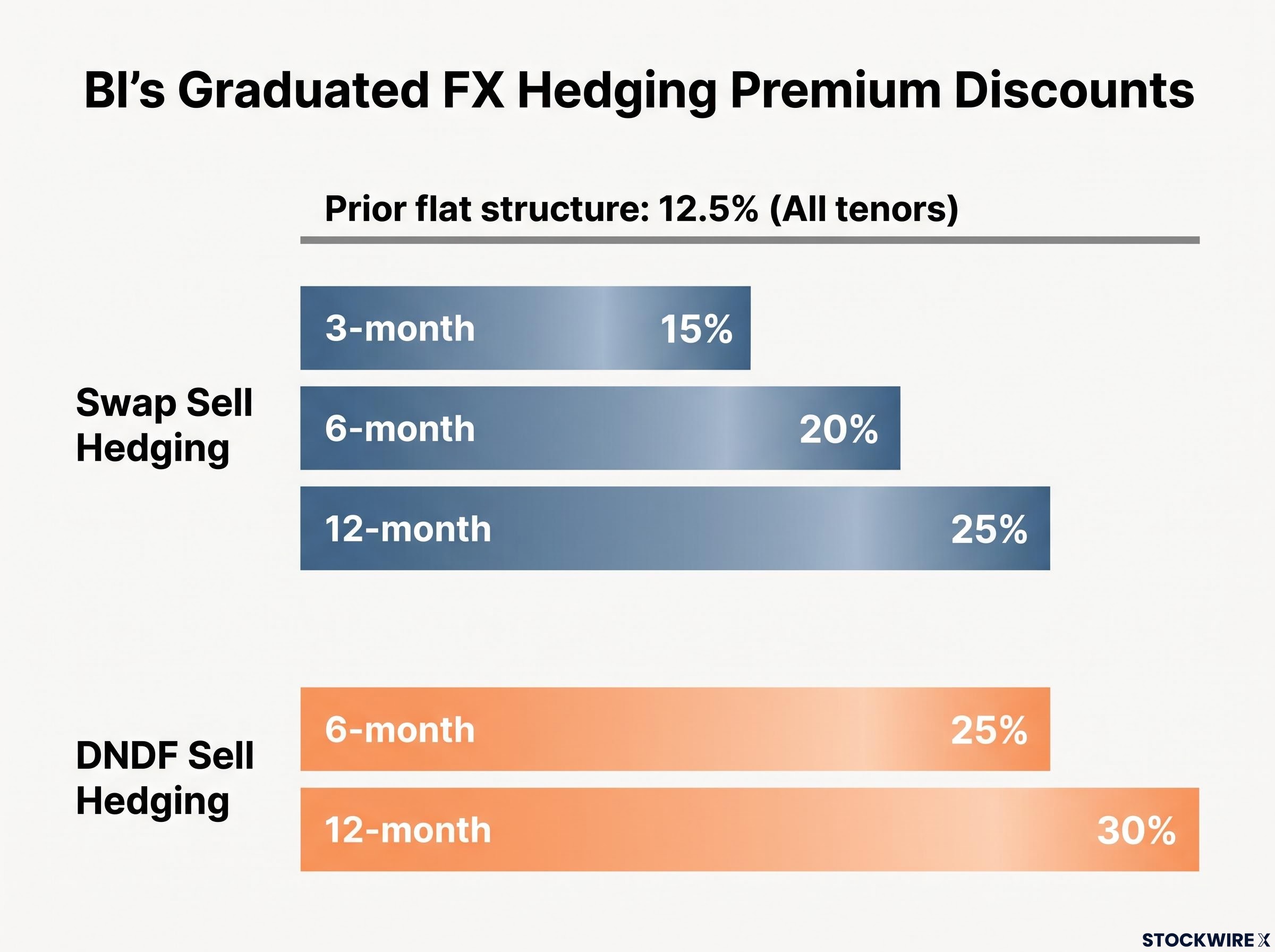
Previously, BI applied a flat 12.5% premium discount across every tenor, meaning the cost of hedging was the same whether a bank locked in cover for three months or twelve. The revised structure replaces that uniformity with tiers that reward longer commitments, and the incentive logic is deliberate: the further out you hedge, the better the terms.
A quick definition before the numbers. A hedging swap here lets a bank or investor lock in a future exchange rate with BI, protecting an FX position against rupiah moves. The premium discount is effectively how much cheaper BI makes that protection.
| Instrument | Tenor | Discount Rate |
|---|---|---|
| Prior flat structure (all instruments) | All tenors | 12.5% |
| Swap Sell Hedging | 3-month | 15% |
| Swap Sell Hedging | 6-month | 20% |
| Swap Sell Hedging | 12-month | 25% |
| DNDF Sell Hedging | 6-month | 25% |
| DNDF Sell Hedging | 12-month | 30% |
The second instrument in that table, the Domestic Non-Deliverable Forward (DNDF), is a rupiah forward contract settled in a foreign currency rather than through physical delivery of rupiah. It lets investors hedge rupiah exposure without moving rupiah offshore, and BI has now made its longer-dated DNDF cover the cheapest tier available.
How the incentive changes behaviour in the FX market
The causal chain is straightforward once the pricing is clear. Cheaper hedging premiums make BI’s onshore instruments more attractive than offshore speculation or spot-market bets, which pulls FX activity into channels BI can see and manage. That concentration of activity is what reduces disorderly rupiah volatility and hands the central bank better visibility into where positioning actually sits.
The graduated tenor design does more than cut costs. By making twelve-month cover the best deal, BI is trying to shape a more durable mix of FX flows, capital that does not bolt at the first flicker of global risk aversion.
One thing this does not do: it leaves the interest-rate gap between Indonesia and advanced economies untouched. That makes the instrument a complement to rate policy, not a replacement for it.
For anyone tracking Indonesia as an investment destination or managing emerging-market currency exposure, the signal is meaningful. BI has shown it will take FX risk onto its own balance sheet to keep markets orderly, and that willingness feeds directly into how rupiah volatility gets priced.
The limits of hedging tools as a currency defence
The instrument has a clear logic. It also has a clear edge, and honesty about where its reach ends matters more than enthusiasm for what it can do.
Three limitations define the boundary:
- The interest-rate differential with advanced economies persists regardless of hedging terms
- Short-term flows attracted by cheap hedging can still exit fast when risk sentiment turns
- BI absorbs balance-sheet cost and rollover risk by expanding its swap and DNDF positions
Take each in turn. If global yields stay well above Indonesian rates, the rupiah can face pressure no matter how generous the hedging discounts are, because the fundamental return gap does not close. The flows drawn in by attractive premiums are often the same flighty capital that reverses in a downturn, so the instrument manages existing exposure more than it guarantees durable inflows. And by writing more swaps and DNDFs, BI expands its own contingent liabilities, taking on maturity mismatches that can become expensive if the rupiah depreciates sharply or global conditions worsen.
IMF research on EMDE central bank interventions documents how domestic non-deliverable forwards and FX swap facilities expand central bank contingent liabilities, with balance-sheet costs that can compound sharply if the domestic currency depreciates during the period when positions are open.
Indonesia’s underlying vulnerabilities sharpen these limits. As a significant commodity exporter exposed to global risk-sentiment swings, its fundamentals can be knocked by a commodity price downturn or a broad flight from emerging-market assets, shocks that hedging incentives are not built to absorb. BI’s own February 2026 Monetary Policy Review flagged persistently high global financial market uncertainty as a key external vulnerability, and the central bank has been explicit that hedging incentives complement conventional tools rather than replace them.
The analyst read Commerzbank analysts Henry Hao and Moses Lim, reported by FXStreet, project BI will hold at 5.75% through year-end, assessing that the current rate and inflow-support mechanisms are adequate provided inflation stays within target and rupiah moves remain orderly.
That projection is more than a forecast. It is a map of the exact conditions BI is watching, which means any break from “orderly rupiah moves” or “inflation within target” is the trip wire that would shift the central bank off its path. For anyone positioning around Indonesian assets, the distinction to hold onto is between a currency that is defended and one that is structurally stable. BI’s tools can smooth volatility. They do not remove the tail risk of a disorderly move if global conditions deteriorate.
For investors wanting a detailed view of the rupiah’s medium-term trajectory, our full explainer on the USD/IDR outlook maps the key technical levels, reserve dynamics, and commodity exposure that determine whether Rp17,855 is a floor or a staging point for further weakness.
How BI’s approach compares to other emerging-market central banks
BI’s playbook, a steady policy rate paired with enhanced FX hedging, is not improvisation. It sits within a recognisable family of emerging-market strategies that lean on FX swap auctions, non-deliverable forwards, and macroprudential measures to manage currency volatility without front-loading rate hikes.
The contrast is with a different orientation entirely. Some emerging-market central banks defend their currencies primarily through yield, accepting slower growth to hike rates and anchor expectations. That approach buys currency support through higher returns; BI’s approach buys it through instrument design and orderly-market operations.
Asian FX reserve adequacy is directly relevant here: cumulative equity outflows across the region reached $134 billion through mid-June 2026, and the PBOC’s management of yuan stability through engineered fixing deviations illustrates how even the largest reserve pools require active instrument deployment rather than passive defence.
| Dimension | Hedging-centric approach | Rate-led defence |
|---|---|---|
| Primary tool | FX hedging incentives, macroprudential measures | Front-loaded policy rate hikes |
| Growth trade-off | Preserves growth continuity | Accepts slower growth to anchor expectations |
| Balance-sheet impact | Higher, via expanded swap and DNDF positions | Lower balance-sheet exposure |
| Speed of response | Gradual, market-smoothing | Rapid, expectations-driven |
BI frames its own policy mix as pro-growth, combining monetary, macroprudential, and FX operations rather than relying on any single lever.
Why BI’s growth context shapes its policy tolerance
The 4.9-5.7% growth forecast is the reason the hedging-centric approach is coherent on BI’s own terms. When growth is already running below capacity, a rate hike front-loads its cost onto the real economy while its currency benefit remains contingent on global conditions cooperating. That maths tilts BI away from tightening.
The calculus flips only if inflation breaks above the 3.5% ceiling or if rupiah depreciation turns disorderly. That is the forward-guidance signal embedded in BI’s communications, and it tells you the threshold for a rate move here is materially higher than in a more hawkish emerging-market peer.
What would push Bank Indonesia to change course?
Everything above converts into a monitoring framework. You do not need to guess at BI’s next move if you know which conditions it has told you it is watching.
| Tightening triggers | Easing conditions |
|---|---|
| Disorderly rupiah depreciation disconnected from fundamentals | Inflation remaining firmly inside the 2.5% plus or minus 1% corridor |
| Headline or core inflation persistently above the 3.5% ceiling | Growth continuing below capacity, calling for support |
| Global financial conditions tightening, amplifying outflows | No renewed downward pressure on the rupiah |
The base case, per Commerzbank’s Henry Hao and Moses Lim, is a hold through year-end. Treat that as a conditional view rather than a fixed prediction: it holds only as long as the triggers above stay dormant.
For readers wanting to understand the external conditions that could most rapidly invalidate BI’s current framework, our deep-dive into geopolitical energy shocks and forward guidance examines how Brent crossing $100 on 9 September 2026 rendered inflation baselines obsolete before the next scheduled central bank meeting.
Governor Damayanti has signalled that rupiah depreciation pressures are currently seen as contained, which is why the FX instruments are doing the work rather than the rate. But look at the inflation buffer. With August headline CPI at 3.19% and the ceiling at 3.5%, the gap is narrow enough that a single adverse month of price data could materially shift the calculus.
That is the practical takeaway for anyone tracking Indonesia. You are watching two or three data points, the inflation print, the rupiah’s behaviour, and the tenor of global financial conditions, and you know in advance what level of movement in each would qualify as the signal to reprice BI’s stance.
This article is for informational purposes only and should not be considered financial advice. Investors should conduct their own research and consult with financial professionals before making investment decisions.
Financial projections are subject to market conditions and various risk factors. Forward-looking statements are speculative and subject to change based on economic developments.
A playbook built for now, with clear boundaries
Strip BI’s strategy to its essence and it reads as a single sentence: hold the rate at 5.75%, enhance the FX instruments, and set a high threshold for conventional tightening, with the rupiah’s orderliness and the 3.5% inflation ceiling as the two visible trip wires.
The hedging tools are credible inside that scope. They smooth volatility and pull FX activity into channels BI can manage. What they do not do is remove Indonesia’s structural exposure to global risk-sentiment shifts or commodity price cycles, and that gap between defended and durably stable is where the real risk lives.
For anyone with exposure to Indonesian assets or emerging-market currency markets, the value here is durability. BI has drawn a clear, public map of its own decision boundaries, which is itself a form of policy credibility. The instruments may evolve, but the logic governing the choices is now legible. The open question is not what BI wants to do; it is whether the external environment stays cooperative enough to let those preferences hold.