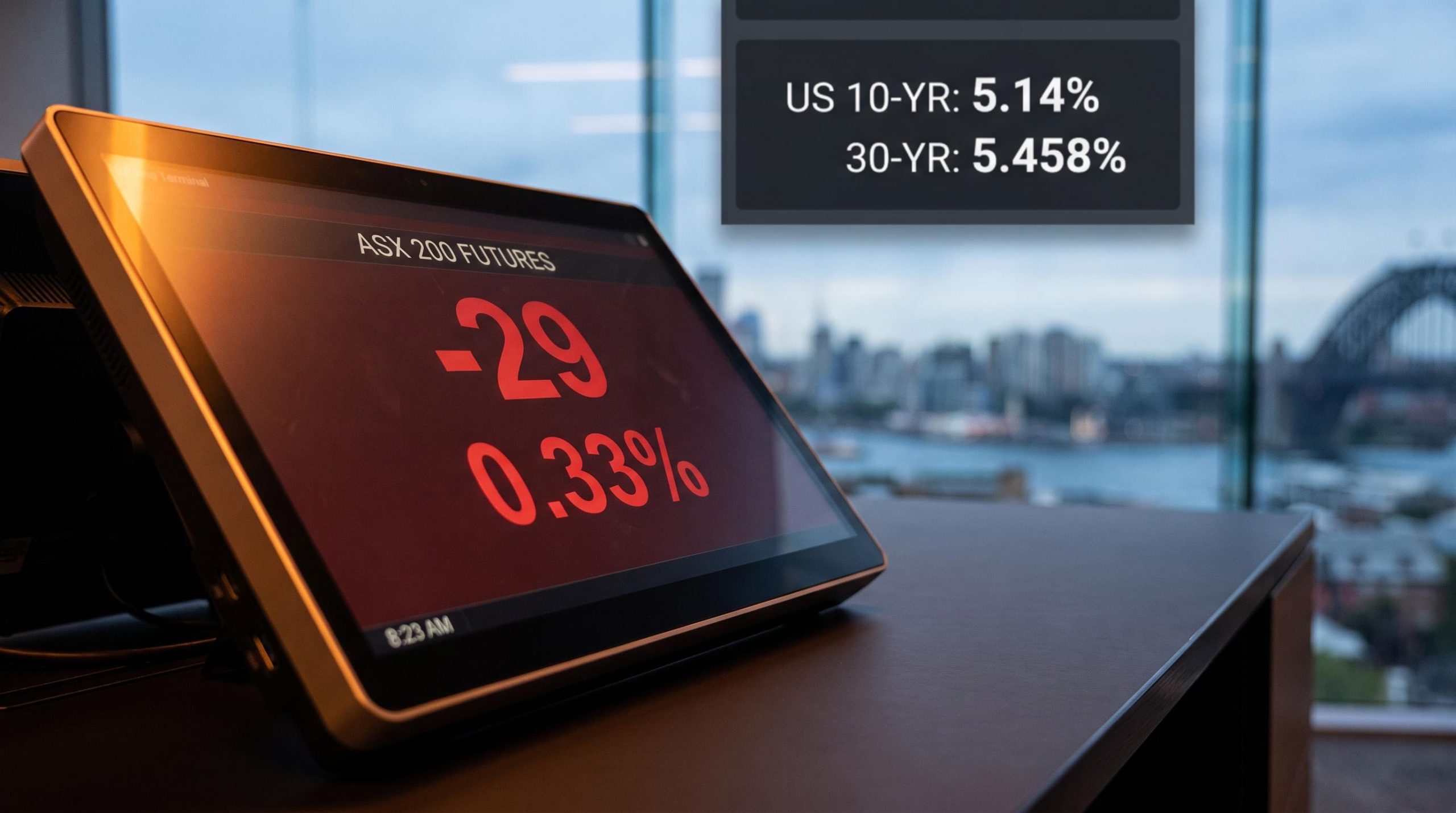
Australian equity futures are pointing to a lower start, with ASX 200 futures down 29 points, roughly 0.33%, as of 8:23 am AEST this morning. The trigger sits offshore in the bond market, where long-dated US Treasury yields have climbed to levels not seen since 2004.
On the surface, the overnight US equity session looked calm. Beneath that calm, surging long-term borrowing costs are quietly repricing risk assets around the world, and that repricing is what is dragging on the Australian market open.
The headline US index performance is a misleading indicator here. The real story is in the yields, and in the specific corners of the market that move when those yields do.
What follows maps out which domestic sectors face immediate valuation pressure this morning, why a near-flat Wall Street close hides genuine weakness, and how stalled diplomacy over the Strait of Hormuz keeps the inflation premium firmly in place.
Rate-sensitive sectors in the crosshairs as yields breach 2004 levels
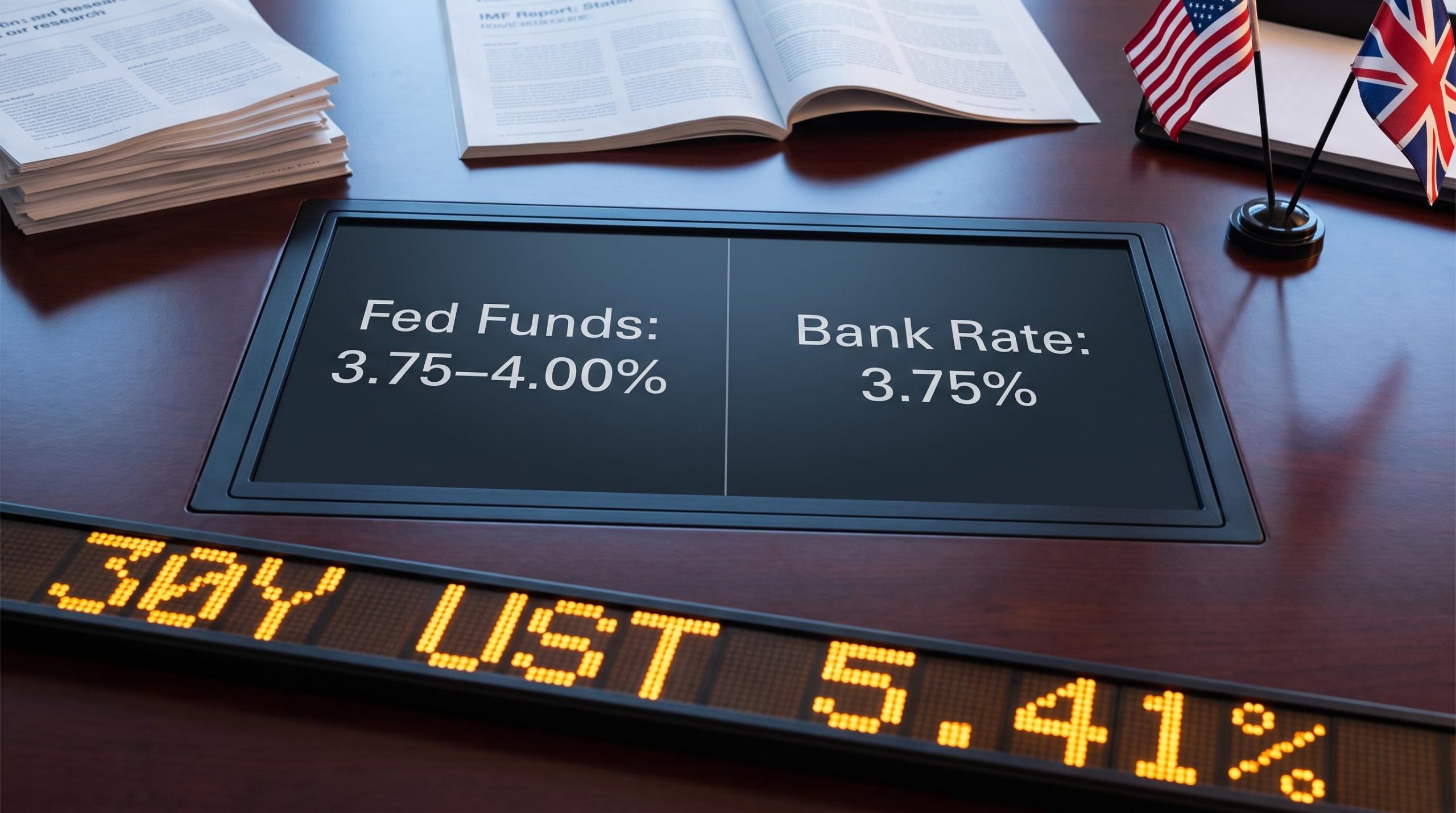
The scale of the bond move is what matters. According to Reuters reporting on 24 September 2026, the US 10-year Treasury yield sits at roughly 5.14%, while the 30-year yield has reached 5.458%, its highest level since 2004. Reuters frames this as part of a deepening global bond sell-off, not a passing inflation scare.
That distinction is the whole point. TradingEconomics, updated 18 September 2026, characterises both yields as the highest since 2004-2007, the stretch that preceded the last major tightening cycle. This looks like a structural repricing of the risk-free rate, and that has direct consequences for anything valued on future cash flows.
The current repricing fits a pattern that has been building across major economies throughout 2026, with the global bond sell-off pushing sovereign yields simultaneously higher in Germany, France, Japan, and the UK, pointing to a structural shift in the risk-free rate rather than a US-specific fiscal event.
The transmission to Australian assets is mechanical. When global benchmark yields rise, the discount rate applied to long-dated rental and infrastructure cash flows rises with them, and safer bonds start to out-compete equity income. For a dividend-heavy property or infrastructure holding, a 5%-plus risk-free alternative devalues that yield directly.
Here is where the opening pressure is likely to concentrate:
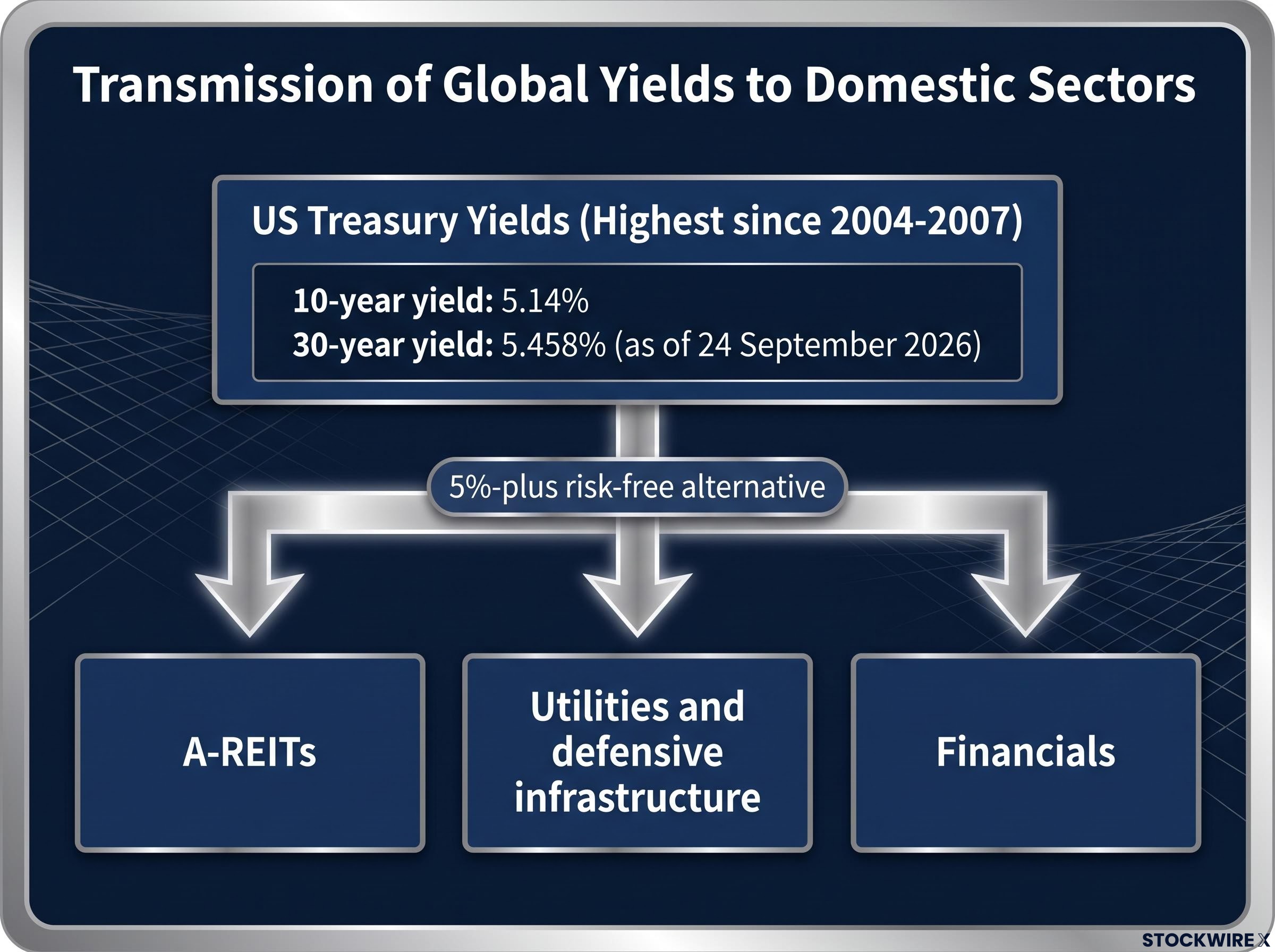
- A-REITs: Higher discount rates compress valuations for listed property trusts, with office and retail landlords carrying the thinnest yield buffers most exposed. Highly leveraged trusts also face refinancing and covenant strain as funding costs climb.
- Utilities and defensive infrastructure: These long-duration, yield-driven names tend to de-rate as investors rotate toward risk-free income, and capital-intensive operators face tighter constraints on growth and dividend plans.
- Financials: The picture is more nuanced. A steeper curve can lift bank net interest margins, but higher long yields plus tighter conditions raise credit risk across Australia’s mortgage-heavy loan books, and wholesale funding gets more expensive in a higher-for-longer world.
For the reader holding income-focused positions, the read is straightforward: the assets that felt safe on their yield are the ones repricing hardest this morning.
Why Wall Street headline stability is masking underlying weakness
A near-flat US close does not mean a calm market. The S&P 500 finished down just 0.02% overnight, having clawed back from an intraday low of around -0.51%. Taken alone, that reads as resilience.
It is not. The equal-weighted version of the same index, which strips out the distorting pull of the largest stocks, fell 0.50%. That gap between the two is the tell.
The ASX breadth divergence between headline index performance and constituent-level damage has been a persistent feature of 2026, with capitalisation-weighting allowing mega-caps such as CBA and BHP to anchor the headline number even as the majority of mid-cap and sector-specific names absorb far deeper drawdowns.
When the cap-weighted index holds flat while the equal-weighted version drops, it means a small cluster of mega-cap names is propping up the headline number while the average company sinks. This is narrow leadership, and it typically shows up when risk appetite is fragile and investors crowd into perceived safety rather than spread bets across the market.
| US index (overnight, 24 September 2026) | Change |
|---|---|
| S&P 500 (cap-weighted) | -0.02% |
| S&P 500 (equal-weighted) | -0.50% |
| Nasdaq Composite | +0.01% |
| Russell 2000 (small-cap) | -0.11% |
The Nasdaq Composite edged up 0.01% while the small-cap Russell 2000 slipped 0.11%, the same pattern in miniature: big names steady, everything else soft. As long yields rise, funding costs bite hardest on smaller and more leveraged companies, and that is exactly the cohort dragging the equal-weighted measure lower.
For the reader, this is the more useful lens. Do not take a flat benchmark as a green light. The average stock in a diversified portfolio is facing considerably tougher conditions than the index print suggests, and that caution is what is feeding through to sentiment in Sydney today.
Stalled Hormuz diplomacy locks in the inflation premium
There is a geopolitical floor under all of this. Indirect, mediator-led talks between US and Iranian officials took place on the sidelines of the UN General Assembly in New York, with reopening the Strait of Hormuz a central topic. According to Reuters on 23 September 2026, these were the first known indirect shuttle talks in months, conducted through a Qatari mediator.
The distance between the two sides remains wide. Iranian officials have said the strait could be reopened within seven days, but only if a specific set of conditions is met first.
The Hormuz oil risk premium has proven durable across multiple rounds of diplomacy throughout 2026, with war-risk insurance withdrawals and shipping route constraints meaning that even a formal ceasefire declaration is unlikely to restore oil supply flows quickly enough to remove the inflation bid from bond markets.
Iran’s preconditions for reopening the Strait of Hormuz Lifting the US naval blockade, releasing frozen Iranian assets, and easing military pressure on Iran. Iranian parliament speaker Mohammad Bagher Ghalibaf stated on 21 September 2026 that Tehran “will not allow the reopening of the Strait of Hormuz until all of its conditions have been met.”
As of 24 September 2026, Anadolu Agency reports that no agreement has been reached and talks remain stalled, with oil prices firming on the impasse. That stalemate matters directly to the reader’s portfolio. Higher oil supports the very inflation expectations pushing long yields to multi-decade highs, so while the strait stays shut, the inflation premium embedded in bond markets, and the pressure it puts on rate-sensitive holdings, stays elevated too.
Navigating the Friday session amid tight global conditions
The Australian trading day opens under three compounding weights: yields at levels last seen in 2004-2007, US market breadth narrowing around a handful of mega-caps, and a Hormuz stalemate keeping energy and inflation risk alive. The 29-point futures deficit is the visible output of all three.
A weaker Australian dollar could sharpen the pressure, since elevated US yields tend to pull capital toward US fixed income and raise offshore funding costs for domestic corporates. That capital gravitation, US bonds over local equities, is the underlying current beneath this morning’s weakness.
Today is a test of domestic corporate resilience against imported tightening, with A-REITs, utilities, and leveraged financials the sectors to watch first.
For readers wanting to understand why bond market pressure has become the primary forcing mechanism on global policy decisions in 2026, our full explainer on how yields now drive policy covers the specific channels through which sustained high rates reshape White House decision-making in ways that equity index moves no longer can.
This article is for informational purposes only and should not be considered financial advice. Investors should conduct their own research and consult with financial professionals before making investment decisions.
Past performance does not guarantee future results. Financial projections are subject to market conditions and various risk factors.