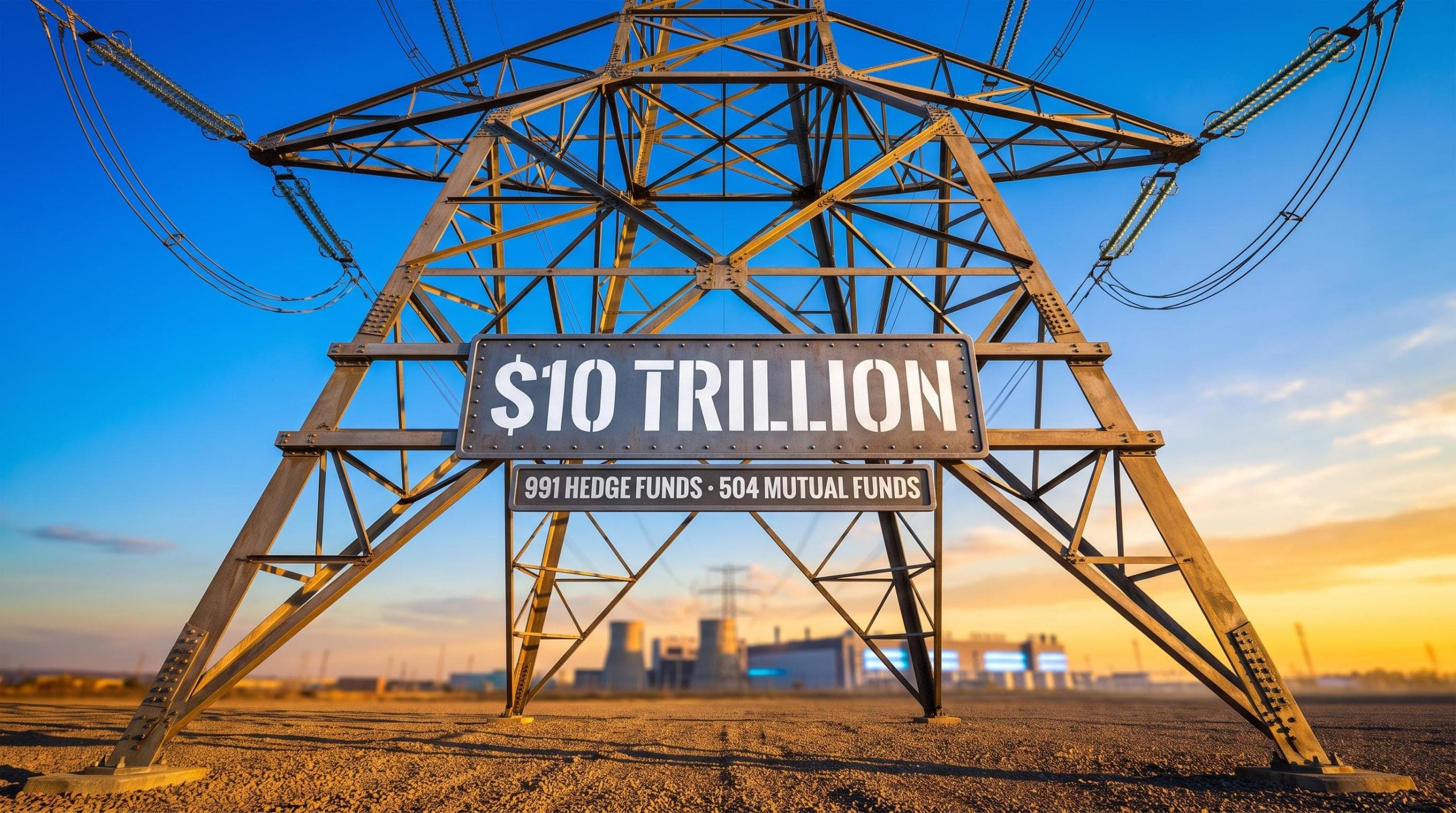
Goldman Sachs just finished scanning nearly $10 trillion in equity assets across 1,495 funds, and the clearest signal it found is not which AI software company is winning. It is that hedge funds and mutual funds are quietly converging on the same power utilities, contract manufacturers, and storage providers sitting behind every AI data centre being built right now.
The Q2 2026 positioning data, drawn from Goldman Sachs’ Hedge Fund Trend Monitor covering 991 funds and its Mutual Fundamentals report covering 504 large-cap active managers, reveals a 12-stock area of genuine institutional consensus and two areas of outright disagreement involving AMD, Micron, Microsoft, and Amazon. Which camp is right on those splits matters for any investor tracking where institutional capital is actually moving in the AI trade.
Here is the full picture: the 12 names both groups added, the exact stocks where they are taking opposite sides, and a practical framework for deciding which layer of the AI trade fits your own risk posture.
How Goldman Sachs built the picture: scope and methodology
Goldman Sachs drew these findings from two separate quarterly publications. The Hedge Fund Trend Monitor encompassed 991 hedge funds with $5.4 trillion in gross equity positions. The Mutual Fundamentals report covered 504 large-cap active mutual funds with $4.6 trillion in equity assets under analysis. Combined, the analysis captures approximately $10 trillion in institutional equity capital as of the start of Q3 2026, reflecting positioning decisions made during Q2 2026.
| Fund Category | Number of Funds | Equity Assets |
|---|---|---|
| Hedge Funds | 991 | $5.4 trillion |
| Large-Cap Active Mutual Funds | 504 | $4.6 trillion |
The scale matters. The patterns identified here are not noise from a handful of managers repositioning around a single catalyst. They reflect the declared positioning of a substantial portion of institutional equity capital in the United States, drawn from two fund categories with fundamentally different mandates, liquidity constraints, and benchmark pressures.
When big ASX news breaks, our subscribers know first
The 12 AI infrastructure stocks both groups added in Q2 2026
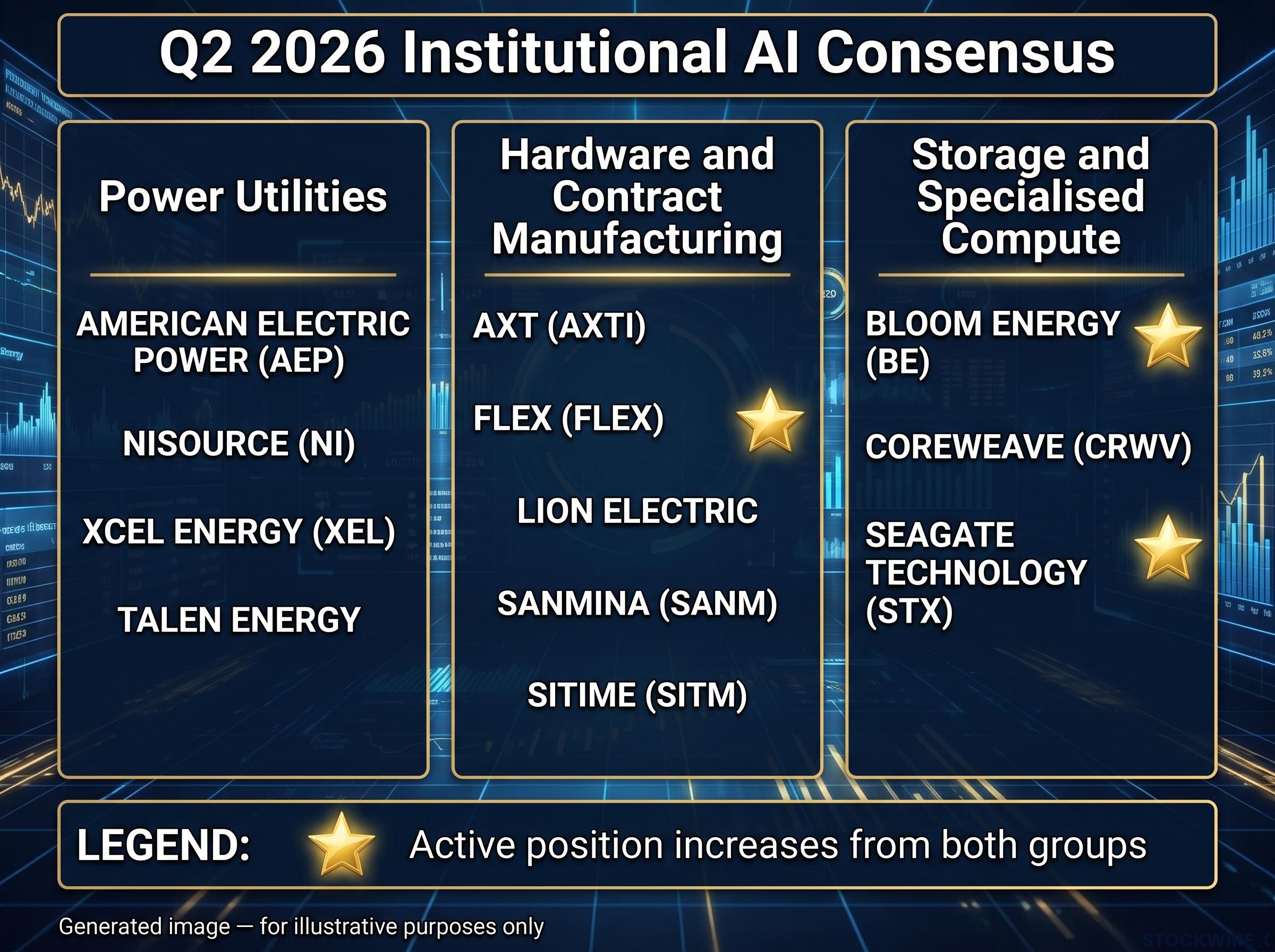
The composition of the consensus list tells its own story before any analyst needs to spell it out. There are no AI chatbot companies. No social media platforms. No consumer software names. What both hedge funds and mutual funds added in Q2 sits almost entirely in the physical layer of the AI build-out:
- Power Utilities: American Electric Power (AEP), NiSource (NI), Xcel Energy (XEL), Talen Energy
- Hardware and Contract Manufacturing: AXT (AXTI), Flex (FLEX), Lion Electric, Sanmina (SANM), SiTime (SITM)
- Storage and Specialised Compute: Bloom Energy (BE), CoreWeave (CRWV), Seagate Technology (STX)
Three names saw active position increases from both groups, not merely maintained holdings: Bloom Energy, Flex, and Seagate Technology. These represent the strongest cross-category conviction signals in the Q2 data.
Hedge funds carry a higher overall AI weighting than mutual funds. Mutual fund allocations to AI infrastructure climbed across 2026, yet those gains fell short of rising benchmark weights, leaving a meaningful sector underweight in place. That gap itself becomes a signal, which the final section of this piece addresses.
The fact that both hedge funds and mutual funds, with very different mandates and time horizons, are adding the same infrastructure names signals that institutional capital views the physical AI build-out as durable rather than speculative.
Why utilities and hardware beat software for the AI consensus trade
The institutional consensus did not land on utilities and hardware manufacturers by accident. These businesses share one characteristic that AI software companies do not: they benefit from AI capital expenditure regardless of which model, chip architecture, or software platform wins the race.
The railroad playbook of prior technology revolutions suggests that companies resolving binding constraints on AI adoption, specifically power availability and cooling density, consistently built more durable compounding franchises than the headline technology providers themselves, a pattern that maps directly onto the infrastructure consensus Goldman Sachs identified in Q2.
According to Goldman Sachs, AI company investment could exceed $500 billion in 2026, with total global AI investment potentially approaching $1 trillion in the same year. That spend is concentrated in compute, networking, power, and data centre construction, precisely the categories where the 12-stock consensus list operates.
Goldman Sachs projects AI capital expenditure among hyperscalers at $755-$800 billion in 2026, rising toward $920 billion in 2027, and PIMCO estimates that figure now absorbs 93-94% of hyperscaler operating cash flow, up from 33-40% in 2022-2023, a compression that shapes which companies in the supply chain actually capture the margin.
Power and grid: the electricity demand shock
AI data centres are creating sustained, geographically concentrated electricity demand that provides multi-year revenue visibility for utilities in key service regions.
- American Electric Power and Xcel Energy serve regions where hyperscaler data centre clusters are expanding rapidly
- NiSource benefits from grid infrastructure investment driven by the same demand
- Talen Energy provides generation capacity directly aligned with data centre power needs
These are not speculative growth stories. They are regulated or semi-regulated businesses with contracted revenue streams that happen to sit directly in the path of AI’s electricity appetite.
Hardware, manufacturing, and storage: the component agnostics
The second group captures AI capex through the supply chain rather than the grid:
- Flex and Sanmina are contract electronics manufacturers whose order books grow as data centre hardware production scales
- SiTime and AXT supply speciality timing chips and substrates used across multiple chip architectures
- Lion Electric provides electrification components for data centre support infrastructure
- Seagate Technology benefits from the explosion in storage volumes driven by AI training and inference data
- CoreWeave offers direct exposure to GPU cloud infrastructure purpose-built for AI workloads
- Bloom Energy provides solid oxide fuel cell technology for high-density, always-on data centre power, a solution particularly suited to the continuous, high-load requirements of AI clusters
For you as an investor, this layer of the AI trade offers a way to express conviction in the build-out cycle without betting on a single chip winner or software platform. That is precisely why it attracts consensus from managers with very different approaches.
Where hedge funds and mutual funds are taking opposite sides
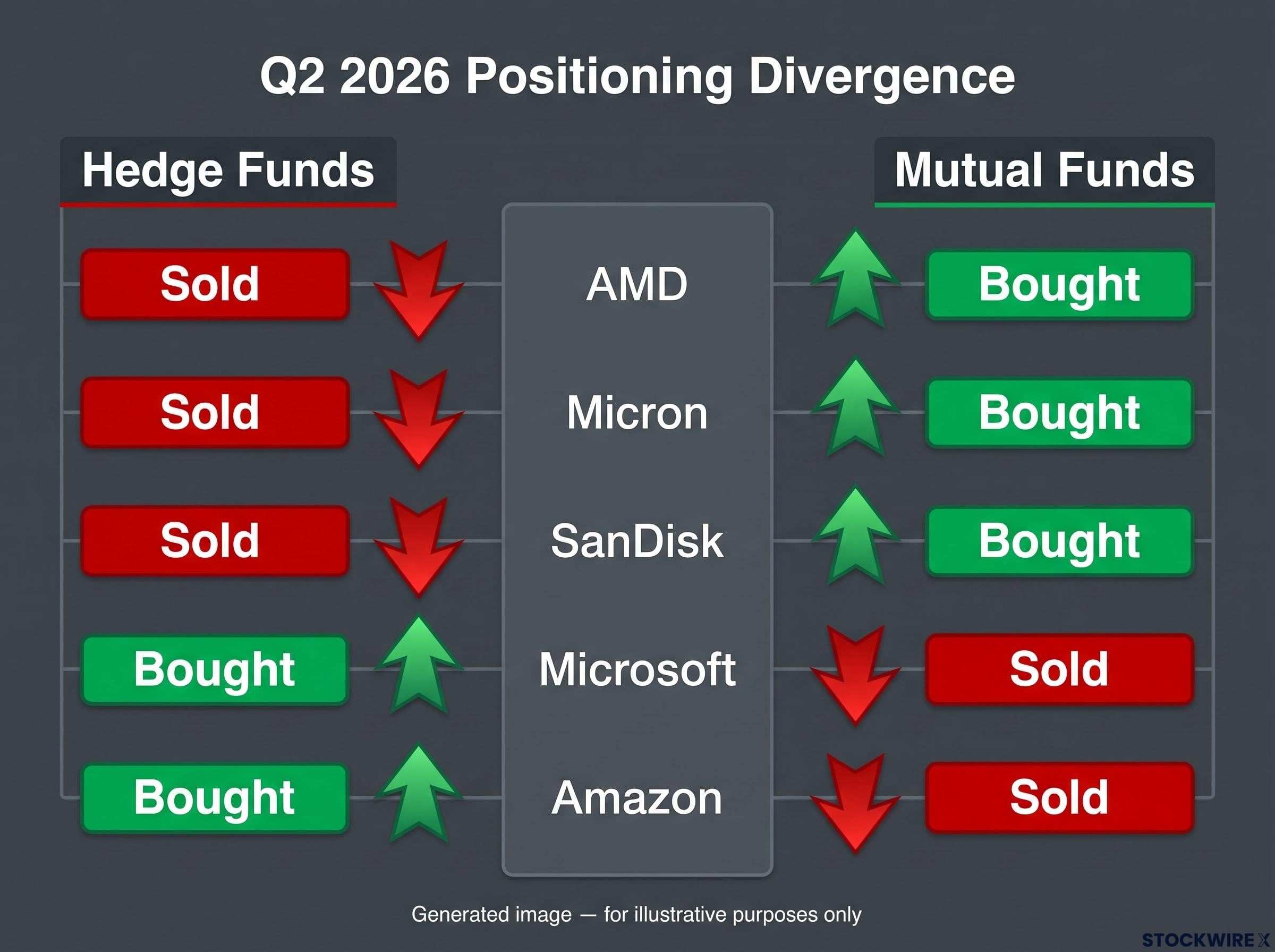
The consensus list is only half the story. On five specific names, hedge funds and mutual funds made directly opposing moves in Q2 2026.
| Stock | Hedge Fund Action | Mutual Fund Action | Rationale |
|---|---|---|---|
| AMD | Sold | Bought | Cycle timing: hedge funds managing near-term risk; mutual funds leaning into longer runway |
| Micron | Sold | Bought | Memory demand: hedge funds taking profits; mutual funds positioning for high-bandwidth memory growth |
| SanDisk | Sold | Bought | Storage cycle: same dynamic as Micron split |
| Microsoft | Bought | Sold | Cloud monetisation: hedge funds using liquid large-caps for tactical AI exposure; mutual funds rotating to direct infrastructure |
| Amazon | Bought | Sold | Same cloud platform dynamic as Microsoft |
Among large-cap AI names, Microsoft and Amazon stood apart as the only two stocks where hedge funds were net purchasers in Q2 2026. Across the rest of the mega-cap AI group, hedge funds trimmed or exited positions during the quarter.
These divergences are not evidence that one group is wrong and one is right. They reflect different frameworks for timing the same theme. Hedge funds can rotate tactically around earnings catalysts and product launches. Mutual funds face benchmark constraints and valuation discipline that push them toward different parts of the AI stack. Knowing which framework matches your own investment approach tells you which side of each split is more relevant to your decisions.
What the splits mean for investors working through their own AI positioning
Institutional flow data is a signal generator, not a buy list. The framework below helps you locate any AI stock by risk layer and decide which positioning signal applies to your situation.
Locating your risk in the four-layer AI stack
- Power and grid (utilities): strongest institutional consensus in Q2; lowest volatility, most regulated revenue streams
- Data-centre hardware and manufacturing: strong consensus; diversified cash-flow exposure to AI capex without single-customer concentration
- Semiconductors and memory: split positioning; higher upside if the cycle is early, higher volatility if hedge fund caution proves correct
- Cloud platforms and software: split positioning; liquid large-cap exposure to AI monetisation, but valuations already price substantial growth
The 12-stock institutional overlap sits almost entirely in layers one and two. That is where consensus is strongest. The splits live in layers three and four, where your own view on cycle timing and valuation becomes the deciding factor.
For investors wanting a structured approach to sizing across the four layers described above, our dedicated guide to AI infrastructure stock allocation walks through a three-layer hardware, cloud, and software framework, with specific weighting rationale for portfolios targeting 20-30% total AI infrastructure exposure.
The questions that matter more than the flows
For any AI stock, whether it appears on the consensus list or the divergence table, three questions anchor the investment case:
- How directly and sustainably is revenue tied to AI data-centre build-out?
- Is management investing ahead of demand in a disciplined way?
- Do current valuations already price in several years of AI growth?
According to Goldman Sachs, professional fund performance has become tightly bound to movements in the AI trade, reflecting how dominant AI positioning has grown within institutional portfolios. But the investment case for any individual name still rests on cash flow, balance sheet, and competitive positioning.
This article is for informational purposes only and should not be considered financial advice. Investors should conduct their own research and consult with financial professionals before making investment decisions.
What the Q2 consensus tells you about where the AI trade goes next
Hedge funds are not retreating from AI. They are rotating within it: from semiconductors into power, infrastructure, and selectively into cloud platforms. That pattern signals the AI capex cycle is expanding in scope rather than contracting.
US IT hardware and software spending reached a record 4.9% of GDP in Q1 2026, surpassing both the dot-com era peak and the cloud buildout peak, a context that frames the current AI investment cycle as structurally unprecedented rather than simply a faster version of prior technology waves.
The gap between mutual fund AI infrastructure holdings and benchmark weights is arguably the most overlooked feature of this data set. As AI infrastructure stocks gain benchmark weight, managers running against those benchmarks face structural pressure to add, which represents a potential tailwind for the 12-stock consensus list.
Three signals will clarify which side of the splits was better positioned over the next 2-3 quarters:
- Semiconductor price action relative to hedge fund exits: if semis outperform, hedge fund caution was premature and the cycle is longer than they assumed
- Cloud platform earnings as a test of the mutual fund sell thesis: if Microsoft and Amazon deliver AI monetisation beats, mutual funds that sold will face reversal pressure
- Benchmark weight changes in AI infrastructure names: rising weight compounds the structural pressure on underweight mutual funds to add the consensus stocks
The Q2 data is a snapshot. Treating it as a framework for monitoring institutional flows over the rest of 2026 is where its real value sits. The 12-stock consensus list is the current institutional anchor for multi-year AI build-out conviction. How the splits resolve will tell you whether that anchor holds or shifts.
Past performance does not guarantee future results. Financial projections are subject to market conditions and various risk factors.