
Most investors who search for the difference between ETFs, mutual funds, and index funds are trying to compare three things that do not sit on the same shelf. Two of those labels describe how a fund is packaged and traded. The third describes what the fund does with the money once it has it. Comparing an ETF to an index fund is a bit like asking whether your car is a sedan or runs on petrol: the question mixes two dimensions that measure completely different things.
The confusion is not your fault. The financial industry uses these three terms interchangeably in marketing, brokerage menus, and retirement plan documents without ever flagging that they come from different classification systems. The result is that millions of investors compare labels that were never meant to compete.
Here is what this piece gives you: a two-axis framework that lets you look at any fund on any platform and ask the two right questions in the right order. Once you have it, the “ETF vs. index fund” debate stops being confusing and starts being the wrong question entirely.
The category error hiding inside the most common comparison
Start with what you probably arrived here believing: that ETFs, mutual funds, and index funds are three distinct products you need to choose between. That framing makes a tidy comparison table, but it collapses the moment you push on it.
ETF and mutual fund describe how a fund is structured and traded. They answer the question: when and how do you buy and sell shares? Index fund, on the other hand, describes what the fund does with your money. It answers a completely different question: is the fund tracking a benchmark or trying to beat one?
Comparing an ETF to an index fund puts a trading mechanism on one side and an investment strategy on the other. The two labels are not rivals. They are answers to separate questions.
One label tells you how a fund trades. The other tells you what it does with the money.
That distinction is the organising principle for everything that follows. Your mental model needs two axes, not three boxes. Once you see the axes, every fund you encounter snaps into place.
When big ASX news breaks, our subscribers know first
What each label actually describes
Each of these three terms does real work, but only if you understand which dimension of a fund it is describing. Here they are, built up in sequence, with the most counterintuitive one saved for last.
- ETF (exchange-traded fund): A collection of securities (shares, bonds, or other assets) bundled together and listed on a stock exchange, where it can be bought or sold at prevailing market prices at any point during trading hours. The label tells you the fund’s structure and trading mechanism. It tells you nothing about whether the fund is passively tracking an index or actively picking stocks.
Concentration risk in stock portfolios is the counterpoint to the diversification argument for ETFs: single-stock declines of up to 68.9% recorded in 2025 wiped out most of a concentrated investor’s capital, while the same decline in a 1% ETF holding produced only a 0.69% portfolio drag.
- Mutual fund: A similarly pooled collection of assets, but with a fundamentally different way of processing transactions. Rather than trading continuously, orders are batched and settled once daily at a price calculated from the portfolio’s end-of-day value. The label tells you the fund’s structure. It does not tell you the strategy either.
- Index fund: Not a product type at all. It is a description of investment strategy. The term refers to any fund, whether structured as an ETF or a mutual fund, whose objective is to mirror a benchmark rather than outperform it. It does this by holding the constituent securities in proportions that reflect the index, keeping turnover low and stock selection to a minimum. In common usage, “index fund” often refers specifically to index mutual funds because that is where index investing originated historically. But an S&P 500 ETF that tracks the same benchmark is also an index fund.
The insight worth holding onto: every fund you will ever encounter is simultaneously a structure (ETF or mutual fund) and a strategy (passive index or active). Both dimensions matter independently, and neither one tells you the other.
The 2×2 grid that eliminates the confusion
Once you have the two axes, you can build a simple grid that places every fund into one of four cells. This is the single most useful mental model the article offers.
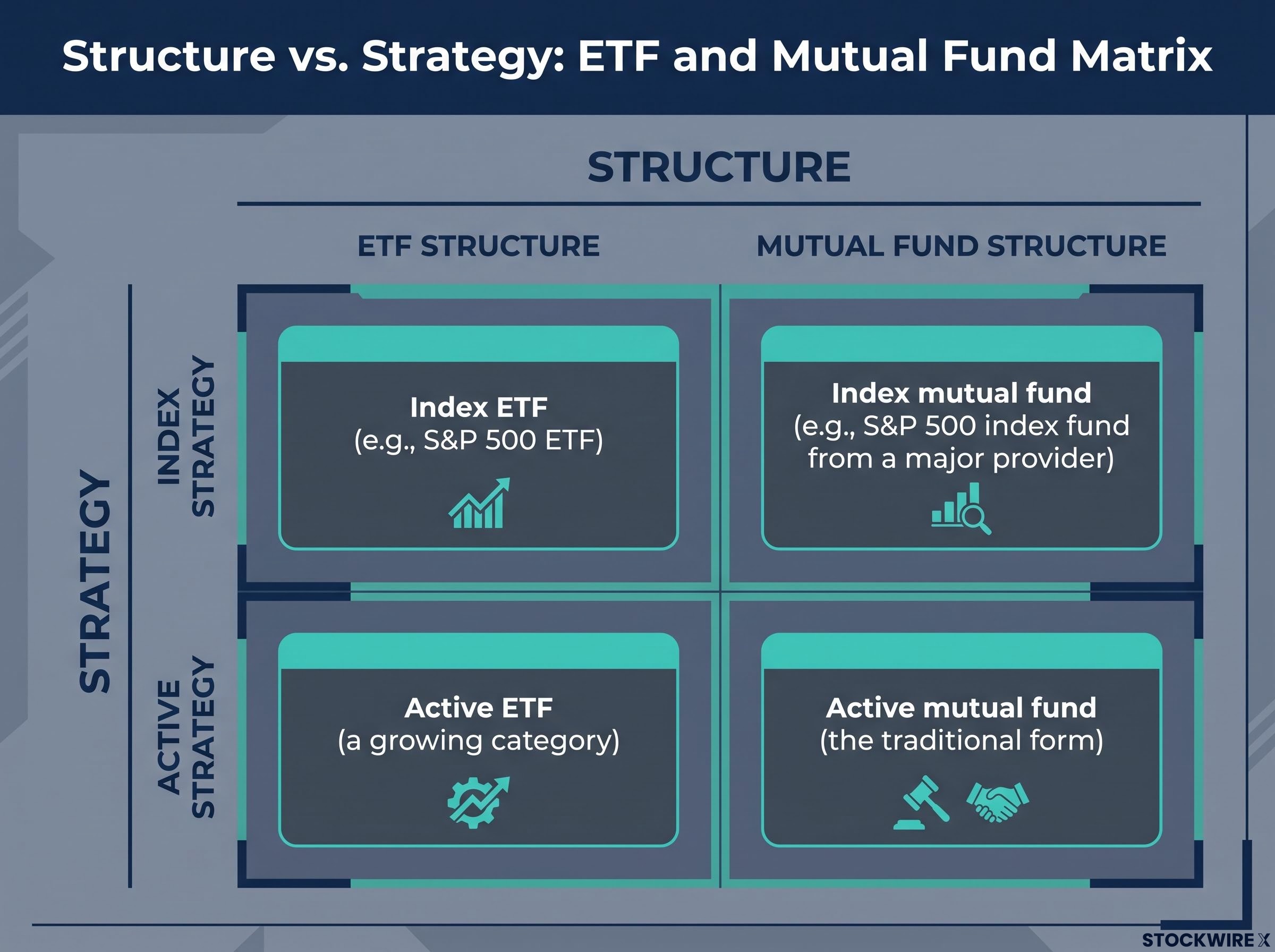
| ETF structure | Mutual fund structure | |
|---|---|---|
| Index strategy | Index ETF (e.g., S&P 500 ETF) | Index mutual fund (e.g., S&P 500 index fund from a major provider) |
| Active strategy | Active ETF (a growing category) | Active mutual fund (the traditional form) |
All four cells represent real, widely available products. But most investors only ever see two of them. When someone says “index fund,” they are usually picturing the top-right cell: an index mutual fund. When someone says “ETF,” they are usually picturing the top-left cell: an index ETF.
That is why the “ETF vs. index fund” comparison feels like it makes sense. In practice, it is often comparing the top-left cell to the top-right cell, two products with the same strategy but different structures. The bottom row, where active ETFs and active mutual funds sit, rarely enters the conversation. Once you can mentally place any fund in this grid, the question “ETF vs. index fund” stops making sense and is replaced by two cleaner questions: what is the structure, and what is the strategy?
The SEC investor guidance on ETFs and mutual funds defines both product types under the Investment Company Act of 1940, establishing that the distinction between them is structural and regulatory, not strategic, which underpins the two-axis framework introduced here.
Why structure produces a real difference in tax efficiency
Structure might sound like a technicality, but it creates a tangible cost difference through one specific mechanism: how money leaves the fund when investors sell.
- ETF in-kind redemption: When ETF investors exit, large authorised intermediaries swap their fund shares for a basket of the underlying securities directly. No open-market sale takes place within the fund itself, which means no capital gain is crystallised and passed through to continuing shareholders. This built-in mechanism is the primary reason ETFs carry a reputation for greater tax efficiency.
- Mutual fund cash redemption: Mutual funds operate without this arrangement. Redemptions require the fund to convert holdings into cash by selling securities on the open market. Those sales can produce realised gains that are then distributed across all current shareholders, regardless of whether those shareholders made any transaction themselves. You can owe tax on gains you never chose to realise.
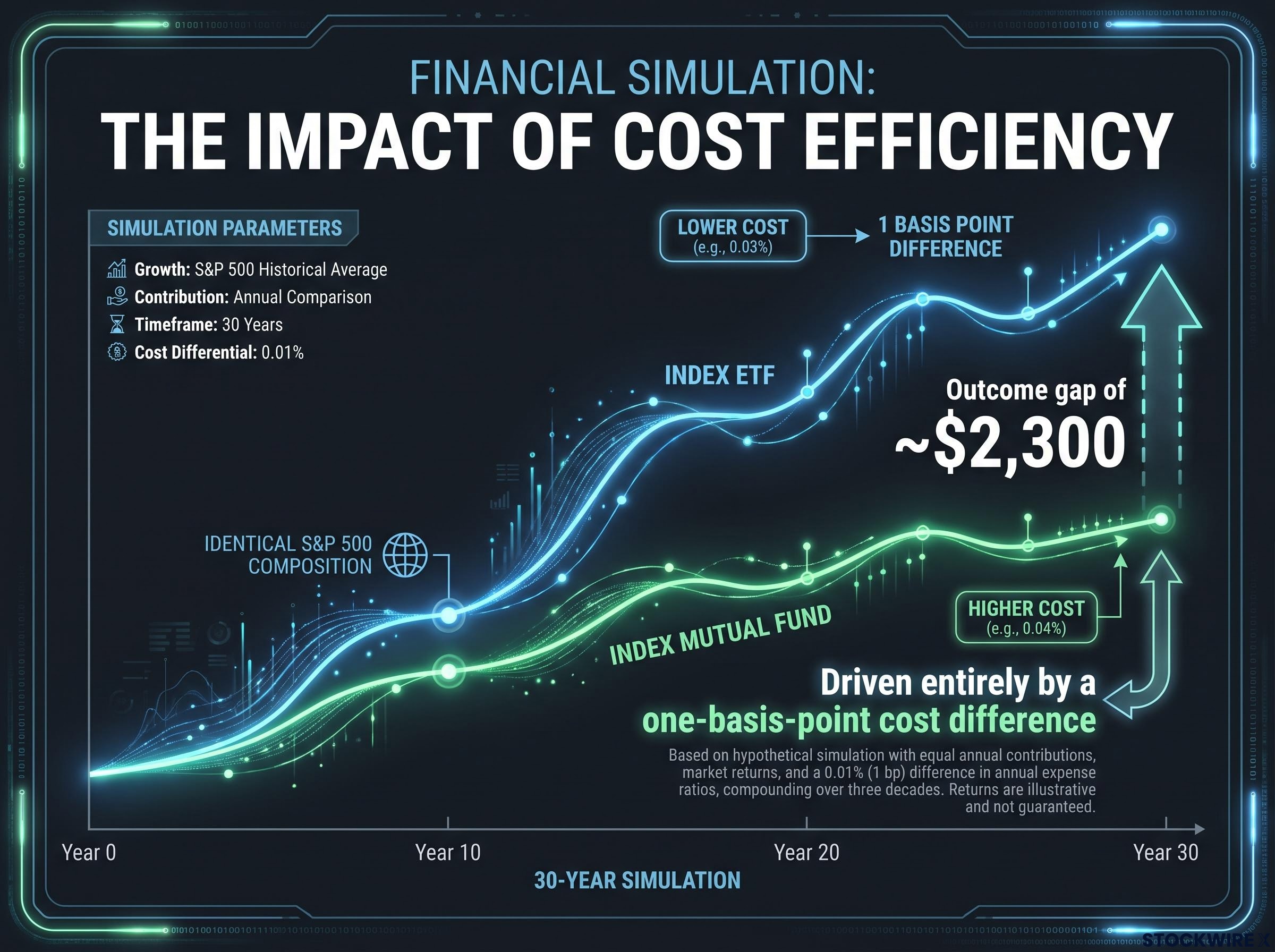
A 30-year simulation tracking an index ETF and an index mutual fund on the identical S&P 500 composition produced an outcome gap of approximately $2,300, driven entirely by a one-basis-point cost difference, not any strategic or structural divergence. When both products follow the same index, the performance gap is usually tiny and comes down to expense ratio and tracking error.
Index mutual funds are more tax-efficient than actively managed mutual funds (because lower turnover means fewer taxable events), but they still tend to distribute more capital gains than comparable index ETFs.
When the structural tax difference actually matters to you
The distinction above applies primarily in taxable brokerage accounts, where capital gains distributions are taxed in the year they occur. In tax-advantaged retirement accounts (such as a 401(k), ISA, superannuation, or equivalent vehicle in your jurisdiction), capital gains are not taxed within the account. The ETF’s structural tax advantage largely disappears.
This means the account type question should come before the ETF-vs-mutual-fund question, not after it. If all of your investing happens inside a retirement account, the in-kind redemption advantage is functionally irrelevant to your decision. If you hold funds in a taxable account, the ETF wrapper can quietly save you money over decades in a way that never appears on any fund factsheet.
Account type and asset location determine how much of the ETF structure’s tax advantage you actually capture: an active stock picker in a taxable account can pay roughly $63,000 more in federal taxes over 30 years than a passive index ETF investor following the same strategy inside a tax-sheltered account.
The comparison that actually drives long-term outcomes
The structure axis gets more attention than it deserves. The comparison that matters more to your returns over a decade or longer sits on the other axis: passive versus active, and at what cost.
Passive index products typically carry expense ratios in the range of approximately 0.02%-0.10%. Actively managed funds charge significantly more. Over long horizons, most actively managed funds fail to beat their benchmark after fees. That makes the passive-vs-active decision more consequential than the ETF-vs-mutual-fund decision for the majority of investors.
The passive vs active debate has decades of SPIVA data behind it: over the one-year period ending December 2025, 79% of active large-cap U.S. equity funds underperformed the S&P 500, a pattern that worsens as the time horizon extends.
When two funds track the same index, the remaining differences are operational:
What the strategy axis determines:
- Long-run cost drag on your returns
- Likelihood of beating or matching the benchmark
- Portfolio turnover and associated friction
What the structure axis determines:
- Intraday trading flexibility versus once-per-day pricing
- Tax efficiency in taxable accounts
- Minimum investment thresholds (some mutual funds require a minimum; most ETFs let you buy a single share)
The strategy axis is where most of the outcome difference lives. The structure axis is where your secondary preferences, around trading, taxes, and account compatibility, get resolved. Framing “ETF vs. index fund” as the primary question leads you to obsess over trading mechanics while overlooking the cost and strategy decisions that have a much larger impact on your actual returns.
A two-question checklist for evaluating any fund you encounter
Everything above collapses into a practical sequence you can apply the next time you open a brokerage menu or review a retirement plan option list.
Strategy axis questions
- Is this fund index-tracking (passive) or actively managed? If active, what is its long-term track record versus a clear benchmark?
- What is the expense ratio, and how does it compare to peers following the same strategy?
Structure axis questions
- Is the account where you will hold this fund taxable or tax-advantaged? If taxable, the ETF structure’s tax efficiency advantage is worth considering. If tax-advantaged, this factor carries less weight.
- Does intraday trading flexibility matter to you, or is once-per-day pricing sufficient for how you invest?
- Is there a minimum investment requirement? Some mutual funds impose one; most ETFs allow you to buy a single share.
Answer the strategy questions first. They determine your cost structure and your likely long-term outcome. Answer the structure questions second. They determine your trading experience and, in certain accounts, your after-tax efficiency.
The answer to “ETF vs. mutual fund vs. index fund” is not a single winner. It is a depends-on framework tied to your account type, your strategy preference, and your cost sensitivity.
For readers wanting a structured process to apply these two questions across a real brokerage menu, our dedicated guide to fund screening covers the six-step workflow analysts use to eliminate poor-quality products before fees compound against you.
This article is for informational purposes only and should not be considered financial advice. Investors should conduct their own research and consult with financial professionals before making investment decisions.
Two axes, one cleaner decision
The terminology confusion dissolves once you stop treating ETF, mutual fund, and index fund as three competing options and start treating them as answers to two separate questions asked in sequence. Settle the strategy question first, because that is where most of the outcome difference lives. Settle the structure question second, because that is where your preferences around trading, taxes, and account type get resolved.
As actively managed ETFs grow in availability, the structure axis will become even less correlated with the strategy axis. That makes this two-question framework more useful over time, not less.
The ETF label describes a trading structure. The mutual fund label describes a different way of accessing the same kind of pooled investment. The index fund label describes what the portfolio is actually trying to achieve. Place any fund on both axes, ask the questions in order, and the three terms stop feeling like rivals.
—