The Euro gave back Tuesday’s relief in a single session on Wednesday, sliding about 0.63% to roughly 1.1188 against the Dollar as French 10-year yields jumped about 2.56% back to near 4.91%. With the pair’s 14-day Relative Strength Index (RSI) now at 22, deep in oversold territory, a bounce looks overdue on paper.
That assumption deserves scrutiny.
French bond stress is no longer only a French story. It now feeds into expectations for the European Central Bank (ECB), into Dollar demand, and into how investors price risk in the Eurozone’s core economies rather than its periphery. The minutes from the US Federal Open Market Committee (FOMC), the Federal Reserve’s rate-setting body, land at 18:00 GMT today and are the immediate event risk.
Any EUR USD outlook now hinges on one contest: stretched technicals pulling one way, unresolved fundamental pressure pulling the other. Here is a framework for judging which side is likely to win, and the specific signals that would tell you the balance has shifted.
Why French bond stress is pulling the Euro lower
Tuesday looked like a turning point. Investors bought French government bonds, known as OATs, after Marine Le Pen floated a larger spending-cut target, and 10-year yields fell about 11 basis points (a basis point is one hundredth of a percentage point).
By Wednesday the buying had reversed. Renewed selling of French debt pushed yields back to where they started the week, and the Euro was the weakest major currency against the Dollar. The US Dollar Index climbed almost 0.5% to around 102.34, adding pressure from the other side of the pair.
The doubt is political. Markets question whether a minority government can push cuts through Parliament without handing out concessions that dilute them.
The French fiscal crisis rests on a debt ratio near 117.6% of GDP and a minority government, and analysts see a budget rollover as more likely than intact passage, which would leave the 2027 deficit well above target.
Wednesday snapshot French 10-year OAT: 4.91% | French-German spread: 120-136 bp | EUR/USD: 1.1188
What the government has put on the table
The draft 2027 budget contains €43 billion in savings inside a broader €54 billion adjustment envelope, according to Finance Minister Roland Lescure and Finance Ministry data. It includes about €9 billion of state spending cuts, a freeze on pension indexation and an extension of a large-company tax worth around €5 billion. The deficit target falls from about 5.4% of GDP to 5.0%, yet Le Monde reports France still plans to borrow about €340 billion in 2027.
France’s Higher Committee for Public Finance, the country’s fiscal watchdog, called the draft very optimistic.
What Le Pen is proposing
Le Pen now targets €140 billion of savings over her term, aiming to bring the deficit below 3% by 2030. Jordan Bardella’s shadow budget for the National Rally (RN) demands €71.6 billion.
| Proposal | Headline savings | Timeframe | Key measures |
|---|---|---|---|
| Government 2027 budget | €43B (within €54B envelope) | 2027 | Spending cuts, pension indexation freeze, large-company tax extension |
| Le Pen plan | €140B | Presidential term, deficit below 3% by 2030 | Streamlining government, abolishing over 120 taxes, capping EU contribution |
| RN shadow budget (Bardella) | €71.6B | 2027 | About €28B from streamlining, €15B from immigration-related spending |
The absolute yield matters less than the spread to Germany, which sat at 120.4 bp on 6 October. A wider gap tells you the market is charging a premium for political risk in a core Eurozone economy, and that premium, not any single data release, is what is weighing on your Euro exposure.
When big ASX news breaks, our subscribers know first
What actually moves the Euro: ECB, inflation and the Dollar side of the pair
Understanding why a Paris budget fight moves a global currency pair starts with the routes the stress travels.
Four channels from Paris to the exchange rate
- Risk premium: investors demand a higher return to hold Euro assets when sovereign risk rises, which pushes EUR/USD lower.
- Capital flows: foreign selling of French bonds and shares turns into Euro selling, and contagion across the bloc deepens the fall.
- ECB policy expectations: stress makes further rate hikes look less likely, reducing the Euro’s yield appeal.
- Dollar and risk-off flows: nervous money moves into US Treasuries and the Dollar, amplifying the decline.
Each channel can be amplified or cushioned by the wider backdrop. The Euro is the world’s second most traded currency, and EUR/USD accounts for about 30% of all foreign exchange transactions, so it reacts to both sides of the Atlantic.
The ECB and Fed backdrop
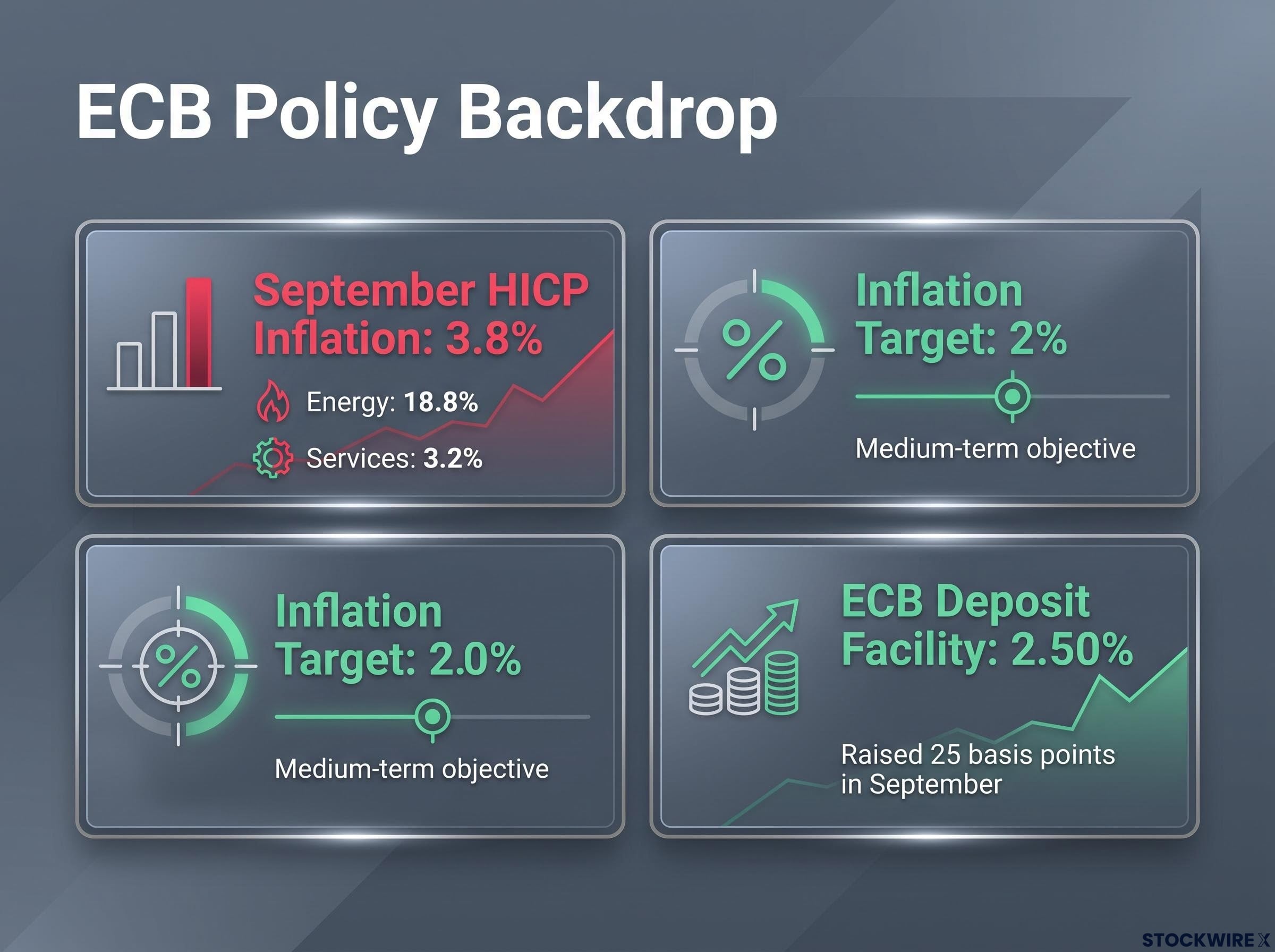
The ECB raised rates by 25 basis points in September, a unanimous decision, taking the deposit facility to 2.50%, main refinancing to 2.65% and marginal lending to 2.90%. Its mandate centres on keeping inflation near 2%.
Inflation is well above that. Eurozone HICP (the Harmonised Index of Consumer Prices, the bloc’s headline inflation gauge) rose to 3.8% in September from 3.2% in August, driven by energy at 18.8%, while services ran at 3.2%.
Here sits the paradox. High inflation would normally support the case for more hikes, yet Bloomberg reports French market stress has dialled back expectations of further tightening. The Fed also hiked in September, though markets are fading hike bets after soft US jobs data.
| Driver | Euro-supportive when | Euro-negative when | Current reading |
|---|---|---|---|
| ECB policy | Hikes expected | Hike bets fade | Deposit rate 2.50%, hike bets scaled back |
| HICP inflation | Above target and pushing hikes | Easing or ignored by policy | 3.8% in September |
| Core economy data | Germany, France, Italy, Spain strong (75% of output) | Weak growth and sentiment | France under fiscal stress |
| Fed and Dollar | Fed turns cautious, soft US data | Fed holds firm, US surprises higher | Dollar Index near 102.34 |
If the ECB looks unable to keep tightening while the Fed holds firm, the rate gap tilts toward the Dollar. That is the scenario that keeps pressure on your EUR/USD view even when inflation data looks hawkish.
Investors exploring the paradox can read our full explainer on ECB hikes and French bond stress, which shows how the ECB ignored bond stress in 2022 and 2023 but reversed in 2011.
Reading the technical picture: is an RSI of 22 a buy signal or a warning?
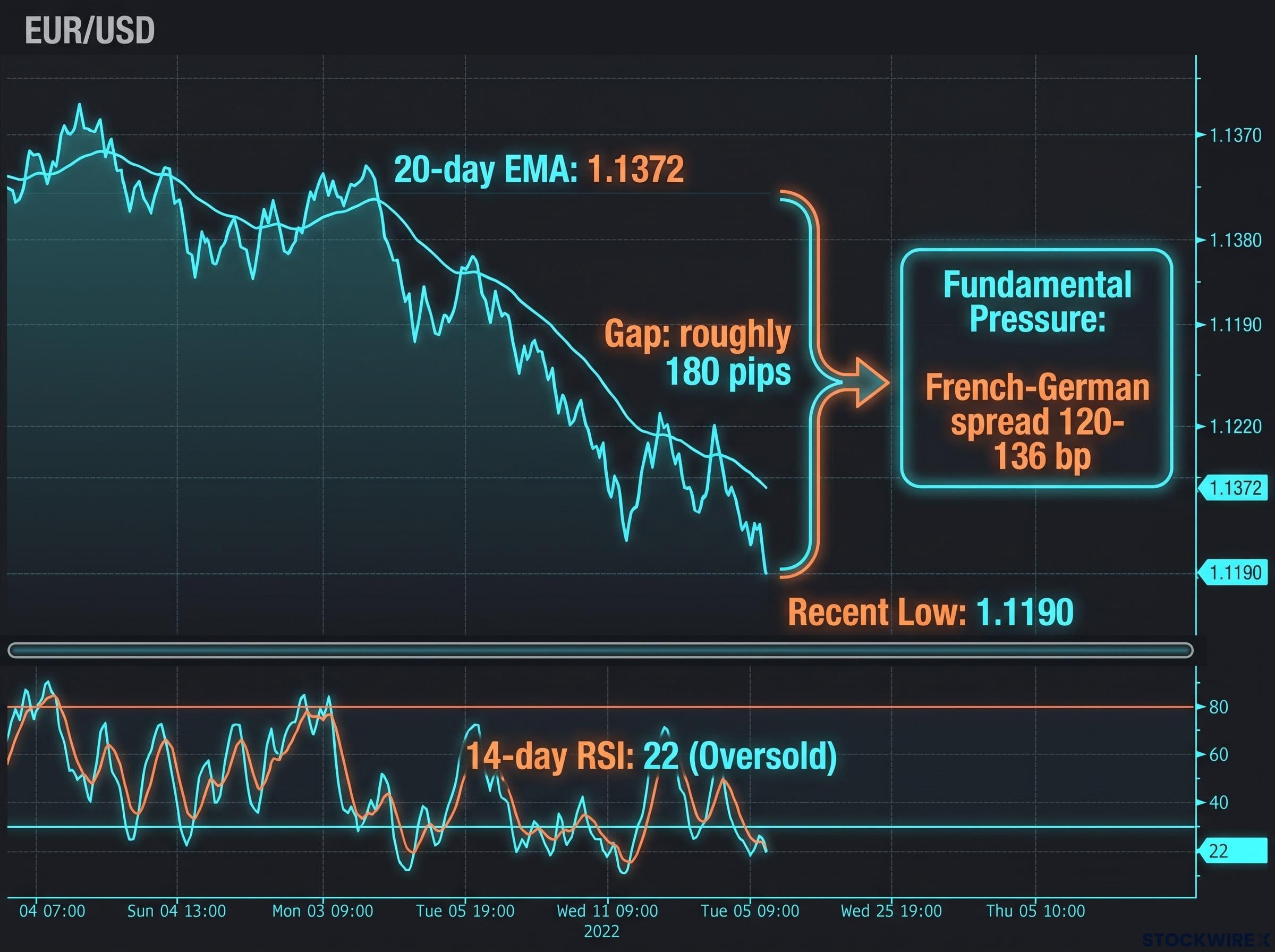
The bullish logic is tempting. RSI measures how fast and how far price has moved recently on a scale of 0 to 100, and readings below 30 are considered oversold. At 22, sellers look exhausted.
The setup reinforces that feeling. Price sits near 1.1190, roughly 180 pips below the 20-day exponential moving average (EMA) at 1.1372, a trend line that gives more weight to recent prices. Stretches that wide often snap back.
What the indicators say
- 1.1190: the recent low, only a provisional pivot because no clear structural support sits nearby.
- 1.1372 (20-day EMA): first resistance any bounce must clear.
- RSI 22: raises the odds of short-covering, where traders who bet against the Euro buy it back to lock in gains.
Why oversold can stay oversold
RSI extremes are a timing tool, not a standalone signal.
In strong fundamental trends, RSI can sit below 30 for weeks while price grinds lower, and bottom-picking fails. A widening French spread is precisely that kind of fundamental driver.
In the prior leg lower, oversold conditions and bearish moving average signals coexisted for days, which shows why a low RSI reading alone has not marked a reversal in this pair.
Counterweights exist. The ECB’s Pandemic Emergency Purchase Programme (PEPP) reinvestments and its Transmission Protection Instrument, a tool designed to curb disorderly spread widening, could cap the worst of the stress.
A bounce toward 1.1372 would be a reaction to stretched positioning. It tells you little about direction unless price holds above that level on a sustained basis.
Bounce or further downside: a scenario framework informed by past French scares
What past French scares suggest
History offers a rough template. During the 2024 snap-election stress and the 2025 budget turmoil, French spreads widened and the Euro sold off, then recovered part of its losses once political clarity arrived and ECB support looked credible. In 2022, the Euro fell below parity as Fed tightening and energy shocks dominated, with fiscal risk adding to the premium.
This episode differs in one respect. France is a core sovereign, which may make the stress broader and longer-lasting.
That divides opinion. The structural view holds that repeated French scares point to a persistent Euro discount. The cyclical view holds that a credible budget would narrow spreads and allow partial mean reversion.
Two paths from here
| Scenario | What would need to happen | EUR/USD implication | Signal to watch |
|---|---|---|---|
| Bounce | Budget passes, ECB backstops reassure, soft US data | Recovery toward and above 1.1372 | French-German spread narrowing |
| Further downside | Budget stalls, rating-agency action, US data surprises higher | New lows below 1.1190 | Spread pushing above recent range |
Over the coming weeks, these are the watchpoints in order of immediacy:
- FOMC minutes at 18:00 GMT today, for the Fed’s appetite for further hikes.
- US data surprises that could re-energise or soften the Dollar.
- Parliamentary votes on the 2027 budget through autumn.
- Any rating-agency review that places France on watch.
- ECB communication on spread backstops.
The spread, more than the RSI, decides which scenario you are in. Check it before acting on any technical bounce.
What the oversold reading changes, and what it does not
The technicals say the Euro is stretched. The fundamentals say the French risk premium has not been resolved. Both can be true at once, which is why an oversold reading alone offers a weak basis for a directional call.
Your framework comes down to four inputs: the French-German spread, progress on the budget vote, ECB tone and US data. A sustained move back above the 20-day EMA would be the first sign the bearish tone is softening.
Tonight’s FOMC minutes and the autumn budget votes are the next decision points. Watch how the spread responds to each before the price chart.
FOMC minutes are best read as supplementary texture, since fresher data such as PCE and payrolls has often landed before the document appears, so the Fed’s appetite for hikes should be weighed against that newer information.
This article is for informational purposes only and should not be considered financial advice. Investors should conduct their own research and consult with financial professionals before making investment decisions. Past performance does not guarantee future results. Financial projections are subject to market conditions and various risk factors.