A single session on Friday 7 August 2026 saw the probability of a September Fed rate hike slide from around 64-67% to just 43-44%, a compression of roughly 20 percentage points, with Asian semiconductor stocks among the sharpest beneficiaries when regional markets reopened on Monday morning.
The trigger was the U.S. July jobs report. The July payroll release showed an outright decline in headcount alongside downward revisions to the preceding two months, and the consequent shift in Federal Reserve expectations drove the S&P 500 and Nasdaq Composite to fresh record closing levels. By Monday, the risk-on impulse had crossed the Pacific into Tokyo, Seoul, Shanghai, and Hong Kong, landing hardest in the region’s chip and tech hardware names.
Here is what the data shows, market by market, and what the Fed pricing shift actually means for semiconductor stocks heading into the September FOMC meeting.
What the jobs report did to Fed expectations in a single session
U.S. payroll data for July came in well below expectations. Employers cut headcount outright, and revisions to the prior two months dragged the overall momentum figure lower still. The labour market, which had been the last pillar supporting the case for a September rate hike, buckled in a single release.
The repricing was immediate.
The July release followed an already-softening trend: the June payrolls miss of just 57,000, roughly half the consensus forecast, had introduced the first serious cracks in the resilient labour market thesis that had sustained the case for further Fed tightening.
September Fed rate hike probability: from approximately 64-67% to approximately 43-44% (CME FedWatch Tool), a drop of roughly 20 percentage points in one session.
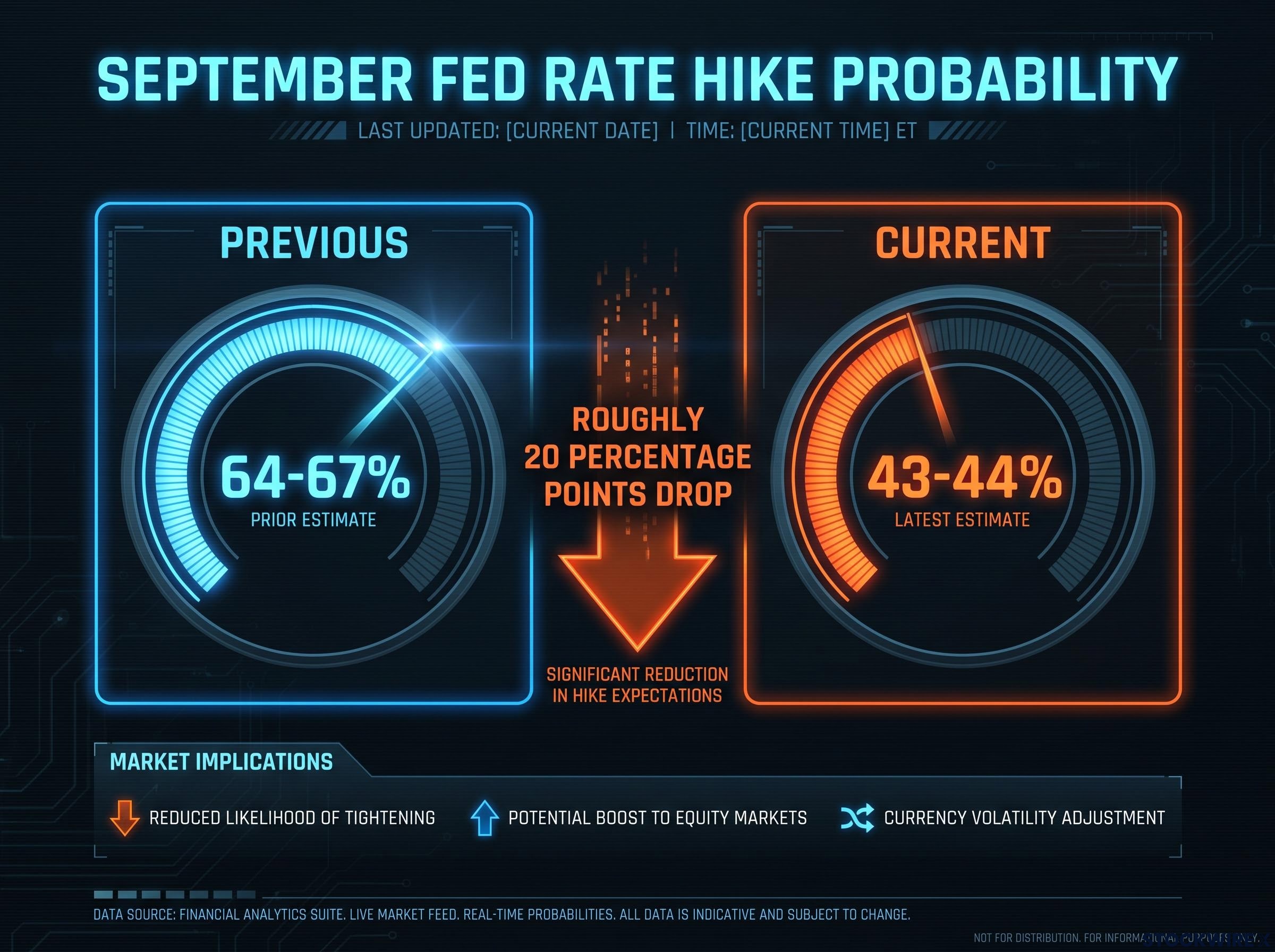
A shift of that magnitude is not a minor recalibration. It represents a near-halving of the market’s conviction that rates will rise next month. For long-duration growth assets like chip stocks, whose valuations are most sensitive to changes in discount rate expectations, that kind of move is the difference between selling pressure and a re-entry wave.
Wall Street responded accordingly. Friday’s close saw the S&P 500 reach a record 7,757.64, a gain of 0.62%, with the Nasdaq Composite also setting a record at 26,690.62, up 1.30% on the day. Those closing prints set the bullish backdrop for everything that followed in Asia on Monday.
When big ASX news breaks, our subscribers know first
Beijing’s tech sector splits in two as macro tailwinds hit company-specific headwinds
Not everything went up. China’s Monday session was the clearest reminder that a positive macro catalyst does not lift all boats uniformly.
At the index level, the divergence was already visible. The CSI 300 edged down by around 0.1% while the Shanghai Composite advanced roughly 0.5%, reflecting different sector weightings and the persistent drag of domestic macroeconomic concerns on certain parts of the market.
The stock-level picture was sharper still.
| Company | Session Move | Direction |
|---|---|---|
| Alibaba | +more than 2% | Gainer |
| Foxconn Industrial Internet | +approximately 1.7% | Gainer |
| NAURA Technology | +over 1% | Gainer |
| BOE Technology | -nearly 3% | Decliner |
| Cambricon Technologies | -more than 5% | Decliner |
Within a single trading session sharing the same macro backdrop, Cambricon Technologies shed more than 5% while Alibaba posted a gain exceeding 2%. Two stocks, one session, two entirely different outcomes.
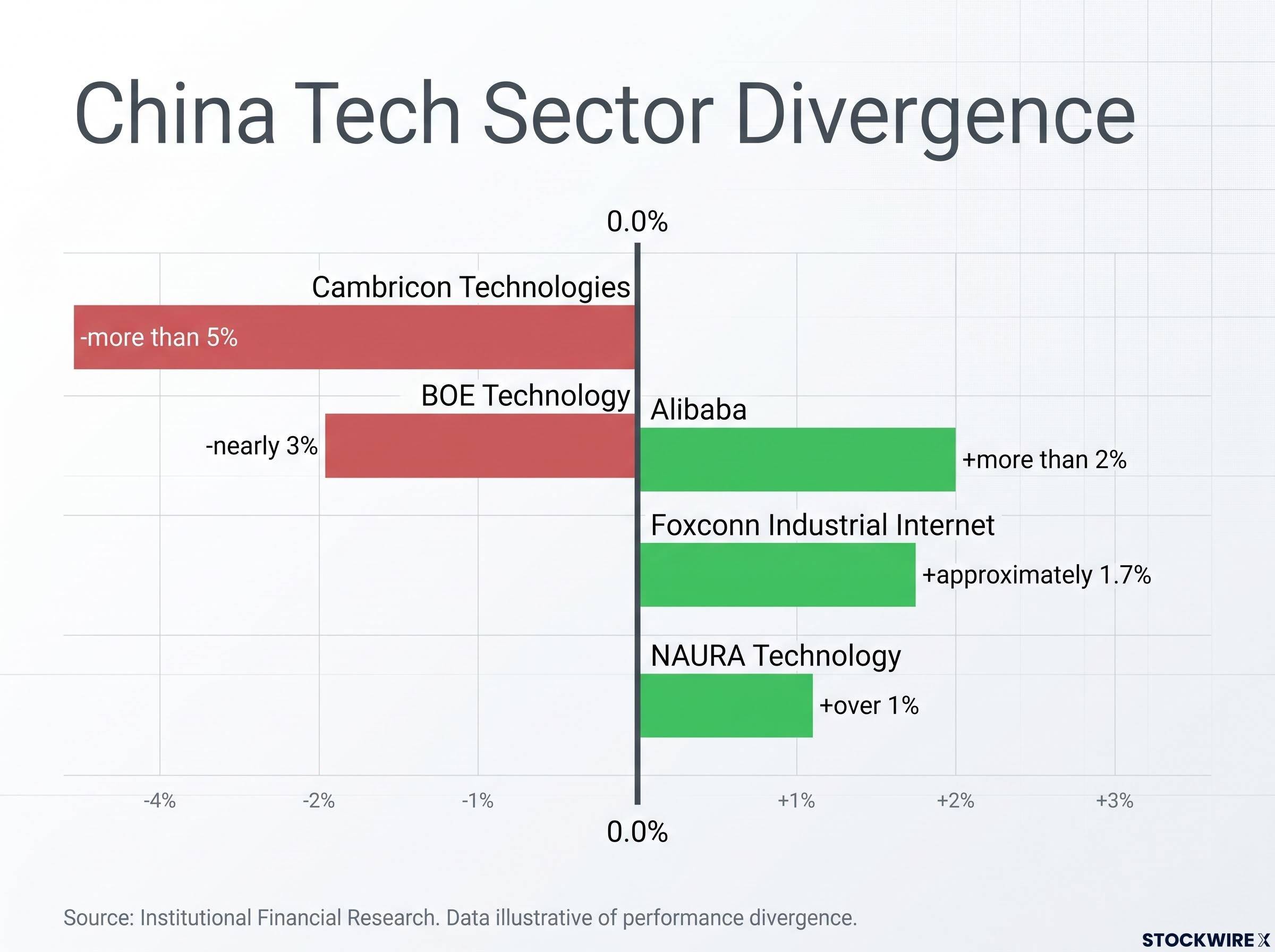
That contrast is the most important signal in the China data. Sector-level headlines about “chip rallies” can obscure meaningful stock-specific risk. A positive index print is not confirmation that any individual name is moving with it, and Monday’s divergence demonstrated that idiosyncratic pressures at the company level remain fully live even when the broader environment turns favourable.
Chip stock valuations entering the August session ranged from Micron at under 9x forward earnings to Intel at approximately 101x, a dispersion wide enough to produce the kind of divergent individual stock outcomes visible in China’s Monday session even when the macro catalyst was uniformly positive.
Tokyo’s session gain extends across the full semiconductor supply chain
Japan delivered the strongest headline performance of the session. The Nikkei 225 posted a gain of close to 2%, with the TOPIX up around 0.8%, a broader but more measured read on Japanese equities overall.
The individual stock moves confirmed the rally was not just index-level noise.
| Company | Country | Sector | Session Move |
|---|---|---|---|
| TDK | Japan | Electronics components | +more than 1% |
| Sony | Japan | Technology / entertainment | +more than 1% |
| Kioxia | Japan | Flash memory | +approximately 0.5% |
| LARGAN Precision | Taiwan | Optics / smartphone components | +nearly 1.7% |
LARGAN Precision, a Taiwan-based optics supplier, is not a pure-play chip name. Its gain tells you the market was re-pricing the entire rate-sensitive technology supply chain, from flash memory to smartphone optics, not just a handful of semiconductor headlines. The breadth of gains across Japanese and regional tech hardware is the clearest evidence of how thoroughly the Fed repricing reached into the Asian supply chain on Monday.
South Korea: big intraday swing, modest close
South Korea’s session told a different story. South Korea’s KOSPI closed with a gain of around 0.4%, a subdued headline figure that masks the considerable intraday volatility the index experienced: at its peak the benchmark was up in excess of 2% before sellers moved in.
The two headline chip names both gained, though the magnitudes diverged:
- SK Hynix: +more than 1.5%
- Samsung Electronics: +approximately 0.4%
Both companies are central global suppliers of HBM (High Bandwidth Memory, a specialised DRAM variant designed for the massive parallel data requirements of AI training and inference) and standard DRAM for AI accelerators and GPUs. That exposure makes their share prices especially sensitive to shifts in rate expectations and broader AI-driven tech sentiment.
The gap between the session peak and the close is the real signal. The macro catalyst was strong enough to trigger re-entry into chip names at the open, but conviction was not deep enough to hold those gains through the full session. Traders remain alert to any reversal in the rate narrative, and Monday’s intraday pattern is a useful real-time indicator of just how fragile the current risk-on impulse remains.
Why semiconductors are among the most rate-sensitive assets on the planet
The mechanism behind Monday’s moves is straightforward once you see the structural logic.
When rate hike odds rise, the discount rate that investors apply to future earnings increases. That compresses the present value of companies whose profits sit further in the future. Semiconductor firms, which invest heavily now for earnings years ahead, absorb that compression more sharply than most sectors. Their valuations are built on long-duration growth expectations, which makes them acutely sensitive to any shift in the rate outlook.
Flip the logic and you get Monday’s rally. When hike odds fall, as they did after the July jobs report, that discount rate pressure eases. Chip stocks are among the first to recover because the same duration sensitivity that punishes them on the way up rewards them on the way down.
Asian chip makers including Samsung and SK Hynix entered this rate-repricing episode with an additional structural tailwind: hyperscaler AI capex commitments running into the hundreds of billions of dollars are concentrated in their product categories, giving the macro-driven re-entry wave an earnings foundation that distinguishes the current rally from purely sentiment-driven moves.
September hike odds at approximately 43-44% represent near-coin-flip uncertainty on whether the Fed raises rates next month.
This dynamic explains the prior week’s selling as well. Asian chip stocks had been under pressure from concerns about AI-rally sustainability and stretched valuations. The roughly 20-percentage-point repricing in hike odds gave investors room to re-enter the sector.
For anyone holding or watching chip stocks, the near-coin-flip probability carries a specific implication: the macro environment is genuinely uncertain in both directions. Any single U.S. data point between now and the September 2026 FOMC meeting could produce another sharp repricing, either in favour of chip stocks or against them.
What the September FOMC window means for chip stocks from here
With September hike odds near 43-44%, the Fed’s next move is essentially a coin flip. That means any incoming U.S. data release, whether labour, inflation, or consumer spending, carries outsized influence over whether chip stocks hold recent gains or give them back.
Monday showed that Asian semiconductor stocks can recover sharply when the macro backdrop shifts. But it also showed the limits of conviction. The KOSPI’s intraday reversal from more than 2% to 0.4% is not the behaviour of a market that has committed to a sustained rally. It is the behaviour of a market testing the thesis and pulling back when it cannot confirm it.
Futures data during the Asian session reinforced the caution. Nasdaq 100 futures gained around 0.2%, while S&P 500 futures were little moved. The Hang Seng closed the session with a gain of approximately 0.5%. Markets were consolidating rather than aggressively extending gains, a digestion phase, not momentum continuation.
Variables to watch from here:
- Incoming U.S. economic data (particularly labour and inflation prints)
- Fed communications and any forward guidance shifts
- The September 2026 FOMC meeting as the next major policy catalyst
- Asian market intraday behaviour as a real-time conviction indicator
The structural vulnerability remains: semiconductors are rate-sensitive in both directions. The same leverage that produced Monday’s gains can reverse quickly on stronger-than-expected U.S. economic data.
One jobs report, one macro repricing, and what holds the rally together now
A single U.S. labour data print moved markets from Wall Street to Tokyo to Seoul to Shanghai within 72 hours, illustrating how tightly global risk assets remain coupled to American rate expectations. Asian semiconductor stocks sit at the sharp end of that coupling: leveraged bets on the rate narrative in both directions. Monday demonstrated the upside through Japan and SK Hynix, and the fragility through the KOSPI’s intraday reversal and Cambricon’s decline.
The sustainability of this rally depends on whether incoming U.S. data continues to support the case for Fed restraint heading into September. Until that question is answered, every data release is a potential catalyst, and every session is a test of conviction.
For investors wanting to understand the structural forces that will shape chip stock returns beyond the September FOMC window, our deep-dive into semiconductor cycle risk examines the locked-in 2027-2029 supply wave and the five-indicator framework for timing exits before multiple compression arrives.
This article is for informational purposes only and should not be considered financial advice. Investors should conduct their own research and consult with financial professionals before making investment decisions. Past performance does not guarantee future results. Financial projections are subject to market conditions and various risk factors.