Ingenia’s board has agreed to let a rival bidder look at its books while a signed, binding deal to buy Peet is still in force. A signed deal does not always mean a settled outcome, and the Ingenia Communities takeover contest shows why.
Warburg Pincus has now made a third approach: $5.25 cash per stapled security, valuing the equity at about $2.14 billion. Ingenia’s board rejected earlier proposals of $4.75 and $5.05.
An update was expected on 5 October 2026, so the timing matters to securityholders now.
Here is how a contested scheme works, why a non-binding proposal is not an offer on the table, and which signals deserve your attention.
How does a scheme of arrangement work, and why does it matter here?
A scheme of arrangement is a court-supervised route to a takeover under Part 5.1 of the Corporations Act 2001 (Cth). The target’s board agrees a deal, shareholders vote, and the court approves it.
Approval needs two tests to be met in each class of shareholders:
- At least 75% of votes cast in favour
- More than 50% of shareholders by number voting in favour
Ingenia sits on opposite sides of two different schemes. In the Peet deal, Ingenia is the buyer, issuing new stapled securities and cash to Peet holders under a Scheme Implementation Deed (SID), a binding contract signed on 26 August 2026. In the Warburg proposal, Ingenia is the target, and the consideration is all cash.
The difference matters. A SID is legally binding, while an indicative proposal is only a statement of interest that the bidder can withdraw.
| Feature | Peet scheme | Warburg proposal |
|---|---|---|
| Ingenia’s role | Acquirer | Target |
| Consideration | New Ingenia securities and cash (to Peet holders) | **$5.25** cash per security, less distributions paid before implementation |
| Binding status | Binding SID | Non-binding, indicative |
| Key conditions | Peet shareholder, court and regulatory approvals; Flagstone City joint venture | Due diligence, exclusivity, board support, debt financing, regulatory approvals, termination of the Peet SID |
The distribution deduction works dollar for dollar. Every cent Ingenia pays out before implementation quietly lowers the effective price you would receive.
So you are weighing a binding, scrip-and-cash growth deal against a conditional cash exit. They are not like-for-like.
When big ASX news breaks, our subscribers know first
Where does the Warburg Pincus proposal stand right now?
The pressure has built in steps. Here is the sequence:
- 6 August: HMC Capital Partners Fund I discloses a stake of about 5%.
- 26 August: Ingenia signs the Peet SID.
- 21 September: The $5.05 proposal is reported rejected.
- 25 September: Warburg’s $5.25 proposal arrives after market close.
- 28 September: Ingenia announces the proposal.
- 2 October: Deadline for the board’s initial due diligence terms.
- 5 October: Update expected.
The board concluded that $5.05 was not in securityholders’ best interests. The new price is nearly 4% above that and more than 10% above $4.75.
What the board has agreed is narrow: limited, non-exclusive due diligence under a confidentiality agreement. It has not endorsed the proposal, and it has not judged it a superior proposal under the Peet deed.
The board “has not yet formed a view on the merits” of the proposal, including whether its conditions are acceptable.
Warburg’s conditions are demanding. It wants full due diligence, exclusivity, board support, debt financing, regulatory approvals and the end of the Peet SID. Due diligence has been referenced as taking about 6-8 weeks from access.
The price context needs care because the reference dates differ. One report put the offer at a 10% premium to the 2 October close of $4.78, while on 28 September shares rose 5.78% to $4.76 from $4.50.
Either way, the shares trade below $5.25. That tells you the market is pricing real doubt about delivery, so treat the headline price as a possibility, not a payout.
What the register is reportedly saying
The Australian Financial Review (AFR) reported that at least 30% of the register backs Warburg. That figure is “reportedly” and uncorroborated, and no formal voting commitments are on record.
AFR Street Talk (4 October) also said the board, chaired by Shane Gannon, was expected to bow to shareholder pressure and engage. Warburg has so far been urging directors to support its offer instead of the Peet acquisition, which many holders dislike.
How do competing bids and superior proposal tests actually play out?
Boards do not negotiate freely once a SID is signed. The contract limits what they can say and do, which explains the cautious wording.
Deal protections and the board’s room to move
Standard SID protections include a no-shop (no soliciting rivals) and a no-talk (no engaging with unsolicited ones). Fiduciary carve-outs let the board engage with, or recommend, a superior proposal.
Takeovers Panel guidance on deal protection treats no-shop and no-talk clauses as acceptable only when fiduciary outs let a board engage with a genuinely superior proposal, which is why Ingenia’s directors can open the books to Warburg despite the Peet deed.
The Peet deal’s holder gets matching rights, often 3-5 business days, to counter a rival. Break fees, commonly about 1% of equity value according to law-firm guides such as Herbert Smith Freehills and King & Wood Mallesons, apply on triggers such as a change of recommendation. The Peet break fee is not disclosed in available sources.
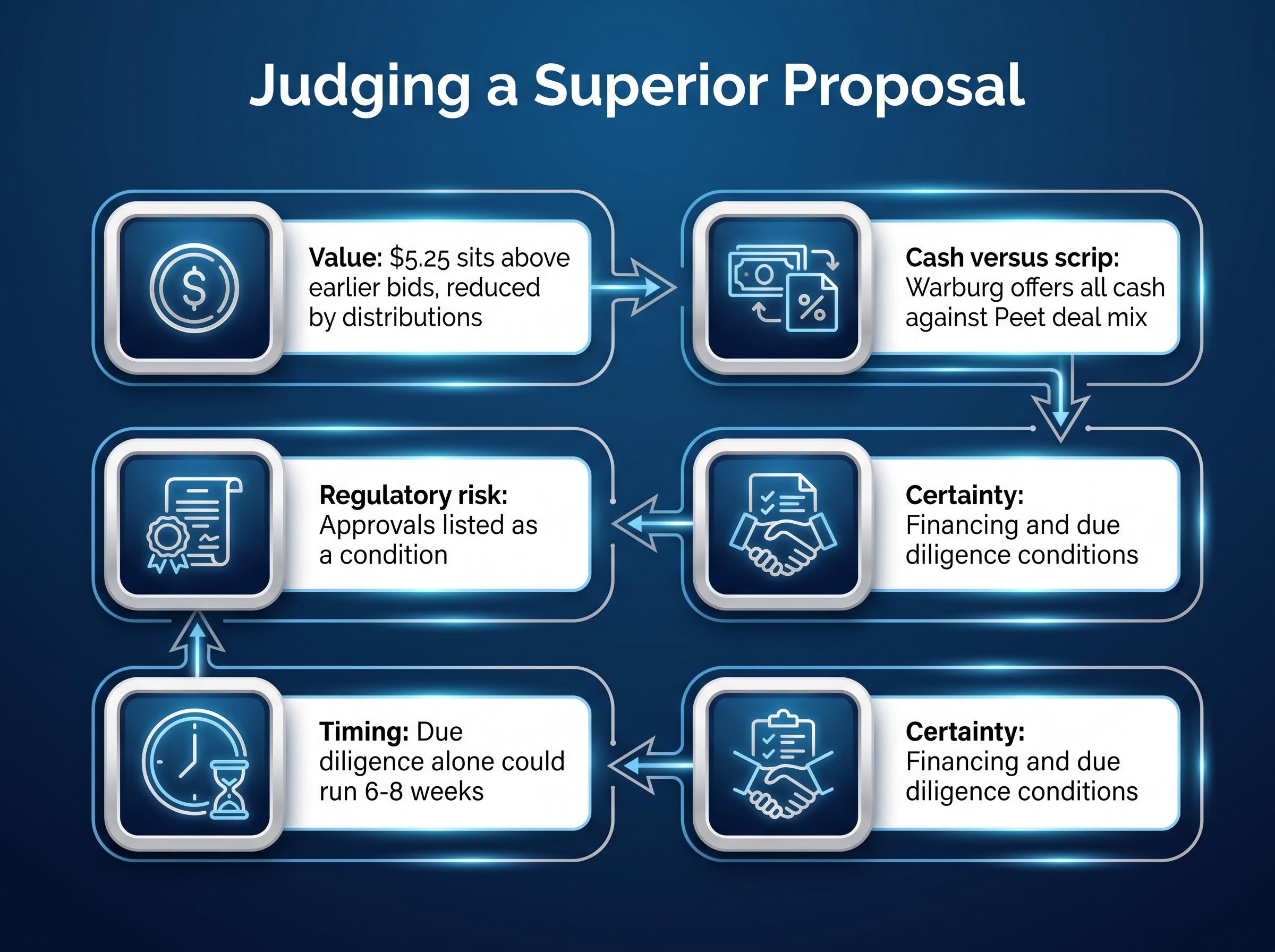
A superior proposal is judged on five factors:
- Value: $5.25 sits above the earlier bids, but is reduced by distributions.
- Cash versus scrip: Warburg offers all cash, against the Peet deal’s mix.
- Certainty: Financing and due diligence conditions weigh against it.
- Timing: Due diligence alone could run 6-8 weeks.
- Regulatory risk: Warburg lists regulatory approvals as a condition.
That framework explains the limited, non-exclusive due diligence, and why termination of the Peet SID is the sticking point. The board’s silence on the merits reflects legal constraint, not rejection or acceptance.
What Australian precedents show
- Asciano (2015-2016): A rival consortium forced improved terms on an agreed scheme.
- APN Outdoor: Regulatory concerns derailed the agreed oOh!media merger.
- Healthscope and MYOB: Private equity indicative proposals either became formal schemes or were withdrawn after due diligence.
Each announcement is a stage in a process, not a verdict.
What are the risks, and what should Ingenia investors watch next?
The appeal of $5.25 is clear, but several things could remove it. Warburg could walk after due diligence, or its financing or regulatory conditions could fail.
Ending the Peet SID could trigger a break fee, and Ingenia could finish with neither deal. The limited due diligence also falls short of the “full due diligence” Warburg has asked for.
The Peet scheme still needs shareholder, court and regulatory approvals. Sources conflict on the scheme meeting, with a late October and an early December 2026 date both reported, though implementation is expected in late December 2026.
Strategically, the split is cash certainty and a premium against Peet’s long-term land-lease and residential development growth case. Morningstar framed the offer as conditional, non-binding and indicative. A cash price only has value if it completes, so ask how likely completion is, not just how high the price is.
Your cash and your securities do not move on the day a scheme vote passes or a trade is placed; the T+2 settlement cycle means ownership and funds change hands two business days later, which matters when you time a sale around a record date.
| Risk | What would signal it | Current status |
|---|---|---|
| Warburg walks away | No binding proposal after due diligence | Non-binding today |
| Financing or regulatory failure | Conditions remain unsatisfied | Both are listed conditions |
| Break fee on Peet termination | Board moves toward ending the SID | Amount undisclosed |
| Neither deal completes | Peet timetable slips while Warburg stalls | Peet approvals outstanding |
Watch these signposts:
- The 5 October update
- Whether the board forms a view on the merits
- The terms of the due diligence
- Any change to the Peet timetable or scheme meeting date
- A binding proposal from Warburg
- Any HMC or other substantial holder notices
The public record still lacks the Peet break fee, the independent expert and a full substantial holder list.
What the next update can settle, and what it cannot
A non-binding, conditional proposal sitting beside a binding scheme means this contest is early-stage, whatever the headlines say.
The 5 October update can reveal the due diligence terms and any shift in the board’s stance. It cannot deliver a recommendation, a binding offer or a vote outcome.
Follow the process signals, check ASX announcements, and consider seeking licensed advice before acting.
Investors exploring whether to sell into the market or wait for a cash payout should read our deep-dive into brokerage fee compounding, which shows how minimum commissions erode small trades.
This article is for informational purposes only and should not be considered financial advice. Investors should conduct their own research and consult with financial professionals before making investment decisions. These statements are speculative and subject to change based on market developments and company performance.
—