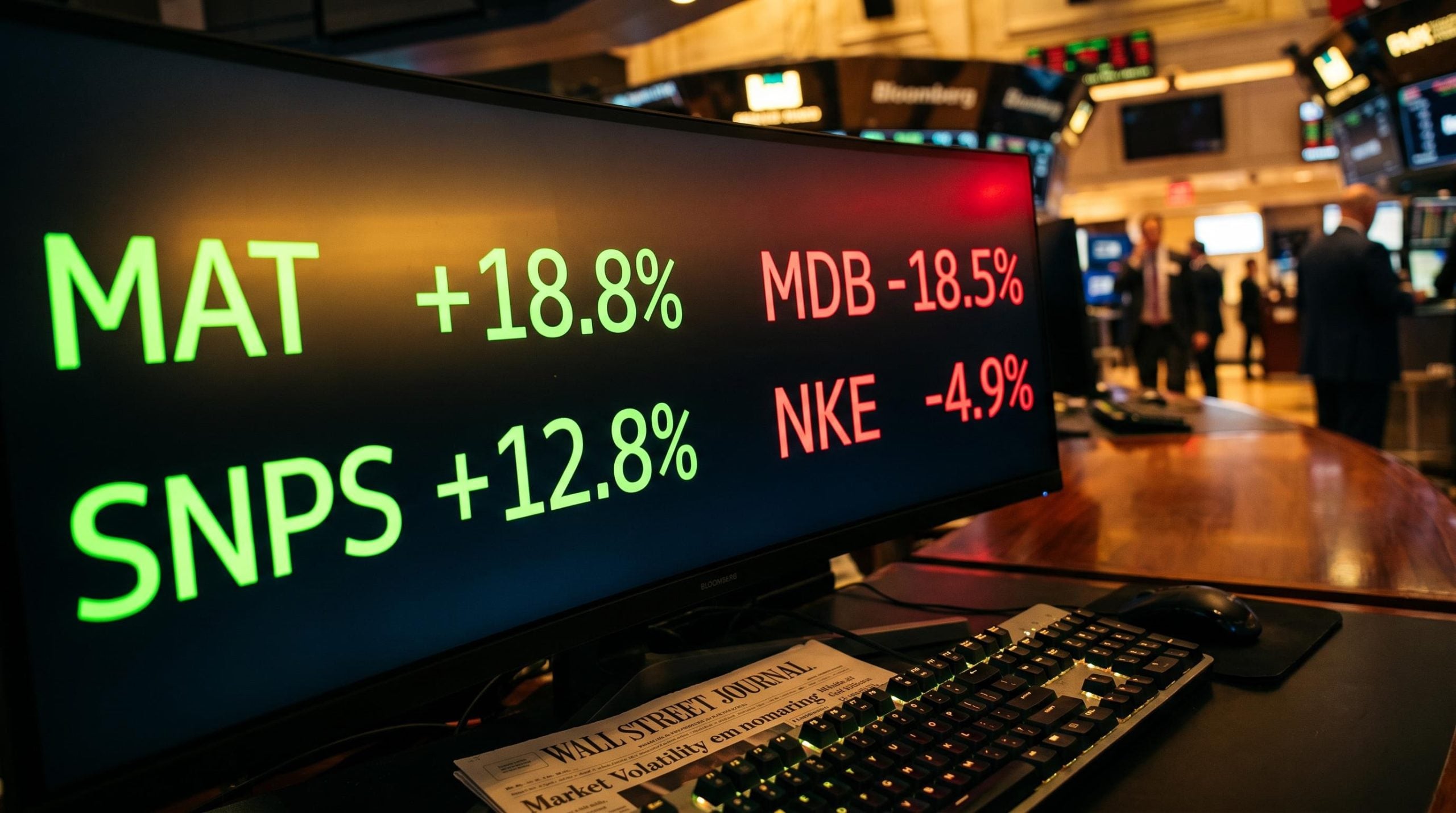
In a single trading week, four well-known US stocks swung between 4.9% and 18.8% in a single day, and each move told a different story. A chip design software company unveiled an OpenAI partnership. A database software CEO bolted to Meta. A toymaker became a takeover rumour. And Nike slid to its lowest price since 2013.
Markets rarely hand investors a week this instructive. Each move was driven by a distinct catalyst type: strategic vision, leadership instability, M&A speculation, and deteriorating fundamentals.
Understanding what separated the gains from the losses matters for anyone trying to read stock moves accurately rather than react to headlines.
This recap breaks down what actually drove these extremes, which signals carry weight and which are noise, and what each story reveals about the competitive dynamics shaping the US equity market right now.
Synopsys’s Investor Day delivered the week’s biggest legitimate catalyst
Synopsys shares climbed 12.8% on Thursday and closed the week up roughly 9.2%, the standout gain among the four names. The trigger was the company’s Investor Day in New York, where management laid out multi-year financial targets and two strategic partnerships that reframed how the market reads the business.
The financial targets came first, and they landed above where analysts had been modelling. Management guided to fiscal 2027 revenue of $11.1 billion to $11.2 billion, roughly 15% growth at the midpoint, alongside a near-term buyback and a margin trajectory that stretches well beyond 2027.
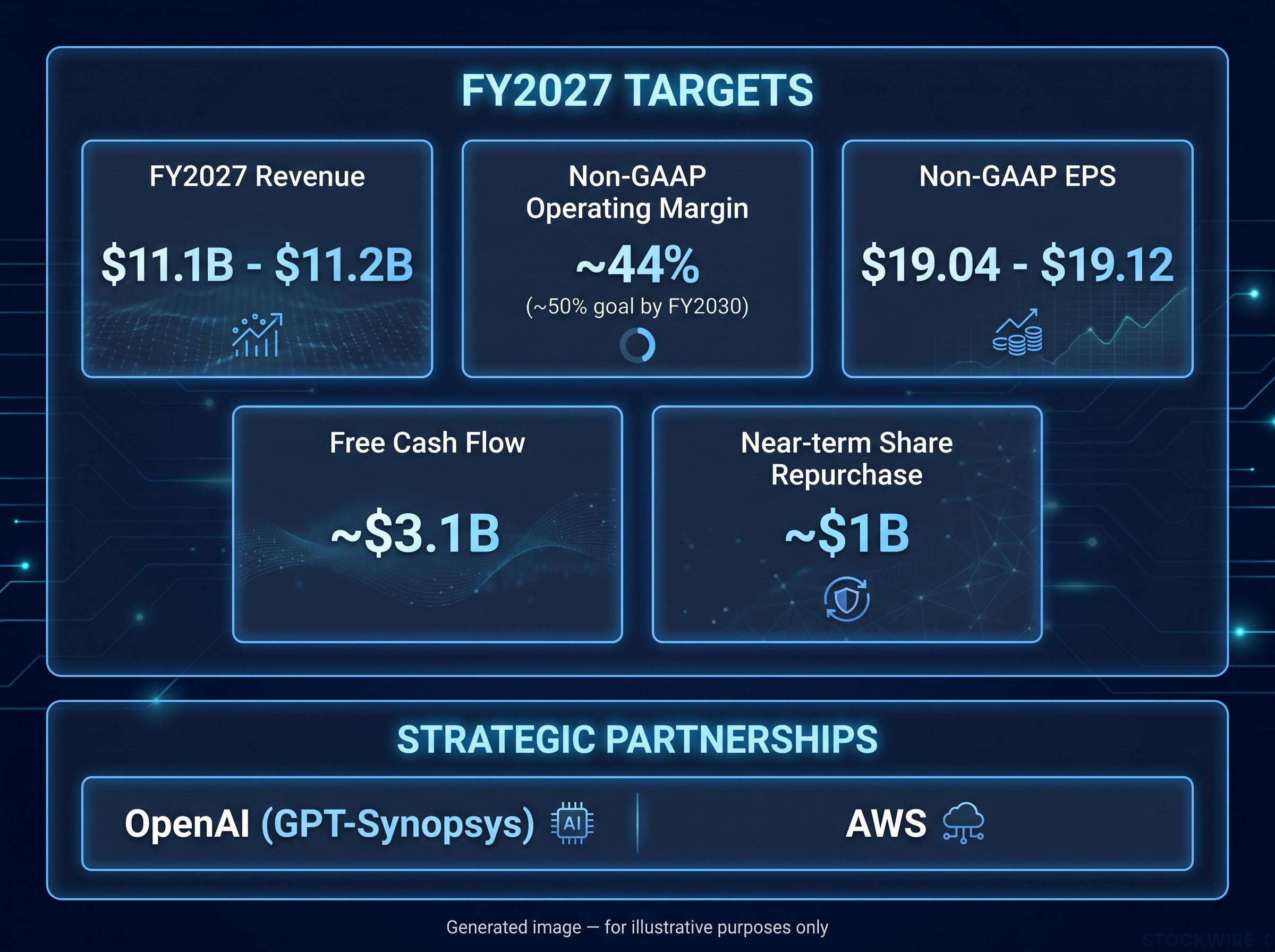
| Metric | FY2027 Target |
|---|---|
| Revenue | $11.1B – $11.2B |
| Non-GAAP operating margin | ~44% (~50% goal by FY2030) |
| Non-GAAP EPS | $19.04 – $19.12 |
| Free cash flow | ~$3.1B |
| Near-term share repurchase | ~$1B |
StoneX analyst Gary Mobley reiterated a Buy rating and a $570 price target, and his framing of the event is worth noting.
StoneX’s Gary Mobley characterised the Investor Day as materially more substantive than comparable events he had recently attended, reaffirming his Buy rating and $570 target.
The OpenAI and AWS deals: what they signal beyond the headlines
AI chip architectures, from GPUs to custom accelerators and specialised interconnects, have grown complex enough that traditional rule-based electronic design automation (EDA) flows struggle to keep up. That makes AI-assisted design tools a genuine need, not a marketing line.
Synopsys announced a collaboration with OpenAI to build GPT-Synopsys, a model purpose-built for chip design, and a multi-year silicon intellectual property agreement with Amazon Web Services for custom silicon work.
The AWS deal matters because it ties Synopsys revenue directly into hyperscaler capital expenditure cycles, which tends to make that revenue stickier over multiple years.
The AWS deal ties Synopsys revenue into the same capital expenditure cycles funding hyperscaler silicon programmes at Google, Amazon, and Microsoft, where the shift from off-the-shelf GPUs toward purpose-built ASICs has made EDA software and silicon IP increasingly central to each hyperscaler’s infrastructure roadmap.
Taken together, the above-consensus targets and two hyperscaler-tier partnerships tell you something important: Synopsys is no longer competing on EDA software alone. It is positioning itself as essential infrastructure for the AI chip design cycle, and that carries a different valuation logic than a routine guidance update.
When big ASX news breaks, our subscribers know first
MongoDB’s CEO departure to Meta triggered a crisis of confidence, not just a personnel change
MongoDB shares dropped 18.5% on Monday, 28 September 2026, the day of the announcement, and ended the week down roughly 14.7%. That severity is the first clue that the market read this as more than a routine reshuffle.
Chirantan “CJ” Desai stepped down as President and CEO effective immediately, after less than a year in the role, to take a senior position at Meta Platforms. His new title is chief enterprise platform officer, and his mandate is to lead the commercial rollout of Meta’s autonomous AI agent, Muse, into corporate accounts.
Dev Ittycheria, a director and former MongoDB chief executive, was appointed interim President and CEO while the board searches for a permanent successor. The company reaffirmed its fiscal third-quarter and full-year 2027 guidance at the same time.
Reassuring guidance did not calm the reaction, because the concern is structural rather than numerical. Governance analysis typically identifies three risk dimensions in a sudden C-suite exit to a rival:
The severity of MongoDB’s single-day drop reflected how markets price CEO departure risk when key-person exposure is embedded in a company’s growth narrative: governance uncertainty, execution gaps on live AI rollouts, and competitive signalling can compound into a move that dwarfs any earnings miss.
- Internal alignment questions, since an abrupt departure can hint at strategy or culture disagreements not yet public
- Execution risk on live initiatives such as AI product rollouts, which can stall when the replacement is interim
- A competitive signal, because talent flowing toward a big-tech rival implies the rival may have the stronger hand in the contested area
Stifel analyst Brad Reback kept his Buy rating and $465 price target, but he was candid about the read.
Stifel’s Brad Reback acknowledged there was no constructive interpretation of the departure, pointing to the Atlas platform upside Desai had been promoting in prior quarters.
Here is what the destination tells you. An experienced enterprise software CEO chose to build an AI platform at a social media company rather than lead MongoDB through its own AI transition. That is Meta signalling it believes it can compete credibly for the same enterprise AI infrastructure accounts MongoDB targets, and a seasoned operator agreeing there was more upside on the other side.
Nike’s 13-year low reflects a brand problem that a single quarter cannot fix
Nike shares fell roughly 5.3% across the week, with a 4.9% drop recorded in Friday trading, and the stock touched its lowest level since 2013. The immediate trigger was fiscal first-quarter results, but the more telling story sits underneath the numbers.
Revenue came in at $11.21 billion, below the $11.35 billion consensus and down 5% on a currency-neutral basis. Adjusted earnings per share of $0.48 beat the $0.44 estimate, so this was not a cost problem.
| Metric | Fiscal Q1 Actual | Analyst Estimate |
|---|---|---|
| Revenue | $11.21B (down 5% currency-neutral) | $11.35B |
| Adjusted EPS | $0.48 | $0.44 |
The weakness was broad. Nike Direct, the brand’s direct-to-consumer arm, fell 8%, and revenue declined across both Greater China and the EMEA region.
The reason analysts are not treating this as a bounce-back setup is the mix of structural and cyclical pressure. The cyclical headwinds are familiar:
- Post-pandemic normalisation in athletic wear demand
- Foreign exchange pressure
- Weaker discretionary spending during macro stress
The structural issues are harder to reverse:
- Over-reliance on direct-to-consumer that strained wholesale relationships, then a partial reversal that created channel and inventory complexity
- Competition from performance upstarts such as Hoka and On, plus fashion-oriented sneaker brands
- Slowing growth and brand erosion in China
- A product pipeline viewed as less innovative than in prior cycles
BofA analyst Lorraine Hutchinson cut her price target to $24 from $30 and kept an Underperform rating.
BofA’s Lorraine Hutchinson stated that a clear path to a meaningful revenue recovery is not yet in view, and that the valuation multiple faces continued downside pressure until an identifiable sales inflection point emerges.
The revenue miss alongside the EPS beat tells you the practical takeaway. Nike can manage its costs, but it has not yet solved its top-line problem, and cost discipline alone is unlikely to rebuild the multiple until a credible sales recovery is visible. The reset under CEO Elliott Hill may still have further to run.
Mattel’s 18.8% surge shows how M&A rumours can temporarily override fundamentals
Mattel shares jumped 18.8% on Thursday and tracked toward a weekly gain of roughly 13.6%, the largest single-day move of the four. Unlike the others, this one rested entirely on an unconfirmed report.
The Wall Street Journal reported that Authentic Brands Group (ABG), a brand-licensing company, had held private discussions about acquiring Mattel, citing people familiar with the matter. The reported figure under discussion valued Mattel at more than $20 per share, implying an enterprise value of roughly $6 billion or higher. As of the reporting date, no agreement had been publicly announced.
ABG’s model explains the logic. The company buys well-known but under-monetised consumer brands and shifts them toward a licensing-heavy structure, partnering with operators for sourcing and distribution while centralising brand management. Applied to Mattel’s portfolio, that would mean extending Barbie, Hot Wheels, and other franchises across media, merchandising, and experiences.
What ABG’s playbook means for Mattel shareholders
The critical nuance is who captures the upside. ABG monetises IP rather than operating brands in the traditional sense, so a deal would likely transform Mattel from a toy manufacturer into a licensing platform.
That transformation value would accrue to ABG as the acquirer, not to current Mattel shareholders who would exit at the deal price. The two scenarios for existing holders look like this:
- The deal completes at a modest premium, locking shareholders into a fixed exit while ABG keeps the long-term licensing upside
- The talks collapse, leaving Mattel exposed to cyclical toy demand without the leverage of a brand-licensing consolidator
Here is the calibration point. A stock jumping nearly 19% on an unconfirmed report means anyone buying into that move is taking acquisition-completion risk on top of ordinary business risk. The size of a move does not tell you how certain its cause is, and this catalyst deserves a different risk posture than Synopsys’s gain on confirmed targets.
Takeover speculation risks are most acute for investors who buy into a move after an unconfirmed report, because the spread between market price and rumoured offer reflects deal probability rather than guaranteed return, and the downside on a failed bid typically erases the entire premium and then some.
What this week’s divergent moves tell investors about where conviction is actually flowing
Read together, the four stories are not random volatility. They are a legible set of market verdicts on four different risk and opportunity profiles.
The week illustrated all four major catalyst types in a compressed timeframe: confirmed strategic targets, leadership instability, structural fundamental deterioration, and unconfirmed M&A each trigger different investor responses and produce moves with meaningfully different durability profiles.
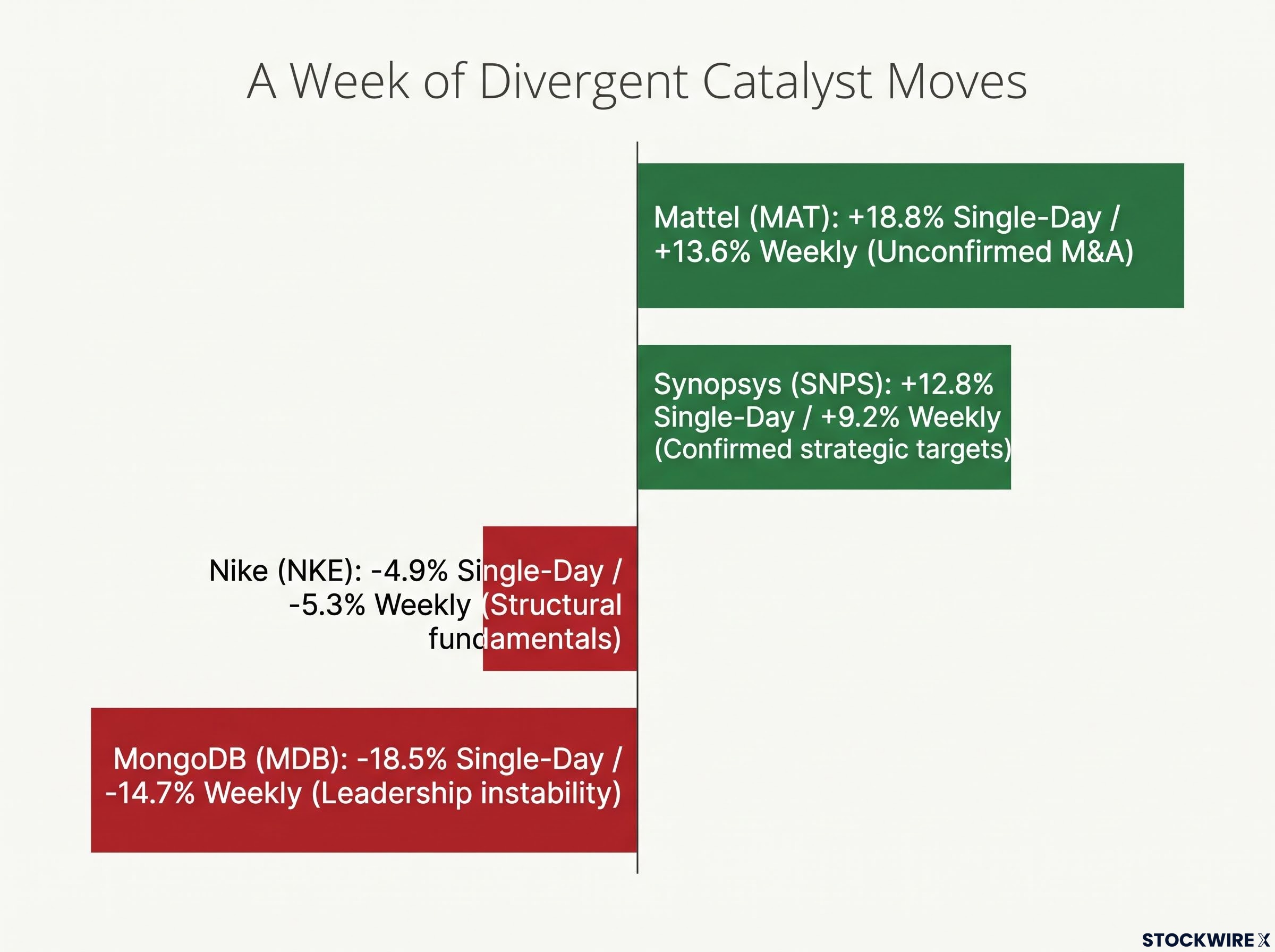
| Stock | Catalyst Type | Single-Day Move | Weekly Move |
|---|---|---|---|
| Synopsys (SNPS) | Confirmed strategic targets and partnerships | +12.8% | +9.2% |
| MongoDB (MDB) | Leadership instability | -18.5% | -14.7% |
| Nike (NKE) | Structural fundamentals | -4.9% | -5.3% |
| Mattel (MAT) | Unconfirmed M&A | +18.8% | +13.6% |
Synopsys and MongoDB are two faces of the same AI infrastructure theme. One company announced it is becoming essential to building AI chips. The other lost its CEO to the entity trying to sell AI infrastructure into enterprise accounts.
Nike and Mattel sit in a separate narrative: legacy consumer brands facing either structural decay or speculative rescue, neither reflecting operational momentum.
The week’s core lesson is that catalyst type determines the durability of a move, not just its direction. Confirmed strategic targets, leadership risk, structural decline, and unconfirmed M&A each behave differently once the headline fades.
For disciplined investors, that distinction is where the value sits. Synopsys’s re-rating had multiple confirming signals. MongoDB’s sell-off had a single but structurally significant one. Mattel’s spike had none that were confirmed. And Nike’s slide reflects a reset that may not be finished.
This article is for informational purposes only and should not be considered financial advice. Investors should conduct their own research and consult with financial professionals before making investment decisions.
Past performance does not guarantee future results. Financial projections and reported acquisition discussions are subject to market conditions, company performance, and various risk factors, and may change based on future developments.