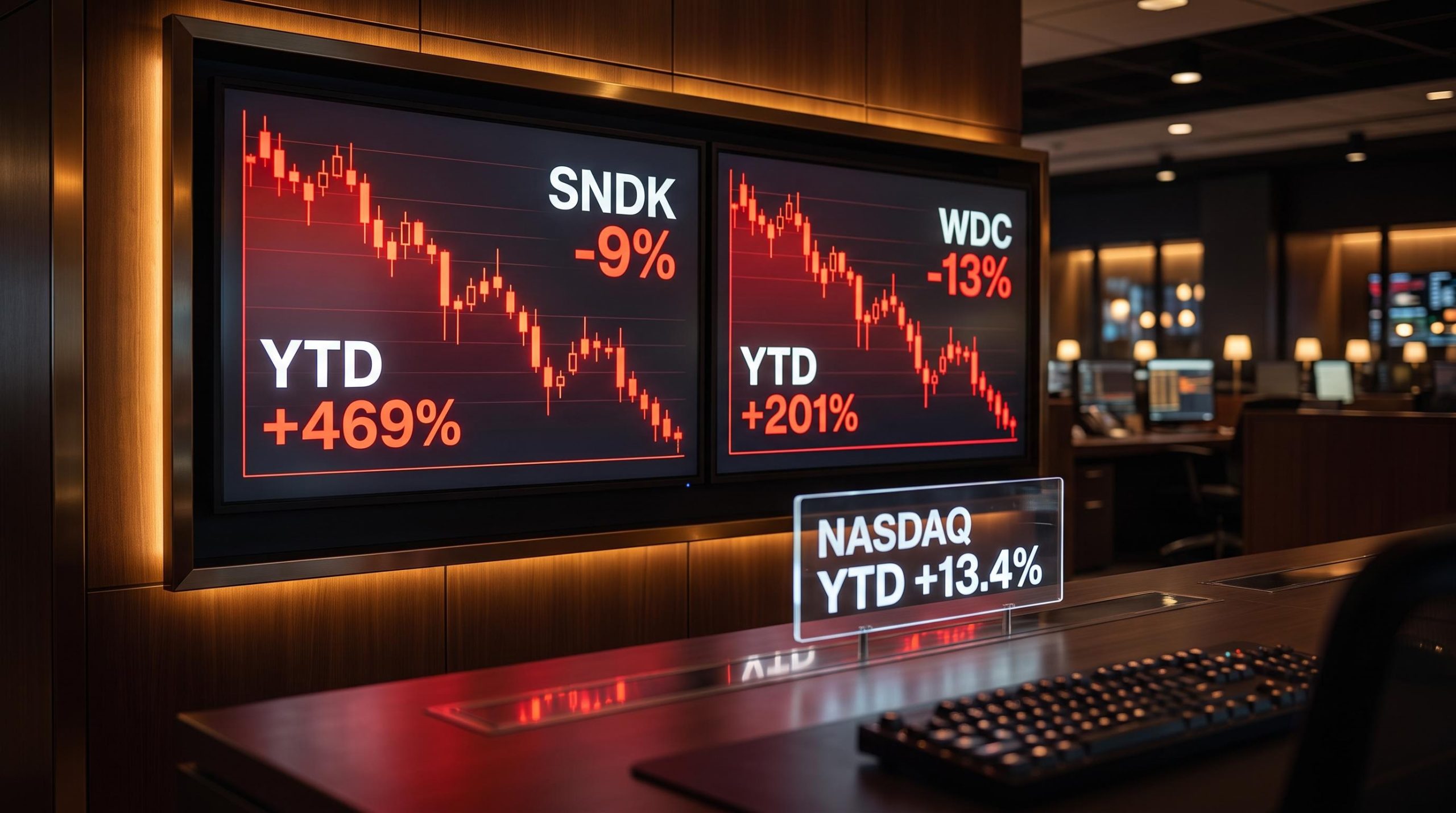
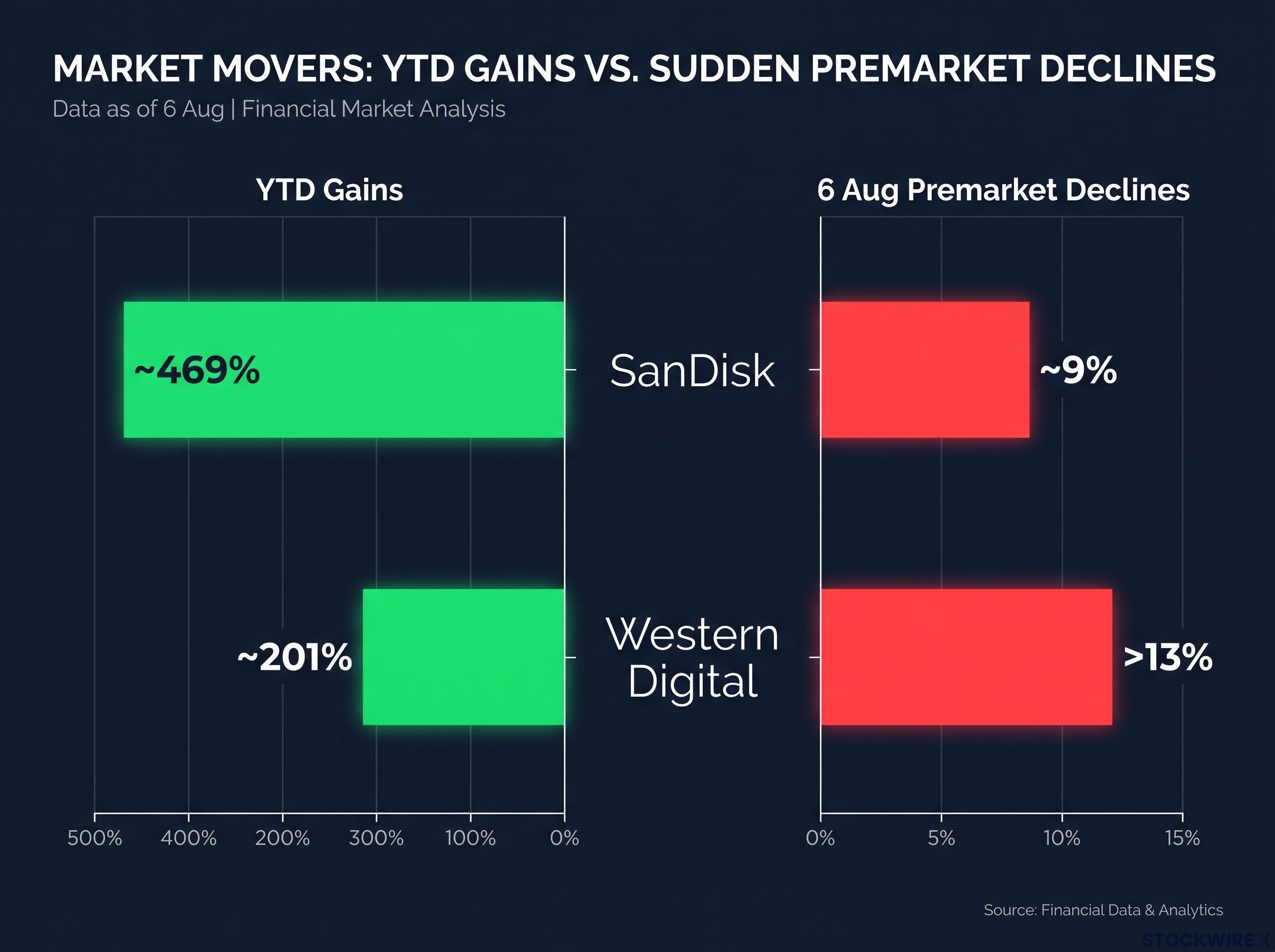
SanDisk beat the $10.47 billion Wall Street Q1 revenue consensus with its guidance, and Western Digital followed suit after the close on 5 August. Both stocks are down sharply in premarket trading anyway, with SanDisk off roughly 9% and Western Digital dropping more than 13%.
The paradox only sharpens when you see the numbers these companies carried into earnings. SanDisk had climbed close to 469% in the year to date. Western Digital had added roughly 201% over the same period. These are not businesses that disappointed. They are businesses whose share prices had already consumed every piece of good news the earnings report could deliver, and then some.
Here is what the selloff actually reveals about the gap between strong fundamentals and unsustainable expectations, and why the pattern matters for any AI momentum position you hold or are watching heading into the rest of earnings season.
SanDisk and Western Digital crater despite beating the street
Both sets of results landed after the close on 5 August 2026. By the time premarket trading opened on 6 August, the market had already rendered its verdict.
SanDisk, which was carved out of Western Digital as a standalone business in 2025 and rapidly established itself as a prominent AI momentum name on the back of swelling NAND flash demand tied to data-centre build-outs, projected Q1 revenue above the published consensus estimate.
SanDisk’s Q1 revenue guidance cleared the published Wall Street consensus of $10.47 billion. Investors sold the stock roughly 9% lower regardless.
Western Digital issued its own above-consensus sales guidance. Premarket traders responded by marking the stock down more than 13%.
| Company | YTD gain heading into 6 Aug | Premarket decline on 6 Aug |
|---|---|---|
| SanDisk | ~469% | ~9% |
| Western Digital | ~201% | >13% |
Neither result was an earnings miss in any conventional sense. That is precisely what makes the reaction worth understanding. The gap between “beat consensus” and “satisfy the market” is real, and it is consequential for anyone holding AI momentum names into earnings.
The expectations gap that punished SanDisk and Western Digital on 6 August is not unique to AI memory names; in Q1 2026, 84% of S&P 500 companies beat EPS estimates and stocks still frequently fell, confirming that the market prices the gap between results and prior expectations, not results in absolute terms.
When big ASX news breaks, our subscribers know first
Why 469% gains make even good news dangerous
Consider what a 469% year-to-date gain actually implies. A stock at that level has already priced in multiple strong quarters, expanding margins, and sustained AI demand. A simple beat-and-raise, exactly the kind SanDisk and Western Digital delivered, is not a positive surprise at those prices. It is the minimum the market requires to stay flat.
This is the “priced for perfection” dynamic, where valuation has run so far ahead of fundamentals that only dramatically above-expectation results can push the share price higher.
The published analyst estimate is not the real hurdle, either. In heavily owned momentum names, the informal market expectation (sometimes called the whisper number) sits above the consensus figure. That whisper number reflects what traders actually believe will happen based on supply-chain checks, options positioning, and institutional sentiment. Meeting or modestly beating the published number, while missing the whisper, triggers selling.
Three linked forces drove what happened on 6 August:
- Priced for perfection: Having posted year-to-date advances of 469% and 201% respectively, far above the Nasdaq Composite’s approximately 13.4% gain over the same period, SanDisk and Western Digital had no margin for anything less than a blowout
- Buy the rumour, sell the news: Early investors who front-ran the AI thesis for months used the earnings confirmation as a planned exit point, locking in gains once the thesis was validated
- Institutional momentum exit: Hedge funds and quantitative strategies that rode the trend treat earnings as a de-risking event, and their selling cascades through other short-term participants
The price you paid, not the earnings result itself, is the primary variable that determines your outcome in a momentum position. SanDisk and Western Digital just demonstrated that in real time.
How one bad reaction spreads across a sector
The selling did not stay contained to two stocks. It moved outward in two distinct waves, each following a different channel but carrying the same underlying message.
Memory and storage sympathy selling
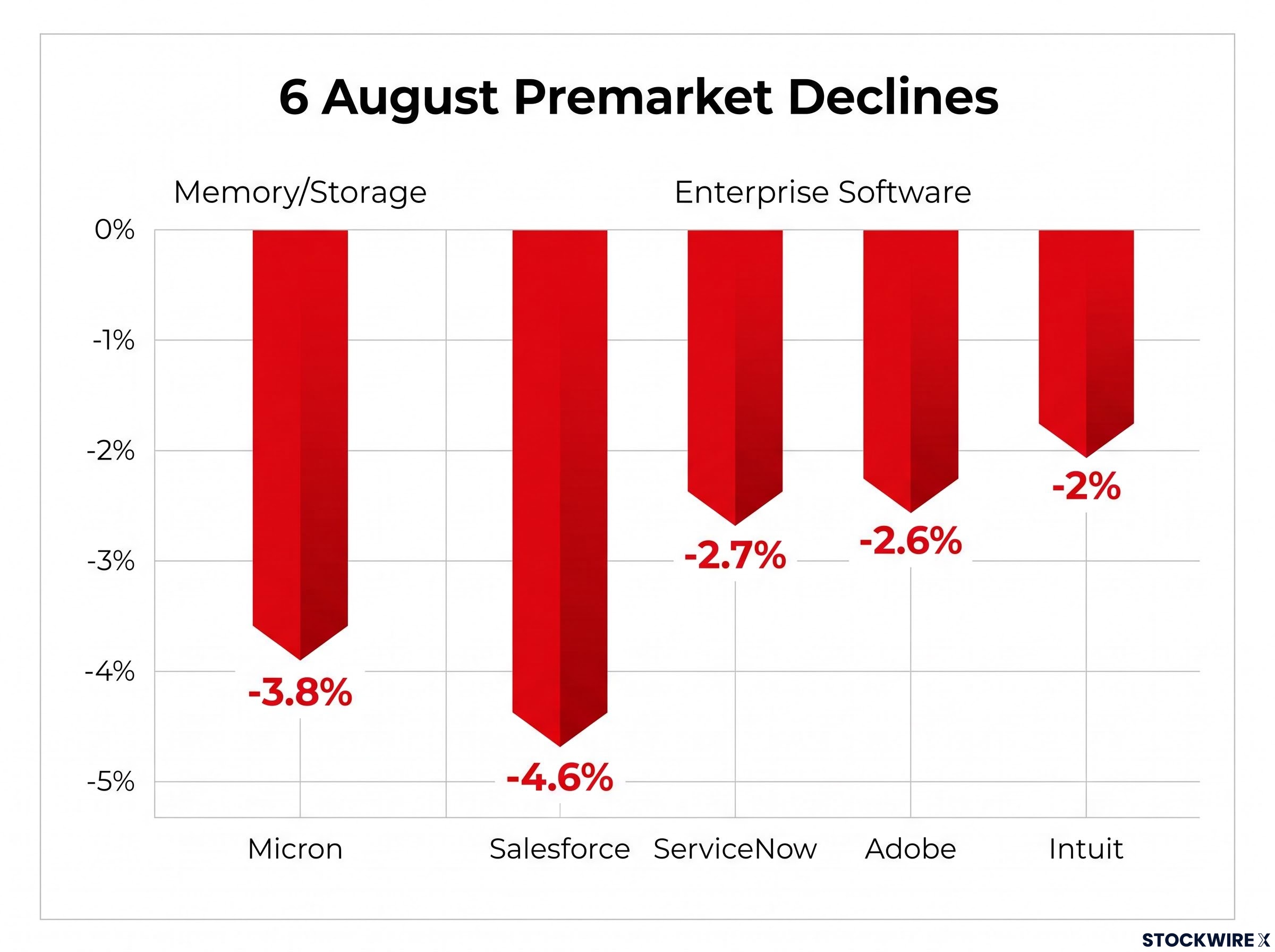
Micron fell roughly 3.8% in premarket trading on 6 August without any fresh company-specific news. The decline was pure sympathy; Micron shares the same AI memory narrative as SanDisk and Western Digital, and when marquee names in that narrative show that strong results cannot sustain extreme valuations, traders reprice the entire peer group.
Enterprise software: the HubSpot ripple
A second contagion channel opened through enterprise software. HubSpot’s negative earnings reaction weighed on sentiment across the sector, pulling down names that had nothing to do with memory or storage.
| Company | Sector | Premarket decline (6 Aug) |
|---|---|---|
| Micron | Memory/Storage | ~3.8% |
| Salesforce | Enterprise Software | 4.6% |
| ServiceNow | Enterprise Software | 2.7% |
| Adobe | Enterprise Software | 2.6% |
| Intuit | Enterprise Software | 2% |
Both channels deliver the same lesson. Diversifying across AI-adjacent names does not protect you from a correlated momentum unwind, because the shared narrative is the common risk factor, not any single company’s earnings.
Sector-wide contagion of this type followed the same script in July 2026, when Netflix fell nearly 9% aftermarket and the Philadelphia Semiconductor Index shed 4.3% in a single session, with SanDisk and Western Digital each absorbing double-digit declines on no company-specific news.
What this selloff says about AI fundamentals (and what it does not)
The instinct when AI stocks drop 9% and 13% in a session is to ask whether the AI story is breaking. It is not.
Data-centre and AI spending remain elevated. Leading chip and foundry companies continue to report strong revenue tied to AI workloads. SanDisk and Western Digital both guided above consensus, confirming business health directly.
Today’s declines are about how much investors are willing to pay for growth, not about whether the growth exists.
The distinction matters because the two questions require opposite responses:
Goldman Sachs flagged momentum reversal risk in May 2026, identifying the AI-driven surge as one of only 11 comparable episodes since 1980, each of which reversed within roughly one month of peaking, with hedge fund gross leverage and net momentum exposure sitting near five-year highs at the time of the warning.
- What this does say: AI-linked stocks are vulnerable when expectations outrun fundamentals. The market is demanding more reasonable risk premia for the same underlying growth. High valuation dispersion, where a subset of AI names trade at clear premiums to the broader market, creates a long runway for further mean reversion.
- What this does not say: That AI infrastructure demand or memory/storage spending is deteriorating. The Nasdaq Composite’s approximately 13.4% YTD gain sits far below the gains posted by the most extreme momentum names, which tells you the valuation adjustment is happening at the edges, not at the index level.
You should not panic-sell broad-market index positions on the back of this action. You should remain clear-eyed that individual AI momentum names may still have further to correct.
Five warning signs your AI position is exposed to post-earnings momentum risk
Every data point from today maps onto a warning sign you can check against your own holdings:
- Triple-digit YTD gains with no pullback. SanDisk’s pre-earnings run of approximately 469% and Western Digital’s advance of around 201% meant the vast majority of the bull case had already been absorbed into the share price. If your position has appreciated that dramatically, the range of earnings outcomes that can support further upside is extremely narrow.
- Consensus beats that leave whisper numbers unmet. Both companies guided above Wall Street estimates and still sold off sharply. In crowded momentum trades, the published number is the floor, not the target. If you are buying ahead of earnings because “they will beat,” ask whether that beat is already priced in.
- Earnings as institutional exit points. Momentum and hedge-fund investors frequently use results as a planned de-risking event. If you are buying right before an earnings release in a heavily appreciated name, you may be buying from institutions that are about to sell into any strength.
- Within-sector correlation masking true concentration. Micron’s 3.8% sympathy decline shows that owning multiple names in the same AI theme does not diversify your risk. A correlated unwind hits them all.
- Valuation dispersion relative to the broader market. When your AI positions trade at multiples far above the Nasdaq Composite and other profitable tech names, mean reversion becomes the gravitational force, and it only needs a sentiment shift to activate.
The bottom line: the price you paid matters as much as the AI story itself.
What today’s repricing changes for AI investors heading into earnings season
Today’s premarket action is a repricing of the momentum premium, not a breakdown of the AI or memory/storage investment case. The businesses are healthy. The valuations were stretched. The market corrected one without invalidating the other.
The shift for investors looking ahead is straightforward: the standard by which AI momentum stocks will be evaluated at future earnings has just been raised. The market has now demonstrated it will penalise even above-consensus guidance when valuations are extended. Guidance must clear the whisper number, not just the published consensus, for price action to be positive.
Three variables to monitor heading into the next major AI earnings period:
- The valuation gap between individual AI momentum names and the Nasdaq Composite, whose 13.4% YTD gain serves as a useful measure of just how far the most elevated outliers have stretched above the broader market
- Whisper-number dynamics in crowded trades, particularly whether options markets are pricing in moves larger than the consensus beat would justify
- Institutional positioning signals, including short interest changes and fund-flow data that reveal whether large holders are building or reducing exposure ahead of results
The AI theme remains intact. The terms of engagement for momentum positions within it have just changed in a measurable way.
For readers wanting to build a complete framework before the next major AI earnings cycle, our full explainer on earnings season mechanics covers how forward guidance is weighted against EPS beats, how to read the earnings call Q-and-A, and why institutional and retail investors respond to surprises in systematically different ways.
This article is for informational purposes only and should not be considered financial advice. Investors should conduct their own research and consult with financial professionals before making investment decisions. Past performance does not guarantee future results.