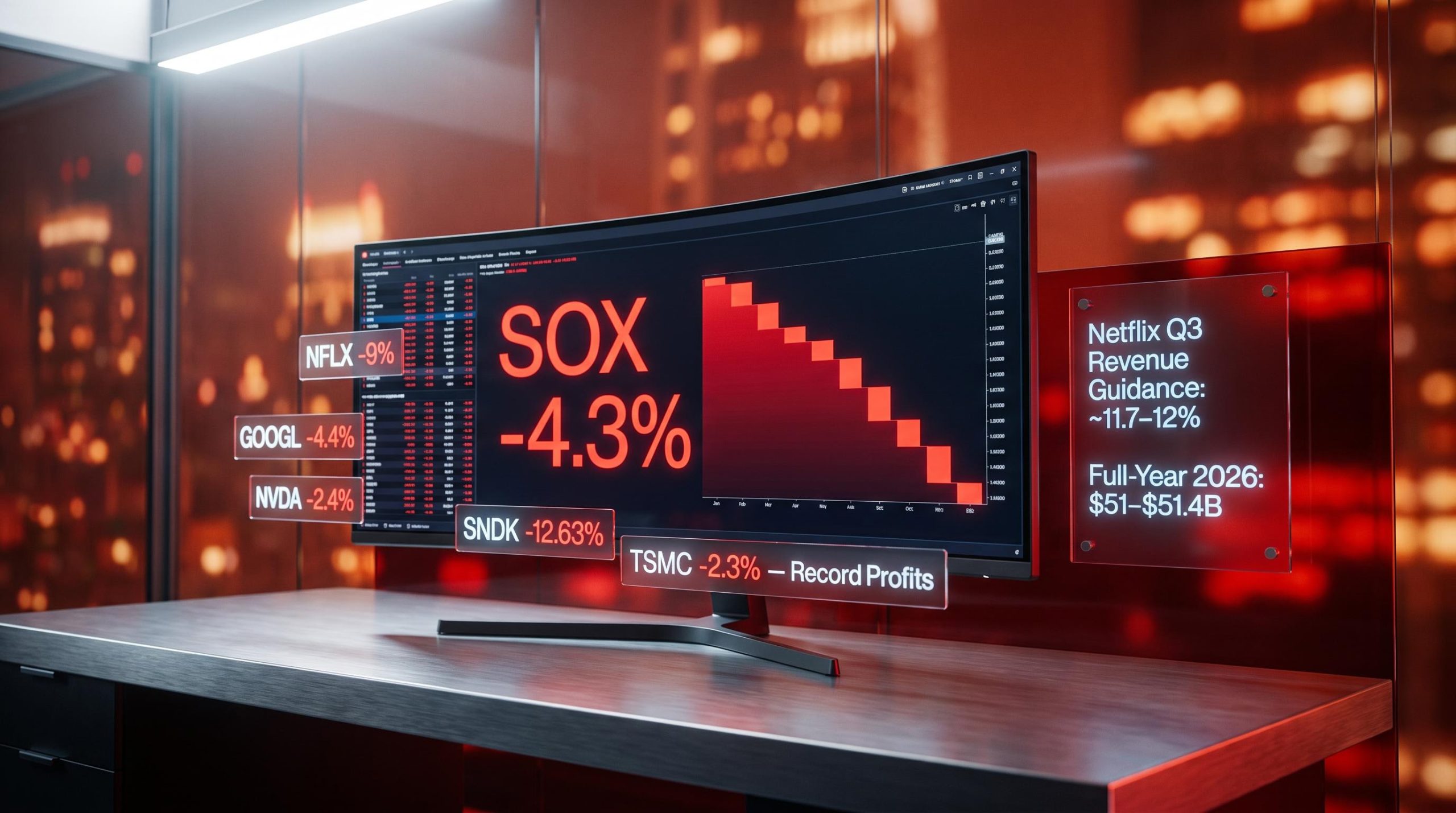
Two separate earnings-season catalysts hit the market on the same day, and by the close of regular trading on 16 July 2026, the Philadelphia Semiconductor Index had shed 4.3%, Netflix was down nearly 9% in aftermarket trading, and Alphabet had lost 4.4% on a product delay that had nothing to do with quarterly numbers.
The tech stock selloff arrived at the worst possible moment: the day before the broader earnings calendar opens for Alphabet, Amazon, Microsoft, and Meta. Whatever those reports deliver will now be measured against a market that has already moved to price in AI execution risk, decelerating growth assumptions, and valuation fragility. Yesterday’s session did not simply reflect bad news. It reflected what happens when stretched valuations meet even marginal disappointment.
Here is what actually caused the damage, how individual stock stories cascaded into a sector event, and what the coming earnings reports will need to deliver to stabilise sentiment.
Netflix set the tone: why a guidance miss hit harder than a beat helped
Netflix reported Q2 2026 earnings on 16 July, and the headline numbers were not bad. Earnings per share came in at $0.80, beating the $0.79 estimate. Revenue grew more than 13% year-over-year. By any standalone measure, this was a solid quarter.
The problem was the forward guidance. Q3 revenue growth of approximately 11.7-12%, implying revenue around $12.86-$12.9 billion, confirmed what investors feared: momentum is decelerating. Full-year 2026 revenue guidance, narrowed to $51-$51.4 billion, offered no upside surprise. The distance between what analysts had priced in and what management delivered was small in absolute terms but enormous in valuation terms.
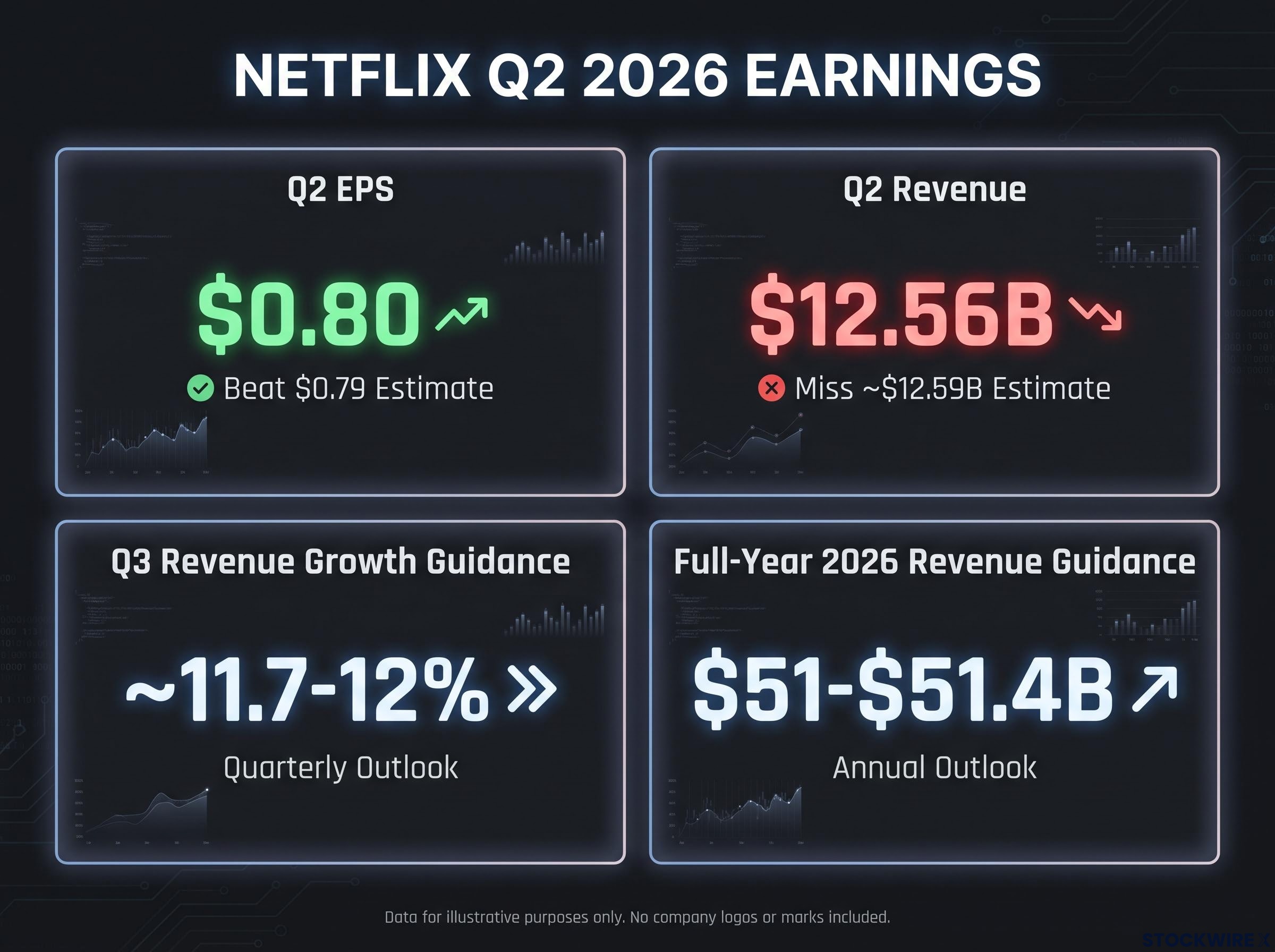
| Metric | Actual | Estimate | Result |
|---|---|---|---|
| Q2 revenue | $12.56B | ~$12.59B | Miss |
| Q2 EPS | $0.80 | $0.79 | Beat |
| Q3 revenue growth guidance | ~11.7-12% | Higher implied | Below expectations |
| Full-year 2026 revenue guidance | $51-$51.4B | Upward revision expected | Narrowed, not raised |
Netflix dropped close to 9% in aftermarket hours on results that, by conventional measures, were not bad. The drop tells you that the stock’s premium multiple had been pricing in acceleration, not continuation, and any guidance that confirmed deceleration was treated as a fundamental disappointment regardless of the current-quarter scorecard.
That asymmetry between backward-looking beats and forward-looking misses is the single most important dynamic for anyone holding or watching a premium-multiple growth stock heading into earnings season.
The expectations gap dynamics at work in Netflix’s reaction are well-documented across earnings history: with 84% of S&P 500 companies beating EPS estimates in Q1 2026, well above the 10-year average of 76%, markets have recalibrated so that a beat alone carries almost no informational value, and only guidance can move the needle.
When big ASX news breaks, our subscribers know first
Alphabet’s Gemini delay: when a product timeline becomes a valuation problem
Alphabet did not report earnings yesterday. It did not issue a profit warning. What it did was confirm, via reports citing Bloomberg, that its Gemini 3.5 Pro artificial intelligence model, previously targeted for an earlier 2026 launch window, had been delayed.
The stock fell 4.4-4.5%.
Why the market treated a product delay as a pricing event
The reaction makes more sense when you consider what a portion of Alphabet’s share price actually represents. A significant slice of the current valuation rests on assumptions about AI monetisation at scale: enterprise adoption of Gemini-powered products, integration across Google’s advertising infrastructure, and competitive positioning against OpenAI and Microsoft. Those assumptions embed specific timelines. When one of those timelines slips, even by a matter of months, the market revises the probability and timing of future cash flows and applies a higher discount rate to them.
The timing compounded the damage. Alphabet’s delay hit the tape on the same day as Netflix’s guidance disappointment, feeding a single narrative: that the growth assumptions embedded in tech’s premium multiples are more fragile than prices had implied. Assessed in isolation, a model delay might have drawn a 1-2% move. Arriving alongside Netflix’s guidance miss, it became part of a broader repricing of AI execution risk.
For anyone holding Alphabet or any AI-infrastructure name, the takeaway is direct: a single delay report was enough to trigger partial repricing of the AI timeline bet baked into the share price.
What earnings season dynamics actually drive sector-wide selling
Netflix disappointed on guidance. Alphabet confirmed a product delay. Neither event, on its own, explains why storage stocks fell 12% or why TSMC declined on record profits. The breadth of yesterday’s damage only makes sense when you understand the mechanical process by which individual stock stories become sector events.
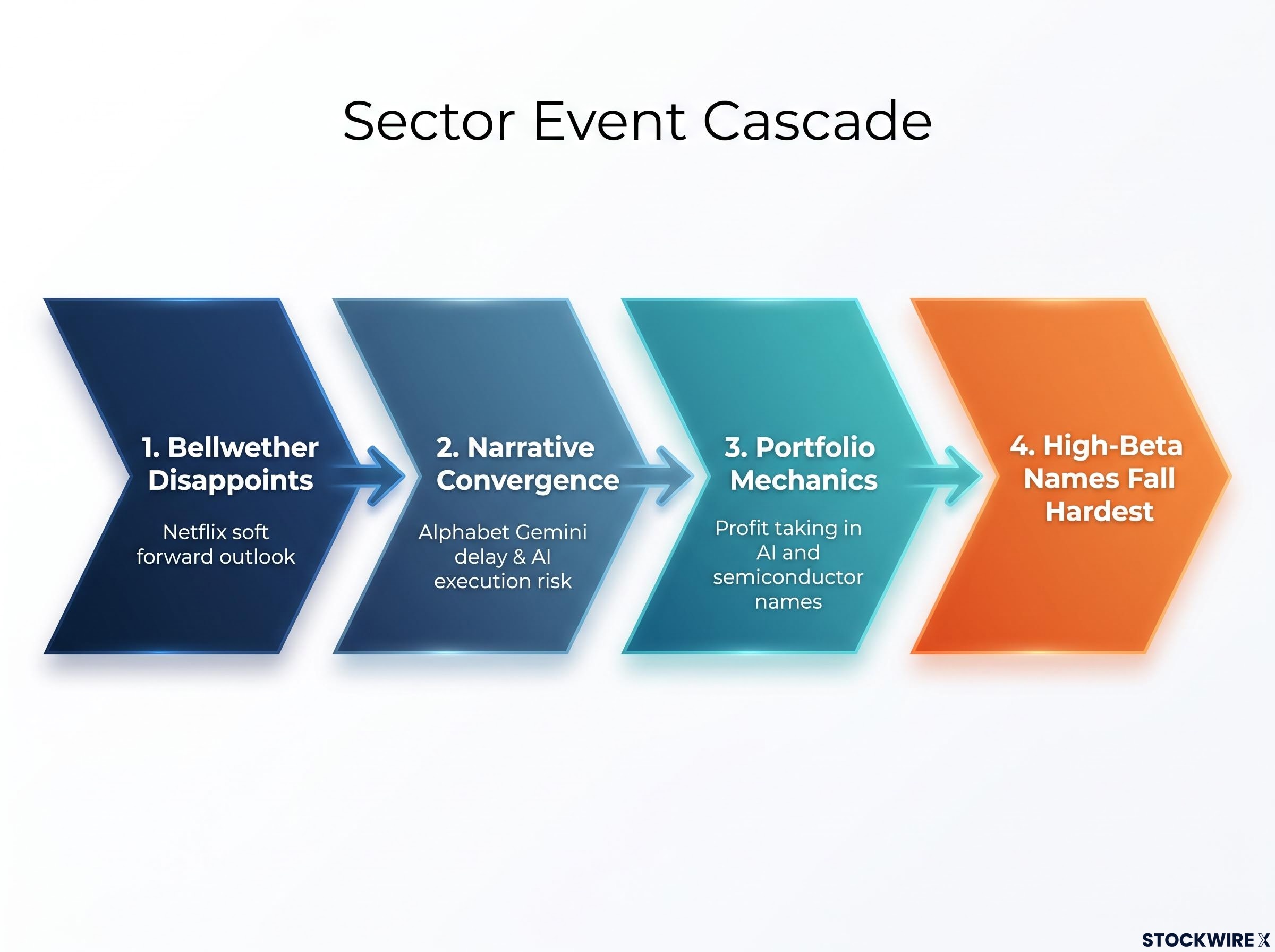
The cascade works in four steps:
- A bellwether disappoints on guidance. Netflix’s soft forward outlook created a negative data point about future growth in high-multiple tech. The immediate aftermarket drop signalled to the rest of the market that the “priced to perfection” dynamic was in effect.
- Narrative convergence around AI execution risk. Alphabet’s Gemini delay fed the same story from a different angle: AI product timelines are uncertain, and AI-premium multiples embed substantial execution risk. Two catalysts, one in consumer tech, one in enterprise AI, pointed toward the same conclusion.
- Portfolio mechanics amplify the move. Investors sitting on large year-to-date gains in AI and semiconductor names used the shock as a trigger to take profits and rebalance overweight tech positions. This selling is mechanical rather than fundamentally driven, but it broadens what starts as a single-stock issue into a sector-wide event.
- High-beta, high-multiple names fall hardest. Semiconductors and AI-adjacent hardware, trading at elevated multiples relative to current earnings, experienced the largest percentage declines because they carry the largest embedded expectations about future AI returns.
The fact that TSMC fell 2.3% on a day it reported record quarterly profits and raised its revenue outlook is the clearest evidence that this cascade was a sentiment and positioning event, not a fundamental reassessment. That distinction matters enormously for how you interpret the damage and how quickly recoveries in individual names are likely to play out.
AI trade crowding had been quantified before this session: the BofA fund manager survey recorded 80% of respondents naming long global semiconductors the most crowded trade in the survey’s 12-year history, a concentration that explains why a sentiment catalyst in one corner of tech could cascade into double-digit declines across storage and memory names with no specific news of their own.
The semiconductor damage in detail: what fell and why the breadth matters
The SOX index shed 4.3% on 16 July 2026, its sharpest single-session decline in months, despite one of its largest constituents reporting record earnings.
The distribution of losses across the semiconductor and AI hardware complex reveals the logic of where cascade selling hits hardest.
| Stock (Ticker) | Decline | Volume | Notes |
|---|---|---|---|
| NBIS | -13.90% | ~28.41M shares | Largest single-day loser |
| Sandisk (SNDK) | -12.63% | ~17.45M shares | Storage/memory |
| Seagate Technology (STX) | -10.00% | ~6.22M shares | Storage/memory |
| Western Digital (WDC) | -9.15% | ~10.53M shares | Storage/memory |
| AMD | -5.33% | ~27.09M shares | Mid-cap AI chip |
| Intel (INTC) | -5.8% | — | Legacy + AI exposure |
| NVIDIA (NVDA) | -2.4% | — | Largest-cap AI chip |
| TSMC (TSM) | -2.3% | — | Record profits, raised guidance |
The pattern is clear. Storage and memory names, which carry higher beta and more elevated multiples relative to current earnings, absorbed the worst of the damage: double-digit declines across Sandisk, Seagate, and Western Digital. Mid-cap chip names like AMD and Intel fell mid-single digits. The largest-cap infrastructure names, NVIDIA and TSMC, declined the least.
The volume data reinforces the read. NBIS traded approximately 28.41 million shares. Sandisk traded 17.45 million. These were not thin-market moves. They reflect deliberate, large-scale position reduction across the AI hardware complex.
The gradient of losses, steepest in the highest-beta names and shallowest in the largest-cap infrastructure plays, tells you the market was systematically reducing AI hardware exposure rather than reacting to any single company’s news. Indiscriminate selling across names with fundamentally different earnings profiles is the signature of a positioning event, not a fundamental repricing, and that distinction shapes how unevenly recoveries tend to play out.
Semiconductor valuation dispersion across the sector means the same 4.3% index decline masks fundamentally different situations: Micron trading below 9x forward earnings is a categorically different repricing risk than Intel at 101x forward earnings, and names that fell on contagion rather than company-specific deterioration carry different recovery trajectories as a result.
What Big Tech earnings will need to deliver to contain the damage
Yesterday’s session has not lowered the bar for the earnings reports that follow. It has raised it.
Alphabet, Amazon, Microsoft, and Meta all report in the coming days, and each report will now be read through the lens of two freshly established concerns: guidance sensitivity (Netflix proved that even small misses trigger outsized moves at premium multiples) and AI execution risk (Alphabet’s Gemini delay showed how quickly product timelines can become valuation problems).
Three things investors will watch in Big Tech earnings
- AI revenue traction: Cloud workloads, enterprise adoption rates, and incremental monetisation evidence. The market needs to see that the spending is converting into revenue, not just capability.
- Margin impact of AI capex: Whether the infrastructure spending cycle is on a path to returns that justify current multiples. TSMC’s elevated capex guidance crystallised this concern: strong demand for AI chips does not automatically translate to strong shareholder returns when the investment required to sustain that demand is also rising sharply.
- AI roadmap credibility: Given Alphabet’s delay, any further signs of timeline slippage across the ecosystem will be heavily scrutinised. Management teams that cannot offer specific, measurable AI monetisation milestones will receive less benefit of the doubt than they would have a week ago.
Netflix’s Q3 guidance implied growth of 11.7-12%, which is solid by any historical standard but was treated as a disappointment because it confirmed deceleration. That is the benchmark for what “good but not good enough” looks like when multiples are stretched. If you are positioned in any of the major megacap tech names heading into earnings, yesterday’s reset means in-line or slightly-above results will receive far less credit than they might have received last week.
What the correction changes, and what it does not
The 16 July selloff was a sentiment and positioning event built on real concerns. AI execution risk is a legitimate issue. Guidance sensitivity at premium multiples is a structural feature, not a one-day anomaly. The market will continue pricing both of these factors through the rest of earnings season.
What yesterday did not do is revise the underlying growth trajectories of the businesses involved. Netflix still grew revenue more than 13% year-over-year and beat on EPS. TSMC posted record profits and raised its outlook. The AI investment cycle remains intact. The issue is not whether AI will generate returns but whether current valuations have priced in too much certainty about the speed and scale of those returns.
Valuation concentration risks in US Tech are not a new observation: MSCI EAFE was trading at roughly a 50-55% forward P/E discount to the S&P 500 IT sector as of Q1-Q2 2026, a spread that historically precedes extended periods of relative underperformance from the leading cohort rather than a single-session correction.
The indiscriminate breadth of the selling, where names with record earnings fell alongside names with no specific news, is itself evidence that the damage was positioning-driven rather than fundamentally deserved across every affected stock. Names that fell primarily due to contagion and portfolio de-risking, rather than company-specific deterioration, may recover faster than names with genuine guidance problems.
The quality of upcoming earnings commentary on AI monetisation timelines, capex returns, and product roadmap credibility will determine whether this episode is a one-session reset or the start of a more sustained repricing of AI-linked growth premiums. Conflating a valuation reset driven by repriced expectations with a fundamental deterioration in the businesses themselves leads to poor entry and exit decisions. Yesterday’s price action was real. The question is whether the businesses behind it justify the same fear.
This article is for informational purposes only and should not be considered financial advice. Investors should conduct their own research and consult with financial professionals before making investment decisions. Past performance does not guarantee future results. Forward-looking statements regarding earnings expectations and AI monetisation timelines are speculative and subject to change based on market developments and company performance.