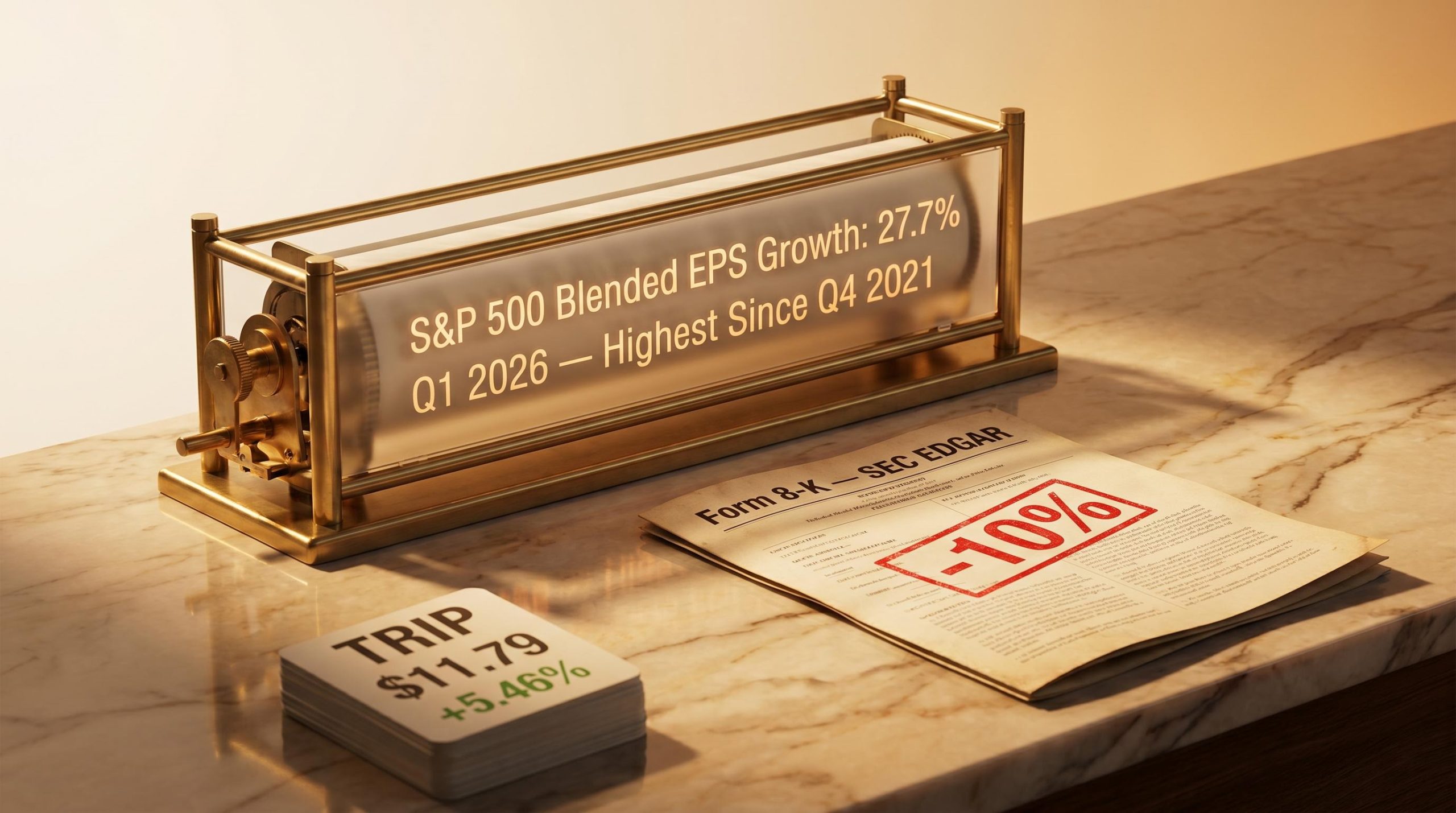
A company can beat earnings estimates and still watch its stock fall 10% by the close of the same session. That single fact captures why earnings season remains one of the most consequential, and most misread, periods on the U.S. stock market calendar. Four times a year, publicly traded companies open their books, and the market reprices itself in response. In Q1 2026, the S&P 500 is tracking a blended year-over-year earnings growth rate of 27.7%, the highest since Q4 2021, according to FactSet. Understanding the mechanics behind earnings season has rarely mattered more. This guide explains what earnings season actually is, which metrics drive stock prices, why beats and misses do not behave as most investors expect, and how to read an earnings call with the same focus a professional portfolio manager brings to the transcript.
What earnings season is and why it moves markets
Earnings season refers to the four recurring windows each year when U.S. publicly traded companies disclose their quarterly financial results. These reporting clusters follow a predictable rhythm tied to the fiscal quarter that has just closed.
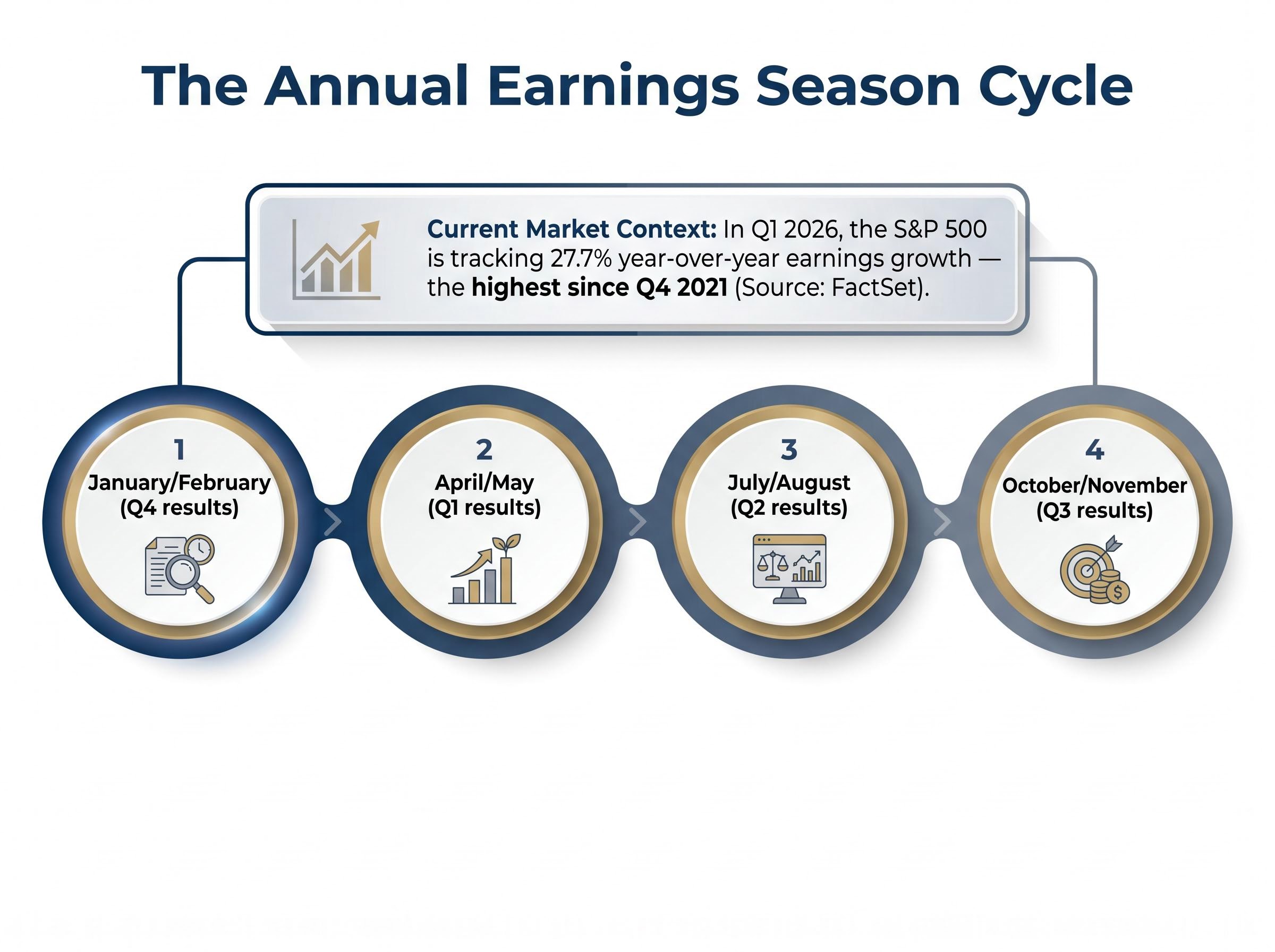
- January/February: Q4 results (prior calendar year)
- April/May: Q1 results
- July/August: Q2 results
- October/November: Q3 results
Regulatory requirements from the Securities and Exchange Commission (SEC) and the Financial Industry Regulatory Authority (FINRA) mandate that these disclosures are accurate and filed within prescribed deadlines. Because the data carries legal weight, it can force genuine repricing of share values when results diverge from what analysts and investors anticipated.
The SEC filing deadlines for quarterly reports vary by filer status, with large accelerated filers required to submit Form 10-Q within 40 days of quarter-end, a tighter window that concentrates the bulk of S&P 500 disclosures into the compressed reporting clusters investors experience as earnings season.
That repricing, however, does not stop at the company that reported.
How sector spillover works in practice
When a major company in a sector releases its results, analysts and fund managers reassess their assumptions for competitors, suppliers, and customers across the same industry. A semiconductor manufacturer reporting weaker demand, for instance, can push down shares of rival chipmakers and the equipment suppliers that service them, none of which have reported yet.
This creates a trading window that extends well beyond the individual ticker. Investors tracking sector-level dynamics, not just the companies they hold, are better positioned to identify both risks and opportunities that surface during these concentrated reporting periods.
When big ASX news breaks, our subscribers know first
How stock prices can fall even when earnings beat expectations
The most common mistake retail investors make during earnings season is treating a beat as a buy signal and a miss as a sell signal. The relationship between earnings surprises and stock price movements is far less straightforward.
When investors already anticipate strong results before the report, the beat contains no new information. The expected outperformance has been “priced in,” meaning the share price already reflects the probability of a strong quarter. A beat in that scenario simply confirms what the market already believed, and confirmation alone does not drive prices higher.
A further layer of complexity sits in the gap between two different sets of expectations. Sell-side consensus (the average of published analyst estimates) is not the same as broader investor expectations. A company can beat the former while missing the latter, producing the counterintuitive result of a stock falling on what the headlines describe as a positive quarter.
The expectations gap operates differently from the consensus estimate itself: blended EPS growth for Q1 2026 reached 27.1% year-over-year, more than double the pre-season forecast of 13.2%, yet individual stocks still fell sharply when their specific guidance failed to match the elevated bar the market had already priced in.
John Campbell, CFA, Senior Portfolio Manager at Allspring Global Investments, has noted that consensus estimates do not fully capture the range of investor expectations. The real benchmark a stock is measured against is often higher, or more nuanced, than the published number.
Forward guidance compounds this dynamic. When strong historical results are paired with cautious or downward-revised guidance, the market consistently prioritises where the company says it is going over where it has been. Equity valuations are built on anticipated future cash flows, not backward-looking confirmation.
Guidance overriding a beat played out in documented form on 29 April 2026, when Spotify fell 12-14% and Corning dropped approximately 9% despite both reporting current-quarter results above consensus estimates, confirming that the market prices forward cash flow expectations rather than backward-looking confirmation.
The Tripadvisor paradox: when a miss leads to a gain
The reverse scenario plays out with equal frequency. Tripadvisor (TRIP) missed earnings expectations in Q1 2026, yet the stock rose 5.46% to $11.79 in pre-market trading on 8 May 2026, according to Investing.com. The likely driver: positive qualitative signals from the earnings call overrode the headline miss, giving investors reasons to believe the forward trajectory was improving despite the backward-looking shortfall.
This pattern illustrates why the earnings call itself, not just the numbers, deserves close attention.
Note: The TRIP example is drawn from a single pre-market session and should be treated as illustrative rather than definitive.
What key financial metrics reveal about a company’s performance
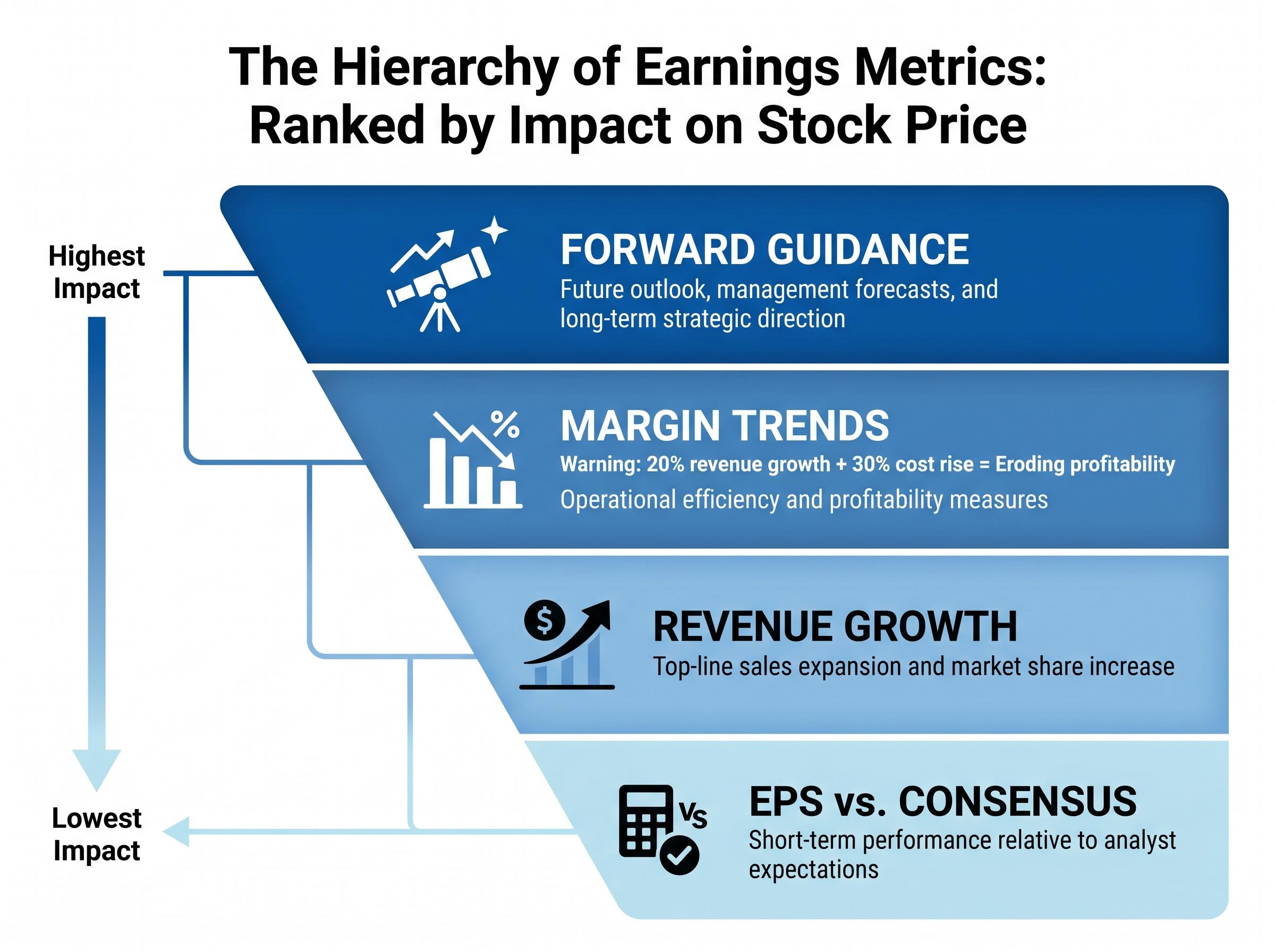
Not all earnings data carries equal weight. The metrics below are ranked in approximate order of their influence on post-earnings stock price movements, from highest impact to lowest.
- Forward guidance: Because equity valuations reflect anticipated future cash flows, where a company says it is heading matters more to price than where it has been. Companies issuing downward guidance revisions tend to face steeper stock declines than those that simply miss historical estimates.
- Margin trends: A company growing revenue by 20% while costs rise by 30% is eroding profitability, not building it. Gross margin compression is often the first signal of structural trouble that headline revenue figures can obscure.
- Revenue growth: Strong revenue momentum indicates expanding customer demand. Decelerating revenue across an industry can signal broader economic strain, making this metric a macro-reading tool as well as a company-level one.
- EPS vs. consensus: Earnings per share is the headline metric most investors track, but its significance depends entirely on how it compares to prior quarters, year-ago periods, and company-issued guidance. It is the starting point of analysis, not the conclusion.
Marcel Miu, CFA, CFP, founder of Simplify Wealth Planning, has emphasised that forward guidance outweighs historical results in determining stock price direction, because the market is always pricing in the next quarter, not the one just completed.
The table below summarises what each metric measures and the warning sign investors should watch for.
| Metric | What It Measures | Red Flag Signal |
|---|---|---|
| EPS | Profit allocated to each outstanding share | Consistent misses vs. consensus over multiple quarters |
| Revenue Growth | Year-over-year change in total sales | Decelerating growth or contraction relative to sector peers |
| Gross Margin | Revenue retained after direct production costs | Margin compression while revenue grows (costs outpacing sales) |
| Forward Guidance | Management’s projection for future quarters | Downward revision from prior guidance or withdrawal of outlook |
Most retail investors scan the beat-or-miss headline and stop there. This ranked framework provides a more productive starting point: check guidance first, then margins, then revenue context, and treat EPS as confirmation rather than the story itself.
How to read an earnings call like a professional investor
Earnings call transcripts are freely available through SEC EDGAR (filed as Form 8-K) and most major brokerage platforms. The document itself splits into two distinct sections, each serving a different analytical purpose.
The prepared remarks, delivered by management at the beginning of the call, set the company’s preferred narrative. This is the scripted portion, carefully drafted and legally reviewed. It tells investors what management wants them to focus on.
The Q-and-A section that follows is where analysts probe for what management did not voluntarily disclose. Professional investors treat this half of the call as the higher-signal portion, because it reveals how management responds under direct questioning about weaknesses, uncertainties, and forward risks.
Three specific elements deserve attention during the Q-and-A:
Operating cash flow quality is frequently a more reliable signal than net income alone, because large and persistent divergences between reported earnings and cash generation can indicate aggressive revenue recognition or working capital deterioration that the income statement obscures until a later quarter confirms the weakness.
- Probing questions on guidance: When multiple analysts press on the same guidance assumption, it signals the market views that assumption as vulnerable.
- Segment-level breakdowns: If overall growth is concentrated in a single business unit, sustainability comes into question. Analysts frequently push for granularity here.
- Management hedging language: Increased use of qualifiers (“we hope,” “if conditions allow,” “subject to”) compared to prior quarters can indicate rising internal uncertainty.
A 2025 study published in the Journal of Accounting and Economics found that evasive or irrelevant answers during earnings calls increase analyst forecast errors. Communication quality itself functions as an investable signal: when management avoids direct answers, the uncertainty gap between the company and the market widens.
John Campbell, CFA, has highlighted that management commentary on supply chains, hiring plans, and cost pressures provides qualitative macroeconomic confirmation that rarely appears in the headline numbers. Marcel Miu, CFA, CFP, recommends focusing on the two or three metrics historically most associated with stock price moves for each specific company, rather than trying to absorb every data point in a single sitting.
The behavioural trap most retail investors fall into during earnings season
The instinct to sell after a miss and buy after a beat feels rational. Research suggests it is the opposite of what profitable positioning requires.
A 2025 NBER working paper (No. 34086) found that retail investors exhibit contrarian behaviour during earnings announcements: buying on negative surprises and selling on positive ones. Institutional investors do the opposite, amplifying moves in the direction of the earnings surprise.
This matters more now than it did five years ago. According to Reuters (reporting in December 2025), retail participation reached nearly 60% of total trading volume in 2025. That level of participation means the contrarian retail pattern is no longer absorbed by institutional momentum alone; it now meaningfully influences post-earnings price drifts.
| Scenario | Retail Investor Behaviour | Institutional Investor Behaviour |
|---|---|---|
| Positive earnings surprise | Tend to sell into strength | Tend to buy, amplifying upward move |
| Negative earnings surprise | Tend to buy the dip | Tend to sell, amplifying downward move |
A structural disadvantage reinforces this pattern. Institutional algorithms respond to earnings data in milliseconds, and financial media operates continuously, making it nearly impossible for retail traders to compete on speed. The SEC’s September 2025 approval of a FINRA rule change eliminating the $25,000 pattern day trader (PDT) requirement further lowers the capital barrier to earnings-driven retail trading, making behavioural awareness more important than ever.
Marcel Miu, CFA, CFP, has suggested that long-term investors can treat earnings-driven volatility as background noise, using it to assess fundamental trajectory rather than as a trigger for immediate action. Knowing that the instinct to react aligns with a documented losing pattern gives investors a concrete reason to pause before acting.
Earnings season is a signal, not a trigger
The investors who use earnings season most effectively are not those who trade fastest. They are those who read most deeply, evaluating guidance, margin trends, segment performance, and call quality together as a connected picture rather than reacting to a single headline number.
A practical approach before any company reports: answer a short checklist of questions in advance, so the earnings release tests an existing thesis rather than creating a new one in the heat of the moment.
- What are the two or three metrics that have historically moved this company’s stock price after earnings?
- What is the current consensus on forward guidance, and does the pre-report price already reflect an optimistic outcome?
- Has the company’s margin trend been expanding or compressing over the past three quarters?
- What sector-level signals have already emerged from competitors that reported earlier in the cycle?
- If the stock moves 5% in either direction post-earnings, does the fundamental thesis change, or does it hold?
Free tools narrow the information gap between retail and institutional investors considerably. Zacks Investment Research and Investing.com both offer earnings calendars with surprise tracking. SEC EDGAR provides the same transcripts and filings that professional analysts read.
The long-term investor’s structural advantage is time. Unlike institutions managing short-term mandates and quarterly performance benchmarks, retail investors can choose to act on what fundamentals actually say rather than what the market momentarily prices. Earnings season, viewed through that lens, becomes a recurring source of evidence, not a quarterly trigger for reactive decisions.
As Marcel Miu, CFA, CFP, and John Campbell, CFA, have each emphasised throughout their commentary: the signal is in the details, not the headline. Reading those details with discipline is a skill that compounds across every future earnings cycle.
Investors wanting to translate the analytical principles covered here into a concrete action plan before results land will find our dedicated guide to post-earnings decision frameworks, which walks through a three-part hold, trim, or wait structure built around the Q1 2026 reporting environment, including how to set pre-set triggers that neutralise loss aversion and reactive selling before the numbers arrive.
This article is for informational purposes only and should not be considered financial advice. Investors should conduct their own research and consult with financial professionals before making investment decisions. Past performance does not guarantee future results.
—