Most investors holding an ASX index fund assume they own a diversified slice of the Australian market. They do, in the sense that the fund holds many companies. But diversification by count and diversification by financial quality are not the same thing, and the distinction matters more when capital conditions tighten.
Heading into FY2027, the environment is shifting. The era of cheap capital rewarded size and narrative; businesses could raise funds easily, and momentum carried portfolios. As credit becomes more selective and investors demand clearer paths to profitability, the criteria baked into a fund’s construction start doing real work. Two ASX-listed ETFs, AQLT and CFLO, each represent a systematic, rules-based answer to that demand: one filtering for quality across Australian equities, the other filtering for free cash flow across global markets.
Here is the framework for understanding what each fund screens for, how the two complement rather than duplicate each other, and whether a fundamentals-first approach fits where your portfolio sits right now.
What ASX index exposure actually buys you (and what it skips)
Passive index funds are efficient, low-cost, and broadly diversified. That much is true. What they are not is quality-filtered. A market-capitalisation-weighted index allocates capital based on accumulated company size, which means it systematically directs more of your money toward whatever is already large.
ETF concentration risk is more widespread than most Australian investors realise: the top 10 stocks in the ASX 200 account for roughly 48-50% of the entire index, meaning a standard domestic ETF concentrates nearly half of every invested dollar into a handful of names before any deliberate quality or cash flow tilt is applied.
That creates a specific set of structural features:
- What it rewards: Companies that have already grown large, regardless of how they got there or how profitable they are today.
- What it does not screen for: Profitability, earnings consistency, balance sheet strength, or free cash flow generation.
- What concentrations it creates in the ASX context: Heavy weighting toward financials (particularly the big four banks) and materials (major miners), reflecting the structure of the Australian economy rather than any deliberate quality filter.
Why the ASX’s structure matters for portfolio construction
The S&P/ASX 200’s concentration in banks and resources is not a flaw in the index’s design. It is an accurate reflection of where Australian market capitalisation sits. But the consequence for your portfolio is real: standard ASX index exposure loads you with interest rate cycle risk through the banking sector and commodity cycle risk through resources, not as incidental side effects but as structural features of the allocation.
Holding a plain ASX index ETF is not a neutral act. It is a specific, if unexamined, bet on the same cyclical exposures that have always dominated the domestic economy. If you want quality-tilted Australian equity exposure, the index itself will not provide it. You need a different mechanism.
When big ASX news breaks, our subscribers know first
How factor investing redefines the selection criteria
If you were picking businesses rather than tracking size, what would you actually screen for? That question is the starting point of factor-based investing. Factor ETFs are systematic portfolios constructed around specific financial criteria, not market capitalisation. Instead of asking how large a company is, they ask how financially strong it is.
Two factors sit at the centre of this analysis:
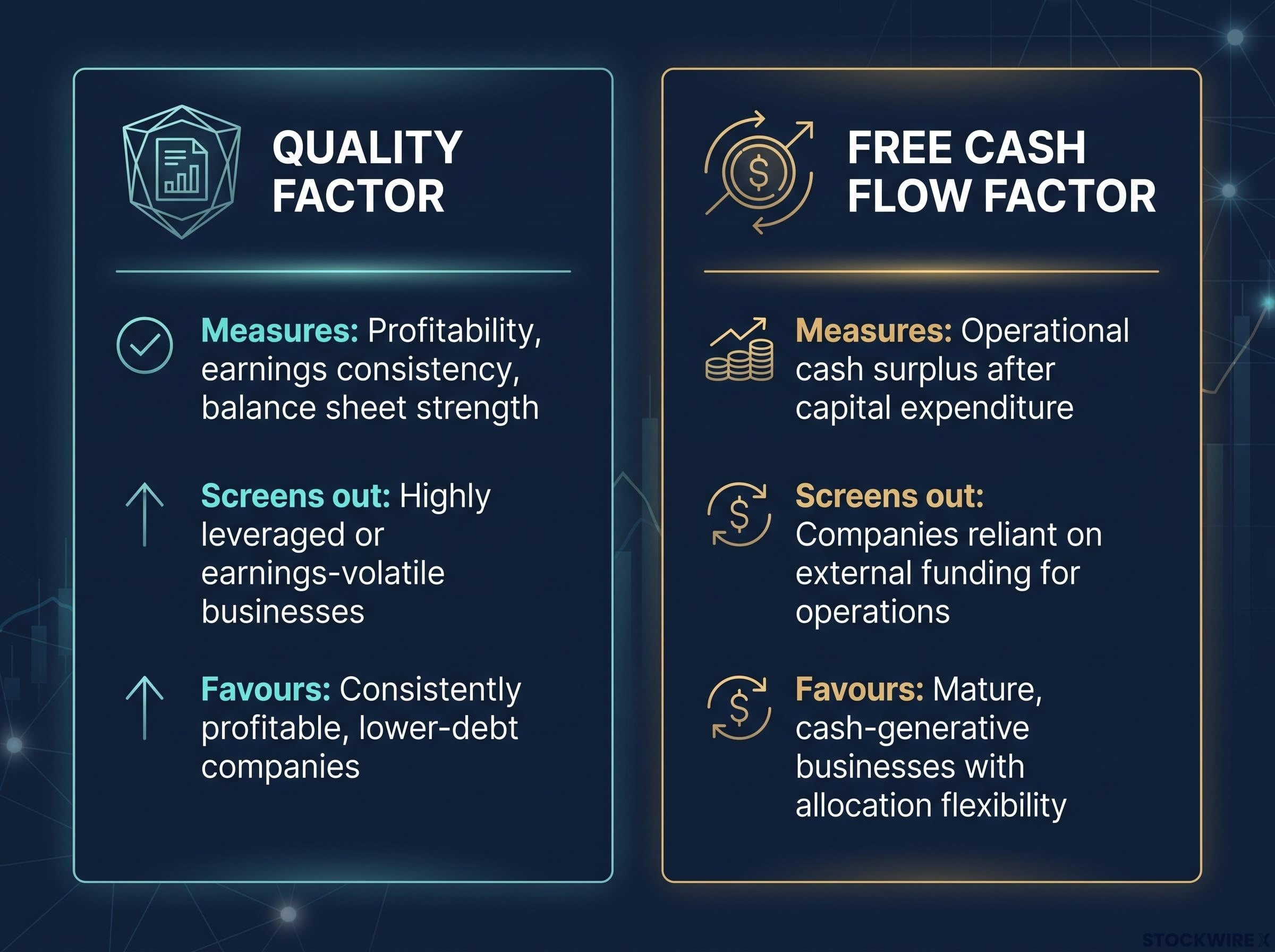
Quality refers to a cluster of measurable financial characteristics: profitability (the returns a company generates on its deployed capital), earnings consistency (stable profits over time rather than volatile, cycle-driven results), and balance sheet strength (lower leverage, meaning less debt relative to equity).
Free cash flow (FCF) is the cash a business generates from its operations after covering the capital expenditure needed to maintain and grow the business. It is the operational surplus that management can allocate at its discretion, and it is a harder signal to manipulate than reported earnings alone.
Companies with strong and consistent free cash flow hold a set of structural advantages that cash-constrained businesses simply cannot access with the same reliability:
- Reinvest in growth without tapping external capital markets for funding
- Pay down debt, building balance sheet resilience across different credit environments
- Distribute capital to shareholders through buybacks or dividends on a durable, ongoing basis
- Sustain operations through downturns without resorting to dilutive equity raisings under pressure
Factor-investing research has associated quality and free cash flow factors with improved risk-adjusted returns over long horizons, though this relationship is not uniform across every market cycle.
AQR’s Quality Minus Junk research documents the quality factor’s historical risk-adjusted return premium across multiple countries and market cycles, providing the empirical foundation for why profitability, safety, and payout screens have generated durable outperformance relative to low-quality counterparts over long horizons.
| Quality Factor | Free Cash Flow Factor | |
|---|---|---|
| What it measures | Profitability, earnings consistency, balance sheet strength | Operational cash surplus after capital expenditure |
| What it screens out | Highly leveraged or earnings-volatile businesses | Companies reliant on external funding for operations |
| Type of business it favours | Consistently profitable, lower-debt companies | Mature, cash-generative businesses with allocation flexibility |
These are not abstract constructs. A company that consistently generates more cash than it spends is structurally different from one that requires ongoing external funding, and that difference becomes visible in portfolio outcomes when capital conditions tighten.
AQLT and what a quality screen does to Australian equity exposure
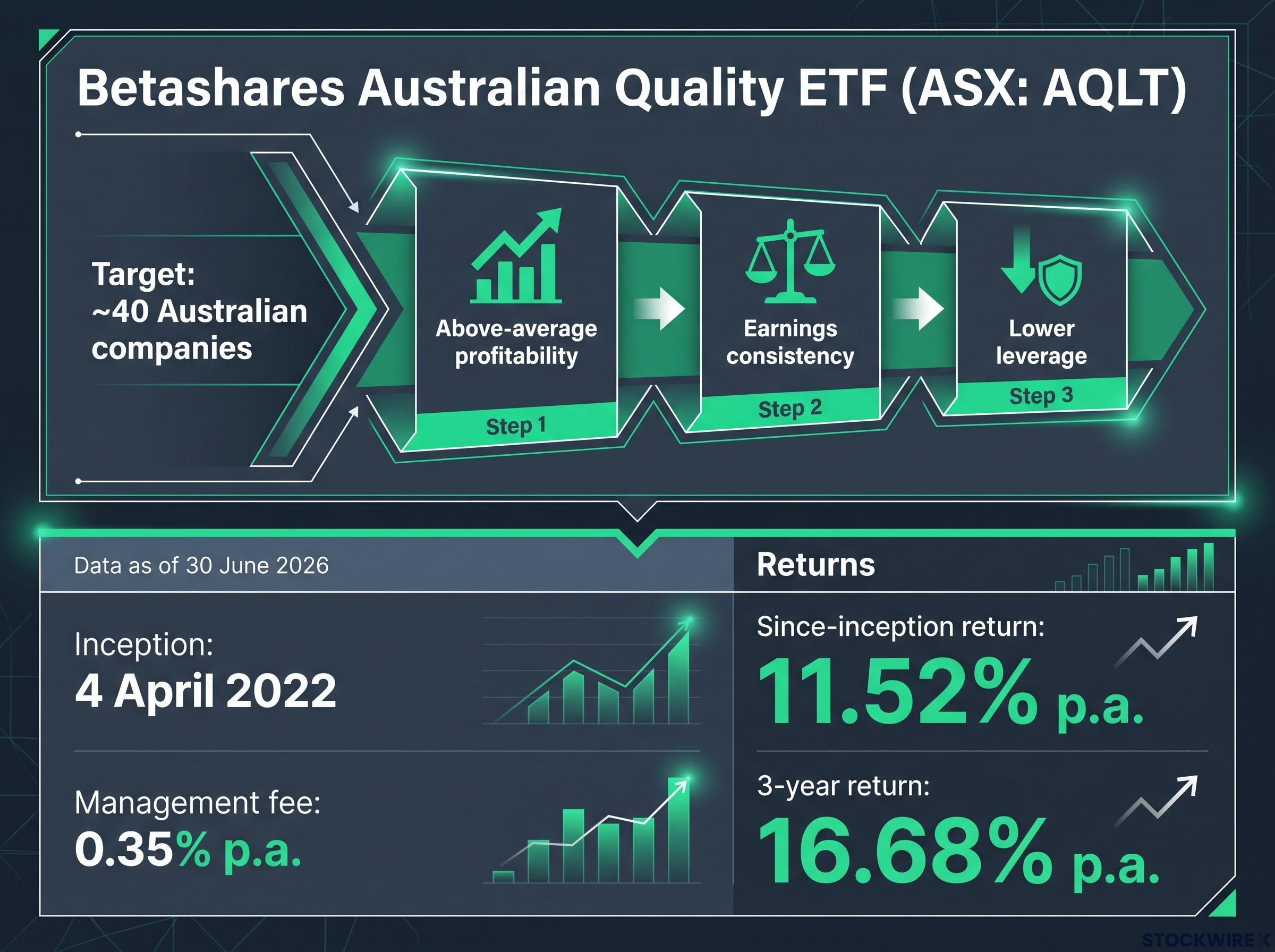
The Betashares Australian Quality ETF (ASX: AQLT) applies a three-part selection methodology to reweight domestic equity exposure away from pure size and toward financial merit. The fund targets approximately 40 high-quality Australian companies, filtering through three screening dimensions:
- Above-average profitability: Attractive returns on deployed capital relative to the broader market.
- Earnings consistency: Relatively stable earnings over time, screening out businesses with highly volatile, cycle-dependent profit streams.
- Lower leverage: Reduced debt loads that improve resilience when credit conditions tighten.
In practice, this results in a portfolio that looks quite different from the S&P/ASX 200. The concentration in banks and miners is reduced, and the weighting shifts toward businesses with more stable earnings profiles. Importantly, investors retain the benefits of domestic equity exposure: currency alignment and access to franking credits, which are preserved even as the quality tilt changes the portfolio’s character.
AQLT performance data (as of 30 June 2026): Since-inception annualised return (inception 4 April 2022): approximately 11.52% p.a. 3-year annualised return: approximately 16.68% p.a. Management fee: 0.35% p.a. Past performance is not indicative of future results.
The performance figures tell one part of the story. The more important implication is structural: AQLT gives domestic investors a way to maintain franking credit access while reducing the cyclical exposure that standard ASX indexing makes unavoidable. For investors who want Australian equity exposure but are conscious of concentration risk, this is a transparent, rules-based mechanism that makes the quality tilt explicit rather than incidental.
CFLO and the case for following cash across global markets
Financial media tends to celebrate revenue growth, user acquisition, and market share gains. Free cash flow gets less airtime but does more work. The Betashares Global Cash Flow Kings ETF (ASX: CFLO), listed in November 2023, tracks the Solactive Global ex-Australia Cash Flow Kings Index across approximately 200 global companies, and its selection criterion systematically excludes many high-profile businesses that still rely on external funding for operations.
What CFLO favours instead are mature, financially resilient firms with demonstrated surplus cash generation. The global dimension adds practical benefits that the domestic market cannot match:
Free cash flow ETFs like CFLO apply a rules-based screen that systematically favours capital-light sectors such as software and payments while underweighting miners and capital-intensive industrials, a sector tilt that makes CFLO a meaningful diversifier for Australian investors already carrying heavy ASX financials and materials exposure.
- Universe size: Access to a far larger pool of listed companies than the ASX offers.
- Geographic diversification: Exposure spread across North America, Europe, and Asia, reducing single-country concentration.
- Sector breadth: A wider range of industries and regulatory environments than Australia’s financials-and-materials-heavy market provides.
Why “Cash Flow Kings” is an analytical claim, not a brand name
The Solactive index name reflects a specific and consistent selection methodology, not a discretionary judgment call. The index’s rule-based structure means the cash flow criterion is applied systematically, not selectively. That consistency is the source of the fund’s discipline: it does not rotate in or out of fashionable names based on narrative; it follows the cash.
For an Australian investor, CFLO is not just a global equities fund. It is a deliberate bet that the most reliably cash-generative businesses outside Australia will deliver on a risk-adjusted basis when the environment demands financial self-sufficiency rather than narrative momentum.
Using AQLT and CFLO together: portfolio construction logic
Understanding each fund individually is useful. Seeing how they fit together is where portfolio construction begins.
AQLT serves as a core domestic holding that addresses the quality gap in standard ASX indexing. CFLO acts as a global satellite that adds free-cash-flow-oriented diversification beyond the domestic market. The pairing is coherent because the two funds share a philosophical foundation:
- Both reject size as the primary selection criterion.
- Both apply rule-based financial screens with transparent, verifiable methodologies.
- Both are constructed for a more demanding capital environment rather than easy-money conditions where narrative alone is rewarded.
The complementary nature runs deeper than geography. AQLT’s multi-factor quality approach (profitability, earnings consistency, leverage) and CFLO’s single-factor cash flow emphasis measure related but distinct aspects of business strength. They overlap in philosophy but not in what they screen for, which is what makes the pairing additive rather than duplicative.
| Fund | Geographic Focus | Selection Criterion | Index | Approx. Holdings |
|---|---|---|---|---|
| AQLT | Australia | Multi-factor quality (profitability, earnings consistency, leverage) | Betashares Australian Quality Index | ~40 |
| CFLO | Global ex-Australia | Free cash flow generation | Solactive Global ex-Australia Cash Flow Kings Index | ~200 |
The mental model is straightforward: AQLT handles the question of what the best version of your Australian equity exposure looks like, while CFLO handles how you access the world’s most cash-generative businesses without picking individual stocks. Both questions answered through a single ETF in each case is the practical value.
What these funds do not do, and when the approach faces pressure
A fair assessment requires the counterweight. Three primary trade-offs apply:
- Factor performance is cyclical. Quality and free cash flow screens will underperform in environments driven by momentum, high beta, or speculative growth. There will be stretches where the broad market, or a riskier subset of it, delivers better returns. Factor-investing research documents this as a characteristic of the approach, not a flaw in these specific products.
Factor performance cycles are well-documented in the academic literature: the 2022-2023 period illustrated how value and low volatility outperformed sharply in one year and then lagged in the next as mega-cap technology concentration reasserted itself in cap-weighted benchmarks, a pattern that investors accepting the factor approach must be willing to absorb.
- Methodology dependency. The value of each ETF is inseparable from the rigour and stability of its screening criteria. Any change to index methodology would directly alter fund character. The current methodologies are transparent and well-defined, but investors should understand that the rules are the product.
- Rule-based discipline, not discretionary flexibility. Systematic screens provide transparency and consistency but cannot respond to short-term qualitative shifts the way an active manager can. For some investors this is a feature. For others it is a limitation. The distinction depends on time horizon and temperament.
The benefits of a factor-tilted approach require patience and a time horizon that accommodates periods of relative underperformance against broad benchmarks. Quality and free cash flow factors have historically shown their strongest relative performance during periods of tightening credit, higher rates, or elevated market volatility, when financial resilience is rewarded most directly.
If you are positioned for a protracted momentum-driven bull market in speculative growth, these funds may frustrate you. If you are building for a more demanding capital environment in FY2027 and beyond, the trade-offs are ones you can accept with eyes open.
The fundamentals-first case for FY2027 and what comes next
The investment environment heading into FY2027 is one where businesses that generate their own cash, maintain clean balance sheets, and produce consistent earnings are structurally better positioned than those reliant on narrative or external funding. That is the argument this analysis has built, and it is the premise that both AQLT and CFLO are constructed around.
The practical question is not whether to choose between the two funds. It is whether a fundamentals-first framework should sit at the core of your equity allocation, with these ETFs offering transparent, rules-based access to that framework across domestic and global markets.
This approach is well-suited to your situation if three conditions hold:
- Your time horizon extends beyond the next quarter and you are building for compounding over multiple years.
- You can tolerate periods of relative underperformance when momentum or speculation drives broader index returns.
- You believe capital conditions will continue to reward financial resilience over growth narratives as the dominant theme for the period ahead.
AQLT and CFLO are not the only tools for disciplined portfolio construction. But at a management fee of 0.35% p.a. for AQLT’s domestic quality screen and a rules-based global cash flow filter through CFLO, they represent a coherent, low-cost starting point for investors who have decided that quality and cash flow should drive selection rather than market cap or momentum.
For investors wanting to understand how AQLT and CFLO sit within a complete allocation framework, our comprehensive walkthrough of ETF portfolio construction for Australian investors covers how to set asset allocation proportions, manage fee drag across multiple funds, and maintain a disciplined structure during periods of market volatility.
This article is for informational purposes only and should not be considered financial advice. Investors should conduct their own research and consult with financial professionals before making investment decisions. Past performance does not guarantee future results. Financial projections are subject to market conditions and various risk factors.